
According to National Today, the number one killer of women is cardiovascular disease, which causes one in three deaths every year. It’s also one of the most preventable: It’s estimated that 87% of these deaths can be avoided, making awareness of this illness and how to reduce risk extremely significant for those affected.
Heart Health Month is held in February of every year. The first Friday in February is Women’s Heart Day (often called National Wear Red Day). This year, it falls on the 3rd of February.
 “The appearance of the U.S. Department of Defense (DoD) visual information does not imply or constitute DoD endorsement.”
The history of National Heart Health Month and Women’s Heart Day
President Lyndon B. Johnson declared National Heart Health Month to be February in 1964, nine years after he personally suffered a heart attack. The tradition of wearing red as a symbol of recognition started in 2002, and donning a red dress or other types of clothing ingrained itself until the first Friday in February became its own day of awareness.
How to prevent cardiovascular disease
You can prevent cardiovascular disease with good habits, including eating well and exercising regularly. You likely already know these are essential qualities of living well, but did you know that exercise alone can reduce the risk of cardiovascular disease by 49-57%, according to a study by PLOS Medicine?
Further, 33% of women don’t engage in sports or physical activity. Because these statistics go both ways, that means not exercising regularly drastically increases your risk of heart disease.
The other part of staying fit is healthy eating habits; this means having a diet rich in whole grains, lean proteins, healthy fats, vegetables and fruits. Specifically, you should aim for:
- 4.5 cups a day of fruits and vegetables.
- Four servings of unsalted nuts, legumes and seeds.
- Two 3.5-ounce servings of fish — especially those rich in oil — each week.
- Three 1-ounce servings of fibrous whole grains every day.
- Less than 1,500 mg of sodium per day.
- Two servings or less of processed meat per week.
- Limit sugary drinks to no more than 450 calories per week.
- Reduce consumption of saturated fats to less than 7% of all calories.
It might sound like a chore to keep track of all of this, but as long as you get the general idea such as more fruits and veggies and less salt and sugar, they’ll quickly become second nature. You certainly don’t have to be 100% precise with your habits, either — just understand the concepts behind them and adjust your diet accordingly.
There’s always room for improvement in your habits
Few people have perfect habits. Even if you think you’re completely healthy, it’s best to reassess your routine every once in a while to ensure you’re still up-to-date on the science involved in heart health and how to best prevent it. You could always do more.
Heart Health Month and Women’s Heart Day are meant to help you understand cardiovascular disease, whom it affects the most, and how you can prevent it. By practicing good habits, you won’t just be helping to prevent heart conditions, you’ll also feel your best.
Valentine’s Day is a day when we take the time to celebrate those we love. We buy gifts, we go out to fancy dinners and we look for ways to show our appreciation. It can sometimes be a challenge to think up an original approach your loved ones will really appreciate.
What if you could offer your loved ones something they can use for the rest of their lives?
Life happens. The reality for many is that few of us are prepared for the financial hardships that come with losing a family member. Consider a new direction to showing your love this Valentine’s Day and seek peace of mind by purchasing life insurance for your loved ones.
 “The appearance of the U.S. Department of Defense (DoD) visual information does not imply or constitute DoD endorsement.”
Top misconceptions about life insurance
The 2022 Life Insurance Barometer Survey tried to find explanations for why people don’t have life insurance, leaving their families at risk for financial difficulty should a family member unexpectedly die. It turns out that many simply don’t understand how life insurance works — what it costs, what it’s good for, whether substitutes are sufficient, or when the best time to buy life insurance is. There were four key misconceptions discovered in the survey:
Life insurance is expensive
Many wildly overestimate the cost of life insurance: 43% of Millennials estimate that life insurance for a healthy 30-year-old would cost $1,000 per year. It actually costs about $170 per year. That means many Millennials believe the cost of life insurance is six times higher than it really is. While it’s understandable that many would prioritize other financial needs because of this misconception, this puts families at risk of great financial hardship if a wage earner were to die unexpectedly.
Workplace life insurance is sufficient
Most employers’ life insurance comes to a flat sum of $20,000 or one year’s salary, which is simply not sufficient for many families. This goes especially for households with dual incomes — and 54% of U.S. households utilize this strategy to stay afloat. This misconception is fairly common: A full 26% of American workers believe their workplace life insurance is enough. This means that 44% of families would face financial hardship within six months and 25% in less than one month.
Buying life insurance is difficult
According to the survey, 54% of uninsured Americans don’t buy life insurance because they don’t know how to figure out the particulars; for example, how much they should buy, or what sort of coverage they need. Additionally, less than one in three respondents claimed they were “very” or “extremely” knowledgeable about life insurance. This uncertainty leads to many putting off taking action on their insurance plans. While working with an agent is an option, a full six in 10 Americans don’t utilize a financial professional when planning out insurance.
You only need life insurance when you’re older
The younger and healthier you are, the less expensive your life insurance tends to be. Putting it off can lead to vastly increased rates. Many insured Americans — about 4 in 10 — wish they had purchased life insurance sooner.
Demonstrate your affection by offering total peace of mind
At AFBA, we’re proud to support the Life Happens Insure Your Love campaign and fully believe in the importance of life insurance. This Valentine’s Day, do something that will leave a lasting, long-term benefit for your loved ones.
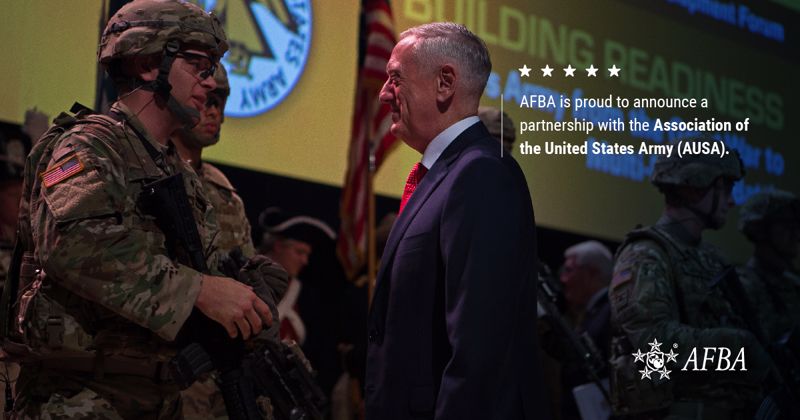
AFBA is proud to announce a partnership with the Association of the United States Army (AUSA). Effective late December 2022, all AFBA members — regardless of military branch affiliation, including first responders and federal and government workers — have a free membership with AUSA.
What is AUSA?
AUSA is a nonprofit educational and professional development association serving America’s Army and supporters of a strong national defense since 1950. AUSA has many events and products related to the military and national security topic. As an Association Partner member, AFBA members receive a variety of products and discounts including:
- LawAssure, a legal document service free for individuals and small businesses.
- Discounts on travel, dining, entertainment, business and electronics, health and wellness and more from dozens of affinity partners.
- Free ACT/SAT Test Prep materials for you, your kids, grandkids or other family members.
- Free Resume Critique and job search tool through AUSA’s Jobs Central.
- Access to more than $300,000 in AUSA scholarships each year.
AUSA stands with the military community
According to AUSA’s website, its mission is to encourage “educational development, advancing national security and promoting greater recognition of the Army’s vital role in American life, past, present and future.” AUSA has 121 chapters worldwide. These volunteers provide a wide array of local programs to support current and former military members and their families.
 “The appearance of the U.S. Department of Defense (DoD) visual information does not imply or constitute DoD endorsement.”
The value of supporting our military and their families
Serving in the military can be an immensely gratifying and rewarding career, but those in the armed forces often need our support both during and after their career. Some challenges include:
- Educational challenges. It’s not just the fact that most service members join fresh out of high school which prevents them from pursuing higher education. Physical and mental health complications are common issues among veterans that can bar them from entry, which is why the partnership between AFBA and AUSA promotes education among their members.
- Occupational barriers. As with higher education, veterans may have difficulties finding work after serving. AUSA’s networking opportunities are for both active military and veterans.
- Lack of legal representation. Many veterans don’t have the resources to hire legal help. For example, social security disability insurance is an option for injured veterans, but this can often get tied up in the courts and become exceptionally difficult to get AUSA is actively involved in the legal affairs of the U.S. government, constantly fighting for the interests of veterans.
There’s never been a better time to be an AFBA member
AFBA proudly supports AUSA and its greater cause of supporting service members and their families. With your new AUSA benefits, there’s never been a better time to be an AFBA member. Together, we will continue to improve the lives of our members and their families.
In the military, you learn certain skills that stick with you throughout your life such as dedication, persistence, and attention to details. And that’s not even counting the specific job aptitudes you may have or learned while in the service.
A challenge veterans and their families often face when returning to civilian life is the transition to working in a non-military job. Thankfully, employers often appreciate those who have armed forces veteran status on their resumes. There are many businesses that specifically advertise to veterans and their families.
Here, we’ll go into a few of those employers that are currently looking for people from the armed forces
to work for them.
Amazon
Amazon advertises its need for employees with veteran status and even provides a helpful cheat sheet. This can tell you how the specific skills you learned in the armed forces would translate to being an effective employee. By filling out details about your service, such as which branch you served in, your rank and the number of years you were active, they’ll match you for a certain position.
The enterprise also features military recruiting teams that hold virtual hiring events. There are also apprenticeships available that can teach you how to build a career in cloud computing, which should be attractive to those with IT experience. Amazon even offers a Military SkillBridge program designed to help you transition from military life to civilian life if you’re within 180 days of leaving the service.
 The appearance of the U.S. Department of Defense (DoD) visual information does not imply or constitute DoD endorsement.
Capital One
Capital One claims to “value the service and sacrifice of our veterans, active military personnel and their families… accountability, collaboration, leadership and dedication make you a crucial member of our team.”
What special benefits do they have to appeal to veterans? Well, for starters, you can expect:
- Military training and active duty time off. Capital One claims that you can take up to eight weeks for training or active duty if you’re called to serve during your employment at the company. They even offer a pay differential between your company salary and military pay after you come back to work.
- Military Spouse Employment Partnership (MSEP). As a partner of MSEP, Capital One offers advantages to the spouses of service members.
- On-leave job security. If you need to go on leave for any reason, your job will be protected for a reasonable amount of time.
- Secondary insurance in addition to your military benefits. Dental, vision, supplemental life coverage, flexible spending accounts and medical care are offered to veterans working for Capital One. If you’re on leave, these benefits persist.
Cisco
As a top leader in the telecommunications, technology and networking industries, Cisco is always looking for bright new talent, especially those who have experience with these fields.
The company offers training for those early in their military transition back to civilian life, special programs and opportunities specifically for veterans, and connects service members and their families with jobs at Cisco and Cisco partners.
With a return to civilian life comes new opportunities just for you
These are just a handful of opportunities you can pursue as you return to civilian life. There are entire resources available just to help veterans find new careers as they transition back home. Some employers are better suited than others for service members, and many are actively looking for new employees with military experience.
If you’re in the armed forces and looking for work outside the military, why not give one of these opportunities a go? You may find it satisfying and rewarding.
More than 650,000 servicemembers were in operation from August 2, 1990, to July 31, 1991. Those who served in the Persian Gulf at Operation Desert Shield and Desert Storm are known as Gulf War-era veterans. Let’s learn a little more about Gulf War-era veterans in this spotlight.
What was the Gulf War?
The Gulf War lasted about seven months and was against Iraq and also involved troops from other countries as well. These troops include the United Kingdom, Saudi Arabia, Egypt, France and Kuwait, according to the U.S. Department of Veterans Affairs. The war was in response to Iraq invading Kuwait because of oil disputes.
The initial stage was known as Operation Desert Shield. Its main goal was to defend Saudi Arabia from Iraqi invading forces, in order to protect one of the world’s main sources of oil. The next part was dubbed Operation Desert Storm and was more of an offensive, active combat mission that was meant to force out the enemy. According to historical records, the Iraqi resistance fell after four days of bombing, and Kuwait was liberated. This is an extremely condensed version of the first Gulf War, and veterans from this era know the true extent of the conflict.
Who are the Gulf War Veterans?
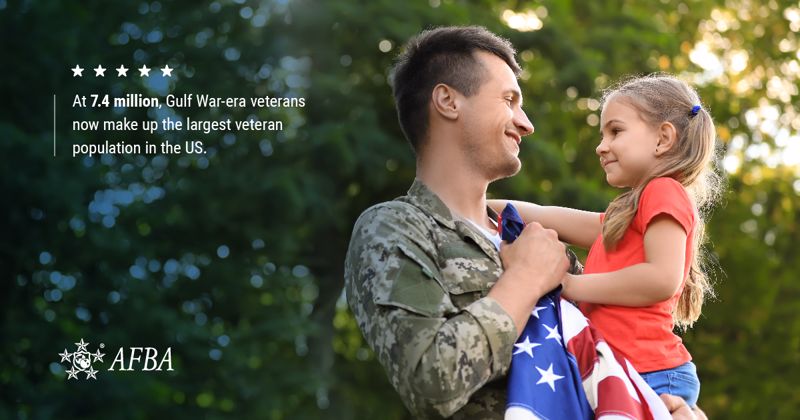
According to the Bureau of Labor Statistics (BLS), there are over 18.8 million veterans. Of these, there are about 7.4 million Gulf War-era veterans, which now make up the largest share of veterans. Before 2016, Vietnam-era veterans were the dominant group. The Gulf War demographic can also be further broken down:
- 17% of Gulf War-era veterans are women, higher than in most recent military conflicts.
- Almost 50% of Gulf War veterans are aged 45 to 54.
- 33% of Gulf War-era veterans are current or past members of the Reserve or National Guard.
 The appearance of the U.S. Department of Defense (DoD) visual information does not imply or constitute DoD endorsement.
Employment
BLS reports that “Gulf War-era II veterans had the highest unemployment rates from 2009 to 2015.” in 2019, “5.6 million Gulf War-era veterans were employed in 2019, about 6 percent of civilian U.S. workers.” Veterans Affairs (VA) offers programs to help people find opportunities to work, which can assist in matching them with employers who are looking for workers who have their skills.
Related health issues
The Gulf War had relatively few deaths during the conflict, but many of this demographic from this era are facing post-war illnesses. The VA reports that this group often experiences a “cluster of medically unexplained chronic symptoms that can include fatigue, headaches, joint pain, indigestion, insomnia, dizziness, respiratory disorders and memory problems,” called chronic multisymptom illness.
Other serious health issues include:
- Fibromyalgia.
- Myalgic Encephalomyelitis/Chronic Fatigue Syndrome (ME/CFS).
- Functional gastrointestinal disorders.
- PTSD.
Long-term illness may also come from the environment that those who served in the Gulf War found themselves in. This could be things like the effects of sand and dust on the respiratory system and chemical and biological weapon side effects. For those that were in proximity of oil well fires or spent any amount of time in military vehicles that use Chemical Agent Resistant Coating (CARC) paint, health issues may arise.
Gulf War veterans deserve our respect and support for their brave service during their time carrying out the nation’s mission. The demographic of post-war individuals in the country is changing, but their valor hasn’t.
“The voluntary blood donor truly gives life itself.” This is what President Richard Nixon proclaimed when he decided to officially dedicate a month to the heroes who selflessly offer a part of themselves so that others may live.
According to America’s Blood Centers, Blood transfusions in the U.S. happen about once every two seconds, and a single blood donation has the capacity to save several lives. A quarter of all blood donations go to patients suffering from cancer, and a third of African-American blood donors are compatible with individuals who have sickle cell disease.
In short, blood is a vital commodity in hospitals across the world, and its life-saving qualities are necessary for many to recover from potentially fatal conditions.
 The appearance of the U.S. Department of Defense (DoD) visual information does not imply or constitute DoD endorsement.
What is National Blood Donor Month?
On December 31, 1969, President Nixon declared the first National Blood Donor Month to be January of the following year. The intent was to honor voluntary blood donors and inspire others to become new ones.
Choosing the winter season to encourage donations was no accident: Blood is in short supply during the winter months, as worsening weather conditions and tight holiday schedules limit the amount of blood hospitals receive.
How do you participate in National Blood Donor Month?
The best way to honor voluntary blood donors is to become a donor yourself. Despite the ongoing need for blood (one in three people will need a transfusion at some point during their lifetime, according to OneBlood), only 3% of Americans give blood each year. With winter being notable for its drop in blood donations, there’s no better time to do your part.
Donating blood is a virtually painless process, and you can safely give to blood banks up to six times each year. Of course, you don’t have to donate any more than you’re comfortable with — even one contribution is an exceptionally honorable and potentially life-saving act.
There are very few limitations to giving blood. You can be as young as 16 years old (with parental consent) to donate, and there’s no upper age limit. Don’t donate if you have an acute infection or are taking blood thinners. Some illnesses may bar you from giving blood. If you’re thinking of contributing, check out this checklist provided by the American Red Cross to ensure you qualify.
Donating at an authorized location is necessary. The AABB offers a tool that can help you find a viable blood donation site online. Blood drives happen frequently throughout the country, so look for one that’s convenient for you.
Health benefits come with donating
Before every donation, you’ll receive a wellness check to ensure you’re in good shape — so why not take advantage of the free checkup? This wellness check looks at:
- Cholesterol levels
- Iron count
- Body temperature
- Pulse rate
- Blood pressure level
It’s not uncommon for donors to discover that they have a medical condition warranting follow-up with a doctor. The results of these screenings can vary frequently throughout your lifetime, so a wellness check as part of your blood donation is a cost-free way to monitor your health.
Save a life this winter, and throughout the year
The need for blood donations doesn’t wane with the seasons, but the supply of blood does. That makes National Blood Donor Month one of the most important times to become a donor. Not only can you help others this way, but you can also help yourself thanks to the added health benefits included with donating.
Blood is a substance that can’t be manufactured by artificial means. It comes from one place and one place only: the hearts of men and women just like you.
While anyone can experience Post Traumatic Stress Disorder (PTSD) at some point during their lifetimes, it’s highly prevalent among veterans, first responders and active duty service members. Estimates of the rates of PTSD vary by era, but veterans who served during Operations Iraqi Freedom and Enduring Freedom have illness rates of about 11-20%, according to the U.S. Department of Veterans Affairs.
It’s not just combat that causes PTSD among veterans: 23% of women who use VA health care report having been sexually assaulted during their service, further increasing rates of PTSD among veterans.
One type of therapy, in particular, stands out as a unique and effective form of treatment for PTSD: music therapy.
What is PTSD, and why does it matter?
PTSD, once known as shell shock to describe similar symptoms among combat veterans, can be an extremely debilitating condition that can occur after a traumatic event. The disorder is a complicated psychiatric illness. Some symptoms of PTSD include, according to the Anxiety and Depression Association of America (ADAA):
- Intrusive thoughts or dreams about the traumatic experience that happen involuntarily and cause distress. This can include episodes of feeling like the traumatic incident is recurring and acting out the event (sometimes called “flashbacks”).
- Intense psychological distress and usually avoidance of triggers that remind one of the episode.
- An inability to remember details about the incident.
- Increased arousal and reactivity.
- Feelings of detachment or estrangement from other people.
- Persistent fear, horror, anger, guilt, or shame.
Left untreated, these symptoms can worsen over time. That’s why it’s vital for sufferers of PTSD to receive intervention from a qualified professional.
 The appearance of the U.S. Department of Defense (DoD) visual information does not imply or constitute DoD endorsement.
Music therapy and PTSD
One form of complementary treatment to treat PTSD and other psychiatric illnesses, is music therapy. Music therapy is the use of music interventions to accomplish goals, e.g., to treat symptoms of PTSD. It can involve songwriting, or playing or listening to music.
Using music therapy to ease PTSD symptoms goes as far back as 1945 with the military’s Technical Bulletin 187, which observed how music affected the reconditioning of service members in Army hospitals.
The U.S. War Department discovered that music positively affected soldiers’ PTSD rehabilitation programs. This effect was demonstrated during physical reconditioning, occupational therapy, education, and recreation. The military followed up on this after the study was completed, attempting to further explore the possibilities of using music during therapy for recovering soldiers.
Various organizations have developed applications as a result of these studies to include programs ranging from active duty airmen improving their stress management and coping skills with music to using songwriting to treat PTSD symptoms.
Why use music therapy when traditional cognitive behavioral treatment exists?
Music therapy can be less intimidating than cognitive behavioral therapy (CBT) because of one factor: stigma. Despite the ongoing efforts by mental health professionals to encourage those with psychiatric symptoms to seek counseling and psychiatric treatment, there is still a strong aversion toward seeking mental health services. According to a recent study by the World Health Organization, between 30-80% of people with psychiatric illnesses do not seek treatment.
Many see music therapy as less intimidating or stigmatizing than psychotherapy, and thus is more broadly accepted.
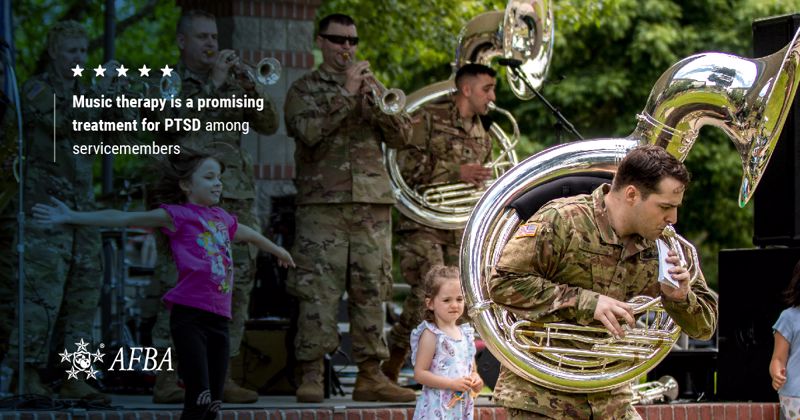
Music therapy is a promising treatment for PTSD among service members
Since its initial success during World War II to treat symptoms of PTSD and promote recovery, associations such as the American Music Therapy Association (AMTA) have helped develop its use to treat psychiatric illnesses such as PTSD.
There’s a long way to go until any PTSD treatment is perfected and universally helpful for sufferers of its symptoms, but music therapy is helping lead the way as a promising source of hope.
In the event that something happens to you, how far do you want doctors to go to revive you? Whom would you prefer to manage your affairs? What do you want to happen to your estate? These are questions that you would no doubt like answered if something unexpected happens and you’re unable to make these decisions.
Why you need estate planning
While everyone can benefit from estate planning, service members understand that military life can be particularly dangerous. Just like in civilian life, it’s not always possible to predict what will come next.
Estate planning allows you to decide what the future will be like for your family should something happen to you. Without the proper arrangements, the distribution of your assets can be somewhat unpredictable. If you make your intentions clear ahead of time, you can determine what happens to your personal assets, property and financial obligations.
This also makes plans for your health care clear should you become unable to make decisions for yourself. Without this, your family could be left with large amounts of debt from medical bills.
In addition to being pragmatic, estate planning can take a large load off your family’s shoulders. With everything arranged ahead of time, neither you nor your loved ones have to worry about certain decisions that would have to be made in the event you become disabled or deceased.
 The appearance of the U.S. Department of Defense (DoD) visual information does not imply or constitute DoD endorsement.
To help get your affairs in order, use the AFBA estate planning checklist
We’ve created a helpful checklist to assist you with estate planning. Included is a list of necessary steps for successful arrangements, such as:
Draw up a will
First, you’ll need to prepare a document that outlines some very important details. This means naming a personal representative and substitute to carry out your wishes, providing a full list of assets and organizing funeral and burial intentions, among other tasks.
An executor of estate needs to be named in this document. This is the person who’s responsible for ensuring your intentions are carried out. The executor is a very important person and should be carefully considered, as they will work with your attorney, identify and manage your probate assets (bank accounts, property, life insurance etc.) and handle your debts.
Arrange for power of attorney
If you become unable to manage your estate, a loved one or other trusted representative can do it for you. While you can revoke this determination at any time, it otherwise lasts for your lifetime.
Create a “living will”
This isn’t the same thing as a traditional will. The living will decides what health care you do or don’t want should you become unable to make decisions for yourself. For example, to what extent should doctors try to resuscitate you? Do you want to be placed on a ventilator if needed to keep you alive?
Gather necessary documents
Personal documents, bank accounts, income tax information and various other papers and pieces of information need to be consolidated. This includes passwords for your online accounts, especially your banking credentials.
You don’t have to do all of this on your own. These steps can be made easier if you appoint a law firm to help you.
Help your loved ones by making plans for the future
There are many unknowns in life, both for civilians and active duty service members. With estate planning, you can get your affairs in order and be more certain of what happens to you and your loved ones. While you may not be able to predict what the future holds, you can still plan for it.
Honoring veterans is an activity that holds important value year-round. Some days, however, are specifically for commemorating their efforts. National Wreaths Across America Day, which takes place on the third Saturday of December every year (Dec. 17 in 2022), is a time during which wreath-laying ceremonies are held at Arlington National Cemetery, as well as at nearly 3,400 other locations in the U.S., at sea, and abroad.
The history of Wreaths Across America Day
In 1992 at the Worcester Wreath Company, Karen and Morrill Worcester of Harrington, Maine realized they had 5,000 extra wreaths that had yet to find homes. The two had the idea to use them to honor veterans at Arlington National Cemetery and contacted their senator. In 2008, Congress unanimously passed legislation creating a day to perform this honor every year.
Initially, the service was local to Arlington, Texas but in 2011 the Wreaths Across America (WAA) organization broadened its scope to include 750 cemeteries and battlefields across the U.S., with thousands more to come.
 The appearance of the U.S. Department of Defense (DoD) visual information does not imply or constitute DoD endorsement.
How to observe the day
Both living and fallen veterans are honored during Wreaths Across America Day. While there are many locations recognized by WAA, you can become a location coordinator for a new cemetery if none of these places work for you.
Here’s how to commemorate the day:
- Sponsor or lay a wreath yourself. If you contact a WAA location coordinator, they can direct you to a location where a wreath-laying ceremony will take place. You can either sponsor a wreath or lay one yourself.
- Sponsor a dog tag. If you prefer, you can choose to sponsor a dog tag with a veteran’s name printed on it. The WAA will create one for you and you can lay it on a gravestone.
- Share your experience with social media. Spread the word about Wreaths Across America Day by sharing your feelings on your social platform of choice.
There are some facts to keep in mind this Wreaths Across America Day. Notably, each year carries a different theme — this year’s is “Be Their Witness.” Inspired by Iraq War veteran and Marine Michael Strobl, the concept is focused on remembering and telling the stories of veterans. Strobl’s tale is noteworthy because of his exemplary valor: After the war was over, he escorted the body of one of his comrades back to the Marine’s hometown in Wyoming.
Teach children the value of freedom
A core aspect of Wreaths Across America Day is educating and inspiring young people on what freedom is and why it’s vital. Both living and fallen generations of veterans served to protect your freedoms, and this must never be forgotten. This means honoring service members whenever you can and paying special attention to days of remembrance and recognition.
Not all fallen veterans are able to be found or identified. Yet, these soldiers deserve just as much attention as those who are known — and wreaths can be dedicated to them, as well. That’s why the Tomb of the Unknown Soldier exists at Arlington National Cemetery. This special place currently contains the remains of three unknown fallen service members who represent all unidentified soldiers.
Lay or sponsor a wreath or dog tag this Wreaths Across America Day
However you choose to commemorate Wreaths Across America Day, always remember why this day — as well as all days specifically made to honor veterans — exists: Because service members give their heart and soul — and sometimes their lives — into preserving freedom and the American way of life. There can be no freedom without sacrifice, and that’s why it’s vital to commemorate the tireless efforts of veterans, whom all serve with a singular purpose: to bring you liberty.
First responders are integral to disaster relief, and few catastrophes are as damaging and life-threatening as hurricanes. These natural disasters can wreak havoc anywhere they go, stranding families and causing mass destruction.
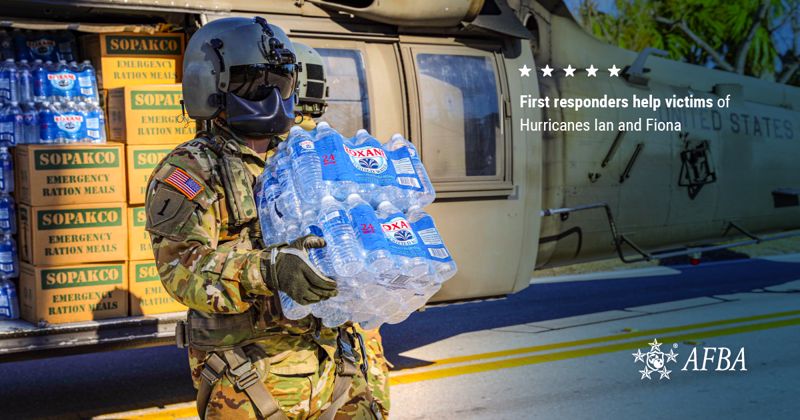
The effects from Hurricanes Ian and Fiona required a great deal of help getting the affected areas back on track and functioning again. Thankfully, many first responders answered the call of duty from across the U.S., applying their expertise and passion to help with many relief efforts.
“You’re looking at 12-hour days”: The IAFF first responder Disaster Relief team helps with Hurricane Ian
Touching down in Florida on September 28, 2022, the destruction from Hurricane Ian cost nearly $60 million to repair and left over 100 people killed. Ian is the second-deadliest hurricane of this century, behind only Katrina in 2005. Ian was classified as a Category 3 storm when it first landed in Cuba, growing to a Category 4 by the time it hit Fort Myers, Florida.
The International Association of Firefighters (IAFF), led by John Gardell, had left to assist with efforts in Florida less than a day before Ian’s landfall. Because the IAFF’s days often started at 7 a.m., Gardell says, they were often working for 12 hours with very little rest, tarping roofs and removing damaged items, among other tasks.
 The appearance of the U.S. Department of Defense (DoD) visual information does not imply or constitute DoD endorsement.
Pennsylvania Task Force 1
The IAFF is one of many first responder teams that helped with Hurricane Ian. In South Carolina were 45 members of Pennsylvania Task Force 1, which included first responders from the Philadelphia Fire Department and others from various parts of PA. This team was practiced in urban search-and-rescue, and they applied their training to relief efforts.
Maryland Task Force 1 and N.Y. state troops help with Hurricane Fiona
Hurricane Fiona, which primarily impacted Puerto Rico, Turks and Caicos, and the Dominican Republic, was a Category 1 hurricane that hit Puerto Rico on September 18, 2022, causing blackouts and leaving many people without running water. Over 1,000 residents required rescuing and four people were killed.
Maryland Task Force 1 was one of the teams who lent their aid to victims of Hurricane Fiona. A FEMA task force, the team consists of 35 firefighters and citizens from across the state. This group was initially the only federal team sent to assist with relief efforts.
The New York Police Department also sent 100 state troops and drones to contribute after Puerto Rico Governor Pedro Pierluisi requested assistance from those who could speak Spanish to help with rescue operations. The drones were intended to conduct surveillance of the damage.
Veterans Affairs
Veterans Affairs had several issues dealing with Hurricanes Fiona and Ian. The VA’s regional team had just finished its efforts with Hurricane Fiona, but when Hurricane Ian hit, they were forced to evacuate their inpatients from the Bay Pines Medical Center. This decision came after speaking with the National Weather Service and local and regional leaders. 152 people were relocated to safety, which included those in acute, hospice, domiciliary, and long-term care.
First responders’ persistent efforts with Hurricanes Ian and Fiona
First responders across the U.S. were sent to help with Hurricanes Ian and Fiona after they had caused severe destruction across Florida, South Carolina and Puerto Rico, among other places. Armed with trained firefighters, medics, and citizens with various talents, first responder airmen and women are always hunting the storms that threaten the U.S., and their efforts are crucial for rescuing citizens and helping rebuild after the damage of a hurricane.