
National Suicide Prevention Lifeline: 1-800-273-8255
Suicide is a concern no matter what community you are a part of, but it has a unique impact on first responders, military veterans and active-duty service members. Rates of suicide are especially high among veterans and those who are serving on active duty, due to the circumstances that members of the military are put in.
With serious contributing factors like trauma, Post Traumatic Stress Disorder, stress and anxiety, suicide has always been a major issue for these groups. However, DoD has reported some of the highest suicide rates during the past four years in particular. In 2019, the rate of suicide among active-duty troops was 25.9 per 100,000 troops, and it has been steadily climbing.
Here are some suicide prevention resources for veterans, active-duty troops, and their families.
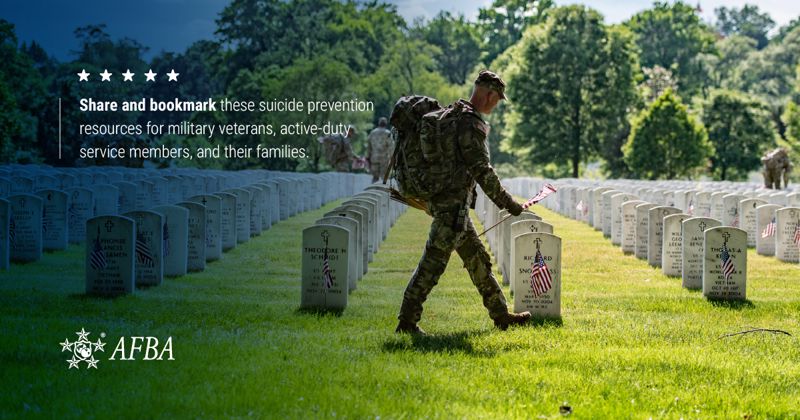 “The appearance of U.S. Department of Defense (DoD) visual information does not imply or constitute DoD endorsement.”
Resources for active-duty troops
Military Crisis Line: 800-273-8255
Active-duty troops face situations and circumstances everyday that not only take a physical toll, but that can have long term mental effects as well. Here are some hotlines and programs that can help to address thoughts of self harm and suicidal ideation.
Overseas crisis assistance
- Europe: Call 00800 1273 8255 or DSN 118
- Korea: Call 0808 555 118 or DSN 118
- Afghanistan: Call 00 1 800 273 8255 or DSN 111
- International crisis chat: https://www.veteranscrisisline.net/get-help/chat
Government provided assistance
Military OneSource provides free and confidential therapy for troops and military families. Whether you or someone you know is struggling with depression, anxiety, PTSD or adjusting to a new life, Military OneSource is here to help.
- Call: 800-342-9647
- Live chat option
- Schedule an online consultation
Resources for veterans
Veterans Crisis Line: 1-800-273-8255
Active duty and military service can leave a lasting impact on veterans. Even years after their service, members of the military face mental health struggles. Preventative action through therapy, medication or even self help is important. Use these resources yourself or send them to a veteran who may find them useful.
- Make the Connection: This website has everything from additional resources to ways to connect with other veterans near you who may understand what you’re going through.
- Coaching Into Care: This is a government-based national telephone service for veterans that provides free coaching from licensed psychologists and social workers. You can also call 888-823-7458 for support.
- Military and Veterans Caregiver Network: Provided by the American Red Cross, this is a community based program that focuses on “peers engaged to exchange experience, empathy, education and encouragement.”
Resources for military families and first responders
Whether you are the loved one of an active-duty troop or a veteran, your mental health can face challenges as well. If you have lost someone to active duty or suicide, its important to seek community. Tragically, suicide is also prevalent among military families.
- Suicide Bereavement for Veterans and Military Families
- Tragedy Assistance Program for Survivors
- Crisis center for first responders
- Psychological Health Resource Center
It’s important that our first responders and veterans feel supported and that they know that there are resources out there. This list of resources are relevant all year around, not just during Suicide Prevention Week. The DoD has more resources that focus on mental health for the military, veterans and their families.
The U.S. military is constantly evaluating its strategy for security, both in the homeland and abroad. Each state in the U.S offers its own benefits to the military, either based on location, climate, or population. The northernmost part of the United States, Alaska, is no exception and provides its own unique advantages to the military. Most recently, as threats from China and Russia mount, Alaska has become a very important strategic asset to the U.S. Military.
150 years of the U.S. military in Alaska
There are nine military bases across the 104 million acres that make up Alaska. This is by no means the most military bases in one state, but each base is strategically located to optimize the benefits.
Alaska has acted as a tactical boon for the U.S., even before it became a state. President Andrew Johnson obtained Alaska for the U.S. from Russia on October 18, 1867. The military actually managed the governance of the area until Alaska became an official state on January 3, 1959.
As of 2019, there were 21,407 active duty military personnel in Alaska. The Air Force has the largest presence, making up 38% of the active duty military population there.
 The appearance of U.S. Department of Defense (DoD) visual information does not imply or constitute DoD endorsement.
Alaska as a strategic location
Alaska’s climate is harsh and unforgiving, with temperatures that sink below 0° F and a climate that supports little vegetation. However, Alaska’s location makes it ideal for military occupation. When Russia sold Alaska to the United States, Japan was occupying several of the Alaskan islands because of the area’s prime location.
The state’s geography allows bases easy simultaneous access to Arctic and Indo-pacific regions. This is a unique advantage for our country because the military can easily traverse both the Pacific Ocean to the south and the Arctic Ocean to the north.
Defense Secretary Lloyd Austin said in a July 2021 press release that the U.S. has increased its defenses in Alaska as a result of mounting pressures from Russia and China. It is the U.S.’s closest reliable landmass to those international security threats.
Protection against homeland security threats
Defense leaders like Austin consider Alaska a key asset in the military’s ability to make its power known in both the Arctic and Indo-pacific regions.
Protective bases in Alaska increase in importance as threats from the Arctic and Asian regions continue to build. Russia dominates most of the Arctic Circle, probably due to the fact that 25% of its GDP comes from natural resources found in the Arctic Circle, according to the U.S. Department of Defense (DoD). But Russia isn’t the only country/government bolstering its arctic activity.
China is also working towards increasing its presence in the Arctic, but it wields a significant amount of influence in Asia. According to a press release from the DoD, China is likely interested in accessing the vast and generally untapped natural resources in the Arctic which include “90 billion barrels of oil and an estimated trillion dollars’ worth of rare earth metals.” These resources are more accessible than ever before, as melting layers of permafrost expose them.
How the U.S. competes
Training has always been a key component of every branch of the military’s success, but this is especially true in Alaska where there is plenty of space for military facilities. A major one is the Joint Pacific Alaska Range Complex, where the training of several branches converge. The facility includes 65,000 miles of airspace, 490 miles of land space with 1.5 million acres of maneuver land and 42,000 nautical miles of sea and airspace in the Gulf of Alaska.
Training is only a part of the military’s efforts to prepare active duty service members and is only a part of the DoD’s homeland security strategy. Among many other things, the U.S. plans to utilize the Alaska-based Air Force units. Defense Secretary Austin cites fifth-generation strike aircraft to integrate air and missile defense as notable examples of how Alaska is essential to the U.S. Military.
The terrorist attacks that occurred September 11, 2001 changed the world forever and on its anniversary, Americans take the time to remember the events of that tragic day. Officially, it is September 11 National Day of Service and Remembrance and is also known as Patriot Day. This is a chance to commemorate and remember those who were lost and survivors of the attack on the World Trade Center.
September 11, 2021 is the 20th anniversary of the attacks. This Remembrance Day, there will be special commemorative events and individuals across the nation will pause for a moment of silence to reflect. The day is a chance to remember the attack that aimed to break America but instead brought people together and made the country stronger.
The 9/11 Memorial & Museum remembers
The 9/11 Memorial Museum is a commemorative exhibit that pays tribute to the event through education and remembrance. According to 911memorial.org, 2,977 people passed away as a result and countless more were injured or impacted in some irreversible way. The anniversary of the tragedy that was the 9/11 terrorist attacks is filled with emotion and gives an opportunity for solace.
The 9/11 Memorial and Museum will be taking special measures for the 20th Anniversary Commemoration. They will be hosting a reading of lost loved ones by family members where there will be six moments of silence. The number six is significant because it acknowledges “when each of the World Trade Center towers was struck and fell and the times corresponding to the attack on the Pentagon and the crash of Flight 93.”
The first moment of silence will be observed at 8:46 a.m. on September 11, 2021 and the memorial will encourage churches to toll their bell as sign of respect and solidarity. Family members who lost someone during 9/11 are allowed free entrance to the ceremony.
 The appearance of U.S. Department of Defense (DoD) visual information does not imply or constitute DoD endorsement.
The FBI and DoD nods to the holiday
Because 2021 marks two decades since the terrorist attacks on the World Trade Centers, the FBI took the time to commemorate how the events changed the bureau. In fact, the FBI director makes it a special requirement that all new agents take the time to visit the memorial and remember the contributions that previous agents made in the focus on terrorism.
9/11 changed the way that the military and all branches of the armed forces operate. It truly changed the course of military action forever. The Department of Defense acknowledges its impact and those who gave their lives in pursuit of freedom with a collection of stories from people whose lives were impacted by that terrible day 20 years ago.
Volunteer opportunities
Whether you were directly impacted by the terrorist attack, every American’s life was touched in some way. If you are unsure how to make a difference, give back, or commemorate the 20th anniversary, here are a few meaningful and easy ways to offer service to our country.
Americorps
Volunteer organization Americorps notes that 9/11 is also National Day of Service, and there is no better way to remember those who lost their lives protecting our nation than to give back to the country they were protecting. Americorps has a great search engine where you can find opportunities that are connected to 9/11.
Take the time for a brief moment of respectful silence, donate time, or commemorate the 20th anniversary of 9/11 in your own way.
First responders like firefighters, emergency medical professionals and police officers devote their lives to their communities. The past few years have displayed that the extreme importance of first responders can not be overstated. First responders come in the form of volunteers, part-time employees and people whose only job is serving their area.
Our nation needs firefighters, law enforcement officers, and EMTs more than ever, but the reality is that there is a shortage of first responders across the country. As of 2020, 60 million Americans are unable to receive emergency help because they live in an area without assistance.
You may want to show your appreciation to the first responders in your community that come to work every day to answer emergencies, but don’t know where to start. Here are three simple ways Americans can thank a hero.
 The appearance of U.S. Department of Defense (DoD) visual information does not imply or constitute DoD endorsement.
1. Offer discounts
According to the U.S. Bureau of Labor Statistics (BLS), the median pay for paramedics and firefighters is $17.62 per hour. The BLS mentions that their work environment is usually very difficult and that they regularly face stressful situations that are even potentially life or death.
Because of their devotion to a job that does not typically yield many monetary rewards, business owners often implement a first responder discount program. This is especially true in the hospitality industry. For example, hotels often have discounts that allow first responders to stay for a cheaper price. The following is a list of a few hotels that first responders can stay at for a discounted rate:
- Best Western: at least 10%.
- Caesars’ Palace: up to 30%.
- Marriott: up to 50%.
- Hilton: up to 25%.
If you own a small business, consider offering a first responder discount. Even something small can mean a lot to these professionals. Aside from helping them save money, it is a gesture that shows recognition of their service.
2. Donate your time or money
When people hear the term “donate,” they often only think of giving money to a charitable organization. Even though monetary donations are always welcome if possible, there are plenty of other ways to give.
Consider donating your time to a local fire department or organization as a volunteer. The shortage of first responders has nearly reached crisis level. This was true even before the international public health disaster of 2020. As a volunteer, you’d be taking some of the burden of labor off of the full-time professionals. In addition, you’ll no doubt learn skills and information that you wouldn’t have otherwise known. Learn how to become a volunteer firefighter or EMT by contacting your local departments.
3. Respect your community
Aside from acting respectfully directly to the first responders themselves, acting responsibly in your everyday life is impactful. For example, about 90% of fires are started by people. American citizens could reduce that number simply by being more aware of their surroundings and the impact of their misplaced campfire. Following fire safety best practices would certainly ease the workload of both urban and rural firefighters.
The same idea applies to driving carefully, staying home when you are sick, and generally considering the impact of your behavior. Inebriated driving is another good example of how your personal choices affect more than just yourself. Even if you would never drive drunk, it’s important to hold your friends and family to the same standard. Aside from the terrible repercussions, you’ll be avoiding using resources for something that was completely preventable.
By following safety guidelines, you are directly reducing any unnecessary burden on the already overworked first responders in your area.
The United States has participated in every Olympic Games since 1896, but 2021 marked the first time a U.S. service member won a gold medal at any Olympic event. 1st Lt. Amber English made history on Monday, July, 26, 2021 at the 2020 Tokyo Olympic Games by winning first place in the shotgun skeet event. Not only did she win a gold medal, she set an Olympic record by hitting 56 of 60 targets.
The US Army in the Tokyo Olympics
English is not the only service member to make the trek to Tokyo to represent the U.S. and its military in the Olympic games. The U.S. military attracts some of the country’s most talented individuals, so it is common for these individuals to find themselves qualifying for the Olympics.
In fact, the Army has a World Class Athlete Program (WCAP) that helps train high-level athletes, known as Soldier-Athletes, for international competitions with the ultimate goal of qualifying for the Olympic and Paralympic games. The WCAP has produced 446 soldiers who have participated in the games, earning 111 medals since 1948.
 Army Lieutenant wins gold at the 2020 Tokyo Olympics, setting two records.
In the 2020 Olympic games, WCAP trained and sent 9 Soldier-Athletes to Tokyo to represent the U.S. The participants include:
- 1LT Amber English: Shooting – Skeet
- SSG Naomi Graham: Boxing – Middleweight
- SSG Nickolaus Mowrer: Shooting – 25m Air Pistol & 50m 3-Position Rifle
- SSG Sandra Uptagrafft: Shooting – 25m Air Pistol & 25m Sport Pistol
- SGT Amro Egleziry: Modern Pentathlon – Individual Event
- SGT Ildar Hafizov: Wrestling – Greco-Roman
- SGT Samantha Schultz: Modern Pentathlon – Individual Event
- SPC Alejandro Sancho: Wrestling – Greco-Roman
- SPC Bernard Keter: Track – 3,000m Steeplechase
The road to gold
After English brought home the gold, Defense Secretary Lloyd Austin wrote a congratulatory tweet to her that read, “Your country is extremely proud of you today, and I’m so glad you’re representing us.”
English’s journey to setting a record and making history as the first U.S. service member to take the No. 1 spot was not an easy one. After barely missing out on qualifying for the 2016 Olympics on her own, she worked diligently to make the 2020 shotgun team. She joined the Army in 2017 and was able to utilize the military’s training resources. In 2018, English took bronze in the World Championships and continued to prove herself a skilled marksman.
Shooting runs deep in her veins, as English comes from a family of successful shotgun competitors. Both sides of her family participated in shooting events. Her father and her uncle made it to the Olympics in the running shotgun event, while her mother and aunt shot rifles in college. Her father’s passing in 2016 served as inspiration for her to join the Army.
In a 2020 article, English said, “I knew I had to completely change everything I was doing in my life – I joined the Army, moved (from Colorado Springs, Colorado) down to Fort Benning (Georgia) and surrounded myself with a seriously winning atmosphere, so it paid off.”
The 2020 Olympic games are anything but usual, but English was able to prove her marksmanship regardless of the circumstances.
With over 2.91 million service members and civilians working in the U.S. Department of Defense (DoD), it can be hard to imagine a time without it. However, it was only established in 1949. August 10, 2021 marks 72 years of the modern version of this federal department officially overseeing the U.S. armed forces (previously known as the U.S. War Department). Over the past seven decades, the department has gone through many changes, but it has always stayed true to its motto of “duty, integrity, ethics, honor, courage and loyalty.”
A brief history of the DoD
Even before the 1940s, the federal government managed the U.S. armed forces. The earliest iteration of the DoD was established by the first congress in 1789 and was called the U.S. War Department. It managed the Army and the Navy, which were the only branches of the U.S. military at the time. However, as the country evolved, so did military operations.
The first reform
In the interim between the War of 1812 and the Civil War, legislators decided it was time to make some serious renovations to the management of the nation’s defense. The change entailed incorporating bureaus, advisors and a Secretary of War who directed the department.
It seemed this change came at an ideal time, because the Civil War required strict management of wartime activities. During the Civil War, the U.S. War Department began recruiting volunteers and members of the Army, bringing upwards of 2 million troops under the DoD’s purview.
The results of the Civil War shaped the U.S. War Department forever. In the mid to late 1860s, the department was given the responsibility of managing formerly enslaved people and wartime refugees. During reconstruction, the new southern American governments needed as much support as they could obtain and the U.S. War Department was tasked with aiding them.
The National Security Act of 1947
Following World War ll, The National Security Act was passed into law with the goal of modernizing the military and intelligence agencies. As a result of the act, the National Military Establishment (NME) was created as the country’s first unified military command under the control of one person: the Secretary of Defense. This is the same act that created the Central Intelligence Agency (CIA), the National Security Council and the United States Air Force.
A noteworthy change was made as a result of the National Security Act: The NME was renamed the “Department of Defense.” This was due to an amendment to the 1949 act and three cabinet-level military departments were absorbed into a singular department.
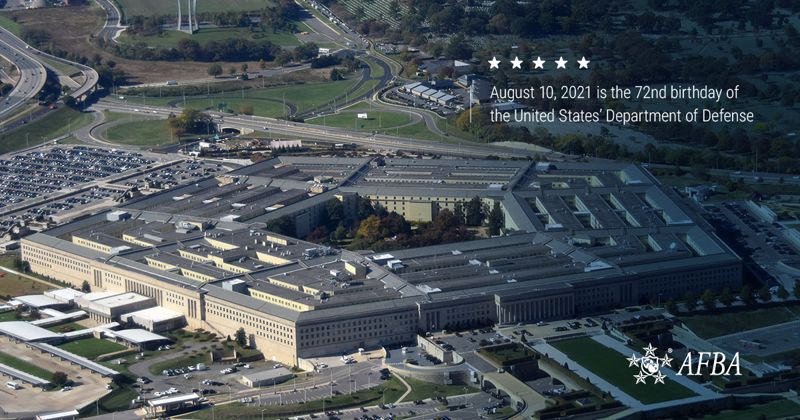 The DoD celebrates 72 years of defending our nation.
The modern DoD
Many adjustments to the department have been made since then, all in an effort to keep up with the shifting national and international security requirements. The Defense Reform Act of 1958 and the Goldwater-Nichols Act of 1986 both made key modifications to the DoD, mostly regarding the restructuring of the power dynamic.
Celebrating the DoD’s Birthday
Despite the fact that August 10 is not a national holiday, members of the department often take the time to recognize the holiday internally. Service members enjoy cake cutting ceremonies and take the time to look back on the rich history of the department.
This year, consider donating time or money to a service project that supports the military, or even just go out of your way to thank a member of the armed services.
Last year has aptly been called "the year of the guard" because of the United States' unparalleled need for the National Guard's resources. On June 9, the National Guard made its annual posture statement public. The document goes over the Guard's operational standings and its missions during the previous year. This is a statement that is released annually, but this year was unique in that 2020 was particularly busy for the National Guard.
As stated in the document, "On June 6, 120,000 National Guard Soldiers and Airmen were mobilized in support of overseas and domestic missions, one of the highest levels of National Guard support to our nation since World War II." Let's break down the posture statement and go over some of the most important points.
Warfight
According to the posture statement, warfight is a premier mission of the National Guard. As such, preparation is key. Winning wars is a driving force behind many of the Guard's goals, including training, equipment attainment, maintenance, and recruitment. National threat levels impact how the Guard conducts business, and the current state of affairs demands a high level of preparedness.
According to the statement, China, Russia, Iran, and North Korea have increased the global threat level. In turn, the Guard has had to expand its investment in training, which has paid off. Along this theme, the Guard offers vital support to the Space Force.
Addressing the changing warfight environment, the Guard says it is the main combat reserve for both the Army and the Air Force. However, it is prepared to deploy more guardsmen than ever before due to their dynamic employment and global operations strategies. This includes:
- Predictable mobilization requirements.
- Geographic agility.
- Maximize the Department of Defense's (DoD) flexibility.
- Modernization.
- Sustainability
- Interoperability.
Homeland
Because the National Guard is active on both a federal and state level, they are able to have a positive impact on the homeland during domestic emergencies. The National Guard's posture statement states that, while the ultimate goal is for threats to remain outside of America's borders, this might not be realistic due to cyberattacks and new-age weapons.
In 2020, teams have responded to the unprecedented COVID-19 global pandemic. The document reports that National Guard members logged about 10.9 million days in service of impacted communities in 2020. This was four times as many as were logged in 2019. Aside from this, the National Guard was called upon to assist in fighting the record number of wildfires in California.
The National Guard has also partnered with corporations and international organizations to provide maximum protection and to support beneficial alliances. One of its crown jewels is its State Partnership Program, which is "the DoD's premier security cooperation initiatives." Through this program, 84 countries have been able to form partnerships with the National Guard, helping promote and assist in providing communities with the COVID-19 vaccine.
The Guard's three priorities
According to the posture statement, the National Guard has three core priorities that it is currently striving to execute for the future of the organization.
- Fighting America's wars.
- Securing the homeland.
- Building enduring partnerships.
"Continued investment in the National Guard ensures we can meet today's demands while preserving the capability, capacity and deterrence our nation needs against a broad spectrum of potential future threats," said Army Gen. Daniel Hokanson, chief of the National Guard Bureau.
From natural disasters to pandemics and international security threats, the National Guard's preparedness and resource management has never been more valuable. While 2020 was the Year of the Guard, the posture statement emphasized a continued reliance on the Guard as it moves into the future of national security.
Every year on July 27, Americans recognize the National Korean War. This day celebrates veterans of the Korean War, one of the most brutal and dangerous wars in United States history. The history and significance of July 27 is deep, and the national holiday gives Americans the chance to honor the service members who sacrificed so much during the Korean War.
A refresh on the Korean War
The Korean War began on June 25, 1950 when North Korea invaded South Korea. The conflict had been brewing for some time. When this military action took place, American troops were deployed by July on behalf of South Korea. America had to take a stand against communism and a harsh, three-year war followed.
Not only did combat itself kill many soldiers, but the hot, humid climate also took a toll on those who occupied the Korean peninsula. Civilian deaths as a result of bombings and other conflicts contributed massively to the total casualties, which was about 5 million, though the total number is still uncertain because North Korea did not release casualty numbers.
Almost 40,000 Americans died in the war, and more than 100,000 were wounded. At the time, there was not as much media coverage of what was happening in Korea, especially when compared to World War ll and the Vietnam war. This led to the Korean War being called "The Forgotten War." Veterans of the war were not treated with as much reverence, as it seemed that Americans wanted to forget this tragic period.
For several years, armistice agreement negotiations were underway, to no avail. That is, until July 27, 1953. On that day, the Korean People's Army (KPA), the Chinese People's Volunteer Army (PVA) and the UN Command signed the Korean Armistice Agreement, and America officially took its troops out of Korea, despite South Korean president Syngman Rhee refusing to sign the agreement. The agreement did not include a peace treaty, but did require North Korea, South Korea, China, and the United States to continue their peace talks.
National Korean War Veterans Armistice Day
National Korean War Veterans Armistice Day is a time to remember the tragedies that occurred during the Korean War and to commemorate those who died in active duty, disappeared as prisoners of war, or were seriously injured in service.
In memoriam, every year the President of the United States issues a proclamation calling on the nation to observe National Korean War Veterans Armistice Day with appropriate ceremonies. American flags across the nation rest at half mast out of respect.
The Korean War Veterans Memorial located in Washington, D.C. was erected on July 27, 1995. If you ever visit the memorial, you will be able to read its inscription: "Our Nation honors her sons and daughters who answered the call to defend a country they never knew and a people they never met."
Take the time to thank a veteran, volunteer in your community, or simply reflect on the impact that the Korean War has on our American legacy.
The fiscal 2022 president’s defense request was released in June. What does this mean for the future of the Department of Defense, its contractors, and spending? The budget request stemmed from President Joe Biden’s Interim National Security Strategic Guidance and focuses on how the Joint Force will work together to stop security threats and be “ready to fight and win across all domains.”
Emphasizing modernization
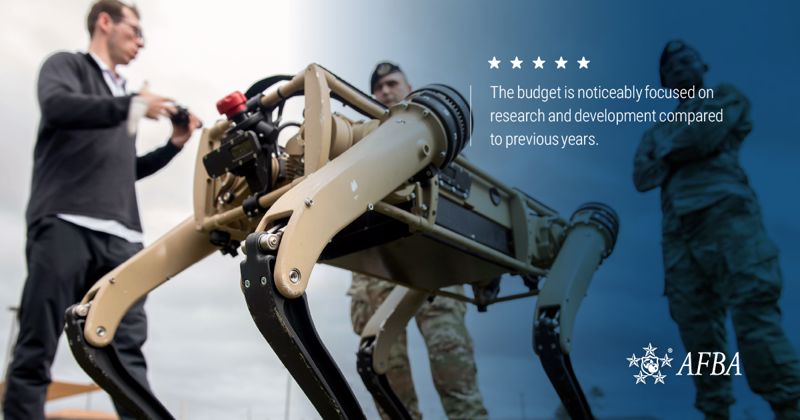 “The appearance of U.S. Department of Defense (DoD) visual information does not imply or constitute DoD endorsement.”
The budget is noticeably focused on research and development compared to previous years. Instead of trying to stop gap short-term issues, the DoD is looking to create innovation and take prevention measures.This 2022 request shows that the Department of Defense (DoD) is moving into a new era that prioritizes long-term preparedness compared to previous appeals. Budget petitions of the past shirked forward thinking modernization, but the 2022 version looks to pave the way into future preparedness.
Sometimes the best course of action is to follow the old adage “out with the old, in with the new,” and that is exactly what the DoD is doing to aid in its modernization efforts. The organization asks for authorization to retire weapons, machinery, and technology that does not benefit the department’s defense goals.
Nuclear weapons: a top priority
One of the most important and notable parts of this year’s request is that it is made clear that nuclear modernization is a top priority. The budget fulfills funding needed for the department to step into the future of nuclear technology. This includes artificial intelligence, hypersonics, long-range fires, microelectronics, cyber defense and attack and 5G computer technologies.
Another valuable asset that the budget mentions is the United State’s relationship with its allies.
An asymmetric advantage
The document describes an asymmetric advantage as the United States’ “network of allies and partners around the world.” The request notes the importance of these relationships to securing an end goal that will not only benefit America, but its allies as well. The budget allocates money to increasing the security of these partnerships.
“I would just tell you that one of the strengths of the United States of America is that we have a lot of allies and partners who want to work with us,” Army Gen. Mark A. Milley, the chairman of the Joint Chiefs of Staff said. “And we will be successful in the future.”
Other important requests
Defense leaders told the Senate Appropriations Committee that the budget calls for cutting edge technologies and the full budget required to realize this is $715 billion. This is a substantial increase from last year’s proposal, which was $703.7 billion. The justification for this increase could be seen in President Biden’s goal of ending the “forever wars”.
A portion of the budget is designated to expand military and civilian personnel pay and maintain military health care. Because of the hardships that were faced globally last year, there is plenty of room in the budget to address the changing climate, COVID-19 and any potential threat from extremist groups. Furthermore, Secretary of Defense Lloyd J. Austin III talked about keeping pace with China as a major motivator for the increased budget given to researching new technologies.
The Department of Defense is prioritizing weapons sustainment in 2021, citing this portion of weapons lifestyle as being the most important, according to the Federal News Network. Acquiring the weapon is only the first part of the DoD’s process and noticeably less expensive than operation procedures that will follow. Moving forward, weapons contractors will have to take this transition into account when selling to the government.
Supply chain
The DoD says that its choice to shift into focusing on weapons sustainment is based on the fact that operations are 70% of the overall cost of the weapon. Over the last few years, the Adaptive Acquisition Framework (AAF) has been going through intense revisions. The six pathways laid out in the framework guide buyers to work more efficiently in the acquisition process. The AFF shows the DoD moving into finding longer lasting products as opposed to buying a larger quantity.
Environmentally conscious
The United States Government is also considering the impact of its weapons on the climate. The changing climate is impacting commercial markets by encouraging sustainable innovation, and the government defense market is no different. The U.S. Army has already begun looking into “new environmentally friendly primary explosive materials”, as just one example of the United States’ efforts to reduce its impact on climate change.
Acting as defense undersecretary for acquisition and sustainment, Stacy Cummings said the DoD is now taking climate change data to assist in how it will buy and develop weapons, as reported by the Federal News Network. For example, combustible engines are not only hard on the environment, but need considerable maintenance.
Contractors who exhibit products that are environmentally conscious and relatively easy to maintain will have an upper hand in selling to the DoD. Additionally, weapons manufacturers should create products that have the ability to work effectively in extreme weather conditions for a long period of time.
Proactive maintenance
Whereas previously weapons contractors and sustainment specialists may have taken a reactionary route to maintenance, the DoD is now more interested in proactive maintenance. Instead of trying to fix a malfunction after it happens, weapons manufacturers need to create products that eliminate issues before they even occur.
The DoD has been making serious efforts to leave reactive maintenance for the past several years. In 2020, DoD Instruction 4151.22 solidified the government’s interest in condition-based maintenance. The goal is to secure more cost-effective and sustainable weapons.
 The appearance of U.S. Department of Defense (DoD) visual information does not imply or constitute DoD endorsement.
Increase sustainment
Cummings specifically mentioned three areas where sustainment is poor, according to the Federal News Network. She mentioned that the DoD is looking to increase operational efficiency in these three areas:
- Technical data agreements.
- Provisioning and cataloging spares.
- Establishing organic repair capabilities.
Contractors would have to sign adjusted agreements and new technologies are necessary to satisfy the DoD’s needs. Contractors will be impacted by the revision of previous instructions and the creation of new ones, namely DODI 5000.91, “Product Support Management for the Adaptive Acquisition Framework.”
High-tech weapons
Enhanced weapons testing is necessary if increased sustainment is to come to fruition. Technological advancements in software and hardware needs to meet additional testing requirements. Not only do the weapons need to hold up against the changing physical environment, but they also should be resistant to cyber attacks.
Contractors need to prove the durability of their product because the digital battlefield is a relatively new warzone. Sustainment and operational effectiveness will be integrated into the life cycle of weapons as early as possible.
As weapons systems evolve, contractors should follow the DoD’s lead.