
The Fourth of July is arguably the most patriotic and exciting of the summer holidays. Americans look forward to the extended weekend, cookouts, and an evening of beautiful fireworks. The root of the July Fourth holiday lies in the passing of the Declaration of Independence by the Continental Congress in 1776. The original 13 colonies declared their autonomy from Great Britain and created the earliest version of the United States of America, which is certainly worth commemorating.
A brief history of America
Every proud American has a general idea why the fourth day of July is so special in U.S. history, but the ins and outs of our independence is not as cut and dry as you may think. In fact, this time in American history is so nuanced that there are historians who spend their entire careers studying the Declaration of Independence and the Revolutionary War. The average person does not need to have that level of dedication, but it may be worth taking the time to refresh your Independence Day knowledge.
A first draft
A year after the Revolutionary War began, the Continental Congress was receiving increased pressure to vote on the issue of independence. Initially the war had begun because the colonies were fighting for their rights and had no intention of declaring independence, but there was growing support for complete separation a year later. Because of this, a committee focused on the issue was formed in order to draft a formal statement. The committee was made up of Thomas Jefferson, John Adams, Roger Sherman, Robert R. Livingston, and Benjamin Franklin.
Signing the declaration
After about a month of working on the document, Congress formally declared independence on July 2 via a democratic vote. John Adams even noted that the second day in July would go down in American history. However, July Fourth became the official date of ratification on the declaration, and the signing wasn’t completed until August 2. In the end, 52 people signed the Declaration of Independence.
244 years of celebrating
While John Adams was two days off, he was correct when he said Independence Day would be marked with fireworks and celebrations annually. Several days after the first Independence Day, public readings were held in Philadelphia’s Independence Square to the sound of church bells and music.
The following year at the Independence Day celebration, Congress adjourned in Philadelphia and marked the occasion with fireworks, bells, and music, just like those public readings in 1776.
At first, the tradition was mostly recognized in Philadelphia, but soon other towns and cities took up celebrating the holiday. On September 3, 1783, the Revolutionary War ended and America became its own country when the Treaty of Paris was signed by representatives of King George III.
In 1870, Congress officially passed a law making Independence Day a national holiday. At that time, Americans were spread across the continent, but even pioneers on the western frontier managed to gather together to celebrate the new federal holiday. In 1938, Congress made it a paid holiday for federal employees, reaffirming the importance of the day in American history.
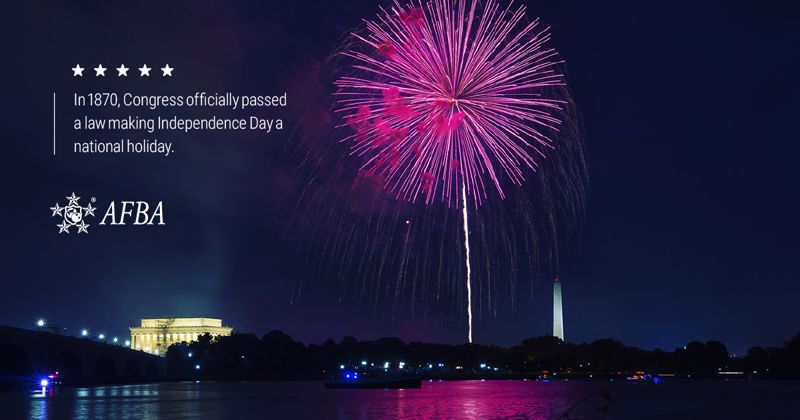 “The appearance of U.S. Department of Defense (DoD) visual information does not imply or constitute DoD endorsement.”
Today, Americans mark the patriotic holiday by with red, white, and blue decorations, watching parades, and celebrating the freedoms afforded us so many years ago. Fireworks are still a huge part of the occasion, with 33% of people plan on marking the day with beautiful pyrotechnics.
This year, while you celebrate with family and friends, be sure to take a moment to reflect on everything that has happened in order to allow us the American freedoms we enjoy today.
Every year on the Fourth of July, the United States of America comes together to celebrate the day that our beautiful country declared independence. While the rest of the country lets loose and commemorates Independence Day, first responders nationwide prepare to make sure that American citizens can do so safely. Let’s take a look at how EMTs, firefighters, and hospital workers prepare for the day when more people are likely to visit the emergency room than any other.
EMTs
Regular summertime fun like boating, grilling, and camping are staples of the holiday, but with nearly all 330 million Americans participating in these activities simultaneously, the likelihood of accidents goes up. July 4 and 5 see an average of 45,000 people in emergency rooms across the country, meaning that EMT staff are working overtime to provide emergency medical assistance and to transport patients to the hospital.
Preparation for this year’s Fourth of July celebration is different from previous Independence Day observances. There is anticipation that Americans will heed the advice of President Joe Biden when he encouraged citizens to use the holiday to also commemorate the return to relative normalcy after the coronavirus pandemic. While celebrating the reopening of America is certainly in order, there is a chance that an increase in exciting activities could lead to a higher possibility for accidents.
Police officers
One way that paramedics and other first responders prepare for the increase of activity is by knowing what kind of accidents are most likely to occur. This is especially true for law enforcement officers. A great example of this is intoxicated driving. What was probably a fun party or get-together could turn deadly if someone makes the choice to drive under the influence of alcohol. Independence Day is only rivaled by New Year’s when it comes to car accidents.
About 38% of the total people who passed away on July Fourth and a fifth died due to car crashes where the driver was under the influence of alcohol. Knowing this, preventive measures can be taken, including media campaigns and an increase of police officers patrolling the roads to stop drunk drivers before the accidents happen.
Firefighters
July is one of the hottest national holidays and is known for being celebrated with beautiful fireworks — a combination that is not necessarily ideal when it comes to fire safety. 2020 was notably the second-worst year for wildfires in America in about 60 years, with nearly 10.1 million acres being burned. 2021 has already been uniquely warm and dry, indicating an increased danger for fire hazards. With July Fourth falling in the middle of fire season, firefighters across the nation are prepared for a rise in structure fires as well as wildland fires caused by fireworks and campfires.
In fact, about 19% of fatal fires happen because of careless behavior, and Independence Day is no exception. Because of the high rate of accidental fires in general, it is best to leave the handling of large fireworks to the professionals. In preparation, fire stations and wildland fire teams hire additional staff and deploy extra volunteers to ensure a safe holiday weekend.
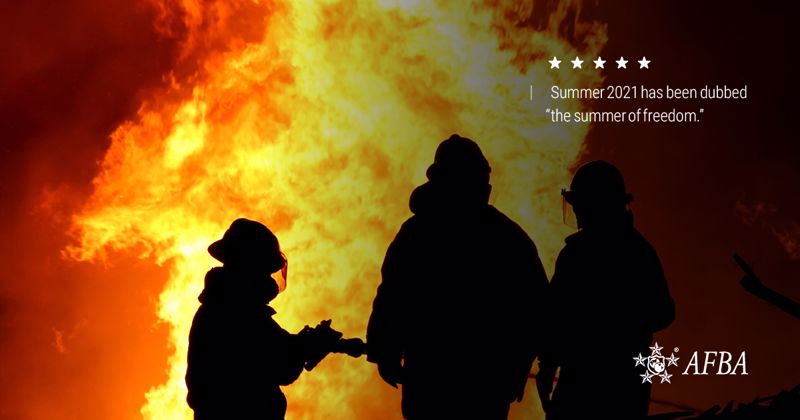 The appearance of U.S. Department of Defense (DoD) visual information does not imply or constitute DoD endorsement.
Summer 2021 has been dubbed “the summer of freedom.” While the Fourth of July is the perfect time to celebrate this, it is important to keep in mind the first responders risking their lives to protect American citizens.
June 14th of every year marks the United States Army’s birthday. The 14th day of June 2021 was the Army’s 246th year of existence. Having been created in 1775, the Army is the oldest branch of the US military and is soaked with a richly fascinating history. The Army’s many years of committed service to the country truly reflect the branch’s dedication to defense.
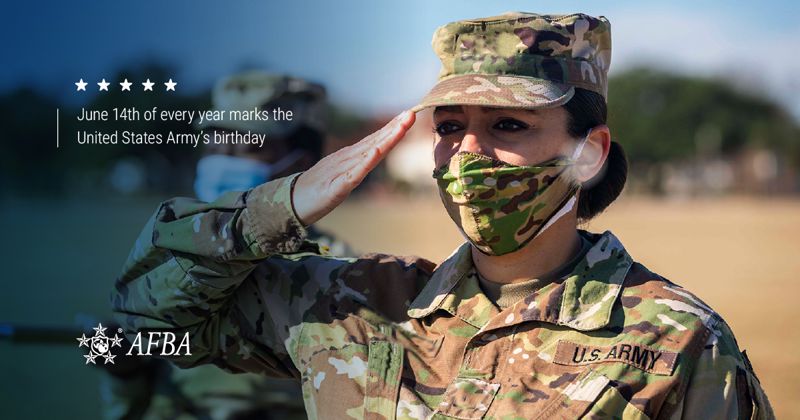 The appearance of U.S. Department of Defense (DoD) visual information does not imply or constitute DoD endorsement.
Historical legacy
The U.S. Army’s legacy started nearly in tandem with the United States itself. In 1778, the Army claimed the motto “This we’ll defend,” and has taken the phrase seriously ever since.
Revolutionary War (1775)
During the rise of civil unrest of the 1770s, the original 13 colonies formed the first version of a U.S. armed forces. The 2nd Continental Congress created the Continental Army as a means of revolting against the rule of Britain. This initial version of the army fought its first battle in 1776, and the 20,000 revolutionaries were forced to retreat by the much more sophisticated redcoats.
With grit and determination that remains today, the army rallied and followed its commander in chief, George Washington, to victory. The U.S. Army is inextricably linked with the United States of America’s brave and independent origins.
The Civil War (1861)
Nearly 100 years later, the United States Army was called into action and underwent a major renovation. The Civil War era was a very important time for weapons technology development in the army. The result was the most deadly war in the Army’s history.
World Wars (1917/1941)
It took many years for the army to build itself back up from the destruction the Civil War wrought. The first world war saw the advancement of the army’s technological sophistication as well as the creation of 17 new National Army divisions. This included the Aviation Section of the Army Signal Corps, which was the predecessor of the Air Force.
Some cite the second World War as being the beginning of the United States Military as we know it today. WWll was also a very important time for the evolution of modern battlefield strategy with the invention of the atomic bomb.
Modern day
Every era of major conflict (many of which are not named here) has resulted in a more advanced and strategic Army, but it’s roots of bravery and valor have remained at its core since the beginning. Today, the United States Army has more than 700,000 members, including both active duty and Army reserve.
Every year on June 14th, members of the Army and their families come together to celebrate the Army’s birthday with balls, dinners, parades and parties. This year was no exception. It was a time for modern-day servicemen to remember and commemorate the incredible history of their branch.
Just like every year, the Pentagon and Capitol Hill recognized the anniversary of the Army through a traditional cake cutting ceremony, using a classic Army saber. Even those who are not directly tied to the United States Army took a brief moment to recognize our country’s oldest military service.
A bill was recently introduced that would give first responders (law enforcement officers, firefighters, Emergency Medical Technicians, paramedics) and teachers access to no down payment options for securing a mortgage. The legislation was introduced by the House of Representatives in May and has been dubbed the HELPER bill, short for Homes for Every Local Protector, Educator, and Responder. The bipartisan HELPER bill is showing support for the community.

This is just one instance of the government reaching out to the people who work every day to make America a better place.
Breaking down HELPER
The national director of Heroes First Home Loans, Samuel Royer, first initiated the HELPER bill. As a former member of the Marine Corps who has benefited from similar legislation created for veterans, Royer looked at this bill as his chance to give back to his community. On may 20th, the HELPER bill was officially introduced by Representatives John Rutherford (R-FL), Al Lawson (D-FL), John Katko (R-NY) and Bonnie Watson Coleman (D-NJ).
The end goal is to give these service workers a leg up in today’s extremely competitive housing market. According to the National Association of Realtors’ Housing Affordability Index, most people have to pay more than 14% of their income in order to satisfy their home payment.
If passed, the HELPER bill would create a one-time-use home loan program that could be used one time under the Federal Housing Administration. Additionally, qualifying people would not need to make a down payment.
This would create opportunities for first responders and teachers that may not otherwise be available. Lastly, HELPER would remove the obligation for a monthly mortgage insurance premium, which is required for all FHA loans.
Government recognition
Teachers add immense value to society just by going to work every day. First responders like EMS personnel also have a low starting pay rate. Despite all this, the federal government has taken action to ensure that those who have chosen such a noble career path are taken care of.
In fact, HELPER is very similar to an already established program called VA Home Loan Program. Through this loan program, United States military veterans can receive benefits which reduce the initial cost of buying a home and can save them up to $90/month in payments. Similar government programs are not uncommon and serve a reminder that the government is grateful for the service of these individuals.
Community recognition
Teachers and first responders directly impact the community they work with and are often held at high personal esteem for their contributions. Despite the discrepancy in financial payment, many who serve find the nature of their work rewarding.
As an example, a survey of 2,000 people showed that 76% say they would gladly pay for a first responder’s meal, if they were out eating and saw one in a restaurant. A bipartisan piece of legislation like the HELPER bill, is a tangible way for a community to show their support.
For some, it might have been easy to take local protectors, educators and responders for granted, but 2020 truly exposed how invaluable they are. The balance of society was held in the palms of doctors, nurses, firefighters and EMT’s. Teachers adapted their entire teaching method and continued working toward a more educated tomorrow. Communities rallied together to support essential workers through classroom funds, in-store discounts and mask drives.
First responders, teachers and health care workers dedicate their lives for the betterment of society. These are people who often live in the communities they serve and the federal government is looking to help those communities show their gratitude by introducing important legislation like the HELPER bill.
The creation of Women Veterans Day in 2018 was meant to recognize the unique struggles and sacrifices of female servicemembers. The holiday is on June 12th and celebrates all women who have served in the armed forces. Though not nationally recognized, more and more states are starting to adopt it.
A brief history of women in the military
Women have provided military service in many different ways since the beginning of the United States’ military. From holding positions as nurses and seamstresses to helping raise money for the war efforts, women have always played an important role in the military.
Early efforts
Outside of these roles, there are many stories of women covertly enlisting in the Civil War era military as spies and even soldiers. Frances Clayton, Nancy Morgan Hart and Deborah Sampson are just a few of the women who disguised themselves as men to fight for their beliefs in the Civil War.
The first woman to formally enlist in the military was Loretta Walsh. In 1917, she became a member of the Navy and acted as the ship’s secretary. It did not take very long for other women to begin formally joining the armed forces.
Women’s Army Corps (WAC)
The Women’s Army Corps was created during World War ll to allow women to assist the war effort in non-combat positions. This allowed 150,000 women to serve their country and opened up America to the idea of a woman among the ranks of the military.
The Women’s Army Corps came into existence thanks to Rep. Edith Nourse Rogers. This was a huge step forward in gender integration, but it expired in 1948. Despite this, there was a huge demand for women to be permanent members of the military.
Women’s Armed Services Integration Act
Directly after the expiration of WAC, the Women’s Armed Services Integration Act was passed and granted women the right to serve in the Army, Navy, Marine Corps and the Air Force.
Modern women in the military
Today, it is nowhere near uncommon for a woman to join the military, and both genders are recruited equally. Generally speaking, there are still more men in active duty than women, but overall trends show an increase in female servicemembers. Despite this, retaining female recruits is far more difficult than the retention of male recruits.
This exposes unique challenges that women face as a part of the military, struggles that each branch works diligently to eliminate. The United States Government Accountability Office released a report in March 2021 that details a retention plan. The report notes this discretion while reporting that the Department of Defense plans on “updating its diversity and inclusion strategic plan.”
Women as veterans
Women make up at least 10% of all living veterans, most of them having served in the Gulf War. Aside from the normal struggles that all veterans face regardless of gender or race, minorities can face additional hardship. Much like their male counterparts, 28% of female veterans are disabled and are unable to find work due to their disability.
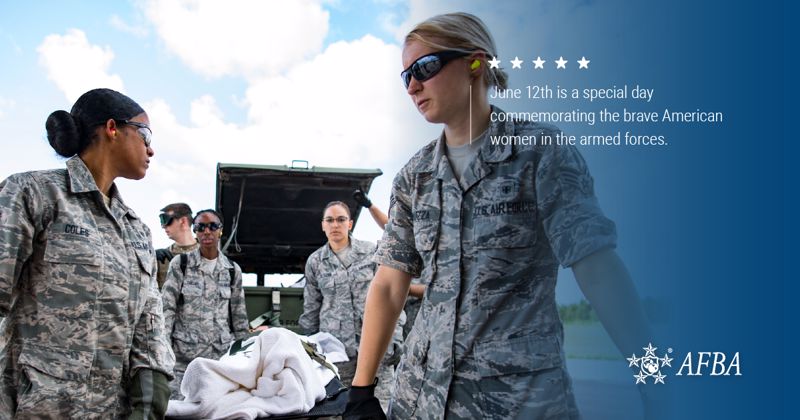 The appearance of U.S. Department of Defense (DoD) visual information does not imply or constitute DoD endorsement.
Womens Veterans Day is an opportunity to thank those women who have given their lives in active duty and those who have dedicated so much in service to the United States of America. June 12th is a special day commemorating the brave American women in the armed forces.
Only several months into the new administration, many government contractors are surely curious about the new trends unfolding.
There are several factors currently at play in reshaping the government contracting landscape:
- Executive orders (EOs).
- New political appointees and agency leadership.
- A host of new policies, programs and initiatives.
Let's examine how these factors may alter the government's priorities and its procurement processes, and what that means for contractors and their businesses.
Executive orders
Beginning shortly after the inauguration, the new administration began rolling out a series of executive orders. While not all of these EOs directly related to government contractors, several have the potential to greatly impact this sector.
The EOs most likely to affect government contractors have largely covered COVID-19 response and mitigation efforts, immigration policy and climate change. For instance, federal agencies are now tasked with examining the impact of climate change from their procurement processes.
Government contractors should ensure their operations meet the updated needs of these agencies. In some cases, contractors with sound sustainable processes can potentially leverage this aspect to their advantage.
New political appointees and agency leadership
Along with the new administration comes a host of new political appointees and agency leadership across the federal government. However, while many of these people have been confirmed for their roles, there are still many deputies and senior leadership members still awaiting confirmation.
As this transition occurs, many government contracting bids and awards might be placed on hold. Even once all the federal agencies are up and running at full capacity, there might still be a waiting period as the new leadership reviews current rules and guidance and updates them accordingly.
Some government contractors may find themselves in a holding pattern as they wait for confirmation of appointees and leadership, along with implementation of updated rules and guidance.
Changes to policies, programs and initiatives
In addition to EOs and new appointments, there are also plenty of policy changes and initiatives underway.
The updated "Made in America" program is most likely to affect government contractors. While "Buy American" has long been a focus for federal contracts, the new administration has refined the program further.
Now, all agencies must review all actions, and consider eliminating any of them that do not align with the "Made in America" initiative. This means all federal financial assistance awards and procurement will need to follow all statutes, rules, regulations and EOs that refer to the "Buy American" or "Made in America" program.
To this end, the Office of Management and Budget (OMB) is establishing a new Director of Made-in-America Office to oversee the implementation of this program. This new Made-in-America Office will:
- Increase oversight of waivers to domestic preference laws.
- Connect new businesses to contracting opportunities.
- Direct a cross-agency review of all domestic preferences.
- Increase domestic content requirements.
- Find ways to close current loopholes in how domestic content is measured.

Domestic government contractors may potentially see more awards and procurement opportunities with this new initiative.
IT overhaul and improved cybersecurity
Many governments still rely on outdated and inadequate information technology (IT) infrastructure and cybersecurity programs. Plus, recent high-profile incidents, such as the SolarWinds hack, have drawn heightened attention to these critical aspects of the government.
Although signed into law back in 2017, the Modernizing Government Technology Act continues to play a vital role in overhauling and updating the IT and cybersecurity of different government agencies.
Government contractors specializing in digital, mobile and cloud technologies, or software, data analytics and more can potentially tap into the $74.8 billion worth of contracts involving IT products and services.
For some, Memorial Day simply represents a three-day weekend and the unofficial beginning of summer. But for many of us, Memorial Day commemorates and celebrates those brave soldiers who sacrificed their lives for the country.
The history and traditions of Memorial Day go back a long way, from the history of casual observances to the first official observances in the U.S. Today.
Origins of Memorial Day
Since antiquity, people have remembered fallen soldiers with parades and memorials.
In the U.S., the first traces of what would become Memorial Day began a few weeks following the end of the Civil War. On May 1, 1865, a regiment of African American Union troops along with more than 1,000 newly freed individuals, marched a procession into a former prisoner of war camp in Charleston, South Carolina. There, the group consecrated a burial site for the more than 250 prisoners who died of disease or exposure. They sang hymns, recited Bible verses and scattered flowers on the graves of the fallen.
Then, on May 5, 1866, the city of Waterloo, New York, held a community-wide ceremony honoring the local Civil War veterans. Residents flew flags at half-mast, businesses closed for the day and vigils were held.
Three years later, in 1868, the Grand Army of the Republic (GAR) established Decoration Day as May 30. The idea was to decorate the graves of the fallen soldiers with flowers, and this day was chosen as many flowers would be in full bloom. Though some legends say this was chosen because no Civil War battles took place on May 30.
May 30, 1868, marks the first observance of Decoration Day. Ceremonies were held at Arlington National Cemetery with General Ulysses S. Grant presiding over the solemn occasion. Small American flags and flowers were placed on the graves of soldiers, a tradition that carries through to this day.
Since that time, however, more than 25 different locations around the country have claimed to be the birthplace of Decoration Day or Memorial Day. In 1966, President Lyndon Johnson and Congress declared Waterloo, New York, as the original home of Memorial Day. Then, in 1971, Congress passed an act declaring Memorial Day a national holiday, and moving the day of remembrance to the last Monday in May.
Memorial Day's Legacy Continues
Although it's been a long journey from the original Decoration Day to the holiday as we know it, today, the tradition and legacy of Memorial Day holds strong across the country and the U.S. military bases around the world.
Most recently, Congress passed the "The National Moment of Remembrance Act" and President George W. Bush signed it into law in December 2000. The act encourages all people in the U.S. to give something back to their country, and to help coordinate commemorations in honor of those who gave their lives in service for the country.
The National Moment of Remembrance is at 3 p.m. on Memorial Day. Remember our fallen soldiers during this moment of silence at your local time.
This can be done anywhere you are, even if you're out with friends or at a cookout with family. Spread the word about the National Moment of Remembrance to help ensure everyone understands what this serious day means for servicemembers and their loved ones.
Although first responders are not always on the clock, they're always on the job.
Even when they're off duty, these brave men and women will still respond to a crisis to make a meaningful impact in any way they can, no matter where they are. Sometimes, this includes providing life-saving emergency services in the nick of time.
Here we highlight three recent instances where these skilled professionals placed a priority on duty, service and a commitment to their values, even while off the job.
Captain Brad Petty, Chattanooga Fire Department
On a recent drive home following his son's wrestling tournament, Captain Brad Petty noticed a driver suddenly swerve and pull over to the side of the expressway about 34 miles southeast of Nashville, Tennessee. Then, according to the Captain, a person hopped out of the car to flag down someone.
Even with his family in the vehicle with him, Captain Petty knew he had a responsibility to stop and try to help. So he pulled over near the other car, only to discover another person in the passenger seat who was suffering from a gunshot wound to the head.
Captain Petty used his emergency response training by opening the victim's airway and applying pressure to the wound, as his daughter, Hannah Petty, called 911. The Petty family waited with the victim until assistance arrived and she was flown to a hospital in a medical helicopter.
Lieutenant Alex Meron and Paramedic Chelsee Meron, Moore Fire Department
The husband and wife couple of Lt. Alex Meron and Paramedic Chelsee Meron recently returned home from a trip. As they made their way through the Will Rogers World Airport in Oklahoma City, they noticed what they thought at first to be a sleeping man in the baggage claim area. But being the keen-eyed first responders they are, they realized something didn't look right, so the pair decided to check the man's pulse. That's when they discovered he didn't have a pulse.
Immediately, Lt. Meron started administering CPR. Meanwhile, Paramedic Meron darted off to locate the closest Automated External Defibrillator (AED) in the airport.
Thankfully, Lt. Meron's CPR attempts worked, and he was able to resuscitate the man and get his pulse started before the Emergency Medical Services Authority (EMSA) arrived to take the man to the hospital.
Staff Sergeant Jason Mendoza-Anaya, US Air Force
While doing his laundry at a Colorado Springs laundromat in 2020, U.S. Air Force Staff Sgt. Jason Mendoza-Anaya, 21st Force Support Squadron unit training manager, heard a guy scream, start to shake and fall over. The man hit his head on a metal chair as he fell and continued shaking on the ground.
Sgt. Mendoza-Anaya recognized the severity of the incident and rushed to the man's side, who was now bleeding from his head wound and still convulsing. Mendoza-Anaya took charge of the situation, directed another laundromat patron to call 911 and another person to see if the man had any medication for seizures he needed in his bags. Meanwhile, Mendoza-Anaya tried to get a pen or pencil into the man's mouth so he didn't bite his tongue off during the seizure, but it was too late, and blood was pooling out of the man's mouth.
Mendoza-Anaya got the man on his side so the blood would spill out and the man wouldn't choke, and then wrapped his sweater around the man's head so he wouldn't cause more damage if he hit it against the floor.
He continued this until an ambulance with on-duty first responders arrived and took over medical care. After applying a neck brace on the man, he woke up and lived.
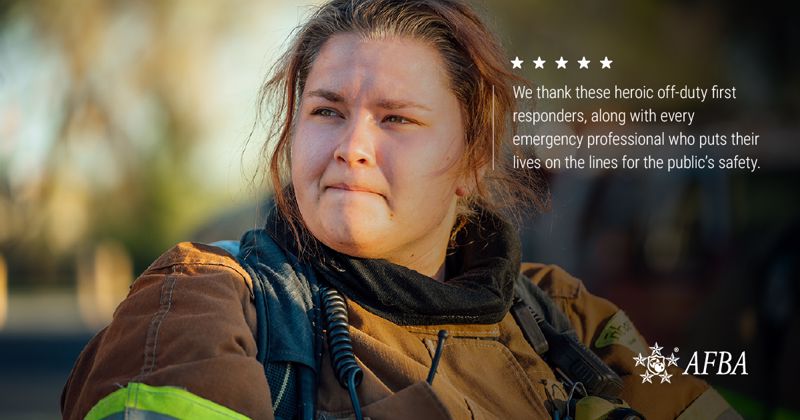
We thank these heroic off-duty first responders, along with every emergency professional who puts their lives on the lines for the public's safety.
Every year on the third Saturday of May, the United States comes together to celebrate and honor our active-duty servicemembers for Armed Forces Day. This day falls toward the end of Armed Forces Week.
This holiday provides Americans the opportunity to acknowledge the contributions of active-duty servicemembers in all six branches of the U.S. military, including the newly formed Space Force, as well as National Guard and Reserve components.
The history and significance of Armed Forces Day
In 1947, President Harry S. Truman signed the National Security Act, which unified the four branches of the military under the Secretary of Defense.
To honor this unification, U.S. Secretary of Defense Louis Johnson announced the creation of an Armed Forces Day on August 31, 1949. The aim was to consolidate the then-current individual Army, Navy, Marine Corps and Air Force Days, which all fell on different dates. These branches still celebrate their own days in addition to the joint observance.
In an excerpt from the Presidential Proclamation on the creation of the Armed Forces Day, President Truman said:
"Armed Forces Day, Saturday, May 20, 1950, marks the first combined demonstration by America's defense team of its progress, under the National Security Act, toward the goal of readiness for any eventuality. It is the first parade of preparedness by the unified forces of our land, sea, and air defense."
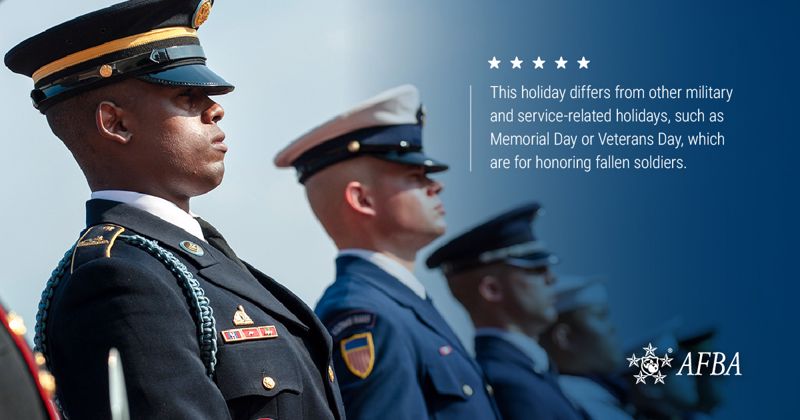
This holiday differs from other military and service-related holidays, such as Memorial Day or Veterans Day, which are for honoring fallen soldiers.
How you can celebrate and Observe Armed Forces Day
If you're close to a military base, many of them host parades, open houses, festivals, parties, picnics, receptions and, in some cases, even air shows.
For instance, the city of Bremerton, in Washington State, has been hosting its Armed Forces Day Parade for more than 70 years. The city is home to the Puget Sound Naval Shipyard and the Bremerton Annex of the Naval Base Kitsap. With average annual attendance of 25,000 to 40,000 spectators and participants, this parade is quite the spectacle to behold. Although this momentous event has had to be greatly scaled back due to the pandemic, its organizers are confident in returning to full force when it becomes possible.
If you're unable to travel to a military base, there are still plenty of options to observe this day.
You can:
- Organize a "Support the Troops" bike rally — either motorcycle or bicycle — and ride around your neighborhood to raise awareness.
- Visit a local public military display, such as a memorial or cemetery. These are good places to pay your respects, while also potentially learning some new information about a historical event and the personnel involved. Sometimes these locations will also host seminars, musical performances or ceremonies on Armed Forces Day.
- Keep it simple and host a barbecue with family and friends, or go on a picnic. This will also provide a great opportunity to spread awareness and raise understanding of this special day that honors those who sacrifice so much.
In addition, some stores and restaurants offer discounts and special deals for servicemembers and their families on these days.
Any veteran who has worked with the Department of Veterans Affairs (VA) to receive GI Bill benefits know the process can be challenging. In an effort to address this issue and provide a more streamlined experience for veterans, the VA will build and launch a new online platform for the management of most GI Bill benefits.
An innovative platform for accessing tuition benefits and more
Accenture Federal Services won the VA contract, and is working closely with the VA to create a user-friendly digital platform.
Following 2017 legislation, the VA has been working hard to update the way veterans can receive tuition and other benefits for higher education. However, these previous attempts led to glitches and other problems, which prompted the department to request additional funds from Congress. The CARES Act, the initial coronavirus relief package Congress passed in March 2020, allocates $243 million for this Digital GI Bill Modernization project.
Although this will be a multi-year, joint undertaking, the VA is optimistic that it will provide a modern, fully integrated solution for the nearly 1 million veteran students the department serves each year.
Goals of the Digital GI Bill Modernization
Currently, the VA distributes around $12 billion dollars worth of benefits using up to 23 different legacy computer systems. Claims processors are required to toggle between the systems, manually transferring data and performing duplicative duties. All this extra, time-consuming work creates more opportunities for human error that can slow down benefit distribution.
The features being developed in this modernization project include:
- Improved customer support and financial services. This will allow for more timely and accurate payment delivery with real-time eligibility and access to benefit information.
- Upgraded communication tools. With these refreshed tools, the VA will be able to call, email, text and chat directly with beneficiaries, as well as grant access to records.
- End-to-end systems management. This will enable proper compliance and oversight of GI Bill programs. It will also ensure the effective use of data and business intelligence tools to track, monitor and measure school and student outcomes.
- New program and policy requirement supports. As the academic community and job market continue to evolve, this will ensure the VA keeps pace with these changes.

Ultimately, the upgraded platform will provide veterans with the advantages of a new, modernized system with real-time support from VA staff. This includes better troubleshooting assistance with payment issues as well as easier, faster access to beneficiary records for VA staff.
While the VA has experienced setbacks with attempts to modernize other major programs, such as electronic health records modernization, the department is hoping for strong progress. By hiring an experienced systems integrator and software developer, the VA will be able to deliver improved services for veterans.
Since the GI Bill's implementation following World War II, the program has been instrumental in ensuring veterans have the means to access higher education and more. This digital modernization effort will guarantee distribution of these benefits, and will evolve alongside the available technology to make the entire process more efficient and streamlined.