
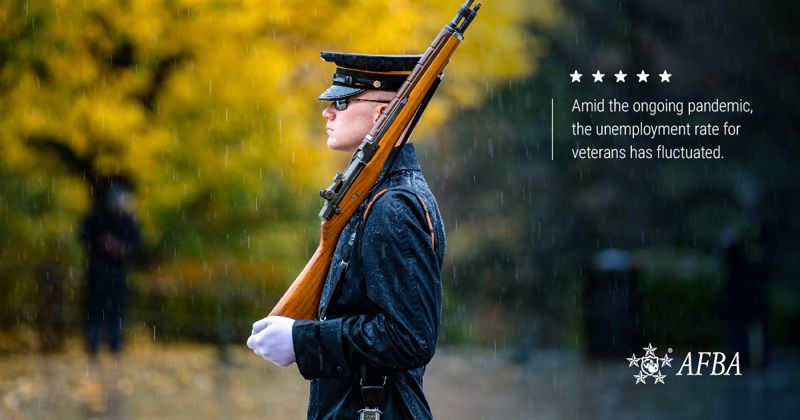
Amid the ongoing pandemic, the unemployment rate for veterans has fluctuated significantly. As the new year begins, here is a look at the latest data, how this compares to the record unemployment lows experienced just over a year ago, and what this means for veterans in the civilian workforce.
Unemployment raced from record lows to record highs in 2020
In January 2020, the veteran population and the workforce at large were continuing a streak of high employment and stability. The Department of Labor (DOL) noted that the 3.1% unemployment rate for veterans seen in 2019 was a 19-year record low.
However, the economic impacts of the COVID-19 pandemic shook the civilian workforce, leading many companies to downsize or shutter their doors for months on end.
According to the latest DOL data, the veteran unemployment rate stood at 6.3% in November 2020, an increase from 5.9% the previous month. This was slightly better than the unemployment rate for the non-veteran working population, which was 6.7%.
Granted, these figures are significantly more promising than the 14.7% collective unemployment rate of April 2020. A staggering 11.7% of the veteran population — more than 1 million former service members — filed for unemployment that month.
Half a million veterans remain unemployed
Despite how far these numbers have settled since the spring, decreasing from nearly 12% in April to about half that figure in November, the ongoing pandemic and widespread economic turmoil still mean employment prospects are shaky for those who were pushed out of the workforce in 2020.
If the government's most recent data is still true for the start of 2021, 552,000 people who served in the armed forces and transitioned to the civilian workforce are still combating the instability of unemployment.
Youngest veterans impacted the most
According to a December 2020 report by the U.S. Bureau of Labor Statistics (BLS), post-9/11 veterans have a higher unemployment rate than most others:
- Of the veterans who served after 2001 (Gulf War era II), 244,000 (6.9%) were unemployed.
- Of the veterans whose service occurred between 1990 and 2001 (Gulf War-era I), 107,000 (4.7%) faced unemployment.
- Of all veterans of the Vietnam War, the Korean War or World War II, 75,000 (6.4%) were unemployed.
- Of veterans of other service periods, 126,000 (7.0%) experienced unemployment.
Certain sectors show promise for job seekers
In December 2020, the BLS reported that, although the retail trade and government sectors experienced declines in employment, "notable job gains occurred in transportation and warehousing, professional and business services and health care."
Veterans seeking employment can focus on these growth areas, while also taking advantage of resources available through the Department of Veterans Affairs, such as the Veteran Readiness and Employment (VR&E) program.

In the Valentine's Day spirit, we're tracing the history of "sweetheart jewelry," which became widely popular during the Second World War.
Traditionally given by a soldier heading off to war to a loved one at home, a piece of sweetheart jewelry was both romantic and patriotic in nature. Today, these items are considered collectible pieces of our nation's past.
Sentimental jewelry to remember soldiers during times of war
As the Cooper Hewitt museum explains, the custom of gifting sweetheart jewelry dates back to World War I. However, it became even more popular during World War II, when countless couples and families were separated as soldiers left home to fight overseas.
Sweetheart jewelry was most commonly exchanged between romantic couples. But fathers, brothers and sons also left family members with these tokens in their absence. Women purchased their own sweetheart jewelry, too, either to remember a certain soldier or show support for the nation's forces as a whole.
Wherever these sentimental items came from, their owners wore them proudly and passionately. Women wore brooches to keep their family and country close to the heart. They tucked pictures of the soldiers they missed into treasured lockets and they wore their hearts on their sleeves in the form of bracelets.
Patriotic colors and imagery permeated jewelry design
While hearts were a common theme, sweetheart jewelry was not only romantic in design; it was also highly patriotic. Many of these items featured military insignia and other icons related to a loved one's branch of service. Others included the American flag or details featuring stars and stripes.
An all-American red, white and blue color scheme was also typical of sweetheart jewelry. Additionally, a library of patriotic imagery, ranging from the eagle and the victory "V" to Uncle Sam's top hat, can be seen in jewelry from the WWII period. Phrases like "Loose Talk Can Cost Lives" and "Remember Pearl Harbor" also made their way into pins and pendants.
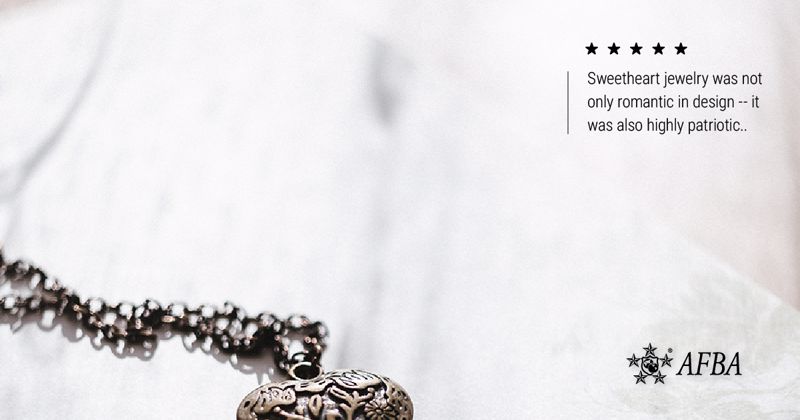
As the National Museum of American History explains, sweetheart jewelry became quite fashionable during WWII. Under rationing rules, new clothes and accessories were hard to come by. Women were urged to make do with what they had. Sporting a sparkling brooch was a welcome way to enliven an old dress collar and show one's support for the nation.
Meaningful jewelry made of modest materials
Sweetheart jewelry did not need to be made of fine, expensive materials like rubies, diamonds or sapphires set in gold. Instead, many Americans exchanged items made of gilded base metals set with sparkling glass crystals, rhinestones and imitation gemstones.
When access to certain base metals was restricted during rationing, jewelers turned to sterling silver. As the Cooper Hewitt museum notes, this forced one manufacturer to triple its jewelry prices — but consumer demand didn't falter.
Other materials such as enamel, wood, mother-of-pearl, shell, and celluloid and Bakelite plastics were also often found in sweetheart jewelry. Some soldiers handcrafted their own sweetheart jewelry items, carving bullets, coins, casings and other metal objects into sentimental adornments.
Sweetheart jewelry inspires a new generation of Americans
According to Collectors Weekly, wartime sweetheart jewelry is now highly collectible: "Sweetheart jewelry is among the most affordable of home-front collectibles, even though the prices have risen in the last 10 years. That's because these items have been growing in popularity with both military and jewelry collectors, as well as Americans who yearn to connect to veterans of past wars and express their patriotism."
Sweetheart jewelry has also inspired a new generation of jewelry makers, including Jessica Gibson, a former Supply Sergeant of the U.S. Army Reserves. In response to the COVID-19 pandemic, Gibson created a sweetheart jewelry-inspired collection.
As she explained in a news release, "1940s fashion and history have captivated my heart over the past few years. Considering all the challenges we are currently navigating, remembering that we've collectively navigated more challenging times has given me hope that together we'll get through this, as we've done in the past. Working on this collection has been therapeutic and inspiring as I designed it with the intention of providing the wearer with a sense of strength and comfort."
The U.S. Army recently announced several major updates to Army Regulation 670-1, Wear and Appearance of Army Uniforms and Insignia, slated to go into effect Feb. 24, 2021. Here is a look at some of the key revisions as well as the reasoning behind the changes.
A people-first approach
As part of the Army's Project Inclusion, instituted in mid-2020, the topics of hair and grooming have come under question. Current guidelines have been critiqued for being discriminatory against various groups, including Black Soldiers and women in the Army. The revised regulations aim to minimize racial bias and promote a more inclusive approach.
"The Army must continue to put people first by fostering a culture of trust that accepts the experiences and backgrounds of every Soldier and civilian," said Deputy Chief of Staff for Personnel, Lt. Gen. Gary Brito, in an announcement. "Our diverse workforce is a competitive advantage, and the Army must continue to offer fair treatment, access and opportunity across the force."
Newly authorized hairstyles are intended to promote healthy, natural hair for all Soldiers
As for hair, a wider range of styles will now be accepted. Previously, women were required to style their hair in a low, tight bun. As this can lead to hair loss, the updated regulations specify that styles such as long ponytails and braids may be worn. They can be tucked into a Soldier's uniform to prevent snagging, and are expected to improve the fit of combat helmets.
"In an effort to stop hair damage and loss stemming from hairstyles like the bun, the Army approved healthier hairstyle options that are more inclusive of various natural styles," explained Sgt. Maj. Mark Anthony Clark.
Furthermore, the Army has loosened strict requirements related to cornrows, braids, twists and locks which may be worn by Black servicemembers. Soldiers were previously permitted one such style at a time, with individual sections limited to half an inch in width. The width requirement has been removed, and Soldiers may now opt for more than one of these styles at a time.
Highlighted hair that maintains a natural appearance will also be permitted, although vibrant, artificial hues like blue, green and purple are still not authorized. A Soldier's dyed or bleached hair color "doesn't necessarily have to be a color that is typically seen on a certain ethnic group," explained Master Sgt. Quintana Mitchell.
In an attempt to improve cultural sensitivity within the grooming regulations, words describing particular styles, such as "Mohawk" and "Fu Manchu," are also being revised in favor of verbiage that is less offensive and more descriptive. New images have also been produced to provide clearer detail about the authorized and unauthorized styles.
Additional grooming guidelines support self-expression and safety
Once the new regulations are in place, simple gold, silver or diamond stud earrings will be authorized for women in most non-combat contexts. Additional lipstick and nail polish colors are being added to the list of accepted cosmetics for women. Male Soldiers will also be permitted to wear clear nail polish, either as a grooming choice or in order to protect their nails while working with rough tools and harsh chemical agents.
"Our identity is important," said Sgt. Maj. Brian Sanders in an Army announcement. "If we care about people first and the Soldier as a whole, we have to care about the many aspects to who they are as well. This is a small, but significant change that positively impacts a considerable size of our force."
"I use the analogy, 'If you look good, you feel good — and if you feel good, you perform [well]," Sanders added, explaining that this more inclusive approach to personal appearance and grooming may result in productivity improvements.
In recognition of National Mentoring Month this January, we're highlighting how people in first responder professions can make an impact by mentoring young members of the community.
What is National Mentoring Month?
Since 2002, National Mentoring Month has been hosted each January by MENTOR: The National Mentoring Partnership in partnership with the Harvard T.H. Chan School of Public Health. MENTOR is on a mission to "fuel the quality and quantity of mentoring relationships for America's young people and to close the mentoring gap for the one in three young people growing up without this critical support."
The campaign's mission is to raise awareness around the value of high-quality mentoring experiences, particularly for young people. Caring adult mentors have the power to help mentees make responsible decisions and carve out a path for themselves in their communities and future careers.
This year, the chosen theme is Mentoring Amplifies. The month-long observance amplifies the positive impact mentoring can have, and how such experiences can amplify potential, confidence, connections and more for young mentees.
Mentors help tomorrow's leaders lay a solid foundation for the future
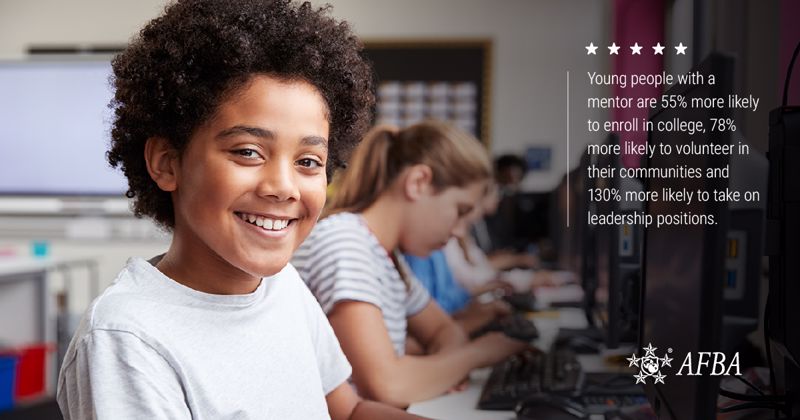
According to the National Mentoring Month organizers, young people who have a mentor are 55% more likely to enroll in college, 78% more likely to volunteer in their local communities and 130% more likely to take on leadership positions.
Being able to connect with a committed mentor gives the leaders of the future opportunities to discover new career fields and possibilities. They can also discuss their aspirations and benefit from a support system outside of their school and household.
Real-world heroes can make a difference in young peoples' lives
Many children look up to firefighters, police officers and emergency medical professionals as real-life superheroes. Some even dream about joining these professions when they grow up. As these little dreamers mature into young adults, first responders can make a meaningful and tangible impact through mentorship.
They can talk about and demonstrate the values of helping others and serving the community. They can help young people learn about qualities like courage and selflessness as well as valuable skills like leadership and teamwork.
A glimpse at first responder mentoring in action
The First Responders Explorer Post #58 of Quakertown, Pennsylvania, is just one example of how first responder agencies can add value to the community through mentorship programs.
In partnership with the local school district and Boy Scouts troop, members of the Quakertown police and fire departments and emergency medicine technicians (EMTs) give high school students real-world exposure to each of these three professions. Participants are invited to climb fire truck ladders, view K9 unit demonstrations, tour 911 call centers and forensic labs and listen in on how real calls are received and how EMT teams, firefighters and police officers dispatched.
As explained by the Department of Justice's Community Policing Dispatch newsletter, this experience gives participants in the mentoring program a look at the collaborative and interdisciplinary nature of these departments. Students can cultivate critical thinking and emergency response skills to apply in their own lives. Plus, it helps the mentees understand the difference between the first responders portrayed on TV and the realities of the job and the people who fill these critical roles.
The benefits of mentoring aren't just for kids
Mentoring young people can have a significant impact on the adults who participate in such programs as well. Supporting and encouraging a mentee can bring a sense of personal fulfillment and accomplishment, especially when it's clear the impact those hours and interactions have had on the mentee.
Furthermore, becoming a mentor — whether through a local initiative or a national mentoring organization — opens the door to the wider mentoring community. Connecting with like-minded people who are excited about making a difference in young peoples' lives can be a positive side effect.
Finally, these experiences can also leave mentors more open-minded and empathetic, with a new perspective of the world as seen through their mentee's eyes. Just a few hours per week can make a major difference for both the first responders and the young people they work with.
The start of a new year can be a meaningful moment to set intentions and goals that will help make the coming year even better than the last. For many people, this involves resolving to make small changes that can add up to major improvements in various aspects of life, including financial health.
Getting rid of debt, increasing savings or financing a major purchase are all worthwhile new year's resolutions. But setting goals is often the simple part — sticking to them can be more of a challenge, especially in turbulent times.
With that in mind, here are three strategies for how to keep your financial resolutions for 2021.
Quantify your financial goals and action items
Setting vague goals will make it difficult to recognize any progress you're making. Plus, this can make simple goals seem overwhelming and out of reach. Instead, translate your overarching desires into tangible and measurable goals. From there, you can determine what actionable steps you'll need to take to tackle those goals.
For example, instead of resolving to "save more money," you could commit to automatically transferring $100 into your savings account each week.
Or, rather than saying you'll "get rid of credit card debt," you could make a more detailed plan. If you have an outstanding balance of $4,200 and you want to pay this off in six months, you could resolve to make monthly payments of $700.
Setting this kind of realistic plan in place will help you stay on track, plus it will be all the more motivating.

Set milestones for long-term financial achievements
Not all financial goals can be taken care of in just a few months or even a few years. Some — like paying off student loans or a mortgage — can take decades of dedicated effort and attention. When you're in it for the long haul, it's important to take the time to recognize the smaller triumphs along the way.
You could create a simple spreadsheet that forecasts how much progress you'll make every month this year, next year and beyond. Pinpoint milestones along the way, like each time you get another $5,000 closer to your overall goal. This way, you can visualize exactly when you might hit these milestones.
When that time comes, go ahead and pat yourself on the back. You could reward yourself with a little treat of some sort, or just take a moment to reflect on how far you've come. This type of incremental positive reinforcement can help you feel like you're on the right path. Additionally, you'll see the value in making slow and steady momentum toward long-term financial changes, which can inspire you to take on even bigger challenges.
Make money management a daily habit
If you want to keep your financial resolutions, you'll need to carve out time in your schedule to attend to your personal finances. Set aside a little time — maybe 20 minutes every other day, or an hour every weekend — to check in with your goals and track your incremental progress.
If you manage your finances jointly with a partner, use that time to get on the same page. Update each other about any recent or upcoming transactions, and celebrate the small wins. If you fell short of savings goals or overspent your discretionary budget, acknowledge the misstep and find ways to break those everyday habits that are holding you back.
Knowing how to make and stick to realistic resolutions for managing your personal finances is not an easy prospect. So, if you're working on setting financial resolutions for 2021, you already have the right mindset. With some dedicated planning and time, you'll be well on your way to financial health and prosperity.
In early December 2020, the Department of Defense (DOD) announced that New Jersey-based construction firm Dobco, Inc. had been chosen to build the new Cyber and Engineering Academic Center (CEAC) at the U.S. Military Academy (USMA) at West Point.
Here's a look at the design and bid process for this major project and the timeline for its completion — as well as the emphasis on cyber engineering skills at West Point and the importance of this field to the military overall.
Award-winning design by Jacobs-EwingCole joint venture
Architecture firms Jacobs and EwingCole joined forces in designing the innovative CEAC building. As EwingCole noted, "it was conceived with an eye towards innovation, collaboration, and the tradition and history of West Point Academy simultaneously."
The CEAC will support scholarship and hands-on experience in the areas of science, technology, engineering and mathematics (STEM) and provide space for cadets across three departments:
- Civil and Mechanical Engineering.
- Electrical Engineering and Computer Science.
- Systems Engineering.
As a solution to academic space shortages and outdated facilities at West Point, the CEAC will include 59 flexible laboratory spaces designed to support interdisciplinary collaboration and innovation. These facilities will support project-based learning within the USMC's cyber, robotics, biomechanics, systems design and infrastructure specialties.
The building will be crowned with a rooftop colloquium space for hosting notable speakers, with views of the Hudson River. There will also be an enclosed pedestrian bridge connecting the CEAC to Mahan Hall across the street. Underground parking facilities for up to 450 vehicles will be added as well.
The Jacobs-EwingCole JV design was chosen for the Society of American Military Engineers' 2020 Planning, Design and Studies Merit Award.
$137.8M bid awarded to build this 136,000-square-foot space
Bids were requested online in June 2020, and the DOD noted that four firms responded. The project falls under the purview of the U.S. Army Corps of Engineers in New York City, and the firm-fixed-price contract was awarded at $137,836,600 to Dobco, Inc.
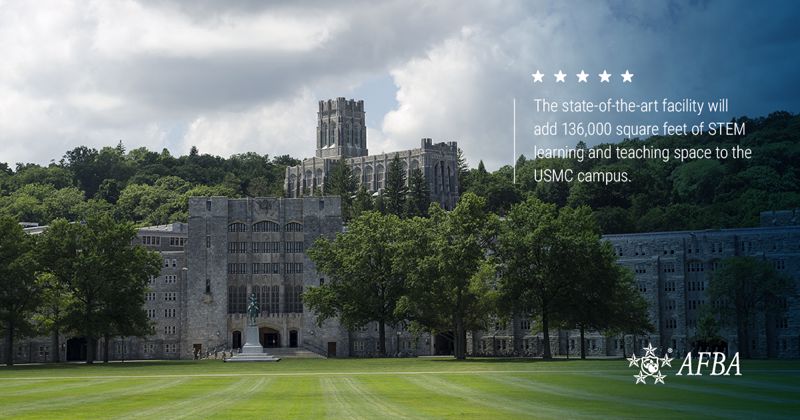
The state-of-the-art facility will add 136,000 square feet of STEM learning and teaching space to the USMC campus. To prepare the site, 300,000 cubic yards of granite must be carefully removed without disturbing the surrounding academic buildings and barracks.
A groundbreaking ceremony was held on Dec. 11, 2020 — just one week after the bid was awarded. The project is slated for completion by December 2024, and is expected to support the attraction of new talent to West Point over the next several years.
The importance of STEM education for the battlefields of the future
In an increasingly digital era that presents many new and yet unknown vulnerabilities, the Army and the nation must be prepared with cutting-edge technological skills.
According to the U.S. Army Corps of Engineers' request for proposals, the CEAC will play a critical role in "enabling USMA Cadets to experiment and develop new and emerging technologies that will enable the United States Military to remain at the technological forefront of new battlefields, both physical and digital."
"The facility will profoundly and positively impact our mission to develop our graduates who will lead with character in a changing, uncertain and technology-driven world," said Brig. Gen. Cindy Jebb, Dean of the Academic Board, when CEAC broke ground. "We are thrilled that it will serve to attract quality talent across cadets, faculty and staff in an increasingly competitive higher ed landscape."
Around the country, the holiday season is looking different than it has in years past. Up and down shopping districts, the gift-buying rush is tempered by social distancing measures and capacity limits for small retailers. Droves of consumers have chosen to place orders from ecommerce retailers instead, overwhelming delivery service providers. Families and friends are opting for smaller, more intimate gatherings over large celebrations.
However, during the ongoing COVID-19 pandemic, it's not quite so easy for first responder families to wait in line or shop online at their leisure. That's why the First Responder Children's Foundation has launched a Toy Express program to send more than 250,000 free gifts and face masks to children of emergency response workers.
Supporting first responder families through difficult holiday seasons
The First Responders Children's Foundation was established after 9/11, when hundreds of families were faced with the prospect of celebrating Thanksgiving after losing a loved one in the line of duty. The organization arranged a Thanksgiving Day Parade Breakfast for more than 800 children and family members.
As the foundation explains, this "began an annual tradition of welcoming devastated first responder families into a supportive environment to face the challenges of the start of a holiday season without a loved one."
This year, as countless first responders work tirelessly on the front lines of the pandemic, the First Responders Children's Foundation aims to add some comfort and joy to what's sure to be a difficult holiday season.
"Toy Express will help make a happy holiday for the children of our first responders which include nurses, firefighters, police officers, EMTs, paramedics, medical personnel and 911 dispatchers." said the organization's president, Jillian Crane, in a news release. "Our first responders are on the frontlines of the pandemic, and they continue to risk their own health every day in selfless service to their local communities across the country."

More than $1 million worth of toys donated
Although large in-person gatherings are not feasible this year, the First Responders Children's Foundation is still spreading holiday cheer to first responder families. It's all happening through partnerships with toy brands, mask manufacturers, logistics companies and families around the country who have made a donation.
The foundation's Toy Express is fueled by a donation of more than $1 million worth of toys from Mattel, including 5,000 American Girl Dolls, plus products from beloved Mattel brands like Hot Wheels, Barbie dolls and Mega Bloks. Other partners helping provide gifts and masks include Toys for Tots, Hess Toy Truck, Jakks Pacific, MaskUSA.com and Good360.
Logistics and transportation companies including CSX and Total Quality Logistics are also backing the program and helping ensure that the donated toys and masks quickly make their way to children around the country.
Toy Express to distribute gifts across more than 80 cities
The organization is spreading generosity and holiday cheer across 84 cities, partnering with local businesses and community organizers. For instance, in Saugerties, New York, more than 800 bags of toys, along with wrapping paper and donated food items, were passed out to first responder families.
"It wasn't just one or two gifts […] — each child received a bag of toys," said Macy Siracusano, vice president of Sawyer Motors, a business that partnered with the foundation to bring the Toy Express to local families. While children of all ages were welcome, "the intention of this was to help the parents for Christmas morning," Siracusano told a local news outlet.
"I think the way everyone was happy and appreciative, that's what makes it all worthwhile," she added. "It makes us want to do it again and again and again."
Members of the public who are interested in contributing to the toy drive or supporting the nonprofit can visit 1stRCF.org or text "TOY" to 24365.
So you're making your list and checking it twice — but you're still stumped on holiday gift ideas for the military servicemembers in your life. Not to worry! We've put together a roundup of seven military-friendly finds your loved ones will enjoy.
1. Handmade challenge coin display
Throughout their military career, your loved one may have collected quite a few challenge coins. What better way to celebrate their accomplishments than to gift them a handsome challenge coin display. From small desk decorations to large wall displays, browsing the selection of handcrafted challenge coin displays on Etsy will show that there are many different ways for the person on your list to showcase their one-of-a-kind collection.
2. Personalized stationery kit
This is a chance to put together a festive gift basket that's functional, too. In your stationery kit, you can include nice-quality letters and envelopes, as well as a set of USPS stamps honoring military working dogs. You can also customize return address labels with your loved one's location and their branch's official emblem. Consider adding in a rugged military-ready pen, or a more formal writing utensil engraved with a special message. Whenever there's something to write home about, the military servicemember in your life will appreciate the convenience of having everything they need all in one place.
3. Tough tumbler and coffee from a veteran-owned brand
A hot cup of joe can help warm up even the coldest, earliest morning. Pick up a bag of coffee grounds from a veteran-owned and operated coffee company. Popular brands include Victory Coffee, founded by a former Navy SEAL, or Black Rifle Coffee Company, established by an Army Special Forces veteran. Pair that with a durable coffee tumbler and your gift is all set for sipping — just add water!

4. Custom military ring
If you're looking for an extra special holiday gift idea for the military servicemember in your life this year, consider ordering a personalized military ring. Whatever branch they serve in, you can find a corresponding ring style and customize the design with the decorative detailing, gemstone and precious metal of your choice. Military rings can even be engraved with a name, date or other meaningful inscription. The one you choose is sure to become are modern family heirloom, cherished for years to come.
5. Military travel guide
Satisfy your servicemember's wanderlust by gifting them a 2021 military travel guide. Options include guides of popular destinations around the U.S., top camping spots and even overseas travel options. This kind of guide book can be helpful for servicemembers and military families who want to make the most of their free time. With all the planning in place thanks to your gift, they can embark on an exciting adventure as soon as it's safe to do so next year.
6. Tablet with durable case
A tablet can be a great, multipurpose piece of technology for a servicemeber on active duty. It's an all-in-one tool that's useful for getting work done on the go, joining video chats with friends and family, winding down with an e-book and everything in between. The larger screen size makes a tablet a nice alternative to a smartphone for a little less eye strain, and the compact size makes it even more portable than a laptop. There are plenty of popular tablets on the market. Whichever you choose, pair it with a rugged case and screen protector to keep it protected in all environments.
7. Tactical socks
Combat boot blisters are no joke. Since the military servicemember on your gift list spends long hours on foot, a pair of comfy, cozy socks will surely bring a smile to their face. Compare some of the best boot socks for the military and you're sure to find a perfect fit.
In its never-ending mission to improve cybersecurity best practices, the U.S. Department of Defense (DOD) published an interim rule in September 2020 on its Cybersecurity Maturity Model Certification (CMMC). The CMMC rule creates a framework for the DOD to more effectively assess the cybersecurity implementation of government defense contractors. The CMMC will also enhance the protection of unclassified information within the DOD supply chain.
Because of these new requirements, prime contractors and subcontractors need to become third-party certified by Nov. 30, 2020, if they wish to continue doing business with the DOD.
"[An] estimated 7,500 companies will be certified in 2021," said Katie Arrington, chief information security officer in the Office of the Undersecretary of Defense for Acquisition and Sustainment. "That doesn't seem like a lot but if you think about the interconnectivity of the [defense industrial base] it's a certification that's good for all DOD contracts for three years."
While the full roll-out of CMMC will take place over the course of five years, contractors need to start moving forward with getting certified quickly.
Breaking down CMMC best practices
The CMMC interim rule falls under the Defense Federal Acquisition Regulation Supplement (DFARS) clause 252.204-7012, Safeguarding Covered Defense Information and Cyber Incident Reporting. The clause requires contractors and subcontractors to implement the 110 security controls set forth in National Institute of Standards and Technology (NIST) Special Publication (SP) 800-171 on "any information system that processes, stores or transmits Controlled Unclassified Information."
The new rule creates a new NIST SP 800-171 Assessment requirement for DOD procurement contracts awarded after Nov. 30 that exceed $10,000. The NIST Framework is segmented into five buckets, or functions: identify, protect, detect, respond and recover.
Even following a successful assessment, certification and authentication process, contractors must keep reviewing and logging activities for rapid detection. Maintaining compliance will involve continuous system monitoring and regularly upgrading necessary safeguards to protect against malicious IPs, coordinated cyberattacks and common web exploits.
Depending on the type of work being contracted, organizations will need to meet varying levels of security requirements, listed as Levels 1 through 5. Level 1 is the least stringent while Level 5 is the most strict:
- Level 1: Performed. This is where documentation of practices begins.
- Level 2: Documented. With documentation in place for all levels, draft a policy that covers all activities.
- Level 3: Managed. A plan exists to cover all activities, which is maintained and resourced.
- Level 4: Reviewed. Activities are reviewed and measured for effectiveness, with the results of the review shared with higher level management.
- Level 5: Optimized. Following the review and measurement, a standardized document approach is implemented across all applicable organizational units.
In each level, all practices must be documented, including those that fall under lower levels.
For this certification, DOD defines "activities" as the organization's mission, goals, project plans, resourcing strategy, training needs and the involvement of relevant stakeholders. The practice progression lists Level 1 companies as having basic cyber hygiene, Level 2 with intermediate cyber hygiene, Level 3 with good cyber hygiene, Level 4 as proactive and Level 5 as advanced and progressive with their cybersecurity practices.
For those federal contractors looking to maintain their government defense contracts, it would be wise to invest in visibility, protection and rapid detection technologies. Contractors and subcontractors can review the associated Federal Register page to find out additional information about this new interim rule, such as expected cost impact.
Around the world on Nov. 25, first responders, humanitarian aid groups and activists come together in recognition of the International Day for the Elimination of Violence Against Women. An important part of this observance is raising awareness about actions that perpetuate violence against women and girls. One of these is human trafficking.
First responders play a vital role in identifying, protecting and supporting human trafficking victims. Let's examine what first responders can do to help stop human trafficking.
Who are the victims?
Due to the illegality of human trafficking, it's difficult to get an accurate number of the number of victims impacted, although experts estimate that between 18,000 and 20,000 people are trafficked into the U.S. each year.
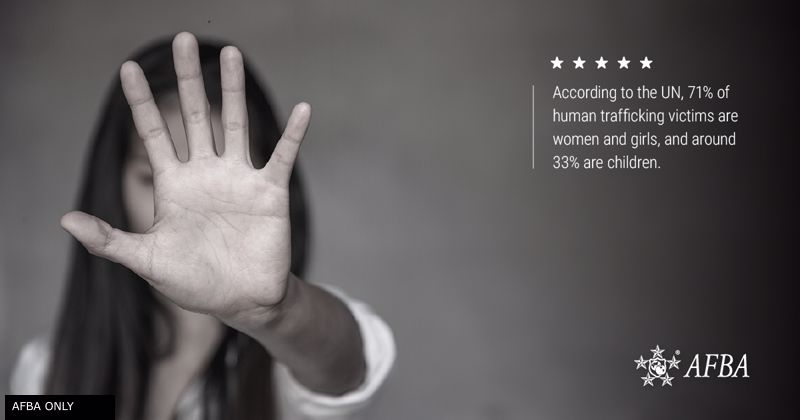
While human trafficking can impact anyone, regardless of age, race, gender identity, sex, ethnicity, nationality, immigration status or socioeconomic class, women are the most common victims. The United Nations Office on Drugs and Crime (UNODC) reported that 71% of human trafficking victims are women and girls, while around 33% are children.
Identifying the signs and alerting authorities
People working on the front lines, such as law enforcement officers, emergency medical technicians (EMTs) or hospital staff, are in a unique position to be able to identify these instances and report them to the proper authorities.
For example, the Department of Homeland Security created the Blue Campaign, an initiative that aims to foster collaboration between first responders and non-government and government entities.
The Blue Campaign noted that, since human trafficking often hides in plain sight, it's important to know how to recognize the signs of a potential victim. While many people might associate trafficking with the sex trade, victims are also forced to work in private residences, on farms, in the hospitality industry and in the health and beauty services industry.
Some red flags to watch for include, but are not limited to:
- Work conditions: A victim of human trafficking may be experiencing verbal or physical abuse from a boss, working excessively with minimum or no pay or living where they work. They might also be forced into illegal work, such as fraudulent activities or commercial sex acts against their will.
- Behavior: A victim may act fearful, agitated, nervous or anxious around a particular person. They might defer answers to this person, or let the other person speak for them.
- Physical state: In addition, a human trafficking victim might show signs of physical or sexual abuse, such as bruises, cuts and other injuries they may not explain. They might also appear malnourished, sleep deprived, lacking medical care or living without essential personal possessions.
Conversely, some signs of a potential trafficking offender include, but are not limited to:
- Restrictions: A trafficker might place severe restrictions and limitations on the actions, movements and personal time of the person they have trafficked. For instance, they might prevent this individual from seeing family or friends, disallow access to a telephone or social media or stopping them from going to their regular work or school.
- Threats: A human trafficking offender might make threatening statements to a victim or constantly keep the victim under a watchful eye.
- Unsafe housing: A trafficker might house their victims in unsafe and unsanitary conditions. This also includes housing a large group of people in one place with poor conditions and limited space.
No single one of these examples represents definitive proof of human trafficking, but these are often common indicators that it is happening. If one of these signs does show up during an ambulance ride, hospital visit or emergency response call, it's important that first responders take a moment to ask follow-up questions and survey the situation more carefully.
If, after more scrutiny, you suspect someone is a victim or a perpetrator of human trafficking, contact the National Human Trafficking Hotline to connect with services and support or to make a report.