
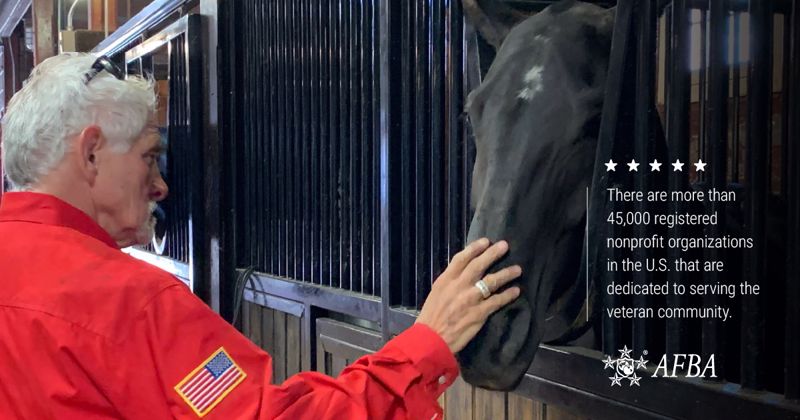
According to GuideStar, there are more than 45,000 registered nonprofit organizations in the U.S. that are dedicated to serving the veteran community. With so many groups doing good, veterans and their families may not be aware of all the services, support and resources available through these nonprofits.
Here is a small introductory handful of the esteemed nonprofits for veterans:
Children of Fallen Patriots Foundation
As a way to honor the fallen and support future generations, this organization helps provide educational counseling and college scholarships to children whose parents have made the ultimate sacrifice in service to our country.
Esposas Militares Hispanas USA Armed Forces
What started as a Facebook group of military spouses soon became a nonprofit organization committed to serving Hispanic military and veteran families by offering helpful resources and information in Spanish.
Give an Hour
This national network of volunteer mental health professionals provides free services to active-duty military personnel and veterans. Give an Hour also advocates for changing the culture around mental and emotional well-being and treatment.
Hire Heroes USA
To help military members transition into civilian life and employment, Hire Heroes USA offers job search support and career assistance to veterans and their spouses.
Honor Flight Network
This nonprofit's mission to support veterans of World War II, the Korean War and the Vietnam War entails flying these veterans out to visit the memorials erected in remembrance of those who served.
Hope For The Warriors
This service organization supports a variety of programs for veterans and military families. These are designed around wellness, peer engagement, recreation, and transition to civilian life.
Operation Gratitude
Since the early 2000s, Operation Gratitude has delivered more than 2.6 million care packages to members of the military, veteran and first responder communities.
Operation Homefront
This nonprofit for veterans helps families secure rent-free transitional housing, financial assistance for homebuying and caregiver support services.
Operation Second Chance
This organization serves ill, injured and wounded combat veterans. Volunteers identify immediate needs and offer support through hospital visits, counseling resources, scholarships, retreats and more.
Operation Troop Appreciation
Active-duty and veteran members of the armed forces have their wish lists fulfilled by morale-boosting gifts from Operation Troop Appreciation. The organization also supports transitional housing and distributes letters of gratitude.
Reel American Heroes Foundation
Partnering with military hospitals and bases, this cleverly named nonprofit provides wounded veterans and service members with recreation therapy through fishing trips and duck hunts.
United Service Organizations
Perhaps one of the most well-known nonprofits for veterans and active-duty servicemembers, the USO supports a broad range of programs and resources, from transitional assistance to entertainment and community building.
Veteran Tickets Foundation
Vet Tix distributes free event tickets to veterans and their loved ones, promoting stress-free opportunities for family bonding, memory-making and community engagement.
Vietnam Veterans of America
The VVA advocates for veterans' issues including health care access, public opinion and perception, POW and MIA accountability, and more, specifically focusing on supporting veterans of the Vietnam War.
Wounded Warrior Project
This nonprofit for veterans serves those who have experienced a physical injury or mental illness as a result of their post-9/11 military service. The organization sponsors a wide range of programs focused on recovery and empowerment.

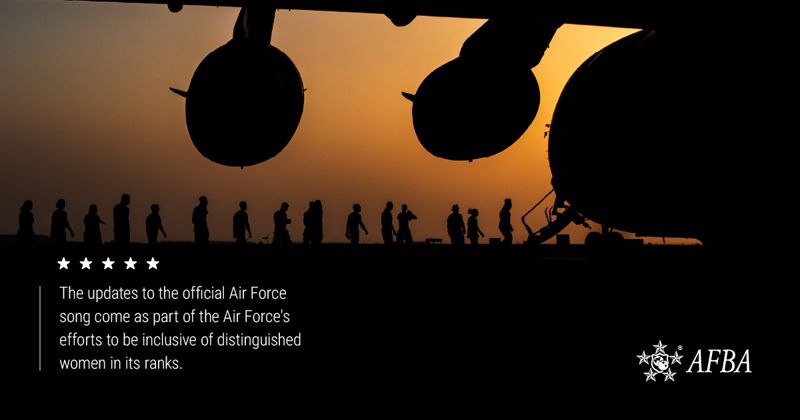
Lyrics to the official Air Force song that formerly recognized the contributions of male airmen only have been rewritten to be gender-neutral. This change comes as part of the Air Force's efforts to be inclusive and to acknowledge the distinguished women airmen in its ranks.
Updates made eighty-one years after the song's initial composition
The song is officially titled "The U.S. Air Force" but is more commonly known by its first line, "Off we go, into the wild blue yonder."
It was originally written to help establish a sense of camaraderie and identity for the U.S. Army Air Corps in the late 1930s. Since the Corps did not have the budget to commission such as song, the publisher of a magazine called "Liberty" established a songwriting contest in 1938 with a $1,000 prize. The winning submission came in a couple of days before the final deadline from a musician and civilian pilot, Robert M. Crawford. Too young to enlist during World War I, he later flew for the U.S. Army Air Forces' Air Transport Command during the Second World War.
This is not the first time the song has been modified in its 81-year lifetime to better reflect the force and its servicemembers. Before the Air Force was its own independent branch, the song was titled "The Army Air Corps." It was changed to "Army Air Forces" during World War II, and the title and lyrics were rewritten once again in 1947 upon the establishment of the U.S. Air Force.
"Off we go, into the wild blue yonder" is also the U.S. Air Force Academy's official school song and is frequently sung at sporting events and during graduation ceremonies. According to Air Force Times, the U.S. Military Academy at West Point and the U.S. Naval Academy already modified their lyrics over a decade ago to better reflect the presence and contributions of women cadets.
Half a dozen gendered reference rewritten
After a series of updates that began in February 2020, half a dozen changes have now been made across the song's four verses. In the popular opening verse, "At 'em boys" is now "At 'em now, give 'em the gun." In the second verse, the phrases "Minds of men," "Hands of men" and "Souls of men" have been updated to create three updated lyrics:
- "Brilliant minds fashioned a crate of thunder."
- "Valiant hands blasted the world asunder."
- "Boundless souls dreaming of skies to conquer."
In the third verse, the lyric formerly ending in "of his brother men who fly" now goes, "To a friend we send a message of the brave who serve on high." Additionally, "men" has been changed to "those" in the verse's triumphant conclusion, "A toast to the host of those we boast, the U.S. Air Force!" And, in the final verse, "Flying men" has been removed in favor of "Fly to fight, guarding the nation's border."
Gender-neutral lyrics acknowledge that one in five airmen are women
According to Air Force demographic data, women could first begin pilot and navigator training in 1976 and 1977, respectively, and were not able to complete fighter pilot training until 1993. Nowadays, approximately one in five Air Force active-duty servicemembers are women — 68,470 women airmen total, as of January 2020. Among them, 806 serve as pilots; 347 are navigators, and 233 are air battle managers for Air Force.
Although the name given to servicemembers — airmen — remains awkwardly gendered, the Air Force considers this a step in the right direction.
"These new lyrics speak more accurately to all we do, all that we are and all that we strive to be as a profession of arms," Air Force Chief of Staff Gen. David L. Goldfein said in a news release. "They add proper respect and recognition to everyone who serves and who has served."
NASA’s SpaceX Falcon 9 launch on May 30, 2020, drew a significant amount of attention. With roughly 10.3 million people streaming the coverage at peak viewership, the event has become NASA’s most-viewed online event.
While astronauts Bob Behnken and Doug Hurley prepared for their journey inside the SpaceX Crew Dragon capsule to the International Space Station, all eyes were on their futuristic apparel. Here, we’re exploring the inspiration, design development and engineering behind the new spacesuits worn by the Dragon crew during the recent launch.
 “The appearance of U.S. Department of Defense (DoD) visual information does not imply or constitute DoD endorsement.”
A new mission symbol
“This [SpaceX] suit is significantly different than the suit we wore on shuttle,” Hurley said during a prelaunch press conference. While participating in earlier NASA space shuttle flights, he previously wore what’s been called the “pumpkin suit” due to its bulky, bright orange appearance.
Behnken noted that SpaceX’s idea was to “reach back and [bring forth] a retro styling or a different way of creating their own unique kind of mission symbol [rather than] copy what was done on the space shuttle side.”
Comparing the pumpkin suit to the sleek new design, Behnken added, “Both of [the suits] have succeeded, I think, in terms of becoming iconic [and] symbolizing the mission in front of us, and the excitement associated with what we’re going to accomplish.”
Superhero suits for space
The iconic new suits were dreamt up by Hollywood costume designer Jose Fernandez, who has designed superhero costumes for films including “The Avengers,” “The Fantastic Four,” “Batman v Superman” and “X-Men II.”
According to an article in The New York Times, “Elon Musk’s SpaceX Suit Is Like a Tuxedo for the Starship Enterprise,” SpaceX founder Musk approached Fernandez and other designers rather than the usual military uniform contractors. Together they fine-tuned the design and then had experts reverse-engineer it to work for the spaceflight setting.
The shape and style of the articulated, structured suits were partly inspired by the tuxedo, a garment that makes its wearer look instantly better by offering padded shoulders and tapered seams that visually sculpt a more muscular-looking torso.
Additionally, the suits recall the futuristic fashions of the 1960s, when, inspired by the sleek Space Age aesthetic, couture designers dressed models in ultra-cool ensembles featuring clean lines, minimalist detailing and lots of white and silver.
Wearable tech in orbit
Even though the spacesuit creators reached back into the canon of visual culture and design history to determine its appearance, the cutting-edge technology and engineering the design represents — as well as the new era of privatized space travel — are incredibly forward-looking.
While they are not intended for lunar walks, NASA explained that the custom-made suits were “designed to be functional, lightweight, and to offer protection from potential depressurization. A single connection point on the suit’s thigh attaches life support systems, including air and power connections.” The custom 3D-printed helmets include similar integrated technologies and microphones.
Scientific American has reported that this new “public-private partnership business model” has saved NASA up to $30 billion on directing contractors to develop new spacecraft and related technologies. The arrangement also allows aesthetics to take center stage.
“As long as space travel was being subsidized by governments, there was no need to make the suits attractive, as the astronauts’ safety was the sole concern,” sci-fi scholar Gary Westfahl told The New York Times. “Yet, if space travel is going to become an activity of private companies seeking profits, they have a natural interest in making their astronauts seem attractive.”
The spacesuits represent a novel hybrid of past and present, fashion and function — and they demonstrate all the best in wearable technology. As Cathleen Lewis, curator of spacesuits at the Smithsonian Institution’s National Air and Space Museum, said in The New York Times, “It’s smart branding because it signals we are starting a new age.”
The month of June is a time for recognizing and raising awareness about posttraumatic stress disorder (PTSD).
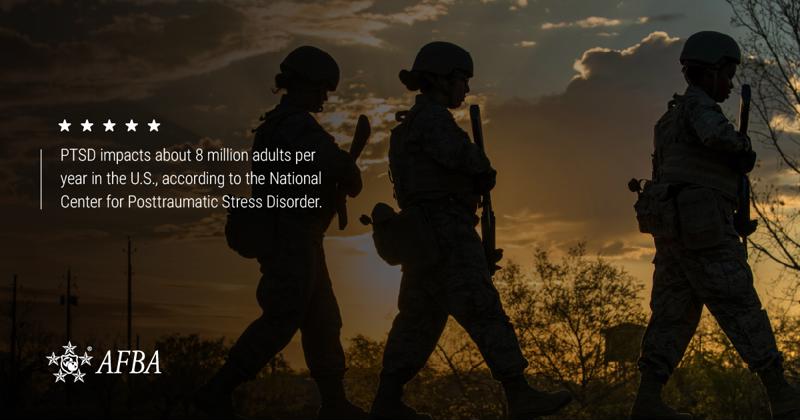
Military servicemembers, veterans and first responders are among the many people whose work exposes them to traumas that can lead to PTSD. This mental health issue impacts about 8 million adults per year in the U.S., and roughly 7-8% of the population will experience PTSD throughout their lives, according to the National Center for Posttraumatic Stress Disorder (NCPTSD), part of the U.S. Department of Veterans Affairs (VA).
 “The appearance of U.S. Department of Defense (DoD) visual information does not imply or constitute DoD endorsement.”
What is PTSD?
The NCPTSD defines PTSD as “a mental health problem that some people develop after experiencing or witnessing a life-threatening event, like combat, a natural disaster, a car accident, or sexual assault.” When a traumatic event causes prolonged symptoms and disruptions in a person’s life, it may be a sign of PTSD.
Experiencing all of the following symptoms would lead a mental health care provider to issue a PTSD diagnosis, according to the NCPTSD:
- Avoiding situations, places and experiences that could recall the traumatic incident.
- Reliving the incident through unwelcome memories and invasive flashbacks.
- Increasingly experiencing negative feelings like sadness, numbness, shame and lack of interest or trust.
- Feeling on edge or hyperaroused and being irritable or unable to sleep or focus as a result.
Anyone experiencing even one of these symptoms can benefit from speaking with a mental health professional.
What is PTSD treatment like?
Treating and overcoming PTSD can be mentally and emotionally draining, and many individuals experiencing symptoms may not feel ready to begin. However, the sooner they start working through therapeutic treatment, the more quickly they can move forward from the traumatic incident and find relief.
It is also important to note that there is nothing wrong or embarrassing about seeking out help for mental health conditions such as PTSD. Anyone experiencing tooth discomfort would visit a dentist who has the right training, tools and outside perspective to see inside their client’s mouth, pinpoint the cause of pain and begin the healing process. In the same way, anyone experiencing the disruption and pain of posttraumatic stress can enlist the help of a therapist who possesses the right training, tools and outside perspective to see into their client’s heart and mind and begin the healing process.
During trauma-focused psychotherapy or cognitive behavioral therapy, a client and therapist typically meet for about an hour and discuss the traumatic event, working from specific treatment goals. According to the Anxiety and Depression Association of America (ADAA), effective treatment methods include:
- Cognitive processing therapy: By exploring the feelings, thoughts and emotions they are left with in the wake of a traumatic incident, individuals with PTSD can work to rewrite those thought patterns.
- Cognitive restructuring therapy: By reexaming what actually happened during the event, versus what memories remain, individuals can overcome feelings of guilt, shame and responsibility for the traumatic incident.
- Prolonged exposure therapy: By revisiting the traumatic memory, individuals with PTSD can explore their emotions and reduce the overpowering impact of that memory so it no longer causes a disruption in their daily life.
- Stress inoculation training: By practicing new ways to manage posttraumatic stress and emotions, individuals can better cope with their symptoms. This treatment is often used in conjunction with other therapies.
- Eye movement desensitization and reprocessing therapy: By exploring negative emotions and memories while focusing on specific visual or audible cues, individuals can change how they respond when those memories resurface.
- Present centered therapy: By examining current experiences rather than the trauma itself, individuals can witness the impact of that incident on their present-day life and work to better manage those issues.
- Prescription medication: A psychiatrist may prescribe medication as part of treatment to provide their clients experiencing PTSD with more of the stress-management chemicals their brain is lacking.
The NCPTSD PTSD Decision Aid is a helpful tool for those who want to learn more about treatment options and consider which one might be the right fit.
The oldest and most senior branch of the United States military in order of precedence, the U.S. Army actually predates the U.S. itself. Congress established the First Continental Army on June 14, 1775, more than a full year before the signing of the Declaration of Independence, to recruit professionally trained soldiers that could combat the British “Redcoats” in the Revolutionary War.
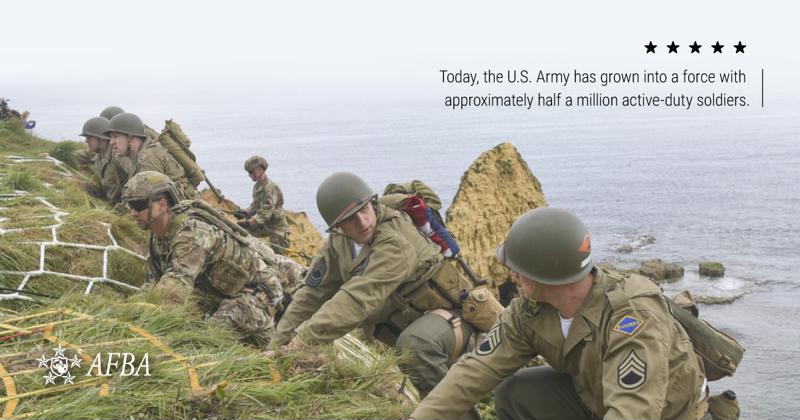
In the centuries since then, America’s Army has grown into a fighting force with approximately half a million active duty soldiers. And on Sunday, June 14, 2020, the U.S. Army will observe its 245th birthday, affording military servicemembers and civilians alike an opportunity to celebrate the branch’s rich history and continued role as a force for good in the world.
How to celebrate the U.S. Army’s birthday in 2020
Celebrations of the U.S. Army’s birthday will look much different this year due to the current pandemic. The Army’s birthday is not an official state or federal holiday, meaning government offices and private places of business remain open on June 14th, while Army and Department of Defense agencies typically choose to celebrate the occasion at the base or local level with special events, ceremonies, and social occasions. Additionally, a wreath will be laid at the Tomb of the Unknown Soldier in Arlington, Virginia, in celebration.
The USO, AMVETS, The American Legion, VFW, and other military service organizations also usually observe the holiday on a local or agency-wide level each year. If you would like to know if and how the birthday is being celebrated in your community, you can reach out to the local chapter of your preferred Veterans Service Organization.
One unique annual celebration is the Army Birthday Ball, which is usually held at military bases, community centers, civilian hotels, and other applicable sites around the world. This black-tie formal event features military members in full-service dress, also known as “Dress Blues” or “Mess Dress,” and includes a long list of traditions that are intended to pay respect to those who sacrificed life and limb to serve and to welcome the newest members of the service and salute the future of the Army at large.
 “The appearance of U.S. Department of Defense (DoD) visual information does not imply or constitute DoD endorsement.”
In that spirit, one of the most popular traditions at the ball is the cutting of the Army birthday cake, in which the oldest serving soldier and the youngest serving soldier use a ceremonial saber to cut the first slice. Another common tradition is the receiving line, in which Army leaders personally greet each attendee entering the ballroom, and the giving of toasts to the United States, military families and to fallen comrades, the latter toast one that is always respectfully answered in silence.
This year, the 245th U.S. Army Birthday Ball was due to be held in Washington D.C. Saturday, June 13. Due to coronavirus, however, the event has been canceled.
Additionally, private citizens can always organize events in their own community or find ways to celebrate with friends and family. The 245th anniversary of the U.S. Army provides a wonderful opportunity to both reflect on the centuries of sacrifice that have come before, and celebrate the bright future that lies ahead for America’s fighting force.
Government contracting roles, such as contract officer and contract specialist, can be challenging and rewarding careers. However, students and emerging professionals may not be familiar with the primary responsibilities, job requirements or internship opportunities related to this field. Read on to learn how to prepare for and find work as a contracting professional.
What do contract officers and specialists do?
The Federal Acquisition Institute (FAI) defines the contract officer (CO) as "a person who can bind the Federal Government of the United States to a contract. Contracting Officers hold a warrant that allows them to negotiate on behalf of the United States Government. As the Government's agent, only COs may execute, modify, or terminate a contract."
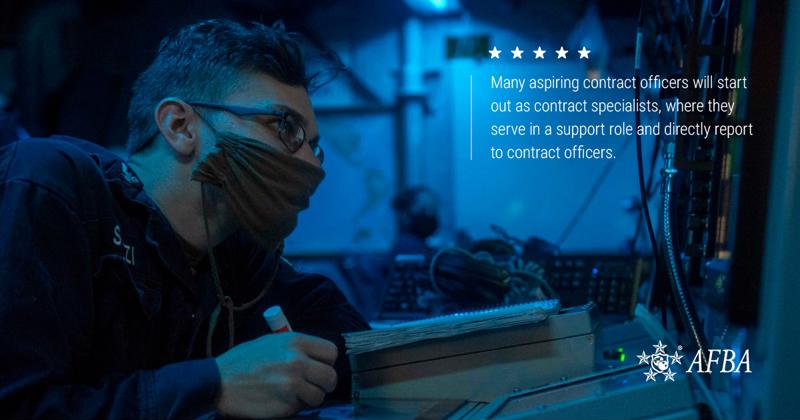
Many aspiring contract officers will start out as contract specialists, where they serve in a support role and directly report to contract officers. Both are civilian roles within the federal government's acquisitions workforce, which is responsible for procuring and selling goods and services on behalf of government agencies. These goods and services may include everything from new information systems, aircraft and military vehicles to cutting-edge research, uniforms and office supplies.
The FAI explains that contract officers are responsible for selecting vendors and overseeing that contractual agreements are legally compliant, appropriately funded, fair and impartial. It is also a CO's job to ensure that contracts are providing maximum value and that taxpayers' money is being responsibly spent.
While the role largely involves contract negotiation and administration, contracting professionals also have the chance to meet with vendors, view and assess the types of products and services under consideration, and gain hands-on experience related to the agencies and programs they are working to support. As a result, some travel may be involved. The FAI explains that contracting professionals are needed throughout the U.S. and overseas, where they are employed by essentially all government agencies and programs, including the branches of the armed forces.
Contracting careers can be professionally rewarding and well-compensated. According to Glassdoor, COs typically make between $57,000 and $128,000 per year, with average earnings of roughly $90,000.
How can someone become a contract officer or specialist?
Students who wish to apply for internship opportunities in contracting can learn more about available internships through the FIA website. Opportunities include government-wide internships like Pathways Program as well as agency-specific programs such as the Department of Homeland Security's Acquisition Professional Career Program (APCP) or the Department of the Navy's Naval Acquisition Development Program (NADP).
Full-time contract officer and specialist positions are advertised through the federal government's career portal, USAjobs.gov. Anyone interested in searching for and applying to these roles will likely need to go through this portal.
According to the FIA, a prospective contracting professional should hold a bachelor's degree. An advanced degree may also be desirable or required for certain positions. The CO role is classified as an 1102 position in the Contracting Series by the U.S. Office of Personnel Management, so prospective candidates should review the specific qualifications.
Applicants interested in a contracting career should generally possess some educational or professional experience in the following subjects:
- Contracts.
- Law.
- Business.
- Accounting.
- Finance.
- Economics.
- Quantitative reasoning.
- Supply chain management.
- Industrial distribution.
- Marketing.
- Market research.
- Communications.
To be successful in a contracting career, one should possess strong communication skills, analytical abilities, and a penchant for problem-solving which will be important in cost analysis, contract negotiation and other administrative duties. COs typically operate in team environments, so collaboration is key as well. Professionals in the contract specialist and contract officer positions are constantly learning and participating in agency-specific training programs.

According to the Department of Defense, there were 1.3 million members of the armed forces as of March 2020. A recent study dives deeper into who these people are, where they come from and how popular beliefs about their origins and reasons for enlisting may be further off than many might think.
 “The appearance of U.S. Department of Defense (DoD) visual information does not imply or constitute DoD endorsement.”
Widely held misconceptions
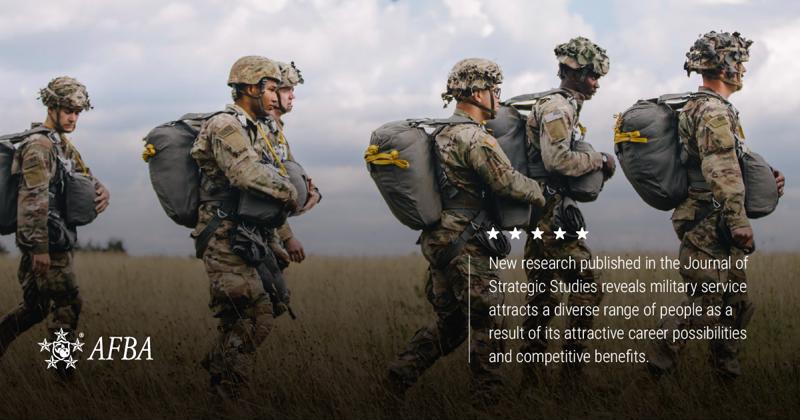
Since service in the armed forces became voluntary in 1973, after the draft was abolished, many Americans believed it would attract primarily disadvantaged groups and young people with limited prospects. However, new research published in the Journal of Strategic Studies reveals that this stereotype does not reflect reality. The study shows that military service attracts a diverse range of people as a result of its attractive career possibilities and competitive benefits.
The study, titled “A mercenary army of the poor? Technological change and the demographic composition of the post-9/11 U.S. military,” debunks the myths that often permeate academic and mass media publications. It explains that many assume that the majority of enlisted personnel come from poor rural communities or economically disadvantaged urban environments, who see the armed forces as an “escape” or “sanctuary.”
As the researchers pointed out, this is not only a problematic stereotype, but it also implies that the demographic makeup of those out on the front lines is disproportionate to the U.S. population as a whole — hence the “rich man’s war, poor man’s fight” perspective.
Class-based conclusions
The researchers tested two assumptions. The first — the opportunity cost theory — “implies that individuals from more disadvantaged socio-economic backgrounds, lacking the skills to compete in the job market, have more to gain and less to lose from joining the military.”
However, according to their findings, the majority of recruits have in fact come from the middle class, with above-average levels of affluence. Contrary to popular belief, the poorest (and wealthiest) communities are underrepresented in the armed forces.
The study concludes that “men and women who serve are likely to embody the values and culture of the median voters. This affects not only the nature of the military itself, but also the calculations in terms of costs and benefits of democracies electing to go to war.”
Skill-related findings
The second assumption — the de-skilling hypothesis — suggests “that increasing reliance on advanced technology has relieved the military from employing highly skilled personnel, thus allowing for the recruitment of less talented individuals.”
On this point, the researchers found most recruits exhibited average cognitive skill levels. However, lower-income individuals with higher intelligence levels — and, by extension, better career prospects — were more likely to enlist.
The researchers conclude that the increased use of technology in the military has actually increased, rather than decreased, the need for highly skilled recruits. They argue that the continued sophistication and complexity of military tactics, tools, threats, and technologies have in fact raised the bar for the recruitment process.
These new understandings help “explain why the U.S. military has displayed high levels of military effectiveness in recent conflicts, an outcome that advanced technology alone cannot account for.”
That the U.S. military is not a last-resort employment destination but rather a selective employer offering attractive career opportunities suggests that each branch will need to maintain a competitive position in the job market. The researchers forecast additional spending, higher compensation and other incentives.
Countless small and local businesses are suffering from the impacts of lockdown orders in cities across the country. And yet, so many have found creative ways to give back to the frontline health care heroes and emergency response workers fighting the COVID-19 pandemic.
Read on to find out how local businesses around the nation are donating goods and services to first responders and health care workers responding to COVID-19.
 “The appearance of U.S. Department of Defense (DoD) visual information does not imply or constitute DoD endorsement.”
Making and donating essential items
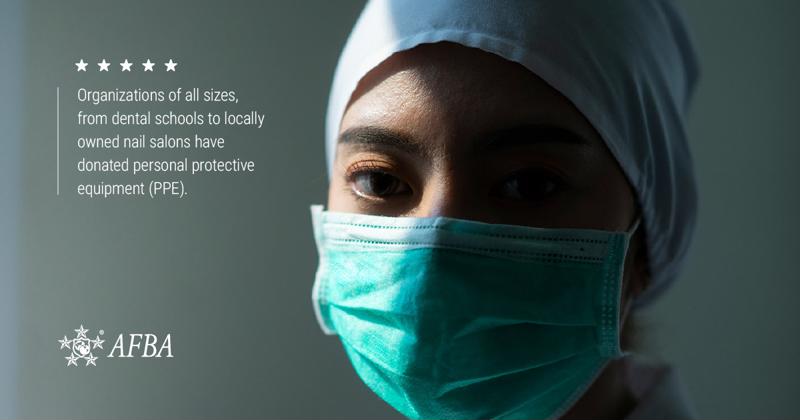
Organizations of all sizes, from dental schools to locally owned nail salons have donated personal protective equipment (PPE) — including N95 masks, gloves, gowns, face masks and other essential supplies — to health care workers and emergency response departments.
Companies with manufacturing facilities have switched over to produce in-demand supplies. For instance, nearly 800 distilleries have turned their attention from making small-batch spirits to creating and distributing hand sanitizer, according to the Distilled Spirits Council.
Offering free technologies and services
While many companies have been faced with workforce reductions and layoffs, numerous organizations are accelerating hiring and onboarding to bring more qualified professionals to the front lines of the coronavirus pandemic. To support these efforts, some HR companies are making their recruiting software and services free to these organizations, according to Human Resource Executive.
Similarly, companies in the mental health sector are offering free services like meditation app subscriptions to those facing the stressful workplace realities of COVID-19.
Sharing gifts of gratitude
Restaurants around the country are donating food and beverages to essential workers. Some bring balanced meals to those working long shifts, while others donate special treats like desserts and bottles of wine as a way to show gratitude. Dairy farms have also donated gallons of milk to local emergency workers and health care professionals.
Retailers that sell everything from comfortable walking shoes to fine jewelry are donating their products to workers out on the front lines, in an effort to make each day a little brighter. A spa franchise[located where] has invited its members to donate spa treatments that essential workers can redeem for some relaxation and renewal once the facilities re-open.
Even unexpected donations can make a big impact. For instance, a roofing company in Charleston, South Carolina has committed to constructing three new roofs on the homes of an EMT, nurse and police officer in its community. Actions like these show that it doesn’t really matter what a company does; as long as they approach the situation with a spirit of generosity and gratitude, they can find creative ways to lighten the load for those out on the front lines of the fight against the coronavirus.
Additional ways to give back
If you operate a local business — or wish to jointly support the small businesses and COVID-19 responders in your community — there are plenty of ways to give back in whatever ways you can. Consider the following ideas:
- Contact local health care organizations and first responder agencies to find out if they are accepting supply donations.
- Host a fundraiser and donate the proceeds to an organization in need of financial support.
- Announce a giveaway of the product or service you offer, and invite your customers to nominate emergency responders.
- Make your product or service available for free to those in desperate need.
- Purchase goods from companies that are donating funds or products for each purchase made.
- Buy gift cards from local businesses and donate them to first responders or health care workers in your community.
Additionally, saying “thank you” with a simple handwritten note or a banner in your front yard can go a long way to making those serving in your community feel your support.
Flyover salutes by the Navy's Blue Angels and Air Force's Thunderbirds are paying tribute to the essential workers, health care professionals and first responders serving in cities across the country in response to the COVID-19 pandemic. The two elite flight demonstration squadrons have flown individually and jointly over major and mid-sized cities hit hardest by the coronavirus outbreak.

Operation America Strong
President Trump announced the flyover plans during an April 22 press briefing, explaining, "We're paying tribute to our frontline health care workers confronting COVID. And it's really a signal to all Americans to remain vigilant during the outbreak."
Called Operation America Strong, the initiative is intended to salute those fighting on the front lines of the national emergency, while demonstrating a sense of national solidarity with those emergency workers.
"This is a tribute to them, to our warriors. Because they are equal warriors to those incredible pilots and all of the fighters that we have for the more traditional fights that we win," the President said. "Operation America Strong was the idea of our great military men and women — the Thunderbirds and the Blue Angels crews who wanted to show support to the American medical workers who, just like military members in a time of war, are fiercely running toward the fight."
Army and Navy unite for a collaborative salute
The Thunderbirds and Blue Angels first appeared together on April 28, when they flew over New York, New Jersey and Pennsylvania. Since then, they have appeared over Maryland, Connecticut, Delaware, Georgia, Texas and the nation's capital. The Blue Angels have completed flyover salutes over Florida and Louisiana, with additional visits anticipated from both demonstration squadrons.
In keeping with Department of Defense policy, the Blue Angels and Thunderbirds are not often seen together. "Each demonstration team showcases U.S. military aviation capabilities to the public separately to maximize Navy or Air Force recruiting efforts," the Blue Angels website explains. For this reason, the joint air demonstrations during Operation America Strong are especially rare and significant displays of national strength and unity.
"We are truly excited to take to the skies with our Navy counterparts for a nation-wide tribute to the men and women keeping our communities safe," said U.S. Air Force Lt. Col. John Caldwell in a Navy statement. Caldwell serves as Thunderbird 1 and the flyover mission commander. "We hope to give Americans a touching display of American resolve that honors those serving on the frontline of our fight with COVID-19," he added.
"We are incredibly honored to have the opportunity to salute those working on the frontline of the COVID-19 response, we are in awe of your strength and resilience," added U.S. Navy Blue Angels commanding officer and flight leader Cmdr. Brian Kesselring. "Thank you to all of those in essential industries keeping our nation moving forward. We will get through this. We are all in this together."
The demonstration squadrons typically participate in numerous air shows throughout the year, many of which have been canceled as a result of the pandemic. Each impressive, high-speed air display costs an estimated $60,000 — but funds for Operation America Strong has been drawn from already budgeted funds, the Washington Post reported.
While a complete schedule has not been announced, destinations and flight paths are being issued one day prior to each flyover. Citizens wishing to witness the flyover salutes in their cities are encouraged to remain in their homes, uphold social distancing measures and refrain from gathering in crowds.
On March 13, 2020, President Trump issued a national emergency declaration in response to the coronavirus outbreak. Since then, the efforts of state and federal agencies to keep the COVID-19 pandemic contained have had a range of impacts on contractors.
While navigating the ever-changing situation may prove challenging for many businesses, exploring some proven and potential results may help illuminate the path forward for those in government contracting.

Clarifying "essential business" status
National Defense advised contractors to be aware that they might not be considered essential simply because they are working to fulfill a federal contract. The outlet noted that state-mandated lockdowns may conflict with contractual obligations when both federal and state classifications remain relatively open to interpretation.
If they have not done so already, businesses should look for the Defense Federal Acquisition (DFA) Regulation Supplement Clause (252.237-7023) in their contracts. This clause states that businesses performing "mission-essential functions" can continue work — but it is essential to do so with all safety precautions taken.
Documenting excusable delays
Just because a national emergency has been declared, contractors are not automatically granted an excusable delay. Instead, any delay excuses must be well-documented and proven.
There is a Federal Acquisition Regulation force majeure clause stating that "the contractor shall not be in default because of any failure to perform this contract under its terms if the failure arises from causes beyond the control and without the fault or negligence of the contractor." Specifically, cited examples include "epidemics" and "quarantine restrictions."
However, contractors must identify precisely how these factors beyond their control impact contractually agreed upon delivery schedules. Once this is possible, it may be advisable to wait before settling on a new timeline, which may be difficult to identify given the continuing coronavirus-related uncertainty.
Accommodating DPA implications
The Defense Production Act (DPA) allows the president to bypass typical contract procurement procedures in an effort to obtain or initiate the manufacture of critical products and technologies. While it is unclear to what extent this authorization will be utilized, there may be some implications for contractors with manufacturing resources.
For instance, in March 2020, President Trump "require[d] General Motors Company to accept, perform and prioritize contracts or orders for the number of ventilators that the Secretary [of Health and Human Services] determines to be appropriate."
Writing for Lawfare, Harvard Law students Masha Simonova and Nathaniel Sobel explained that "the government could use this authority in the current pandemic to grant relief in the form of loans or loan guarantees to contractors who are facing lost profits or hardships as a result of complying with DPA orders."
Securing additional relief
In addition to possible DPA-related financial relief, contractors can turn to the FAR Changes Clause (52.243-1 through 52.243-4). If new direction from a contracting officer (CO) will hinder a vendor from completing their contracted services, the law firm Pillsbury has suggested "that the contractor make a timely request to its CO for a schedule extension."
Furthermore, Pillsbury has advised "separately account[ing] for the cost growth they experience as a result of the CO direction, in case they cannot reach an informal resolution and need to submit a claim for financial relief."
Essentially, it is critical for impacted government contractors to prioritize immediate and open communication with contracting officers and other stakeholders while maintaining detailed records of coronavirus-related impacts on contractual obligations. While attention and vigilance may not resolve the situation immediately, given the ever-changing nature of the ongoing pandemic, these actions can help contractors understand where they stand and may lead to securing much-needed financial assistance or schedule relief.