
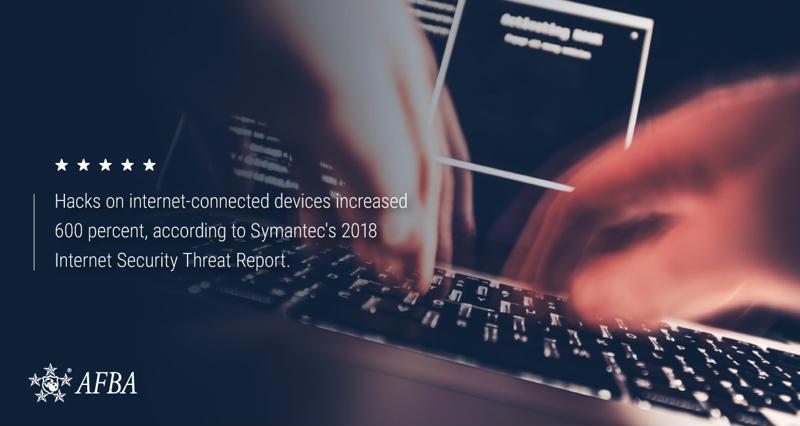
Cybersecurity attacks are getting increasingly sophisticated. According to Symantec's 2018 Internet Security Threat Report, the number and complexity of major hacks are growing. Hacks on internet-connected devices increased 600 percent, while crypotjacking (hacking a device to mine digital currency without the owner's knowledge or consent) grew a whopping 8,500 percent. Even mobile devices aren't safe, as targeted malware more than doubled.
This means that organizations of all types need to take cybersecurity seriously if they haven't done so already. The consequences can be dire, especially for government contractors.
Risks are on the rise
To understand how much damage could occur from a single hack – as well as the most likely threats – consider the recent news that hackers connected to the Chinese government stole 614 gigabytes of data from a private contractor.
As The Washington Post first reported, the target was a contractor working for the Naval Undersea Warfare Center, an organization that researches and develops underwater materials such as weapons and submarines. The contractor was not identified, but among the data stolen were plans for a supersonic anti-ship missile that would be added to U.S. submarines by 2020. Hackers also stole radio information, data from signals and sensors.
These details are bad enough, but what makes the situation most upsetting is the fact that the data stolen, when collected as a unit, could be considered classified but was stored on the contractor's unclassified network.
Unfortunately, this hack is not an isolated incident. A report from BitSight, a cybersecurity firm, found that a number of government contractors suffered data breaches between Jan. 1, 2016 and Feb. 1, 2018. While the actual percentages of contractors that disclosed one or more breaches are technically small – healthcare/wellness was the largest at 8.2 percent – even a small number of contractors could hold highly sensitive data that could be detrimental to the U.S. if it ends up in the wrong hands.
The report also noted that contractors fall far behind government agencies in terms of security. Interestingly, those in manufacturing, engineering and technology did worse than companies in business services, aerospace/defense and healthcare/wellness.
Protecting against security threats
Per The Washington Post, Defense Secretary Jim Mattis asked the Pentagon's inspector general's office to focus on cybersecurity issues affecting government contractors. Given these recent events, it's also a good idea for contractors to make sure they adhere to data security best practices.
BitSight identified several areas where contractors fail in that regard. For example, almost 20 percent of aerospace/defense and technology contractors use outdated internet browsers, which leaves them vulnerable to a number of different hacking strategies.
Here are a few simple ways contractors can start improving their security.
- Keep internet browsers and software updated: Developers constantly release new versions that protect against known security issues. Using outdated browsers and software leaves contractors unprotected against the latest threats.
- Train employees on common cybersecurity risks: Contracting staff should know never to give their credentials to an unauthorized party. They should also be trained to spot hackers pretending to be reputable organizations in order to access sensitive information, a technique known as phishing.
- Limit access to sensitive data: Only a handful of people should be able to view classified data.
- Terminate user sessions after a set period of inactivity: This way, unauthorized users are less likely to see classified information.
- Secure wireless access with encryption and authentication: This can prevent unauthorized users from spying on contractor networks.
- Encrypt data: If hackers manage to access a network, encrypting any data transmitted makes it harder for them to decipher information.
For more information, government contractors should visit the National Institute of Standards and Technology's page on cybersecurity.

Veterans advocates unveiled a new mantra on June 14. Named the Veteran's Creed, it was designed to promote camaraderie and public service among former servicemembers and help them adjust to civilian life.
Many veterans feel disconnected from their communities and their fellow servicemembers after leaving the military. Pew Research found that 27 percent of veterans have a hard time returning to civilian life. That number increases to 44 percent when focusing solely on those who have served since Sept. 11, 2001. Researchers wanted to know why only a certain subset of veterans had such difficulties, so they used a statistical technique called logistical regression to discover six variables that led to difficult reentry, listed below:
- Having an emotionally traumatic experience while serving.
- Suffering a serious service-related injury.
- Serving in a combat zone.
- Knowing someone who was killed or injured.
- Served during the post-9/11 period while married.
- Served during the post-9/11 period and didn't attend religious services after retirement.
This struggle may be part of the reason why approximately 22 veterans commit suicide every day. The Creed will hopefully remind veterans of the good they've done and can do, helping them create communities with one another and better adjust to life outside the military.
"It can serve as a unifying concept to remind veterans of the value of their military service, to inspire veterans to continue to serve and lead at local, state and national levels, and to push them to continue to excel," said retired Gen. George Casey, one of the leaders of the Creed discussions, to Military Times.
Many groups supporting veterans
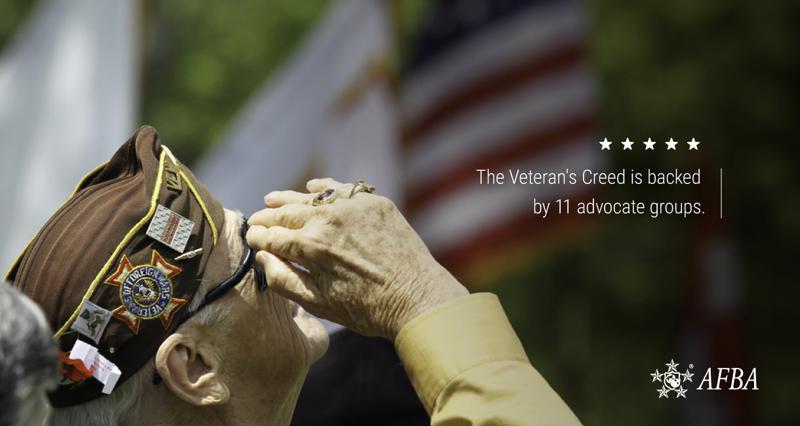
The Veteran's Creed is backed by several advocate groups, including Veterans of Foreign Wars, Disabled American Veterans, Iraq and Afghanistan Veterans of America, Wounded Warrior Project and The Military Order of the Purple Heart. The latter published a press release noting that each element of the Creed is rooted in military tenets, the missions of the participating organizations and the altruism shared by many veterans. The Creed should also remind American civilians that the values veterans learned while serving (teamwork, integrity, leadership and selfless service) can benefit the entire country.
The Veteran's Creed reads:
- I am an American Veteran.
- I proudly served my country.
- I live the values I learned in the military.
- I continue to serve my community, my country and my fellow veterans.
- I maintain my physical and mental discipline.
- I continue to lead and improve.
- I make a difference.
- I honor and remember my fallen comrades.
Per Military.com, the Creed was officially adopted at a Flag Day event at the Reserve Officers Association. It is the result of many discussions that began last fall at Georgetown University.
"In the Army I lived both the Soldier's Creed and the NCO Creed," John Towles, Director of National Security and Foreign Affairs for the Veterans of Foreign Wars told Military.com. "As veterans, we must realize that our service does not stop simply because we take off the uniform. Many of us struggle to find our place once we leave the military, but now we have a new set of watchwords to guide and remind our brothers and our sisters in arms that our mission is far from over."
While these words may not be enough to prevent every single veteran suicide in future years, they're certainly a good first step toward building community among former servicemembers. Hopefully, with these words in their hearts, veterans will have an easier time transitioning to civilian life.

The Navy is taking a comprehensive approach to recruit and retain servicemembers during a time when the U.S. economy is doing exceptionally well. Unemployment is the lowest it's been in 18 years, which should be good news for recruiting efforts. In truth, however, this means the Navy faces stiff competition from other military branches and the private sector. What's more, interest in joining the military usually drops as the economy improves. Not only are qualified individuals choosing jobs, but parents push students to go to college rather than enlist.
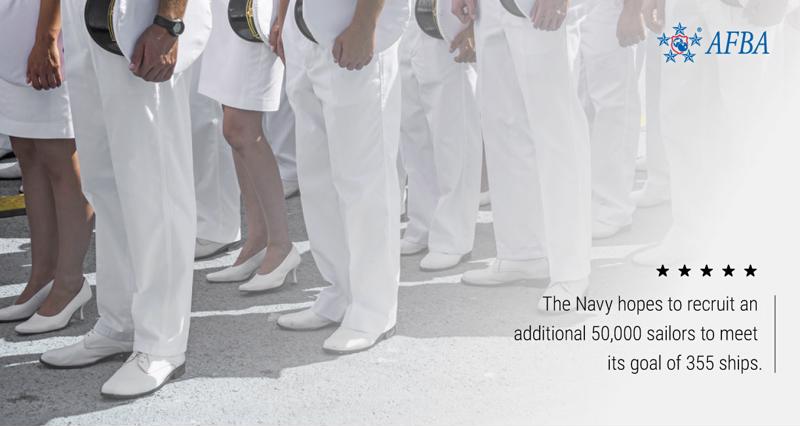
Finally, more than 70 percent of Americans of prime recruiting age can't serve due to obesity, criminal records or a lack of high school diploma or GED. Combined, these circumstances spell trouble for the Navy. The military branch is about 11,000 sailors short of what it needs to man its current fleet, and it will need about 50,000 more to meet its goal of 355 fully crewed ships.
According to an article from Military.com, Navy Secretary Richard Spencer expressed his concerns over the state of the branch's recruitment efforts during the Naval War College's annual two-day Current Strategy Forum.
"As the economy improves, we compete," said Spencer, per the article. "The game is now in our court to do the best we can to have the tools that we need to recruit, train and retain the best that our country has to offer."
Strategies to boost Navy recruitment efforts
President Donald Trump requested $686.1 billion for the military in his budget proposal for next year. The Navy should get a portion of that, and many funds will likely go toward recruiting.
The Navy also announced a new program that would allow sailors who leave to rapidly reenlist in a few years. Further, as the U.S. Naval Institute reported, the military branch increased the pace of its sea-going apprentice program: the long-running Professional Apprenticeship Career Track (PACT). Now, new sailors sign a three-year contract instead of a four-year enlistment. This gives them an idea of the various Navy jobs available and puts them on the path to a career sooner. This strategy boosts retention and encourages sailors to reenlist.
The goal of this change to PACT is to better match the wishes of new sailors with the needs of the military, according to Navy Branch Head for Enlisted Plans and Policy, Capt. Mery-Angela Katson. New sailors will take jobs at sea and work alongside other, trained servicemembers in one of three basic career paths: surface warfare, engineering or aviation.
"It's a way to give sailors the ability to look at jobs in these tracks and then give them a specific skills training pipeline to become rated sailors and continue on in that path through advancement and a career in the Navy," Katson said to USNI News.
Finally, the Navy is revising its typical recruitment strategies. According to Military.com, it's considering hiring private-sector professionals who are in the middle of their careers. Per Secretary Spencer, this strategy would help the military find and recruit top talent in a competitive market.
Additionally, per an NPR broadcast, the military branch is creating ads aimed at centennials, who are described as members of the first generation born with access to the internet. These ads are an attempt to dispel the notion that the military is the last hope for young people with nowhere else to go.
Combined, these strategies should increase the number of new sailors recruited into the Navy and improve retention numbers. Hopefully, the Navy will have no trouble meeting its manpower goals over the next few years.
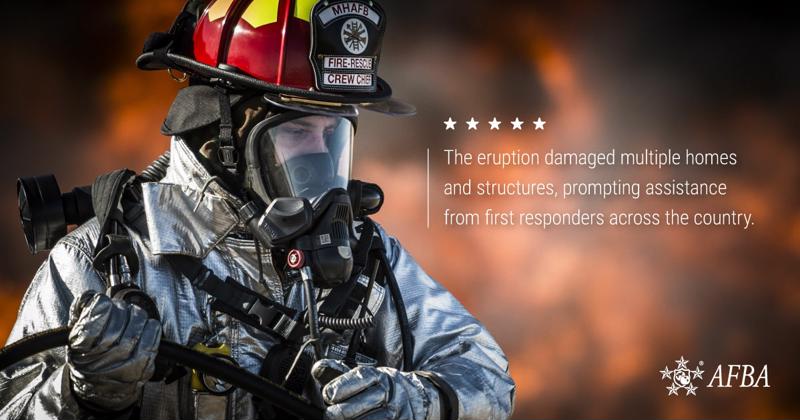
On May 3, 2018, a volcanic event known as the 2018 lower Puna eruption occurred on Kilauea volcano's East Rift Zone on Hawaii's Big Island. Earthquakes caused cracks in the roads, leading to lava foundations up to 300 feet high and destroyed homes in the Leilani Estates subdivision. Nearly 2000 residents were forced to evacuate, and the Puna Geothermal Venture, which provides electricity for a significant part of the island, was forced to shut down and later damaged. This event is part of the larger, long-term Kilauea eruption that began Jan. 3, 1983.
As part of the efforts to minimize the volcano's damage and destruction, first responders from around the nation made their way to Hawaii. A CBS News affiliate from Greensboro, North Carolina, covered a story about a group of local first responders leaving for the island at the end of May. Ten of the state's fire service officials and emergency managers made their way to an emergency operations center in Hilo, Hawaii. There, they assisted an incident management team and the Hawaii County Civil Defense agency for 14 days before returning home.
Another group of responders came from Oregon and southwest Washington, per an NBC News affiliate. They're assisting local authorities by erecting disaster relief shelters and providing food, water and mental health services. One, a former Southern California firefighter and current Red Cross volunteer, noted how the unpredictability of the volcano makes operations difficult.
"It's slow and it's unpredictable," said volunteer Jerry Hall to the news station. "Tornadoes and hurricanes…you pretty much know what to expect as it happens. This is ongoing and the lava is changing directions all the time and changing areas. So, it's a lot of uncertainty for the people who live here."
Hall's statements were echoed by Cowlitz 2 Battalion Chief Joe Tone of Washington state.
"A few days in, I realized the severity as far as danger to myself and the other guys because (the lava) is so unpredictable," Tone said to The Daily News Online.
He went on to explain how, even though the fissures are all erupting on a single line, it's difficult to predict exactly where the next one will occur. But aside from trying to predict where the next event will happen, rescue workers must also assist the people who live in existing danger areas. Tone recalled seeing 20 homes in a single neighborhood destroyed. Some were overcome by flowing lava, others fell into the opening fissures and more caught fire from flying sparks.
Unfortunately, the lava isn't the only hazard of the ongoing eruptions. Thousands of people's lives were jeopardized by the toxic gases released by the volcano. So, in addition to physically rescuing trapped civilians, setting up shelters and transporting people to safety, first responders such as Tone also needed to monitor the island's air quality and chart where the gasses might spread next. Given the volcano's unpredictability and the natural movements of wind, this couldn't have been an easy task.
Tone and other first responders also worked to remove hazardous chemicals from the nearby geothermal plant, preventing a possible explosion that had a potential blast radius of half a mile. Thanks to their efforts, such risk was eliminated.
The damage from Kilauea
According to Reuters, this volcanic eruption is the most destructive since that of Mount St. Helens in 1980, with over nine square miles of the Big Island covered in lava. Estimates on the number of destroyed homes range from 455 to 600; regardless of the actual number, it is the greatest quantity of homes destroyed by the volcano in such a short time.
Richard Overton celebrated his 112th birthday on May 11, 2018. This in itself is remarkable, but Overton is more than one of the oldest men in the world. He's also America's oldest living veteran.
The birthday celebration started a month earlier, after Overton spoke with Austin businessman Robert F. Smith. The centenarian mentioned that he wanted to see the recently opened National Museum of African American History and Culture in Washington, D.C. Smith, who had donated approximately $20 million to the museum, flew Overton to visit on a private jet. There, Overton was greeted by former secretary of state Colin Powell and treated to a private tour.
A life of experience
Many people never fly privately in their lifetimes, let alone get to avoid the crowds at a Smithsonian museum. Yet, Overton's done a lot more in life than most. He's visited the White House several times and met numerous people of influence, including comedian Steve Harvey and former president Barack Obama.
The secret to his age? Overton credits his love of cigars, whiskey, coffee, fried catfish and butter pecan ice cream. He also refuses to think about death.
"I don't think about [dying]," he said on the TODAY Show in 2014, according to an NBC News article. "You can't do anything about that. It's going to come, whether you want it or not. I just think about living."
Overton celebrated his 112th birthday proper with a block party. The event wasn't unusual; he lives on a street in East Austin, Texas, named after him, and people often visit after hearing his story. The frequent guests don't seem to bother him.
Buying it in the 1940s for $4,500, Overton's lived in his home for more than 70 years. Per USA Today, his home underwent several repairs provided by Austin Energy, Home Depot and Meals on Wheels to make his home more accessible, adding heat and air conditioning, fixing the plumbing and wiring, and bringing the house up to code.
As for his daily life, Overton's various family members help him often. Additionally, thanks to online fundraising, he's able to live independently with round-the-clock health care. Overton is surprisingly mobile for a man in his second century of life. Per the NBC article, he was still driving and tending to his lawn at age 109. His veteran's benefits would allow him to stay in an assisted-living facility, but Volma Overton, his 70-year-old cousin and caregiver, thinks the experience would be bad for him.
"His front porch is his everything," Ms. Overton told the Washington Post. "It's his throne. He's outlived almost everybody in his family."

A family legacy
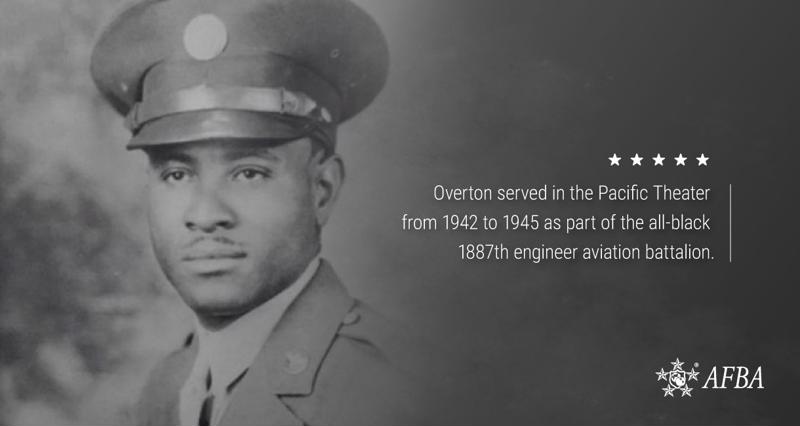
Overton's grandfather was a slave in Tennessee. After receiving his freedom, he moved to Texas to set roots. Overton himself was born May 11, 1906 in Bastrop County, Texas. He forwent college to join the U.S. Army at Fort Sam Houston, Texas. He served in the Pacific Theater from 1942 to 1945 as part of the all-black 1887th engineer aviation battalion. As part of his service, Overton was stationed in Palau, Guam, Iwo Jima and Okinawa.
Overton retired in 1945 as a corporal technician fifth grade. He received the Expert Rifle Marksmanship Badge, a Meritorious Unit Commendation and the American Campaign Medal, among other distinctions.
Yet it wasn't until 2013 that Overton gained a bit of fame. Two East Austin filmmakers, Matt Cooper and Rocky Conly, began filming a documentary about his day-to-day life. Overton quickly became a nationwide sensation, and he plans to keep living with the same jovial attitude.
Minnesota legislators recently passed a bill that greatly benefits first responders. As a local Fox News affiliate reported, first responders such as police, firefighters, paramedics and corrections officers are no longer required to prove what events caused their employment-related post-traumatic stress disorder in order to receive worker's compensation.
This bill can do much to help first responders get the care they need. Consider the story of Brian Cristofono, a firefighter who suffered from job-related nightmares and panic attacks. According to an NBC station from Minneapolis, Cristofono became irritable, started drinking and his marriage ultimately fell apart. The firefighter also saw three coworkers succumb to suicidal thoughts and thought about taking his own life.
Luckily, Cristofono was able to get help – a psychologist diagnosed him with PTSD and drafted a list of events believed to have caused the condition. Creating this list couldn't have been easy, as PTSD symptoms can manifest months or years after the trigger event occurred. Cristofono used his diagnosis to apply for worker's comp, but his claim was denied.
"There was no physical injury associated with any of those calls," Cristofono told the news station, relaying the response he received from the city. "So it could not be PTSD."
The burden of proof is now shifted thanks to this bill, and PTSD is now an assumed side effect of being a first responder. This news comes just in time for National PTSD Awareness Month.
PTSD among first responders and veterans
The Mayo Clinic defines PTSD as a mental health condition resulting from experiencing or witnessing a terrifying event. The disorder is difficult to cope with, especially if it's left untreated. Symptoms include nightmares, uncontrollable thoughts, flashbacks and severe anxiety.
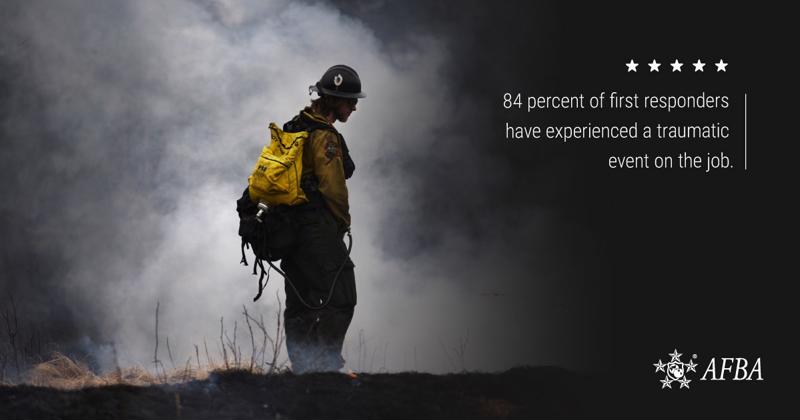
Some occupations are more prone to possible PTSD than others – particularly military and first responder roles. A 2017 survey from the University of Phoenix found 84 percent of police officers, firefighters, EMTs, paramedics and nurses have suffered symptoms related to mental health issues. Furthermore, 84 percent have experienced a traumatic event on the job, but only 34 percent were diagnosed with a mental health disorder. This isn't to say that traumatic experiences only affect a small percentage; it's more likely that people have PTSD but aren't diagnosed.
Why might this be true? Unfortunately, there remains a pervasive stigma against mental health services, especially among first responders. Seventy-four percent of survey respondents said they have therapy, counseling and similar opportunities available, but only 39 percent actively sought them out. Reasons for avoiding such services included fears that supervisors would treat them differently, that coworkers would perceive them as weak and that they'd be passed over for promotions.
Such stigmas are, in part, why Congress named June 27 PTSD Awareness Day back in 2010. What's more, the Senate designated all of June as PTSD Awareness Month just four years later in 2014.
The goal of these measures, according to the Department of Veterans Affairs, is to promote awareness of PTSD and its effective treatments. The VA provides many helpful aids to assist veterans and their families in understanding PTSD and seeking help, and first responders may benefit from these resources as well.
One booklet, titled "Understanding PTSD and PTSD Treatment," helps you define PTSD, lists possible PTSD-causing traumatic events, describes various symptoms and answers common questions about treatment. Another tool, the PTSD Treatment Decision Aid, helps you make the best choices for your life and health when addressing your condition.
If you suspect yourself or someone you love suffers from PTSD, talk to your doctor or a mental health professional. If you don't yet have a counselor, look for one who specializes in PTSD. Reach out to loved ones, and call the National Suicide Prevention Lifeline (1-800-273-8255) if you're having suicidal thoughts.
Now that your time in the military has come to an end, you may be concerned about your next steps. Civilian life seems daunting, but it doesn’t have to be. With a solid strategy and the support of family and friends, you can feel just as fulfilled as you did during your service.
Here’s what to do when your time in the military has come to an end and you’re ready to create a civilian life that you love:
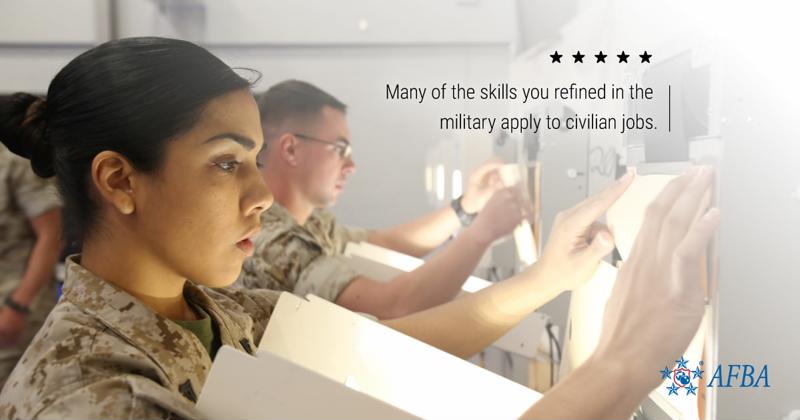 The knowledge you’ve gained through your military experience can be directly applied to civilian responsibilities.
Know your value
Now that you’re not in the Armed Forces, you may feel like you have no skills that apply to the civilian job market. That idea couldn’t be further from the truth. The military, in fact, gave you qualities that are impossible to acquire in any other format. You learned soft skills like teamwork and communication as well as specific knowledge related to technology, machine maintenance and medical care.
Consider how your military experience translates to the modern job market. Doing so helps you find an appropriate employer and make the transition easier. Make a list of all your skills and research what jobs apply to them. If, for example, you served in a leadership position in the military, you could be a great fit for management or corporate training.
Remember that jobs are not careers
A career is your passion, while a job is a stepping stone. Jobs give you financial stability while you search for (or develop the skills for) your dream career.
You may have to work whatever jobs you can find after retiring from the military, and they may make you feel discouraged, apathetic or even depressed about your situation. Don’t let this discouragement consume you. Your first post-military job doesn’t have to be your career, and you can use the experience you get to help you find a better position.
Review your finances
Check all of your bank accounts and credit statements to see how much money you have and how much you need. At minimum, you should have a checking account with money already deposited, a savings or emergency account with a year’s worth of expenses, and a retirement account. If you don’t have any of these, don’t panic, but create them as soon as you can.
Also, look over your debts and start taking measures to pay off all that you owe. There are several debt relief programs specifically for servicemembers and veterans, including:
- The Servicemember Civil Relief Act, which regulates interest rates for credit cards, auto loans and other financial services.
- The Military Lending Act, which keeps interest rates for credit products from exceeding 36 percent.
- The Veterans Housing Benefit Program, which offers veterans home loans with low interest rates.
You can also use a credit counseling service to help you manage your debt and boost your credit, allowing you to make major purchases like cars and homes.
Know your health insurance options
A medical crisis can strike anyone at any time, making health insurance a necessity. Luckily, you’re eligible for TRICARE between your military retirement and before getting a new job. The Continued Health Care Benefit program is another temporary coverage option, but you’ll need to find your own health care eventually. Look into possible VA benefits, and try to find a job with employer-provided insurance options.
Connect with your family and build a network
Having personal freedom may feel odd after years of taking and giving commands. It’s not uncommon for veterans to feel depressed after the rigid structure of the military, which is why a support network of peers and loved ones is so essential. Make connections with other veterans, open up to your family, and consult a therapist if you need to.
You may suffer some growing pains when transitioning to life after the military, but you’ll come through with the right plan.
To learn more about preparing for retirement, download our 2018 Financial Planning Guide.
Various branches of the military have seen numerous aviation crashes – some of which have been fatal – over the past few years. These accidents represent a disturbing trend that servicemembers and Congress are anxiously trying to solve.
Just this past May, a Lockheed WC-130H transport aircraft crashed shortly after departing the Savannah Air National Guard Base, killing all nine members of the Puerto Rico Air National Guard on board. In March, two Navy aviators died after their FA-18 fighter jet crashed near Key West, Florida, CNN reported. So far this fiscal year, 12 accidents (consisting of 11 crashes and one incident on the ground) have claimed the lives of 35 servicemembers, tying the start of 2018 with 2016's total number of aviator deaths.
Unfortunately, these issues have lingered for years, and some connect them to the 2013 congressional budget cuts, per Military Times.
"We are reaping the benefits – or the tragedies – that we got into back in sequestration," said retired Air Force General Herbert Carlisle, according to the publication.
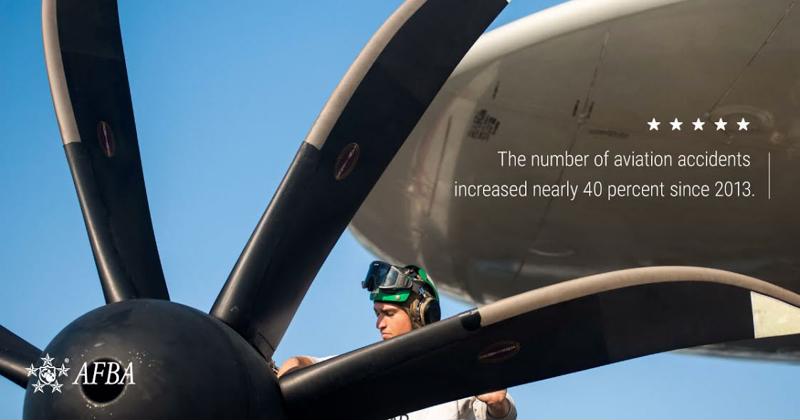
According to data Military Times obtained through multiple Freedom of Information requests, the number of aviation accidents increased by nearly 40 percent since 2013. Since 2011, more than 7,500 incidents ranging from Class A through Class C have occurred.
Various departments taking action to address crashes
Despite the data, the Department of Defense has clarified that these incidents shouldn't be considered a crisis. Yet, many military branches are investigating the cause of these accidents, although they echo the DoD's statement. For example, General Ellen Pawlikowski, head of the Air Force Materiel Command, recently sent a memo telling its safety organizations to review all aircrafts by the middle of July, according to Air Force Times.
"Take another look at that data from a different angle and see if there is anything that we are missing in there that would help us to predict what might be the next mishap," she said to reporters, according to the publication. "I think how the Air Force has approached this is not to panic. We don't consider it a crisis, but we have elevated [interest] in making sure that we aren't missing anything and that we really do empower the airmen to make sure that safety is always first."
Pawlikowski also objected to the idea that the crashes are directly related to the 2013 budget cuts. She said that instead of operating an aircraft in need of maintenance – a difficult task when money is tight – the Air Force would simply ground the plane to protect servicemembers.
Additionally, Air Force Chief of Staff Gen. Dave Goldfein ordered all flying and maintenance wings to participate in a one-day safety stand down, according to a separate Military Times article. Active-duty units had a deadline of May 21 to conduct their review, while Guard and Reserve have until June 25.
That said, Congress might soon push the military to do more in its investigation over the coming years. Democratic Rep. Adam Smith of Washington, ranking member of the House Armed Services Committee, introduced legislation early May that would create an independent panel tasked with examining the string of crashes. Titled the National Commission on Military Aviation Safety, the panel would consist of eight people who would look into the possible causes of these incidents and, if necessary, recommend any modifications to training, maintenance, safety or other policies. Their first report would be due Feb. 1, 2020. Panelists would be appointed by the president and certain members of Congress.
In response to another U.S. shooting, this time on the campus of a major tech company, Silicon Valley banded together to support the first responders of San Bruno, California.
On April 3, 2018, a shooting occurred at the YouTube headquarters in San Bruno. The suspect entered through a parking garage and opened fire on an outdoor patio with a semi-automatic pistol. Three people were wounded, one critically, before the suspect turned the gun on herself.
The female shooter was Nasim Najafi Aghdam, a YouTuber who was unhappy with the company's policies and procedures. According to her videos and website, Aghdam claimed YouTube demonetized her videos and prevented her from getting views.
YouTube's response was quick, with CEO Susan Wojcicki immediately releasing a statement on Twitter.
"There are no words to describe how horrible it was to have an active shooter @YouTube today," she wrote. "Our deepest gratitude to law enforcement & first responders for their rapid response. Our hearts go out to all those injured & impacted today. We will come together to heal as a family."
Responding with more than words
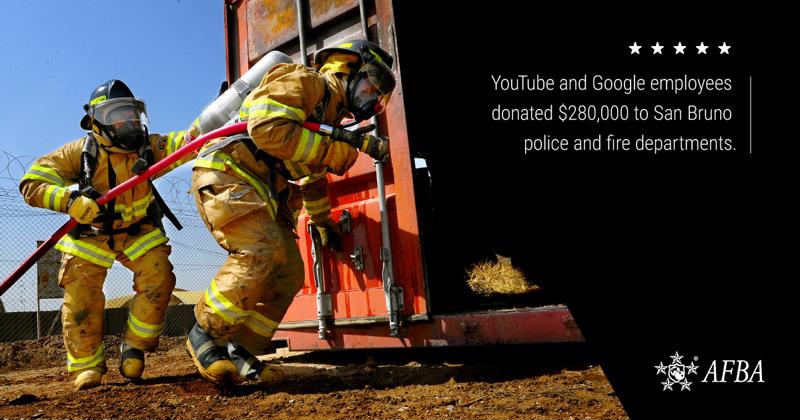
But, words on Twitter wasn't the end of it; these companies are putting their money where their mouths are. According to the Silicon Valley Business Journal, Google and YouTube employees donated money to San Bruno first responder training efforts. In fact, although Google encouraged its employees to take some days off to recover from the incident, more than 800 of the company's employees from across the globe donated $90,000 within the first two days. Google also matched its employee donations with a $100,000 grant to the San Bruno Community Foundation.
Collectively, the two tech companies donated more than $280,000 to San Bruno police and fire departments. Indeed, it was the skills of these first responders that kept the building safe.
Police arrived within minutes of the first 911 calls, per the Silicon Valley Business Journal. They evacuated the building and searched the premises. An estimated 300 first responders came to the scene. The San Bruno officers received assistance from departments from Daly City, South San Francisco, San Mateo, Redwood City, Burlingame and the county sheriff's office.
"We are grateful to our police and fire departments for their swift and thoughtful response in the face of tragedy in San Bruno, and to Google.org and the entire Google and YouTube community for partnering with the foundation to strengthen first responder prevention and preparedness efforts in our community," said Nancy Kraus, president of the San Bruno Community Foundation, in a press release. "The Google/YouTube donations will support programs that help ensure that San Bruno's first responders will be ready and prepared to act in future public safety incidents."
With this donation, the city's officers will be able to continue their exemplary responses to disastrous events.
When people hear the words “Memorial Day,” they often think of sales and three-day weekends. While the holiday is a nice way to welcome warmer weather, it’s important not to forget the day’s history and meaning.
Memorial Day was first celebrated after the end of the Civil War, which concluded May 5, 1868. It was started by an organization of Union veterans known as the Grand Army of the Republic. Maj. Gen. John A. Logan, the head of this organization, declared what was then known as Decoration Day would be observed May 30. Celebrations involved laying flowers on the graves of dead soldiers.
There are two possible reasons for the choice of date. The U.S. Department of Veterans Affairs suggested that May 30 was a day when flowers were likely blooming across the nation, so everyone could participate. Meanwhile, the History Channel noted that May 30 is one of the rare spring days that wasn’t the anniversary of a major Civil War battle.
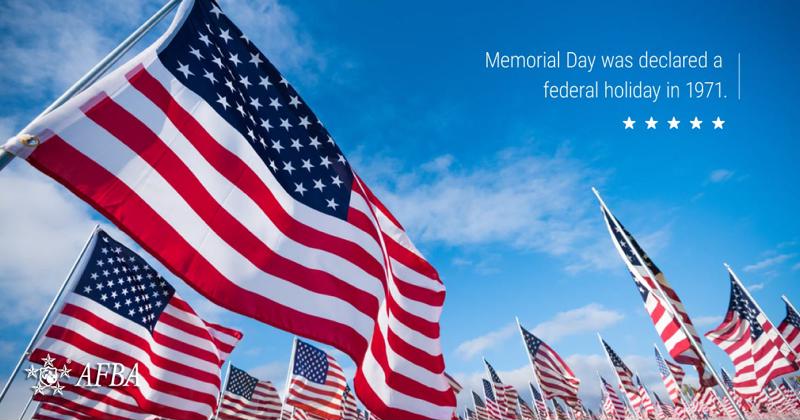 Memorial Day is celebrated on the last Monday in May.
Recognizing fallen soldiers before Memorial Day
Regardless of the true reason, it’s likely that Maj. Gen. Logan got the idea for such a holiday from other groups. One of the first such commemorations was organized by recently freed slaves as a way of thanking Union soldiers.
Near the end of the war, thousands of captured Union servicemembers were transferred to camps in Charleston, South Carolina. Conditions at one of the camps were so bad that over 250 prisoners died from disease or exposure, and their bodies were simply buried in a mass grave. After the confederate surrender on May 1, 1865, over 1,000 former slaves, accompanied by a few white Charlestonians and regiments of the U.S. Colored Troops, gathered in the camp to consecrate a new, proper burial for the soldiers.
Another commemorative service was sponsored by a Mississippi women’s group. On April 25, 1866, these women visited cemeteries in Columbus to decorate the graves of both Confederate and Union soldiers who died during the battle at Shiloh.
With so many separate memorials occurring across the nation, it’s difficult to determine which city is the true birthplace of Memorial Day. Many claimed the title, but President Lyndon Johnson and Congress ultimately decided that Waterloo, New York was the official place of origin in 1966.
Memorial Day was finally expanded to commemorate all soldiers after World War I. Congress declared it a federal holiday in 1971, transitioning the date to the last Monday in May and unofficially launching the tradition of the three-day weekend.
Memorial Day in 2018
Today, many people use Memorial Day to celebrate the unofficial start of summer. Pools open, barbecues are fired up, and people everywhere take road trips. AAA expects over 41.5 million Americans will travel for this year’s holiday, with the busiest days being May 24 and 25.
The holiday is also incredibly commercial. A quick online search reveals page after page of sales advertisements. While sales are great for the economy, people shouldn’t forget the true reason for the holiday.
The real symbolism of Memorial Day is much deeper than a discount. It commemorates all of the fallen soldiers who fought for this country.