
To alleviate the stress and burden of finding a new job after relocating, consider unconventional, individual work options. There are two primary avenues they can take: starting a business of their own or working remotely for an employer.

Starting a business: Your job moves with you
U.S. Veterans Magazine offered this suggestion, and it's a great way to maintain a consistent job position despite moving so often. Owning a business allows you to manage your time on your terms and alleviates the stress of finding a new employer. If you work purely from home and don't rely on outside resources or vendors, you can easily relocate your physical office.
That said, there are several things to think about before venturing into the world of entrepreneurship. First, you should consider whether you're suited to start your own company. U.S. Veterans Magazine provided a helpful self-assessment, asking readers to examine personal details like:
- Personal and business goals.
- Current funds and investment requirements.
- Existence or lack of family support.
Next, you should critically evaluate your skill set and identify what you can monetize in different locations. If you're moving to Alaska, for example, your talent for raising tropical plants probably won't be in demand. To get started, here are a few careers that are either universally in demand or don't require a local client base:
- Computer programming.
- Accounting.
- Creative services (such as copywriting or graphic design).
- Tutoring.
- Child care.
Furthermore, and perhaps most importantly, business law and taxes change between states, so relocating isn't a simple matter of moving your computer. To get a basic understanding of the scope of moving your company to a new state, the U.S. Small Business Administration provided a helpful legal guide.
Working remotely: Freedom and flexibility
Remote work, on the other hand, removes much of the complications of owning a business. Remote positions may have been hard to come by in the past, but research shows that attitudes are changing. According to Gallup, the proportion of employees who work from home grew from 39 percent to 43 percent between 2012 and 2016. This type of setup makes military spousal life much easier, allowing you to pack up and move at a moment's notice without leaving your job.
That said, you may need to convince your current employer that remote work is a good option. Point them to Gallup's State of the American Workplace study, which proves that remote work can boost employee engagement. Also note that working from home reduces employee churn and allows you to remain with the company after a move.
However, it's also a good idea to consider your current position before asking about remote work. Based on your job description, how likely is your employer to agree to let you work from home? You may be better off looking for a new company that offers a more flexible policy.
Additionally, even remote work comes with a few struggles. You'll still need to take time off for moving purposes, and you may feel disconnected from certain conversations or alienated from your coworkers. To solve these issues, ask your employer about working flexible hours – for instance, in the mornings and evenings instead of a strict 9 to 5, saving the middle of the day for the move – and travel back to the main office when you can.
Working as the spouse of a servicemember can be stressful, but these suggestions give you more control over your employment.

Army servicemembers may soon have new uniforms inspired by those of World War II. Sergeant Major of the Army Dan Dailey began his push to bring back the iconic attire back in May, Army Times reported. He believes the pinks and greens, as the uniforms are called, are perfect for boosting morale among servicemembers and civilians.
"That was the uniform of the 'Greatest Generation,'" Dailey told Army Times. "There was a lot of prestige and honor associated with that. The American public identified with that uniform."
Dailey also noted the revised pinks and greens would give the army a daily uniform more appropriate for business rather than combat.
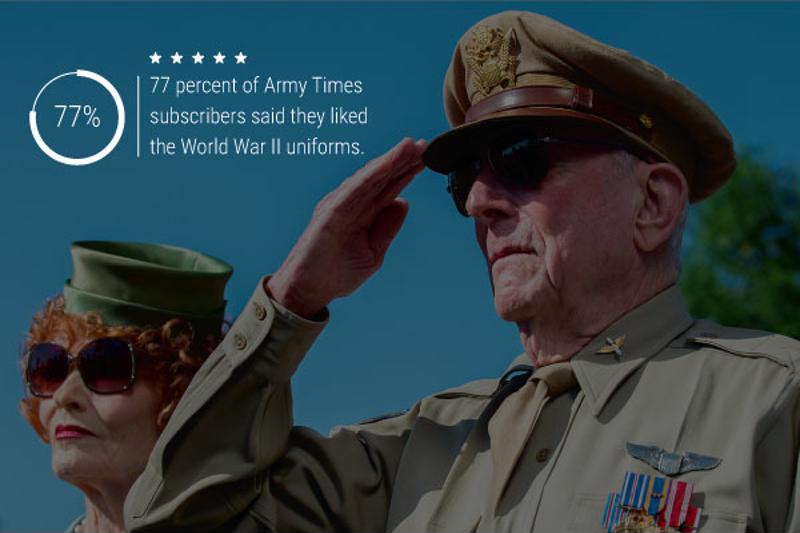
In May, Dailey first made his case during a uniform board meeting with the results of a survey sourced exclusively from Army Times subscribers. About 28,000 readers received the survey, and approximately 5,000 of them responded. Their answers showed overwhelming support for the proposed change:
- 77 percent said they liked the uniforms.
- 59 percent said they preferred the pinks and greens to current uniforms.
- 72 percent said they would like the option to wear pinks and greens.
First round of prototypes unveiled in October
Several months after what turned out to be a successful board meeting, the uniforms are now close to finalization, according to Military.com. Dailey unveiled the first round of prototypes during the Association of the United States Army's annual October meeting. This version had multiple options for the jacket, trousers and shoes. Dailey noted that the final prototypes would be more historically accurate and closely align with what General George C. Marshall wore when serving as the Army's chief of staff during World War II, noting that they will have khaki shirts, brown leather shoes and belted jackets. They will also be made from higher-quality materials and designed for functionality, fit and endurance.
Dailey added he is very aware of the cost of redesigning and implementing new uniforms. He acknowledged that such changes use taxpayer funds and indicated he is adamant about making sure the decision is the correct one before proceeding.
If the new pinks and greens are approved, the occasion will mark the second major dress uniform change in 10 years. The current Army Service Uniform debuted back in 2014, but many considered it to be too formal for everyday office wear.
That said, the amount of support the new uniforms have garnered indicates both servicemembers and the American public are on board with the changes.
Army still debating while Dailey keeps up support
The Army isn't expected to make a final decision on the new uniforms until spring 2018, according to Task and Purpose. Still, Dailey remains a public advocate, wearing them again during the annual Army-Navy football game on December 9. He also tweeted about the event, exclaiming that the uniforms brought good fortune and helped secure an Army win.
Dailey's enthusiasm reiterates his belief that the new uniforms, which will be as historically accurate as possible, would be great tools for boosting resolve. At a time when Army servicemembers are stationed across the globe, the uniforms will be a universal symbol that commands respect while also keeping the wearer looking sleek.
"This is the symbol, for me, of the American soldier," Dailey said according to Task and Purpose. "Still to this day, people can remember what a soldier looked like in the pinks and greens."
A new partnership between a technology company and a wounded veterans service would provide smart glasses to former servicemembers suffering from vision problems. According to U.S. Veterans Magazine, the Wounded Warrior Program, Minton-Jones Company and Ability One vendors are working with Cyber Timez, Inc., a company that designs augmented reality applications for smart glasses, to bring these novel devices to veterans with blindness or low vision. The project would help such vets live more independent lives.
The smart glasses are equipped with a high-definition camera and an optical character recognition engine, allowing them to effectively "read" text and transmit it aloud to veterans. The sound waves go directly into the ear, so whatever the wearer is reading remains private and he or she doesn't disturb others. The glasses are also independent of the cloud, so veterans don't need an internet connection to use them.
With this technology, blind and vision-impaired veterans can effectively read signs, manuals and any other text or documents without assistance. The software can read text in over 100 languages, identify over 16 billion objects, scan barcodes to identify various products and interpret more than 1,000 colors. It even has the capacity to decipher a person's mood based on his or her face. The glasses can also magnify details up to 15 times, which can be life changing for veterans with low vision.
"Our goal with this project at the Wounded Warrior Program is to outfit thousands of American veterans and wounded warriors impacted by low vision and blindness, both men and women with smart glasses to help them find jobs, improve their quality of life and give them financial independence," said Wounded Warrior Program National Director Dr. David Godbold.
When it comes to the issues servicemembers face, most people think of amputated limbs and traumatic brain injuries rather than vision problems. However, blindness and vision impairment are both combat risks and have already affected thousands of veterans.
Blindness as a result of combat
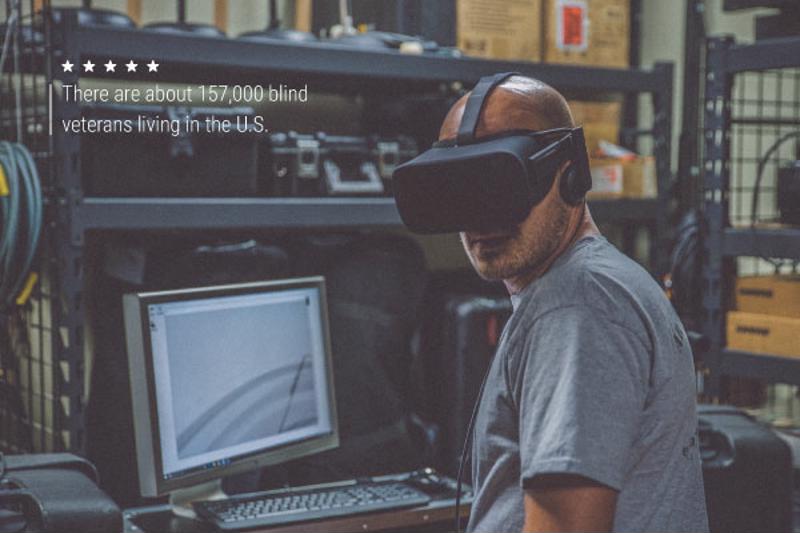
According to the U.S. Department of Veterans Affairs, there are about 157,000 blind veterans living in the U.S. The VA estimates at least an additional 1 million veterans are visually impaired.
For many veterans, these disabilities are caused by standard issues such as age-related macular degeneration, diabetic retinopathy, stroke, cataracts and glaucoma. Nevertheless, their service is reason to include such naturally developing conditions under the umbrella of "veterans issues."
That said, veterans can also suffer vision problems as a side effect of traumatic brain injuries. According to the VA, blindness or low vision affects as much as 64 percent of servicemembers with TBIs.
While experiencing vision loss can be frustrating, veterans shouldn't lose hope. They can regain independence with technological innovations like smart glasses and find other assistance through organizations like the Wounded Warrior Program, the Blinded Veterans Association, the National Association of Blind Veterans and the Defense and Veterans Brain Injury Center. They should also look for rehab centers designed specifically for blind veterans, like the Gulf Coast Veterans Rehab Center in Biloxi, Mississippi. As the Associated Press reported, this specific center has helped 173 veterans reclaim their lives.
"It opens those doors for independence once again," said Facility Chief Debra Gilley, according to the Associated Press. "It's wonderful to see somebody who has been sitting at home on the couch thinking that life is not open to them anymore, and to see them out crossing the street and getting out there."
Veterans with vision problems should not seclude themselves from the world. With the help of local disability resources and ground-breaking tech, they can regain the confidence to be active in society once again.

The opioid epidemic remains one of the most pervasive medical crises in the U.S. According to the American Society of Addiction Medicine, opioids are responsible for the majority of drug overdose deaths in the nation. In 2015 alone, heroin overdoses claimed 12,990 lives, while prescription pain relievers claimed 20,101. The total number of deaths from opioids is surely higher, given that these statistics don't account for fentanyl or Carfentanil, two extremely dangerous drugs that are driving the crisis.
As a result, first responders have been put on the frontline of this battle, responding to overdose calls en masse and saving countless lives with the overdose-reversal drug naloxone. Some responders are even working to expand addiction treatment services in their local communities.
Take Nashua, New Hampshire, for example. As the Huffington Post detailed, members of the city's local fire department created a program called Safe Stations to get opioid addicts the help they need before they overdose. An addict can show up at a firehouse unannounced and ask for help, and firefighters on duty will dispose of any drugs on the person, take vital signs, see to his or her immediate needs and arrange for treatment. The program is designed to create a space where addicts feel safe rather than judged to better encourage people to make use of the service.
"Immediately six or seven firefighters came to my aid," said a patient only identified as Brian during a public forum where he described his experience with Safe Stations, the Huffington Post reported. "I showed up at the safe station and they immediately took my vital signs. I even hugged all the firefighters because I didn't know what to do."
That said, while firefighters and first responders can be considered heroes of the epidemic, they also put themselves at risk of a threat many people don't consider: an accidental overdose.
The DEA warns responders of contact with opioids
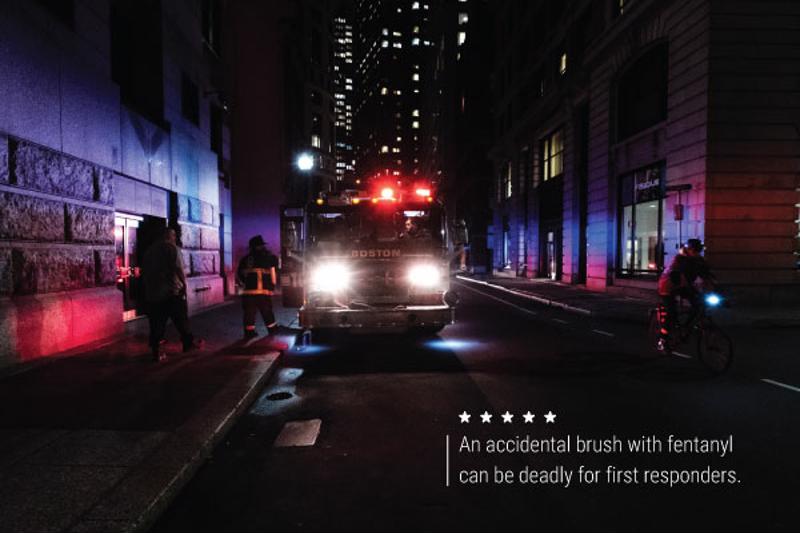
As first responders arrive to treat overdose patients, they risk coming into contact with the drugs themselves. Highly potent synthetic opioids like fentanyl and Carfentanil can be transmitted through the skin, and even a small amount can trigger a fatal overdose. In fact, 2 or 3 milligrams of fentanyl – the equivalent of five grains of table salt – can lead to respiratory depression or arrest, cardiac arrest and death. This means that a responder could die simply by brushing a bit of powder on a his or her uniform.
This is almost what happened to Officer Chris Green of East Liverpool, Ohio, CNN reported. He brushed some powder off of his uniform after a drug bust, then began feeling the effects of an overdose. Green, like many others, made a full recovery, but the threat of death is still incredibly real.
The danger is so great that the U.S. Drug Enforcement Administration issued a synthetic opioid briefing guide to the nation's first responders in June 2017, detailing best practices for safety. It advises responders to take the following precautions when encountering an area where fentanyl may be present:
- Wear personal protective equipment such as coveralls, gloves, eye protection and dust masks.
- Carry naloxone injectors on their persons.
- Contact the nearest DEA office or request the help of HAZMAT officials if they suspect a substance contains opioids.
As we thank first responders for saving the lives of countless opioid patients, we must also recognize the incredible danger they put themselves in.
This past September, a female Marine Corps became the first woman infantry officer after successfully completing the Infantry Officer Course, the Marine Corps announced in a press release. Commonly referred to as the IOC, the intensive 13-week course is regarded as one of the toughest in the military. An average of 10 percent of students fail to pass the first day, which includes a skills assessment and a combat endurance test consisting of hikes and an obstacle course. Of the female officer's class, only 88 out of 131 students graduated.
The IOC is designed to teach and assess infantry and ground intelligence officers in the leadership, character and infantry skills necessary to serve in the position. As the Washington Post noted, the course takes an incredible amount of stamina and strength, requiring students to have the ability to carry up to 152 pounds of equipment.
"I am proud of this officer and those in her class who have earned the infantry officer MOS," Marine Corps Commandant Gen. Robert Neller said of the woman, who asked to remain anonymous, in the press release. "Marines expect and rightfully deserve competent and capable leaders, and these IOC graduates met every training requirement as they prepare for the next challenge of leading infantry Marines; ultimately, in combat."
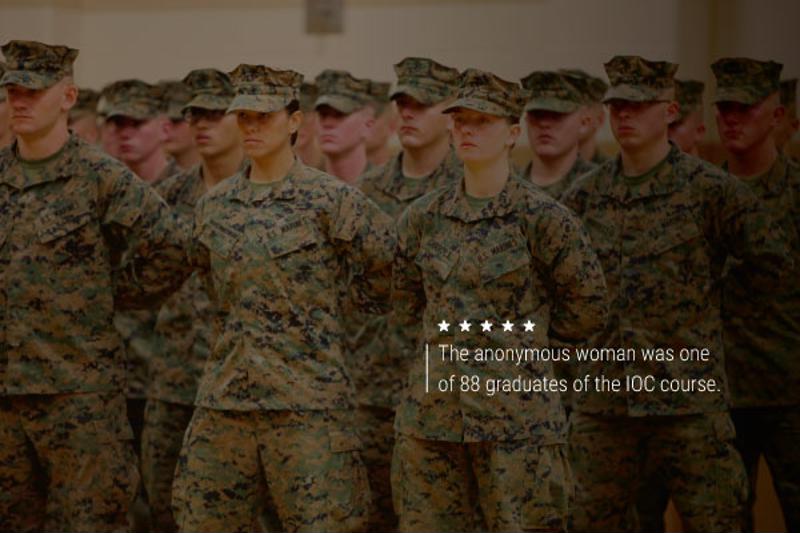
The reasoning behind the woman's decision to keep her identity private is unknown, but some speculate she requested so in order to best attend to her new position. Former Marine Corps helicopter pilot Kyleanne Hunter, who currently serves as a member of the Pentagon's Defense Advisory Committee for Women in the Services, told the Washington Post that the anonymous woman faces unparalleled performance pressures, especially from critics who want her to fail.
"Too much attention can take away from her operational requirements," Hunter told the newspaper. "Her first challenge is going to be to remain anonymous, for lack of a better term, and just do her job."
The infantry officer will also need to win over the people under her command, which may prove difficult as the Marine Corps has historically been resistant to gender integration.
Accepting gender diversity in military branches
The Marine Corp first opened the IOC to women in 2012 as part of its research on how to introduce women into all-male units. That same year, 75 percent of surveyed active-duty marines said they were opposed to complete gender integration, per the Washington Post. Ninety percent expressed concern about possible relationships forming within units, and more than 80 percent of male respondents were concerned about false sexual allegations, fraternization and women getting preferential treatment.
Furthermore, sexual harassment also served as a barrier to gender equality within the military branch. Earlier this year, news broke of a private Facebook group where male Marines were sharing nude photos of female servicemembers, often identifying them by name, rank, location or social media handle and leaving explicit comments. According to Reveal News, which broke the story, over 30,000 men were members of the group.
These issues have not stopped the Marine Corps or other military branches from seeking greater gender diversity, however, nor did it dissuade some female servicemembers from high-ranking positions. In 2015, the Pentagon officially opened all combat jobs to women. Since then, four other women, not including the recent female graduate, attempted the IOC. Although none of the four completed it, their determination signals a shift in attitudes regarding who should and who should not serve in the military.
Moving is expensive, especially for military families. Servicemembers, their spouses and their children are typically asked to move around the country – and even internationally – several times throughout their tenure. Each time, the spouse has to find a new job, which further increases expenses if that job requires a professional license or similar documentation. Previously, spouses would have to pay for the costs of obtaining a new license out of pocket, placing a burden on lawyers, nurses, teachers and people in similar positions. These costs are often a last-minute detail military families may not consider until starting the job hunt.
Thanks to a proposal in the 2018 National Authorization Act, however, military families may not have to worry as much about these costs.
Financial assistance for new licenses
The 2018 NDAA, which must still be passed by Congress, would give the Department of Defense and the Coast Guard permission to reimburse military spouses up to $500 for "transfer fees" – essentially, money to help cover the cost of exams, certificates, licenses and other such professional expenses.
According to Military.com, the idea was originally proposed by New York Representative Elise Stefanik-R.
"Military spouses serve too, and this update will help alleviate unnecessary stress and expenses, help ease the transition, and will give these spouses and their families some deserved predictability," Stefanik told Military.com.
The proposal could indeed be hugely beneficial. According to Brooke Goldberg, head of military spouse programs at the Military Officers Association of America, approximately half the spouses her organization survey require a professional license for their career. Not only could the proposal assist a significant number of military families, but the $500 can significantly reduce expenses. Although the cost of obtaining a new license can reach thousands of dollars per move, even a portion of that amount reduces a family's financial burden.
To be eligible for the reimbursement, the spouse must be forced to get a new license in his or her existing career field due to a permanent change-of-station move. However, the proposed NDAA doesn't detail how spouses should apply for reimbursement and, as noted previously, still needs to be passed by the House and Senate.
Proposal praised by military career advocates
Unsurprisingly, this portion of the bill was met with much enthusiasm.
"Anything that facilitates an opportunity to make life easier for military spouses to stay in their desired industry … is a step in the right direction," said Elizabeth O'Brien, director of spouse programs for Hiring our Heroes, according to Military.com.
While the government is required to pay for moves, families still face financial strain – especially if they're forced to move frequently. If they choose a do-it-yourself move, the government will reimburse them 95 percent of what it would cost the organizing body – not the family – to hire commercial help. Alternatively, families can allow the government itself to pack, ship and unpack their items.
With either choice, there are often up-front cash payments that leave families strapped until the next payment comes through. Additionally, the reimbursement may not cover all moving expenses, such as gas or lodging, or families may break government-mandated weight restrictions and be liable for the excess. Such financial strain is then increased when the spouse reapplies for licensure.
While $500 toward the cost of a new license doesn't completely alleviate the moving burden, any amount can help. Military spouses sacrifice a lot to support servicemembers, so support from the government is a welcome form of assistance.
Starting this month, discharged veterans will be able to identify themselves a little more easily. Instead of keeping their copy of their discharge papers, which are commonly referred to as DD-214s, they can get a photo ID card from the Department of Veterans Affairs by applying on the VA's website.
This new method results from the Veterans Identification Card Act, a law passed in 2015. Per the legislation, the VA must issue a hard-copy photo ID to any discharged veteran who applies. Representatives stated the VA will provide the cards at no cost, although the law does allow the government body to collect a fee.
The legislation makes it much safer for veterans to carry identification. Before, the only form of ID most vets had was their DD-214, which proved cumbersome for vets to keep on their persons. In addition, DD-214s contain sensitive information like birth dates and Social Security numbers. Carrying these forms around increased the risk of veterans becoming victims of identity theft or fraud.
The new cards, on the other hand, will only have the holder's name, photo and a non-Social Security identification number.
Previously, methods of identifying veterans were inconsistent across the country. Only military retirees receive a retiree card from the Defense Department, and only certain veterans can get a photo ID VA health card. Similarly, many, but not all, states allow veterans to identify themselves on their drivers licenses. This new system provides a more uniform, standardized and secure way for vets to prove their service for non-government reasons – for example, to receive military appreciation discounts from retailers.
However, not everyone is completely satisfied by the new ID option. Many veteran advocates are upset because the new cards aren't available to everyone who served.
Identifying veterans with other-than-honorable discharges
As the Army Times pointed out, the Act states that the VA must provide a new ID to any veteran who requests one and presents a document from their military personnel file or a copy of their DD-214 form. However, VA Press Secretary Curt Cashour recently confirmed that only veterans with "honorable service" will be eligible.
Advocates believe this unfairly punishes veterans suffering from mental health issues. They note that many instances of drug abuse and minor insubordination, which lead to dishonorable discharges, stem from untreated mental health issues. Additionally, as Military.com noted, LGBTQ servicemembers who were publicly outed before the repeal of "Don't ask, don't tell" were also dishonorably discharged.
"I find it incredibly frustrating, and deeply hurtful, that the VA would deny hundreds of thousands of veterans like me our very identity, after all that we know today about the nexus of PTSD and bad paper," said Kris Goldsmith, who received a dishonorable discharge. Goldsmith is the founder of High Ground Veterans Advocacy.
The decision to deny cards to vets with other-than-honorable discharges is surprising given that just this summer, the VA reversed its existing policy on mental health care. Prior to July, only honorably discharged veterans could receive these services. Now, those with so-called bad paper can receive emergency mental health support.
In the eyes of VA Secretary David Shulkin, allowing other-than-honorably discharged veterans to receive emergency room mental health services would help the VA spot untreated mental health issues and, as a result, reduce veteran suicides. Veterans advocates applauded the move, but they see the recent ID card issue as a complete about-face.
Advocates will likely continue fighting for access to the new cards. In the meantime, honorably discharged vets have a more convenient way of identifying themselves.
The October incident in Las Vegas is the deadliest mass shooting committed by a single person in the U.S. throughout the country's history. That said, the number of casualties could have been much higher. As the Las Vegas Review-Journal reported, emergency responders credit their years of training for their efficient response, which helped them save an untold number of victims.
A thorough response that saved lives
Overall, 160 firefighters responded to the attack, according to the Review-Journal. The majority were from the Clark County Fire Department, while the remainder came from the Las Vegas, North Las Vegas and Henderson Departments.
According to Clark County Fire Department Chief Greg Cassell, the first responders learned from prior events like the shootings at Columbine and Aurora. He said there would have been many more casualties had the Las Vegas attack occurred a decade ago.
"We knew what to do," Cassell told numerous reporters, according to the Review-Journal. "It was much grander than we ever envisioned. However, we were able to handle it because of our people, our training, our professionalism and our equipment and our relationships."
"Knowing their city could be a target, firefighters and police began training years ago."
Las Vegas police and firefighters, knowing their popular city could be the target of a terrorist event, began training in counterterrorism efforts after the 2009 attacks in Mumbai, India. Now, all Las Vegas first responders participate in drills run at schools, hotels, hospitals and malls.
Help from strangers blocks away
Additionally, average citizens stayed on the scene to help the injured, further preventing more deaths. Cassell noted these individuals, as well as the paramedics and other first responders, performed wonderfully under fire.
Some of the assisting citizens were in fact military veterans. According to a local Fox affiliate, Portland resident and Army veteran Austin Depiazza ran to the gunfire when he was first alerted of the attack.
Depiazza arrived in Las Vegas a few hours before the attack with a few military friends, Jose Ortiz, Edward Prince and Keith Hewitt. They were at a casino two blocks away when a woman ran in and alerted everyone to the situation. Depiazza and his friends headed to the venue, tearing down a fence in order to get inside and help the injured, all while the gunfire continued.
"Trying to help the ones that lost people there, that was the biggest thing, getting them to safety," Depiazza told the news station. "Because they wanted to stay there with their loved ones, which I understand, but we had to do everything to help."
Of course, active-duty servicemembers on the scene helped where they could as well. As the Tribunist reported, Army soldier Matthew Cobos's heroic actions were captured in one of the most iconic photographs of the attack. In the image, Cobos is physically shielding a woman on the ground, using his body to protect her from gunfire. He even reportedly held his hand in front of her eyes to prevent her from witnessing the devastation. At one point, Cobos was able to move the unidentified woman to a safe location before returning to help others who had been injured.
These stories reveal the strength and courage of first responders, veterans and ordinary citizens. They also emphasize the importance of proper training, both of which the responders and servicemembers had. With their direction, concert-goers and people standing by were able to provide assistance without causing further chaos.
Thanksgiving is a time for families, but not everyone gets to celebrate the holiday with their loved ones. Thousands of active duty military members may be forced to celebrate the holidays overseas, and those in the states may not be able to make long-distance trips.
These circumstances haven't stopped them, however, as active duty military members have held Thanksgiving celebrations since the Revolutionary War.
A history of military Thanksgiving
According to the independently owned Military Benefits, servicemembers celebrated days of Thanksgiving during both the Revolutionary and Civil Wars. Although the holiday as we know it didn't officially come into being until 1863, these celebrations were held in hopes of unifying the U.S. during its most divided times.
During World War I, independent service providers like the Red Cross and the YMCA began organizing dinners for soldiers, and French families invited servicemembers into their homes after Armistice Day. During World War II, Thanksgiving meals were either shipped to soldiers or sourced locally.
Modern military traditions
Today, active duty personnel celebrate Thanksgiving in a number of ways. Junior servicemembers, many of whom are away from home for the first time, generally receive a dinner provided by senior leaders.
Those stationed in the U.S. mostly spend the holiday on their base. Sometimes they are invited to dinner by local families or houses of worship. Experienced servicemembers who have families nearby may even invite their juniors to dinner.
"Many hold special services or events for veterans and active duty military."
In addition, many local and national organizations hold special services or events for veterans and active duty military. For example, Operation Homefront provides free dinners to military personnel and their families through its Holiday Meals for Military. This tradition began after a soldier, shopping for groceries with his wife and infant, tried to purchase food for their Thanksgiving dinner in 2008. The total exceeded the amount they had on hand, but an executive behind them paid for the groceries in full. Since its inception, Holiday Meals for Military has provided dinners for almost 70,000 such families.
Paradies Lagardere, a travel retailer, also extends holiday services for military members and veterans. The company's Treat Our Troops program routinely offers free meals to servicemembers visiting its airport restaurants.
Meanwhile, servicemembers stationed abroad usually celebrate the holiday on base. According to Task and Purpose, while each branch of the military creates its own Thanksgiving menu, they all choose from a single set of standardized recipes, so an army soldier will have the same style of turkey and gravy as a member of the Coast Guard. In addition, today's servicemembers have the benefits of technology like Skype and Facetime, so they can still see and speak with their loved ones even if they can't visit in person.
That said, sometimes servicemembers will have a less traditional Thanksgiving and participate in local cultural activities instead. They'll eat a holiday meal with local dishes or participate in other cultural traditions.
Coping with Thanksgiving deployments
Spending Thanksgiving overseas isn't as bad as it sounds. An article on the U.S. Department of Veterans Affairs shared first-hand accounts of the experience, and many veterans remembered their holidays positively.
"I spent two Thanksgivings in Fallujah and they weren't bad at all," said Anthony Schmiedeler. "You had your brothers to the left and right which might as well be family. And the leadership did everything they could to give us a proper Thanksgiving meal with all the fixings. I'm grateful."
While Thanksgiving in the military differs from civilian life, the spirit of the holiday remains the same.
This past summer, the U.S. Department of Veterans Affairs and the U.S. General Services Administration partnered to better help VA buyers find veteran-owned small businesses for government contracting purposes. On July 10, the two parties signed a memorandum of understanding allowing veteran-owned and service-disabled veteran-owned small businesses already listed in the VA's Verified Vendor database to be included in GSA's VA Advantage with an icon identifying them as VIP. This designation will make it easier for VA acquisition professionals to find and utilize such vendors, as the icon makes VIP veteran contractors more visible on VA Advantage.
"Gaining verified VA VIP status provides access to important resources for veteran-owned businesses," Acting Deputy Commissioner of GSA's Federal Acquisition Service Mary Davie explained in a statement. "The MOU provides VIP veteran contractors with valuable increased visibility to vendors through GSA's VA Advantage."
Jane Frye, the VA's Logistics and Senior Procurement Executive and Deputy Assistant Secretary for Acquisition, added that the icon program enhances the longstanding partnership between the two government agencies. It will also make it easier for VA employees to make better-informed purchasing decisions and fulfill their mission of assisting veterans.
The new changes fall under the umbrella of the Veterans First Contracting Program. Veteran-owned venders must first complete the verification process before they can participate.

Veteran's First Verification Program
The Vets First Verification Program is a cautionary measure designed to guarantee only veteran-owned businesses receive set-aside funds. The VA provided the following checklist to help veteran business owners prepare for verification:
- Veteran status: Business owners must meet the definition of "veteran" (a person who served on active duty with the Air Force, Army, Coast Guard, Marine Corps or Navy and was discharged or released under conditions that were not dishonorable) or "service-disabled veteran" (a veteran with either a disability determination from the Department of Defense or a disability rating letter issued by the VA).
- Ownership: A majority of the business (at least 51 percent) must be directly and unconditionally owned by at least one veteran or service-disabled veteran.
- Control: Veteran owners must have full control over various aspects of the business, including but not limited to strategic policy and daily management.
- Prequalification: While not required, veterans who utilize prequalification resources may have their applications processed more quickly.
To qualify, eligible government contractors must approach the Center for Verification and Evaluation and receive verification through the MyVA Verification Process, which includes three mandatory and one optional step:
- Prequalification: This optional step helps potential veteran contractors assess their eligibility and learn about available resources. It may also shorten processing time.
- Intake: Applicants create a profile in VetBiz VIP and are contacted by an Intake Analyst, who explains the process and next steps, and a Case Analyst, who manages the application.
- Pre-application review: The Case Analyst briefly inspects the veteran's application and conducts public research on the business and its owner. He or she informs the applicant of any discrepancies or areas of noncompliance and advises correction.
- Assessment: The Case Analyst thoroughly reviews all documents and, if necessary, requests clarification or advises the applicant to address areas of noncompliance.
- Decision: A federal employee reviews the case and approves or denies the applicant.
Although the process is extensive, it's necessary to ensure only qualified veterans receive verification. Combined with the icon program outlined in the MOU, VIP veteran government contractors have increased visibility and, therefore, another chance to serve their country.