
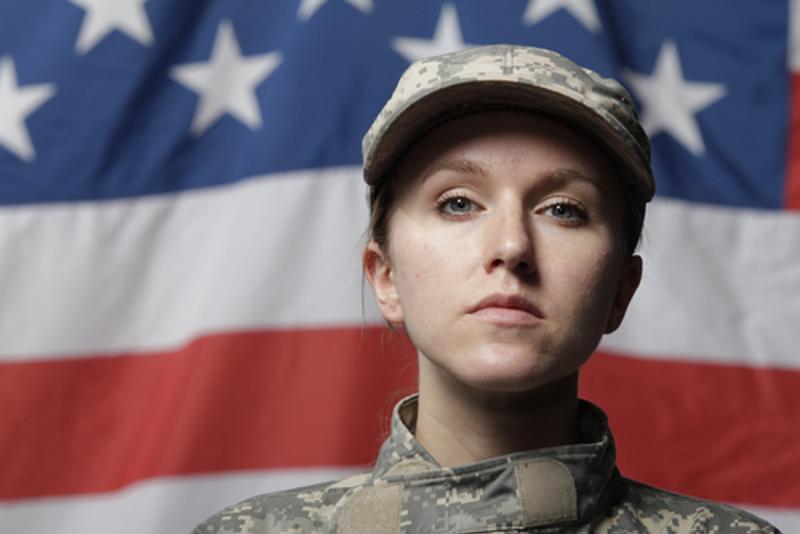
From Sara Emma Edmonds, who served in the Civil War as a man to Army Gen. Ann E. Dunwoody, the first female 4-star general, women veterans have made considerable contributions to the U.S through their service.
Comprising 10 percent of the armed services veteran population in the United States and projected to grow to 15 percent by 2030, women veterans experience some unique challenges and opportunities compared to male veterans, according to the U.S. Department of Veterans Affairs.
With more than 2 million women veterans there are many programs in place to provide an easier way for female veterans to transition back into civilian life and get started on their next chapter, whether that's going to school, starting a family or opening their own business. The National Woman's Veterans Summit serves as one such event where individuals can come together to learn about issues that affect women veterans, such as entrepreneurial training and opportunities.

The National Women Veterans Summit
The 2017 National Women Veterans Summit, originally scheduled for April but now moved to August, will celebrate the storied history and sacrifices made by women in the armed forces. The event, which takes place in Dallas, offers women veterans and their families a great opportunity to spark dialogues and collaboration among:
- Private industry.
- Nonprofit sector.
- Federal government.
- Innovators.
- Researchers.
- Caregivers.
This event marks the first national-level summit for women veterans since 2011 and will provide a platform to discuss the issues important to women veterans, on topics such as:
- Employment.
- Mental health.
- Entrepreneurship.
- Military sexual trauma.
- Reproductive health.
- Culture change.
While all of these are important women veterans issues, many attendees visit the summit for the chance to learn more about starting a new business or growing a current one.
Entrepreneurial aspirations
One of the more popular aspects of the National Women Veterans Summit is the guidance and workshops for boosting entrepreneurship among women veterans. Women veterans own more than 380,000 small businesses, according to the VA. Not only are these owners seeking new networking opportunities, many entrepreneurs and prospective founders attend the summit for guidance on how to get their business ideas up and running.
To help women in their pursuit of following the American dream and starting their own business or growing a current one, there are many different programs and resources already available for female veterans.
One such program is the VA's Office of Small and Disadvantaged Business Utilization, which helps veterans navigate the federal procurement system and increase participation.
The U.S. Small Business Administration also has several programs and offers several grants for women veterans. Some of these grants include the Veteran Women Igniting the Spirit of Entrepreneurship and the San Antonio Lift Fund, a seven-week entrepreneurship program. Late last year, the SBA and the VA partnered together to provide $300,000 in funding for women and veteran-owned businesses by granting up to six awards of at least $25,000.
The Coalition for Veteran Owned Business serves entrepreneurial military veterans by connecting them with additional programs for education and training on commerce and supplier opportunities.
For those individuals who need a place to network, collaborate and exchange ideas, Women As Veteran Entrepreneurs provides a forum for small-business owners to connect with subcontracting and mentoring opportunities, strategic information, business teaming and more.
With a proud history in the military and many outreach programs available, women veterans have many promising entrepreneurial opportunities awaiting them when they finish their service to our country.
In addition to wanting to serve their country, many people join the armed forces as a launchpad for a college education. The GI Bill and other military-based programs provide assistance to smooth out the transition and help fund a higher education. Active duty servicemembers interested in attending college after discharge should consider military-friendly universities and schools.
How the army helps vets attend college
Thanks to the passing of the GI Bill, the armed forces offers one of the best routes for Americans to gain access to a higher education. There are many options for colleges all across the country for our men and women in uniform, as well as a growing number of online programs. Best of all, many universities are uniquely suited to help veterans or servicemen and women transition from active duty to civilian life through campus engagement groups, veterans clubs and other memberships.
The military is there to help servicemen and women obtain a college education in many different ways. The Post-9/11 GI Bill provides financial help for those eligible for:
- Tuition and fee payments.
- Monthly housing allowance.
- Books and supplies stipend.
- One-time rural benefit for certain veterans.
For the 2017 academic year (Aug. 1, 2017 through July 31, 2018), the Post-9/11 GI Bill covers all tuition and fee payments for an in-state public school or up to $22,805.34 per academic year for a private or foreign school. The Post-9/11 GI Bill also established the Yellow Ribbon Program, which allows colleges, universities and other degree-granting programs to voluntarily work with the VA to fund any costs that the bill doesn't cover.

Top 10 best schools for vets
Active duty servicemembers researching schools for after discharge or current veterans who want to apply now should consider institutions that rank highly for being friendly to members of the military.
The Military Times released its Best for Vets: Colleges 2017, with its top 130 schools listed based on military enrollment, retention and graduation rates, as well as affordability, extracurriculars and Yellow Ribbon compliance. The Military Times listed the following as the top 10 schools:
- The University of South Florida, Tampa, Florida
- Rutgers, the State University of New Jersey, New Brunswick, New Jersey.
- Syracuse University, Syracuse, New York.
- Armstrong State University, Savannah, Georgia.
- D'Youville College, Buffalo, New York.
- Colorado State University, Fort Collins, Colorado.
- Georgia State University, Atlanta, Georgia.
- South Dakota State University, Brookings, South Dakota.
- University of Nebraska at Omaha, Omaha, Nebraska.
- The University of Kansas, Lawrence, Kansas.

Best military colleges online
Unlike traditional students who attend college after graduating high school, servicemen and women enter college after their enlistment period. This means many military personnel already have a family and a household in place that needs support. With so many responsibilities and limited resources, pursuing a degree online can be a smart move.
U.S. News & World Report released its list of Best Online Bachelor's Programs for Veterans, ranking the offerings to obtain a degree in higher education using predominantly internet-based coursework. The list relied on factors such as reputation, faculty credentials, retention rates and graduate debt loads. The publication also included whether the program has a critical mass of students with military backgrounds and if the school designed the programs to make them veteran-focused, either participating in the Yellow Ribbon Program or charging in-state tuition which the GI Bill can cover.
U.S. News & World Report's top five online bachelor's programs for veterans were:
- Embry-Riddle Aeronautical University-Worldwide, Daytona Beach, Florida.
- University of Oklahoma, Norman, Oklahoma.
- Arizona State University, Tempe, Arizona.
- Western Kentucky University, Bowling Green, Kentucky.
- California University of Pennsylvania, California, Pennsylvania.
With so many options to choose from, military personnel should have no trouble finding the college or university that best suits their financial needs and helps them transition back into civilian life.
With a nearly 2.5 million Americans now veterans of the conflicts in Iraq and Afghanistan, the need for programs and networks to help soldiers transition from military to civilian life is greater than ever.
According to a recent survey of veterans commissioned by The Washington Post and the Kaiser Family Foundation, 55 percent of respondents said they sometimes or often feel disconnected from civilian life after the end of active service.
While there are several ways for veterans to go about transitioning from military to civilian life – from social support groups to veteran empowerment organizations – one of the best options is focusing on fitness programs. Speaking with Homeland Magazine, long-time military fitness trainer, Tee Major, explained that newly minted veterans struggle with no longer being told what to do on a daily basis.
However, the structure provided by a regimented gym schedule can help ease the shift, in addition to providing the healthy and active lifestyle these former soldiers have been accustomed to living.

Veteran gyms and health programs on the rise
In an effort to help bridge this re-integration, gyms and facilities across the country are providing special programs to help veterans transition from military to civilian life.
The Outpost Training Facility is one such special gym. Located in Greenville, South Carolina, the facility has partnered with non-profits to provide better workout opportunities geared specifically to veterans, WSPA.com reported.
Launched by two veterans, Josh Formaneck and Matt Cassabon, the gym's aim is to not only encourage better health and fitness among veterans, but to also give these returning warriors a place to find camaraderie with their brothers and sisters in arms.
"This is a place where we can share those stories from our past with people that understand, that can relate and want to hear what we've been through," explained Formaneck.
While the Outpost Training Facility operates as a physical establishment, other programs exist online for veterans to use no matter where they're located.
In addition to his work as a military trainer, Tee Major created online specialty fitness programs to promote health and fitness among veterans. With guiding principles that incorporate the creeds and core values of the different military branches, fitness programs like these mirror the patterns and practices that are commonplace in the armed services.
Sometimes veterans must transition to civilian life following a major injury. Many gyms have launched programs aimed specifically at helping veterans who have suffered serious injuries. For instance, a Crossfit gym is Oregon is providing free membership for post-9/11 veterans who have a 30 percent disability or more, reported KTVL.
Finding careers in fitness
With such strong demand for gyms and fitness programs aimed at veterans, many former service members are getting into the game to help their brothers and sisters at arms. The discipline learned and stamina built up while in the military lends itself well to the rigors of being a personal trainer.
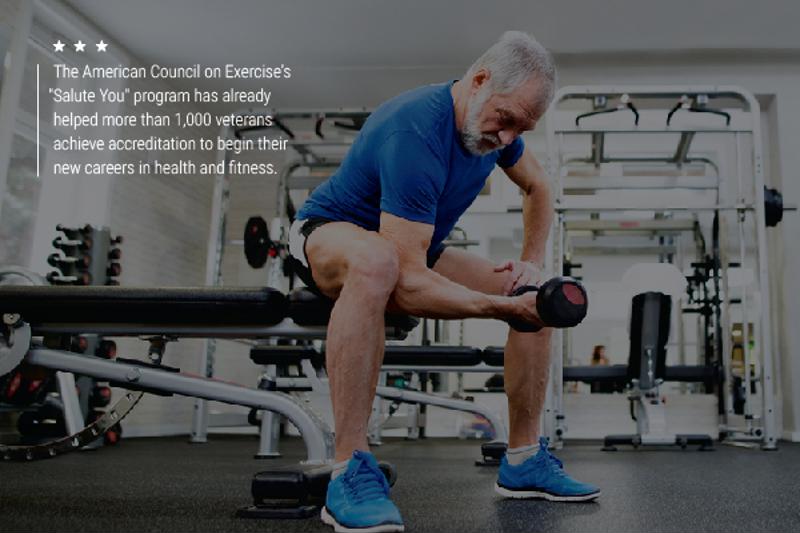
In an effort to assist veterans, the American Council on Exercise launched its Salute You Scholarship program, which helps honorably discharged military men and women in obtaining certification to become ACE Personal Trainers. With study materials, an exam registration voucher and one-on-one study assistance all provided free of charge, the American Council on Exericise's "Salute You" program has already helped more than 1,000 veterans achieve accreditation to begin their new careers in health and fitness.
First responders serving and protecting their communities are receiving a helping hand of their own thanks to new technology from the National Aeronautics and Space Administration (NASA).
Developed at NASA's Jet Propulsion Laboratory in Pasadena, Calif., the POINTER system is a tracking technology that helps first responders combat the unreliability associated with current GPS devices.
POINTER, which stands for Precision Outdoor and Indoor Navigation and Tracking for Emergency Responders, could represent a "Holy Grail" capability for the men and women who brave dangerous environments during emergencies, according to Greg Price, first responder technologies division director at the Department of Homeland Security (DHS).
"To this day, the ability to track and locate first responders is a number one priority for disaster agencies across the country," Price said. "If the POINTER project continues along its current path of success, first responders will be safer in the future."
"POINTER could represent a 'Holy Grail' capability."
When GPS is life or death
First responders such as firefighters rely on GPS to navigate treacherous environments. Reliable GPS data can make all the difference between escaping a burning building or rescuing a civilian trapped under debris.
Xenophon Gikas, fire captain at the Los Angeles Fire Department and part of the DHS' First Responder Resource Group, recently set the scene for Newsweek, illustrating how even in-depth first responder training is no match for the harsh realities of the job.
"It's hot and it's loud [at a fire]," Gikas said. "People are screaming, saws are going off.… We have blowers that we turn on to blow heat and smoke. It's a crappy environment. It's the worst one we have. That problem of trying to find one of us who's trapped or down or lost – whoever figures that one out is going to have the Holy Grail in their hand."
Instead of relying on radio waves, which can ricochet off walls or fail to penetrate indoors, the POINTER system utilizes magnetoquasistatic fields. This class of electromagnetic field has shown high accuracy and reliability indoors, providing first responders with detailed information regarding individuals' location, elevation and orientation.
Salvation the size of a cell phone
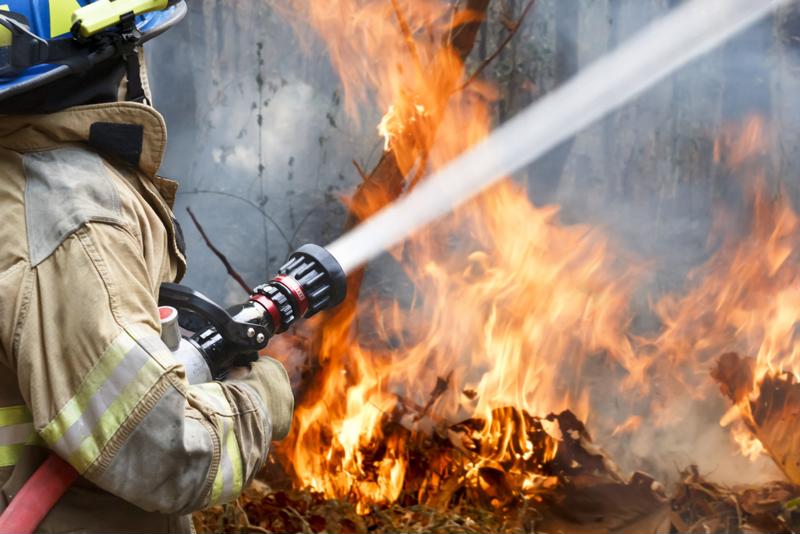
While POINTER is life-saving technology for first responders, it's also cumbersome in its current state. As highlighted by Newsweek, POINTER is approximately the size of a shoebox and weighs three pounds. Firefighters wear it like a backpack, with the field it generates being tracked by a separate device nearby.
Now plans are in motion to miniaturize this technology, replacing the backpack with a device the size of a cellular phone. It's hoped that in addition to being used by fire and police departments, the technology could be adopted by military personnel. There are also applications for POINTER to be used in space exploration.
"POINTER could be used in space robotics," said Darmindra Arumugam, the NASA researcher who led the technology's development. "It could be used for tracking robots in underground tunnels, caves or under ice. They need to be able to navigate themselves, and we don't have sensors today that would be able to track them. For us, this is a great opportunity to develop a technology for NASA and non-NASA uses."
The development of POINTER is in keeping with the DHS' renewed focus on new technologies for first responders. For example, the DHS selected 10 startup companies last year as part of its EMERGE 2016: Wearable Technology Accelerator Program. The program is intended to invigorate tech companies to create wearable tools that can replace the heavy and unwieldy equipment many first responders are forced to carry.
Field trials for POINTER are on the horizon, and following them, perhaps speedy adoption among first responders across the country.
We are proud to announce our 70th anniversary!
We were created as a nonprofit organization in 1947 with the support of General of the Army, Dwight D. Eisenhower. Initially formed in the basement of the Pentagon to provide $10,000 of life insurance to active duty officers serving overseas, we are one of the oldest and largest associations of our kind. Over the years, we have changed our name a few times, moved offices, added new products to our portfolio, and expanded our membership eligibility to cover all military, DoD, federal employees, and first responders. We have also created our own insurance company, 5Star Life, to underwrite our member eligible products and to serve our country's civilian work force through the worksite market.
"From workplace to war zone, we stand behind our insured families…"
While we have grown considerably and come a long way since our founding, our core mission remains steadfast – serving those who serve this great nation. And we will never be too large to forget that we are here to serve with integrity by offering flexible, customized insurance solutions.
Because there are no limits to the sacrifices our members and policyholders may be called up on to make, we do not exclude any occupation, duty assignment, deployment, or hazard from our protection at any time. From workplace to war zone, we stand behind our insured families, ready to deliver on our promise to pay claims quickly and compassionately. We hope to pay a benefit to the families suffering loss in every claim instance and we lean forward to do just that. And unlike anyone else in our industry, we offer a no cost scholarship benefit to the survivors of those whose deaths occur as a result of combat, terrorism, or participation as a first responder in an emergency.
We have paid almost $2 billion in claims, served thousands of members, and helped countless families achieve financial security in time of need. Today, we are 430,000 members strong, financially sound, and strategically positioned to face the future and serve new generations of members.
Thank you to our members, employees, field representatives, board of directors, and senior leaders as we say Happy Birthday AFBA!
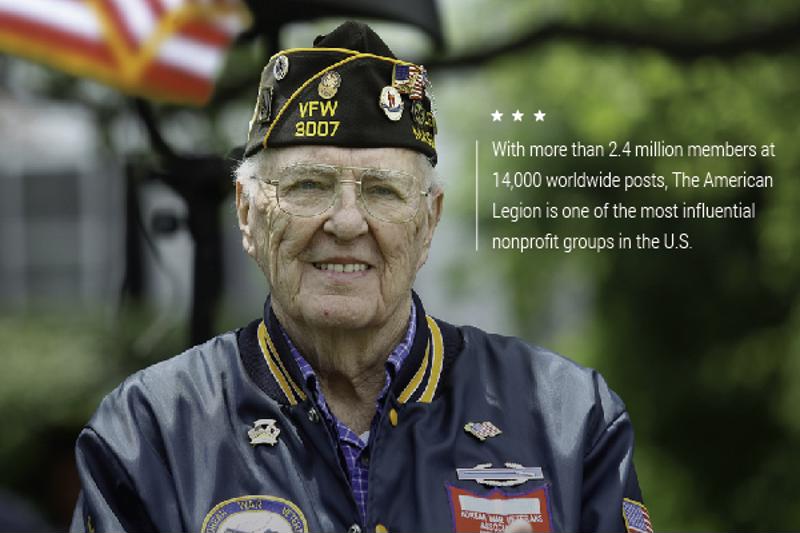
Founded in 1919, The American Legion celebrated its 98th birthday this year. During the nearly 100 years since its founding, The American Legion has not only made it their mission to ensure the well being of veterans, it's also made significant contributions to American society as a whole. With more than 2.4 million members at 14,000 worldwide posts, The American Legion is one of the most influential nonprofit groups in the U.S.
The history of The American Legion
In the aftermath of World War I, Colonel Ernest Lester Jones, a member of the First Army Air Service overseas, had the idea of creating a veterans group to commemorate the comradeship and sacrifices made by those who fought in the Great War, according to the National Oceanic and Atmospheric Administration. After convening a meeting of 375 veterans at the Cosmos Club in Washington D.C. on March 7, 1919, Col. Jones and the representatives decided not to form a permanent organization since so many soldiers were still deployed overseas. However, the caucus did organize the first unit and elect officers at this meeting.
Eight days later on March 15, another group of officers and members of the American Expeditionary Force met in Paris and formally adopted the name "The American Legion" for this fledgling veterans group.
Two months later, another caucus was held in St. Louis, Missouri, where the assembled individuals adopted the group's now world-famous preamble and constitution. Shortly after this caucus, the members unanimously elected Col. Jones as the first department commander of The American Legion.
Congress chartered The American Legion in September of that year, and the First Legion convention convened in Minneapolis that November.
Major accomplishments for veterans benefits
In the ensuing 98 years, The American Legion has made significant accomplishments for veterans in a variety of ways.
Only two years into their existence, the Legion was instrumental in the creation of the U.S. Veterans Bureau, which continues to this day as the Veterans Administration, a crucial department that helps meet the medical needs of veterans after their active duty service finishes.
In 1943, Harry W. Colmery, a former National Commander of The American Legion, began drafting the "GI Bill of Rights." A year later President Franklin D. Roosevelt signed the Serviceman's Readjustment Act, otherwise known as the GI Bill, which incorporated much of Colmery's draft.
Continuing its noble tradition today
Over the past 98 years, The American Legion has made a major impact in helping veterans receive funding for medical, disability, educational and other benefits. In addition, the group has also been influential in producing many important programs for children and youths.
More than 1,700 Boy Scout units, comprised of around 64,000 youths, owe their chartering agency to The American Legion. The American Legion Baseball program has about 82,000 youths involved each year, and more than 50 percent of players in Major League Baseball have graduated from the program. In 1946, the group presented a $50,000 grant to the American Heart Association, which was at that time a small, struggling organization. The funds allowed the Association to grow and to become a leader in the study, prevention and treatment of rheumatic heart disease.
In its ongoing effort to improve the mental and physical well being of veterans, The American Legion recently passed a resolution calling on Congress to "reclassify [cannabis] in a category that, at a minimum will recognize [it] as a drug with potential medical value" for veterans. The resolution stems from the potential for cannabis to help in the treatment of post-traumatic stress disorder and traumatic brain injury, two conditions that remain major problems for veterans.
With its centennial anniversary around the corner, The American Legion remains a positive force in advocating for veterans benefits and other social endeavors.
On Wed. Jan. 11, President-elect Donald Trump announced Dr. David Shulkin, undersecretary of health for the Department of Veterans Affairs, as his pick to assume the top leadership role at the agency, The New York Times reported. The physician currently leads the Veterans Health Administration, which serves an estimated 8.76 million former service members each year at 1,700 sites across the country. The Senate must confirm Shulkin before he can take over as VA secretary.
The choice was a pleasant surprise to veterans groups, as many had expected Trump to select an outside candidate to lead a top-down transformation of the department.
“The Trump campaign made a big deal of what a sucking chest wound the VA was,” Phillip Carter, an Iraq War veteran and director of the Military, Veterans and Society Program at the Center for a New American Security, told the newspaper. “Then they realized how hard it would be to turn around, and decided they needed to continue with the reforms that are already taking effect.”
A physician takes the helm
Shulkin, a board-certified internist, held numerous leadership positions in the private health care sector and founded a physician ratings service before joining the VA in June 2015. President Barack Obama was responsible for his appointment, according to NPR. For all his medical expertise, Shulkin is not a veteran and, if confirmed, will be the first secretary of veterans affairs without military experience. So far, key service member organizations have expressed support for the physician despite his strictly civilian resume, The Washington Post reported.
“The VFW is proud to support the nomination of Dr. David Shulkin as the next secretary of veterans affairs, and we are most appreciative of his willingness to continue serving veterans and making the VA better,” Brian Duffy, the national commander for The Veterans for Foreign Wars, said in a statement to the newspaper.
While Shulkin lacks the armed services background of past VA administrators, many believe he comes equipped with a deep knowledge of the department and the demonstrable skills needed to oversee a vast network of services. In fact, in his current position, he leads the largest integrated health care system in the country. Overall, those familiar with the day-to-day operations say Shulkin will be able to transfer into his new role seamlessly with little lag time, allowing the VA to continue with internal improvement efforts started during the Obama administration.
“Someone new coming in could take a year just to understand the issues,” Nancy Schlichting, former chief executive for the Henry Ford Health System, explained in an interview with The Times. “Someone like David Shulkin really provides continuity that can get reforms moving forward.”
 Shulkin hopes to reform the VA and forge partnerships with private health care and service providers.
Challenges ahead
Even with recent improvements, further changes are needed to improve the inner-workings of the VA and provide better services to the veterans it serves. Shulkin has some experience in this area, as he was directly involved with improving the Veterans Choice Program, an initiative designed to connect former service members with private physicians. The program suffered from internal flaws from the outset, leaving many veterans waiting months for care. Shulkin and his colleagues stepped in to address the problems last year.
In an interview with NPR soon after interceding to correct the floundering initiative, Shulkin laid out what many now believe will serve as his modus operandi as VA secretary.
“This is a different VA. We’ve brought in people from the outside who have private sector experience. And what we’re saying is that we have to do business differently,” Shulkin explained.
If confirmed, the physician must address a number of large-scale issues impacting the VA and ex-military personnel across the country, including personnel shortages, large volumes of backlogged disability claims and growing opiate addiction and suicide rates. For his part, Shulkin plans to take the issues head on and introduce sweeping reforms that could greatly improve both the department and the former service members it serves.
Soon after announcing Shulkin’s appointment during a press conference Jan. 11, President-elect Trump issued a statement praising the VA official.
“I have no doubt Dr. Shulkin will be able to lead the turnaround our Department of Veterans Affairs needs,” Trump said. “His sole mandate will be to serve our veterans and restore the level of care we owe to our brave men and women in the military.”
The Senate is expected to hold a confirmation hearing for Shulkin in the near future, Politico reported.
Veterans in southeast New York struggling with post-traumatic stress disorder and other psychological wounds of war now have a new therapeutic resource, according to the Times-Herald Record. Squirrelwood Equine Sanctuary in Montgomery recently debuted a recovery program that helps these former service members regain control over their lives and connect with other veterans dealing with deployment-related problems through horses.
Social worker Christine Bruckner started the service, which teaches participants how to care for and handle the animals. This introduces a steady routine into their lives, allowing them some semblance of self-possession. Plus, the wide open spaces of the 92-acre property allow veterans to peacefully evaluate their issues and form bonds with fellow attendees.
“It opens up a whole conversation about those changes – and how, often, they really want to get back to that pre-deployment self, but they can’t, and how do they bridge that gap in finding a new normal,” Bruckner explained to the news source. “There are a lot of complex things that they’re coming back with that can be healed much more effectively if they’re talking about these things with other guys who have been through that.”
 Equestrian therapy can help veterans combat PTSD and other deployment-related psychological conditions.
An equestrian solution
Equestrian therapy emerged during the 1990s with the help of Army veteran and cowboy Greg Kersten. In 1997, the Nebraska native developed a formalized training program based on the technique and founded the Equine Assisted Growth and Learning Association, an international nonprofit that equips social workers and therapists with the skills they need to successfully host such therapy sessions. Kersten believes veterans, through military training, are conditioned to function in groups or, as he calls them, “herds.” In his estimation, former service members must work to build new herds after re-entering the civilian world. Equestrian therapy helps veterans realize they need help from others and catalyzes the search for a new support system that not only includes family members and friends but also fellow ex-military personnel.
“Even though (veterans have) come back home to a supposedly familiar herd – their family, their friends – they’re being treated differently by the herd … The returning veteran feels less safe even with his family than he did with the other soldiers,” he told the Times-Herald Record.
In the years since Kersten popularized the method, a host of psychological professionals and service organizations have come to support it and its core tenets. In fact, the Department of Veterans Affairs now recommends equine-assisted therapy as a treatment for PTSD. Consequently, such initiatives have popped up at ranches around the country.
The Squirrelwood approach
The program at Squirrelwood established exercises associated with equestrian therapy, including an introductory assignment in which veterans choose horses with personalities that mirror their own. However, it does offer an added wrinkle: All of the horses involved were rescued from untoward owners.
“During an introductory session, veterans choose horses with personalities that mirror their own.”
“It’s really a unique and remarkable place,” Ed Kangas, one of the many donors who helped fund the equestrian program at Squirrelwood, told the Times-Herald Record. “It’s really very, very special. It’s a way to help those animals, but it’s also a way to help people who have been damaged and abused by war.”
Kangas and his wife Cathy donated $100,000 to Squirrelwood last month, Patch reported. Former Nebraska Sen. Bob Kerrey, who served as a Navy SEAL and earned the Medal of Honor prior to entering public service, helped the couple fundraise the sum through a charity event.
Currently, four veterans are enrolled in the program, which is comprised of 12 separate sessions spread out over three months. Total fees amount to $3,000.
Ultimately, Bruckner hopes expansion is on the horizon, as veterans and their supporters embrace equestrian therapy and its healing, herd-building potential.
On Thursday Jan. 5, 32 disabled veterans sped through the streets of Miami during the 12th-Annual Soldier Ride, according to the Miami Herald. The Wounded Warrior Project hosts the four-day event, which allows former service members to explore a large swath of Southern Florida via bicycle. Along the way, participants break at scheduled stops, including the Miami zoological park Jungle Island and the Truman Little White House, a vacation home located in Key West that regularly hosted President Harry S. Truman.
"This program forces us to push our limits, to get ourselves out there," Kevin Matos, an Army National Guard veteran participating in the event, told the newspaper. "We suffer from social anxieties and it is really uplifting to be able to undergo this struggle with people who are like us."

Get rolling again
The first Soldier Ride took place in 2004 and included a single rider, Amagansett, New York, bartender Chris Carney. With encouragement from friends and family, Carney set out to raise money for veterans by completing a 4,000-mile, coast-to-coast bike ride. The New York native successfully raised more than $1 million for the Wounded Warrior Project. One year later, two veterans – retired Army Staff Sergeant Heath Calhoun and Army Reserve Staff Sergeant Ryan Kelly, both of whom suffered catastrophic lower-leg injuries during Operation Iraqi Freedom – joined Carney on a 4,200-mile ride from Long Island to San Diego. The event not only inspired a feature-length documentary but also led the Wounded Warrior Project to establish an annual bike outing based on the trek.
Now, cities across the country host these events, many of which draw immense crowds and important attendees. President Barack Obama has attended every Washington, D.C., Soldier Ride since he took office in 2009. In April of last year, he kicked off the journey with prepared remarks and one piercing ring from an air horn, according to the White House.
"You represent what's best about our nation, and I hope all of the American people along the route will come out and show their support for these heroes, not just today but every single day," he told the 65 participants.
Cycling through South Florida
While the Miami event lacked a presidential appearance, many locals came out to cheer on the riders, several of whom rode custom-made bicycles designed for physically disabled veterans. Most of the rigs were constructed days prior to the Thursday kickoff, local news station WSVN reported. Workers from the Wounded Warriors Project and volunteers assembled the bikes, some of which featured hand-powered gears for cyclers with missing limbs. Those participating in the race voiced their appreciation for the bikes, which were ready to go just in time for the start.
"Yeah, I didn't have to do any adjustments, which is actually kind of amazing," Air Force veteran and Soldier Ride participant Kyle Cook told the news station.
The veterans involved with the event wait in anticipation throughout the year, as the four-day sojourn gives them the unique opportunity to stretch their muscles, see the sights, connect with fellow service members and bolster their self-confidence in the face of immense challenges, NBC Miami reported.
"When you go through severe trauma you need to be reminded that you have the ability to do whatever you want, no matter what your injury is, whether it's physical or mental you can overcome anything," Air Force veteran Sebastiana Lopez-Arelano told NBC Miami.
With solid funding and a strong reputation among former service members, Soldier Rides will continue to bring veterans and their supporters together for the foreseeable future in Miami and cities throughout the U.S.
Michigan legislators have passed new legislation that will fund two new veterans care facilities in Detroit and Grand Rapids, according to MLive. Sen. Dave Hildenbrand, a Republican, sponsored Senate Bill 1100, the centerpiece of the four-part legislative package giving state officials the authority and capital they need to construct the sites.
"Our veterans have served our nation valiantly and deserve the best possible care," Hildenbrand told the publication. "This legislation will modernize the way our veterans homes operate and transform them into facilities that can quickly and easily adapt to the ever-changing nature of long-term care services."
The senator's legislation allows for the creation of an autonomous regulatory body within Michigan's Department of Military and Veterans Affairs (DMVA), one local ABC affiliate reported. This work group will have the authority to allocate funding, purchase property and enforce local, state and federal compliance standards. On Jan. 11, Gov. Rick Snyder signed SB 1100 and its three counterparts into law.

New facilities coming to Michigan
Building new facilities in Detroit and Grand Rapids will be the first task for the freshly formed body. Each site will cover roughly 132,000 square feet and include 120 beds, residential units and expansive common spaces. Construction is scheduled to begin in June 2018 and end in August 2019. Together, the buildings carry a total price tag of $108 million, including almost $66 million in federal funding. State officials must apply for the latter before work can begin in earnest.
An answer to statewide concerns
In recent years, the DMVA has faced criticism for its treatment of Michigan veterans. In February of last year, state auditors discovered that employees at the Grand Rapids Home, a clinic for ailing former service members, failed to follow up on allegations of abuse and neglect and issue prescriptions in a timely fashion. Additionally, the facility suffered from crippling staffing shortages that went unaddressed.
Jeff Barnes, director of the Michigan Veterans Affairs Agency, a subdivision of the DMVA responsible for coordinating benefits for former service members, resigned in the wake of the audit, the Detroit Free Press reported. In the months following Barnes' departure, Michigan legislators developed an exhaustive strategy to improve veterans facilities and services statewide. This strategy includes the provisions in SB 1100 and other overarching reforms.
Hildenbrand and his colleagues in the Michigan legislature hope to meet the April deadline for federal funding and start improvements as soon as possible.