
Every November since 1993 has been federally recognized as Military Family Appreciation Month. During this month, several military-themed holidays are celebrated. This period is a great opportunity to show your appreciation for both veterans and military families who have loved ones in the armed forces. If you know any of these people in your life or just want to anonymously help out with those you might not know, November is the perfect time to show them you recognize the uncommon challenges they go through.
Military families serve along with their loved servicemembers. They are aware of the risks involved in serving in the armed forces as well as the sacrifice of being away from them during long periods of training and deployment.
The history of Military Family Appreciation Month
In 1993, the Armed Services YMCA looked for a way to honor military families and recognize their sacrifice, dedication, and contributions to the armed forces which they’re an intrinsic part of. Thus, they came up with Military Family Appreciation Month as a time to do exactly that. After being officially endorsed by the President of the United States, November was chosen as the month in which the observation would take place.
 The appearance of the U.S. Department of Defense (DoD) visual information does not imply or constitute DoD endorsement.
What military-related holidays happen in November?
Several important holidays take place in November, and they’re perfect opportunities to plan out your shows of appreciation.
First is the Marine Corps’ Birthday on Nov. 10. This originated in 1921, when Marine Corps Order No. 47 was issued. This order intended to commemorate the founding of the Marine Corps and directed that it be repeated each year on the same day. This day is typically commemorated with the annual Marine Corps Birthday Ball. First held in 1925 and observed every year since, the ball includes entertainment, cake, and a formal dinner.
The celebration of the Marine Corps’ birthday has evolved over the years. In 1923, a formal dance was held at the Marine Barracks in Ft. Mifflin, Pennsylvania. Meanwhile, a mock battle occurred at the Washington Navy Yard, and a baseball game was held at Guantanamo Bay, Cuba. Later, in 1925, the first official Birthday Ball was held in Philadelphia. The cake-cutting ceremony began in 1952, which included the first piece of cake being presented to the oldest Marine present and being passed to the youngest as a symbol of the tradition passing.
After that is Veterans Day on Nov. 11. This day is especially important, as it is a federally-recognized holiday specifically meant as a day to pay respect to veterans. The day was originally known as Armistice Day to commemorate the end of World War I, but was later expanded to include all veterans.
Thanksgiving is also a part of Military Family Appreciation Month as one of the ideal times to give thanks to the people in our armed forces who have dedicated their lives to keeping America and its citizens safe from harm. Military families at the Thanksgiving table can use this opportunity to appreciate their loved servicemembers, while non-military families can take the time to show respect to both servicemembers and their families.
However you choose to recognize the holidays during Military Family Appreciation Month, it’s important to always give thanks both to servicemembers and their families so they know they’re loved and appreciated. In addition to the ever-important respect toward the members of the armed forces themselves, remember that the families of servicemembers have their own unique challenges to tackle every day and they deserve recognition just as much as their cherished servicemembers do.
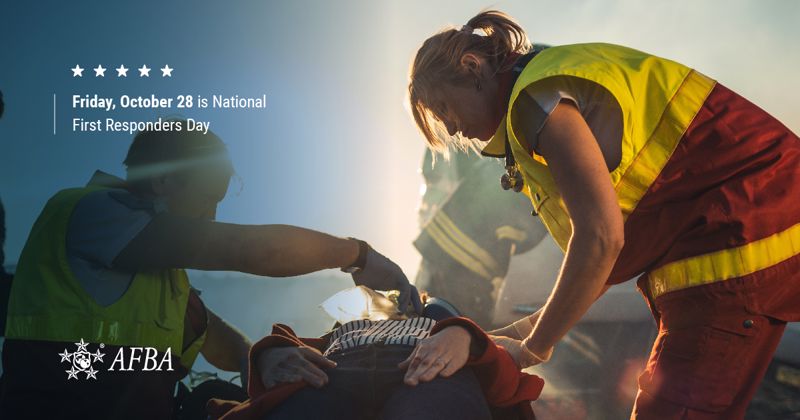
National First Responders Day is here on Oct. 28, and it’s a time to honor the efforts of first responders everywhere who work selflessly to keep Americans safe. How can you do that? One of the best things you can do for a first responder is to appreciate the trauma and harsh reality these individuals experience daily.
Helping Our Heroes With Post-Traumatic Stress Disorder and Alcohol Addiction
Being a first responder is one of the most difficult jobs anyone can do. Paramedics, police officers, and firefighters have a sworn duty to protect others in the harshest of conditions. They are the first at the scene to witness scenes of violence, suffering and death while also having to think clearly and remain calm.
This takes a toll on many of them. The proof of this is in the data: According to the Help For Our Heroes Program, 14.6% of paramedics face PTSD at least once in their lifetime, with firefighters having a 7.3% rate and police experiencing a 4.7% rate. Rates of alcohol and drug abuse are also far higher than in the general population. According to a study cited by the Nova Recovery Center, nearly a third of firefighters suffered from alcohol addiction.
 The appearance of the U.S. Department of Defense (DoD) visual information does not imply or constitute DoD endorsement.
Don’t Suffer in Silence: Newport News, Virginia, Holds an Awareness Event for First Responders
With mental health disorders on the rise in the first responder population, there must be hope for these protectors of the people. The first responders of Newport News, Virginia with the local Critical Incident Stress Management Team are trying to help them.
A public meeting was held at the First Baptist Church with the objective of aiding first responders in dealing with the trauma and stress of their professions.
Darius Davis, a Newport News police officer and crisis negotiator, was a speaker at the event. “Suicide affects military, police and first responders 80% more than any other population,” he claims.
Joining him was city fire department Battalion Chief David Lewis. The two have something in common: Both admit to having considered suicide as a solution to their seemingly impossible levels of stress.
Lewis recalls a memory of when he was pulling into a parking lot near his fire station. While trying to cope with the stresses of his job, which included responding to calls involving shootings, stabbings, murder, and suicides, he had lost a child just six hours before. He says he felt he had “no solution” for any of the problems he was dealing with, so he “basically shut down.” Lewis kept his thoughts to himself for nearly two years before finally seeking help. Now, he works to prevent others from suffering as he did, encouraging them to reach out instead of suffering in silence.
Suicide Prevention Month ended in September, a time in which discussions around suicidal thoughts, the stigma of mental health, and the effects they have on preventing many from seeking help are encouraged. Mental health affects people from all walks of life, but in the first responder community, it’s especially problematic as many in the field don’t see any means of relief.
Helping Others First Comes at a Cost, But We’re Making Progress
National First Responders day is a time meant to show appreciation for first responders in everything they do. This includes acknowledging the realities of the job and the toll they take on these paragons of courage. There’s a lot of work to be done, but we’re slowly but surely making it just a bit easier for first responders to continue to selflessly serve us by paying attention to the realities of their experiences.
A firefighter is one of the most honorable and difficult positions one can imagine. They’re first responders who are expected to arrive at the scene of any emergency call before anyone else. Having undergone EMT training and being responsible for running headfirst into the thick of danger, it might seem like firefighters know exactly what to do in any situation.
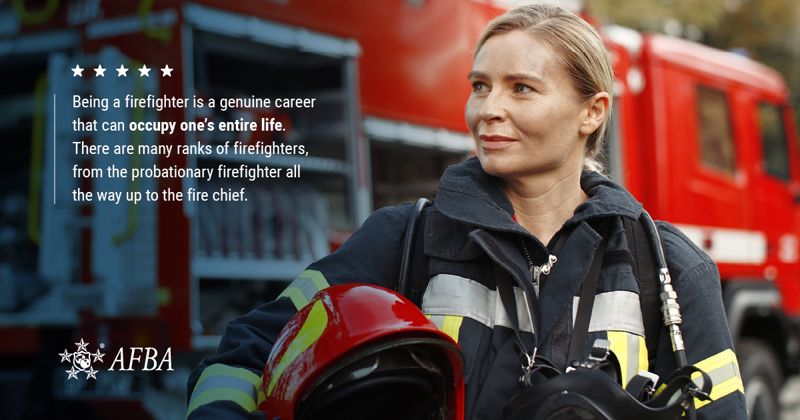
However, firefighters have superior officers, too, and those officers were once firefighters themselves. Being a firefighter is a genuine career that can occupy one’s entire life. There are many ranks of firefighters, from the probationary firefighter all the way up to the fire chief.
Here’s what the career path of a firefighter often looks like:
 The appearance of the U.S. Department of Defense (DoD) visual information does not imply or constitute DoD endorsement.
Probationary firefighter
As soon as someone meets the requirements in the recruit academy, they can start their journey as a probationary firefighter. This period lasts anywhere between 12 and 18 months and requires exemplary commitment and effort.
A probationary firefighter’s job isn’t easy, nor is it supposed to be. Their working hours will be long, and their sleeping periods will be strict. Above all, they’re expected to prove that they’d make a good firefighter, which means that they can get along with others.
Firefighter
If a prospective firefighter can make it through their probationary period, they become an official firefighter. Firefighters have four main jobs, including:
- Extinguishing fires.
- Investigating the causes of fires.
- Aiding anyone who might be injured.
- Helping prevent fires.
A firefighter is also responsible for rescuing people who are in danger, including during incidents not related to fire, such as natural disasters and auto accidents. Because virtually all firefighters have EMT training, they’re prepared to protect those in danger and administer first aid to anyone in need.
Driver engineer
These are the individuals who drive the fire truck and are duty-bound to get people in and out of a call safely.
Driver engineers need to have mastered the ins and outs of fire apparatus systems, fire trucks, equipment, and water supplies to do their job effectively because they’re responsible for all of these things.
Lieutenant
The firefighter lieutenant is capable of all the tasks of a driver engineer, plus ensuring the function of the fire department. They’re responsible for inspecting buildings to make sure they don’t have any fire hazards and conducting training exercises to prepare for special emergencies such as earthquakes and chemical spills.
Captain
A firefighter captain is responsible for managing their station. When at the scene of a fire, the captain assesses the situation and plans a course of action for firefighters to follow.
Depending on the size of the station, a firefighter captain may have staff working under them or, as the most senior officer at the station, be responsible for the operations of the entire unit.
Battalion chief
The battalion chief is the first rank of all the chief officers. Similar to other ranks, they’re responsible for fire safety compliance, equipment operation, staff evaluations, and making sure the station is in top shape. They have the additional task of being responsible for all officers under them, from the captain on down.
Assistant chief
Assistant chiefs are the second in command, taking over when the fire chief is out. They assist the fire chief in all tasks, including strategic and operational planning for fire stations. Having mastered the previous ranks, they’re extremely capable individuals.
Fire chief
Fire chiefs are the head honchos of the fire department. These individuals are responsible for strategizing and collaborating with local government officials to ensure the fire department is prepared for anything and to prevent disasters from happening in the first place.
Since the war on drugs officially began in 1971 under President Nixon, U.S. armed forces have been deployed in areas where drugs run rampant in an effort to reduce the number of narcotics entering the country. The U.S. government and its armed forces have stepped up tremendously in their efforts, with over $1 trillion spent on the war on drugs since its inception.
The war on drugs is still ongoing and shows no signs of ending any time soon, but that doesn’t mean the U.S. armed forces are going to idly sit by and watch drug smugglers and criminal organizations succeed. On the contrary: There have been numerous efforts to interrupt the flow of narcotics and keep both the U.S. and other countries safe from harm.
U.S. Coast Guard helps seize $475M worth of drugs from smugglers
The Navy is a key part of the U.S. armed forces’ contributions to the war on drugs. This year, a U.S. ship cooperated with a Royal Netherlands Navy vessel to confiscate $475M worth of drugs from smugglers in the Caribbean Sea and the Eastern Pacific Ocean. This included 3,892 pounds of marijuana and 24,700 pounds of cocaine. The seizure was ultimately hauled in and unloaded in Miami Beach.
Cdr. Jeremy M. Greenwood, the commanding officer of the 270-foot cutter stationed in Virginia named the Legare, praised the crew responsible for the bust, citing their commitment to duty. He also applauded the various crews who contributed both to the mission and the ongoing counter-drug campaign, which included the “dismantling of transnational criminal organizations.” He proudly claimed the operation “will result in significantly fewer drug-related overdoses.”
 The appearance of the U.S. Department of Defense (DoD) visual information does not imply or constitute DoD endorsement.
The U.S. Air Force sends help to Curacao to combat narcotics trafficking
40 miles off the coast of Venezuela is the island of Curacao. This nation is a Caribbean island that has a close alliance with the U.S. Together, they’ve spent two decades fighting international narcotics trafficking and transnational criminal organizations in the area. In 2020, those efforts gained a big boost in the form of extra equipment and personnel.
After the U.S. State Department accused Venezuela of drug trafficking, they sent four U.S. Air Force aircrafts to the island. These planes were meant to run detection and monitoring operations in an effort to interrupt the flow of drugs coming from Venezuela and surrounding areas.
The armaments introduced included an E-3 Sentry surveillance aircraft, an E-8C Joint Surveillance Target Attack Radar System plan, and two KC-135 Stratotanker aerial refueling aircrafts. Combined, these new assets, in addition to 200 extra personnel at the Cooperative Security Location (CSL), should give Curacao a leg up on drug trafficking operations in the area.
Air strikes used to destroy Taliban drug labs
Afghanistan has a primarily opiate-based economy. While the U.S. was still attempting to occupy Afghanistan in 2018, the U.S. armed forces, together with the Afghan military, targeted drug labs for precision air strikes. The U.S. Air Force’s F22A Raptor aircraft armed with small-diameter bombs were used to minimize civilian casualties.
The U.S. military has worked hand-in-hand with many foreign governments and entities in an effort to reduce drug trafficking and the spread of drugs into the U.S. and internationally. While the efforts are still ongoing, the U.S. armed forces have made significant progress in interfering with transnational criminal organizations and drug smugglers across the world. While the war on drugs persists, the U.S. armed forces constantly look for ways to help end it.
In many ways, Electric Vehicles (EVs) are vastly superior to traditional gasoline-powered vehicles. While it's true that they're environmentally friendly and arguably vital to stopping the damage to nature caused by carbon emissions, it's also a fact that EVs are very, very fast and comparatively much easier to maintain. This makes them superb vehicles for first responders.
With the planned switch to EVs comes some challenges, however, as these vehicles are wildly different from their predecessors in ways that first responders need to anticipate. A few companies are preparing for exactly that.
EVs are being introduced to the New York Police Department
What does a 480-horsepower all-electric police interceptor look like? It looks exactly like the Ford Mustang Mach-E GT, the police interceptor version of which was presented in Apr. 2022 at the Javits Center for the New York International Auto Show.
With the advent of EVs and their colossal growth that's set to overtake sales of gasoline-powered vehicles as soon as 2025 by some estimates, the NYPD stepped up and purchased its first Tesla Model 3 EV to be used as a patrol vehicle in 2021. By the middle of Apr. 2022, New York City approved the purchase of 250 more. Now, intending to be carbon-neutral by 2050, NYC has begun an initiative to make its entire vehicle lineup completely electric by 2035 starting this year with the Mach-E GT.
Out of a variety of potential EV police interceptors, the Mach-E GT scored the highest for sheer acceleration — able to hit 60 mph from zero in 3.5 seconds — and braking. The Mach-E GT is capable of traveling 270 miles on a full charge with its 88 kWh battery pack.
GM is introducing an EV First Responder Training program
As part of GM's new EV lineup, which includes the Cadillac Lyriq, GMC Hummer EV, and Chevrolet Bolt, the company is advancing a training program for first responders to introduce them to the unique challenges that EVs hold in situations involving them.
For example, unlike traditional gasoline-powered vehicles, EVs place much of the weight in the vehicle at the bottom. This is where the battery pack is typically located, often weighing thousands of pounds. It's not just the redistributed weight that can make rescuing the people inside a challenge, it's also the sheer amount of energy that's stored in the battery pack.
The courses combine live presentations, virtual demonstrations, videos, and discussions from experts. GM encourages both first responders and owners of EVs to take advantage of its program.
GM isn't the only company involved in training first responders
In addition to GM's efforts, Tesla maintains a dedicated website intended for first responders. Its purpose is for "helping the fire departments and first responders safely handle emergency situations involving all Tesla products." Included are "emergency response guides" and "quick response sheets," individually produced for many of their vehicles.
The National Fire Protection Association (NFPA) maintains its own Emergency Response Guides compiled from over 60 manufacturers for first responders to use as reference. From newer companies such as Lucid to established brands such as Ford and Jeep, all of its guides are free to download and readily available.
The advantages of EVs make them excellent vehicles for first responders both from a performance and maintenance standpoint. Nonetheless, while these benefits are numerous, there are still some challenges to overcome before they can become mainstream for first responder units. These groups need to be aware of the hazards and mechanical differences inherent to these cars and trucks to avoid unnecessary injury. Companies such as GM and Tesla as well as the NFPA are attempting to make the switch as seamless as possible so first responders can take advantage of these new vehicles.
In many ways, Electric Vehicles (EVs) are vastly superior to traditional gasoline-powered vehicles. While it’s true that they’re environmentally friendly and arguably vital to stopping the damage to nature caused by carbon emissions, it’s also a fact that EVs are very, very fast and comparatively much easier to maintain. This makes them superb vehicles for first responders.
With the planned switch to EVs comes some challenges, however, as these vehicles are wildly different from their predecessors in ways that first responders need to anticipate. A few companies are preparing for exactly that.
 The appearance of the U.S. Department of Defense (DoD) visual information does not imply or constitute DoD endorsement.
EVs are being introduced to the New York Police Department
What does a 480-horsepower all-electric police interceptor look like? It looks exactly like the Ford Mustang Mach-E GT, the police interceptor version of which was presented in Apr. 2022 at the Javits Center for the New York International Auto Show.
With the advent of EVs and their colossal growth that’s set to overtake sales of gasoline-powered vehicles as soon as 2025 by some estimates, the NYPD stepped up and purchased its first Tesla Model 3 EV to be used as a patrol vehicle in 2021. By the middle of Apr. 2022, New York City approved the purchase of 250 more. Now, intending to be carbon-neutral by 2050, NYC has begun an initiative to make its entire vehicle lineup completely electric by 2035 starting this year with the Mach-E GT.
Out of a variety of potential EV police interceptors, the Mach-E GT scored the highest for sheer acceleration — able to hit 60 mph from zero in 3.5 seconds — and braking. The Mach-E GT is capable of traveling 270 miles on a full charge with its 88 kWh battery pack.
GM is introducing an EV First Responder Training program
As part of GM’s new EV lineup, which includes the Cadillac Lyriq, GMC Hummer EV, and Chevrolet Bolt, the company is advancing a training program for first responders to introduce them to the unique challenges that EVs hold in situations involving them.
For example, unlike traditional gasoline-powered vehicles, EVs place much of the weight in the vehicle at the bottom. This is where the battery pack is typically located, often weighing thousands of pounds. It’s not just the redistributed weight that can make rescuing the people inside a challenge, it’s also the sheer amount of energy that’s stored in the battery pack.
The courses combine live presentations, virtual demonstrations, videos, and discussions from experts. GM encourages both first responders and owners of EVs to take advantage of its program.
GM isn’t the only company involved in training first responders
In addition to GM’s efforts, Tesla maintains a dedicated website intended for first responders. Its purpose is for “helping the fire departments and first responders safely handle emergency situations involving all Tesla products.” Included are “emergency response guides” and “quick response sheets,” individually produced for many of their vehicles.
The National Fire Protection Association (NFPA) maintains its own Emergency Response Guides compiled from over 60 manufacturers for first responders to use as reference. From newer companies such as Lucid to established brands such as Ford and Jeep, all of its guides are free to download and readily available.
The advantages of EVs make them excellent vehicles for first responders both from a performance and maintenance standpoint. Nonetheless, while these benefits are numerous, there are still some challenges to overcome before they can become mainstream for first responder units. These groups need to be aware of the hazards and mechanical differences inherent to these cars and trucks to avoid unnecessary injury. Companies such as GM and Tesla as well as the NFPA are attempting to make the switch as seamless as possible so first responders can take advantage of these new vehicles.
First observed in 1968 by President Lyndon Johnson as Hispanic Heritage Week and later broadened into 30 days and enacted into law by President Ronald Reagan Aug. 17, 1988, Hispanic Heritage Month runs from Sept. 15 to Oct. 15 every year. The month is a recognition and celebration of Hispanic people including those in the armed forces as well as first responders, as there are many unique and notable Hispanic service members, police, firefighters and paramedics all deserving of our honor.

Staff Sgt. Henry Meza: "He's going to be a soldier."
Staff Sgt. Henry Meza, a Honduran-born member of the Iowa National Guard, had the idea from a very young age that he was destined to serve. His grandmother used to say to friends and family, "He's going to be a soldier."
Growing up in his birthplace of Siguatepeque, Honduras, which had no electricity, Meza helped out with his family's coffee business by working on a farm. He regularly hauled 100-pound bags of coffee beans on his back at the age of 10. When he was 12, he immigrated to the U.S. to join his mother in New Jersey. Having been very active in school with track, wrestling and soccer, he earned a sports scholarship to Grand View University in Iowa. In 2012, he enrolled in the Iowa National Guard.
Meza found a special place in the National Guard's Service to Citizenship program, which helps relatives of young adults in the Guard become U.S. citizens. Meza, who gained citizenship in 2013, is well aware of how arduous the process can be without assistance from initiatives like these. Speaking of the program, he says diversity makes the National Guard more capable by connecting the military branch to different cultures and walks of life. When those people see others who share the same culture, they're more inclined to join the Guard, he says.
Sergeant Diana Munoz: The first Hispanic police sergeant in Greenville, S.C.
Diana Munoz knows that when first responders answer a call from a Hispanic family, they might be wary of trusting them. But when Munoz, who was born in Colombia, South America shows up, they're immediately put at ease.
A historic figure in Greenville, S.C., Munoz was the first Hispanic police sergeant to serve in the town's police department. As a supervisor, she's responsible for officers both in the Law Enforcement Center and when they're outside and on-duty.
Munoz hopes to one day be a police captain, though she acknowledges that she has a lot of work to do to reach that goal.
Joining Forces With the First Fully Spanish SNCO Course
New Mexico Air National Guard Master Sgt. Diana Melero-Sena participated in the first International Senior Noncommissioned Officer Course hosted completely in Spanish at Joint Base San Antonio-Lackland, Texas, between Oct. 4 and Dec. 8, 2021. Taught in the course were core leadership principles, ways to unite different forces and best practices meant to inspire the formation of strong professional relationships. Melero-Sena was one of two Citizen-Airmen who enrolled. The proud daughter of Mexican immigrants, she said that when she heard the Inter-American Air Forces Academy (IAAFA) was hosting a fully Spanish SNCO course, she knew she had to attend.
As the National Guard knows, with diversity comes strength. People of different cultures feel they have a place in the Guard because they see others sharing their culture within it. With the theme of 2022's Hispanic Heritage Month being "Unidos: Inclusivity for a Stronger Nation," the period reminds us that Hispanic Americans and everything they bring from their different cultures stand out as invaluable and integral parts of American society.
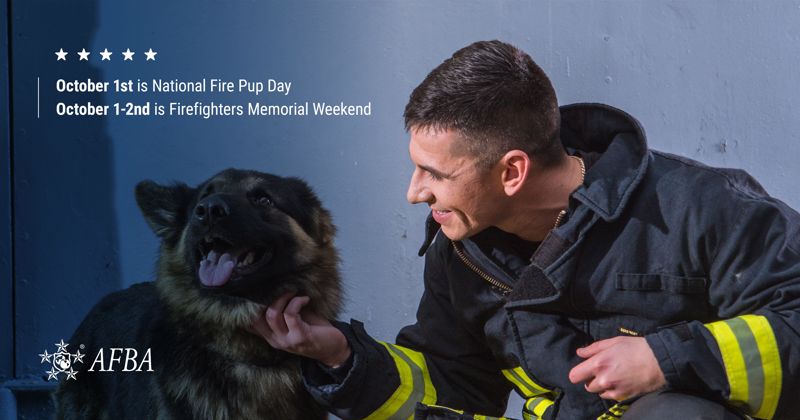
National Fire Pup Day, a holiday meant to celebrate the noble legacy of fire dogs, lands on Oct. 1 this year. In addition to this observance, the Firefighters Memorial Weekend, in which families and friends of fallen firefighters are brought together to mourn, is also recognized between Oct. 8 and 9.
The noble history of the fire dog
Fire dogs have a long and proud history of being staples of fire departments throughout the U.S. before mechanical fire engines even existed. Hundreds of years ago, when fire equipment and passengers were carried in a horse-drawn carriage, fire dogs were used to keep the horses calm as firefighters worked to put out blazes and help others when disaster struck.
According to Cheryl F. Steinmetz, historian for the Dalmatian Club of America, some of the dogs would instinctively take point in certain positions around the back or directly underneath the horse. The Dalmatian was and still is the most common breed of fire dog.
Dalmatians have been used since 1870 when the Fire Department of New York City began adopting them. Dogs of this variety are ideal for helping firefighters because of their exceptional stamina and strength as well as their apparent comfort around horses. They also make for first-rate mascots because of their distinctive black spots! They’re common companions to groups that go into schools and other places to teach fire safety.
Beginning in 1910, the Westminster Dog Show began holding a new category for fire department Dalmatians. Its first inaugural winner was Mike, a Dalmatian from New York Engine Company 8 on 51st Street. This category persisted for 30 years.
Fire dogs haven’t gone out of style
We use National Fire Pup Day to honor the fire dogs that have served fire departments everywhere for over a century.
 The appearance of the U.S. Department of Defense (DoD) visual information does not imply or constitute DoD endorsement.
Today, fire dogs perform a variety of tasks, including:
- Working as therapy dogs to help first responders process their experiences.
- Sniffing out causes of fires after it’s been extinguished, such as gasoline.
- Searching for people who might be concealed under rubble
Honoring fallen firefighters
In addition to celebrating National Fire Pup Day, October is also the month when the National Fallen Firefighters Memorial Weekend is held. This time is set aside to honor fallen firefighters
Both new families and those who have participated before from around the U.S. join together to celebrate the lives of these fallen heroes. Special programs and public ceremonies are held to commemorate their sacrifices. Professional grief counselors are made available to speak with the bereaved on Family Day.
Those who attended previous Firefighters Memorial Weekends ceremonies at the National Fallen Firefighters Memorial are crucial sources of support for the grieving. These returning families join together with new families to support each other through the grieving process.
The event is being held in Emmitsburg, Maryland. Firefighters who have lost a fellow firefighter are also welcome to attend. Volunteers can serve as Fire Service Escorts for the families of their lost friends. Acting as representatives for these individuals, many consider the experience unforgettable as they walk with the forever-grateful bereaved.
After families appear at the Memorial, they are then accompanied by their Fire Escorts and uniformed fire service personnel to perform the Walk of Honor® through the “Sea of Blue.” Representatives from the Honor Guard and Pipe Band Units also serve to help with the ceremonies as well as offer appreciation to the loved ones that have shown up to memorialize the fallen protectors.
This October, join us in the celebration of fire dogs as well as the mourning of those who have been lost in the line of duty.
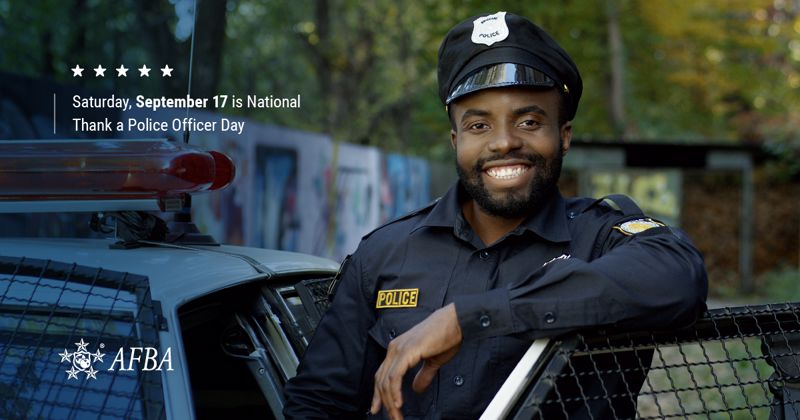
In America, September 17th is known as Thank a Police Officer Day. While many American citizens may not be aware of the celebration, the day is reserved as a way to remember the brave men and women who take care of our communities with skill and devotion.
Many people really only think of the police when they are in emergency situations, but the force is also working tirelessly behind the scenes to support the people who they live and work with on top of reacting to 911 calls. While we will be sharing some standout points of reference, the police are laying their lives on the line every day and they deserve respect and recognition. Here are some highlights of their good work in the country over the past few years.
Community engagement during the COVID-19 pandemic
Since the onset of the pandemic that disrupted so much in America, the police have been a pillar of their communities. One of the most essential workers, the police force was called on by state and local authorities to step forward.
Despite the fact that the virus was the leading cause of death among the police, they persevered bravely to do the job that they were called to do. An amazing example of this can be seen in Oklahoma, where the governor enlisted the police to assist in schools that were in dire need of personnel assistance. The City of Moore Police Department law enforcement officers were serving as elementary school substitutes for a short period of time.
In Waterbury, Connecticut the chief of police created a task force to help children who are the victims of trauma — something that has increased as a result of the pandemic. Increased social isolation can make already bad situations worse, and the task force works with local schools and other community partners to help impacted children.
There are countless stories of local law enforcement officers making a massive difference in their communities every day and these were just a couple of amazing examples.
Changing response to the virus
The police force is instrumental in preventing the spread of COVID-19 in their communities. Here are some of the commitments that police departments across the country have made as listed by The International Association of Chiefs of Police (IACP):
- Purchasing protective gear.
- Working to supply departments with hygiene kits, towels and cell phone chargers.
- Funding professional decontamination of police facilities and equipment.
- Providing sanitizer stations.
- Securing a COVID-19 testing center for exclusive use by first responders and other essential employees.
- Installing mobile trailers equipped with cameras and license plate readers to address areas with an uptick in crime.
- Promoting compliance with public health orders.
The first responder community came together and helped each other share the burden that comes with taking care of people who were —and are still — overwhelmed by the impact of the virus. With this came an elevated focus on the mental health of our police officers. The culture surrounding the force has changed greatly. Now, there are more resources than ever to help support these strong individuals.
This September 17th, don't forget to thank police officers for all their contributions, locally and nationally. Whether that be someone in your family, or you see someone in the blue out in the community, take the time to show your appreciation for the hard work that they do every day. From laying their life on the line to helping out where their country needs it the most, they deserve to know how valuable they are.
Image: https://pictures.brafton.com/x_0_0_0_14024210_400.jpg
Sources:
https://www.americanprogress.org/article/policing-coronavirus-pandemic/
https://www.facebook.com/moorepolice/posts/297810225720317
https://www.ctinsider.com/hartford/article/CT-police-step-up-to-help-children-dealing-with-17416865.php
https://www.theiacp.org/resources/document/the-role-of-police-foundations-during-the-covid-19-pandemic
https://www.rti.org/brochures/resources-supporting-police-officer-health-well-being-during-covid-19-pandemic-and-beyond
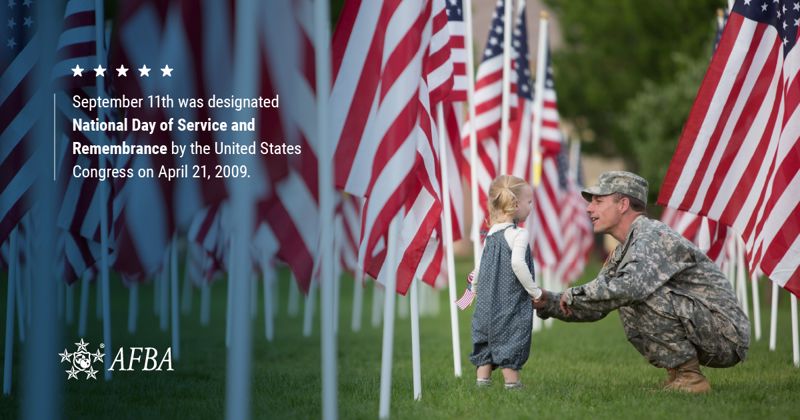
21 years ago, the tragic attack on the World Trade Center (WTC) and the Pentagon left Americans stunned and shocked. On its anniversary, citizens take the day to commemorate heroes who acted in bravery and those who lost their lives in the senseless act of terrorism. Today, we want to share some facts to consider on this day of remembrance.
1. The World Trade Center
Before the attacks, the WTC hosted many employees who went to work every weekday. The Twin Towers normally had 50,000 workers and 40,000 additional visitors. During the attacks, over 3,000 people passed away, many of whom were first responders who arrived on the scene to save civilian lives.
2. Dangerous cleanup
The horrible terrorist attacks cost thousands of lives and resulted in dangerous wreckage that trapped even more people. The rescue crews were able to save 18 individuals from the ruins, which, by expert estimations, weighed 1.8 million pounds. The recovery process lasted nine months and ended on May 30, 2002.
3. Terrible loss of life
Most people know the attacks on the WTC resulted in the tragic loss of life, but the act of terrorism marked an awful day for another reason as well. It was the largest loss of life by a foreign attack on American soil.
4. The catalyst of change
The horrific event changed the ways that Americans saw security and safety. In fact, in 2001, 50% of Americans reported to Pew Research that they wanted to see America change in a serious way. Here are some of the biggest policy changes implemented after the attacks:
- Created new institutions like the Department of Homeland Security, Directorate of National Intelligence, and National Counterterrorism Center.
- Increased resources for intelligence programs in the US.
- Increased air travel security.
- Urged leaders to increase counterterrorism partnerships across the globe.
After the attacks, American leaders took a more serious approach to homeland security and preventing terrorism on American soil.
5. Impact on public opinion
The atrocious event shocked American citizens and completely altered public perception and opinion. The impacts of this can be seen in the increased patriotic sentiment across the country. Pew Research found that 79% of adults "displayed an American flag" in 2001. Political divides shrunk as people shared a sense of loss and tragedy, with about 60% of adults reporting that they trusted in the federal government in October of 2001. This is a high that was unseen in the previous 30 years and has not been met since.
The events of 9/11 changed the course of American history and deserve to be remembered with respect. Each year the attacks grow further away, but the memory of the day will not be forgotten. Take the time for a brief moment of respectful silence or learn more about the events to honor those who were lost.