
So you're making your list and checking it twice — but you're still stumped on holiday gift ideas for the military servicemembers in your life. Not to worry! We've put together a roundup of seven military-friendly finds your loved ones will enjoy.
1. Handmade challenge coin display
Throughout their military career, your loved one may have collected quite a few challenge coins. What better way to celebrate their accomplishments than to gift them a handsome challenge coin display. From small desk decorations to large wall displays, browsing the selection of handcrafted challenge coin displays on Etsy will show that there are many different ways for the person on your list to showcase their one-of-a-kind collection.
2. Personalized stationery kit
This is a chance to put together a festive gift basket that's functional, too. In your stationery kit, you can include nice-quality letters and envelopes, as well as a set of USPS stamps honoring military working dogs. You can also customize return address labels with your loved one's location and their branch's official emblem. Consider adding in a rugged military-ready pen, or a more formal writing utensil engraved with a special message. Whenever there's something to write home about, the military servicemember in your life will appreciate the convenience of having everything they need all in one place.
3. Tough tumbler and coffee from a veteran-owned brand
A hot cup of joe can help warm up even the coldest, earliest morning. Pick up a bag of coffee grounds from a veteran-owned and operated coffee company. Popular brands include Victory Coffee, founded by a former Navy SEAL, or Black Rifle Coffee Company, established by an Army Special Forces veteran. Pair that with a durable coffee tumbler and your gift is all set for sipping — just add water!

4. Custom military ring
If you're looking for an extra special holiday gift idea for the military servicemember in your life this year, consider ordering a personalized military ring. Whatever branch they serve in, you can find a corresponding ring style and customize the design with the decorative detailing, gemstone and precious metal of your choice. Military rings can even be engraved with a name, date or other meaningful inscription. The one you choose is sure to become are modern family heirloom, cherished for years to come.
5. Military travel guide
Satisfy your servicemember's wanderlust by gifting them a 2021 military travel guide. Options include guides of popular destinations around the U.S., top camping spots and even overseas travel options. This kind of guide book can be helpful for servicemembers and military families who want to make the most of their free time. With all the planning in place thanks to your gift, they can embark on an exciting adventure as soon as it's safe to do so next year.
6. Tablet with durable case
A tablet can be a great, multipurpose piece of technology for a servicemeber on active duty. It's an all-in-one tool that's useful for getting work done on the go, joining video chats with friends and family, winding down with an e-book and everything in between. The larger screen size makes a tablet a nice alternative to a smartphone for a little less eye strain, and the compact size makes it even more portable than a laptop. There are plenty of popular tablets on the market. Whichever you choose, pair it with a rugged case and screen protector to keep it protected in all environments.
7. Tactical socks
Combat boot blisters are no joke. Since the military servicemember on your gift list spends long hours on foot, a pair of comfy, cozy socks will surely bring a smile to their face. Compare some of the best boot socks for the military and you're sure to find a perfect fit.
The U.S. Armed Forces continue to push technological innovation while boosting inclusion for all of its brave servicemembers. One recent example of this is how women jet fighter pilots may have a better-fitting and safer G-force suit available in the near future.
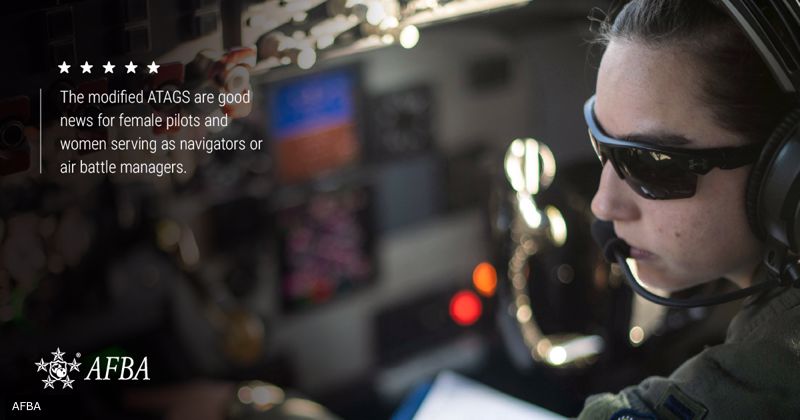
The Air Force announced the testing of a modified version of the Advanced Technology Anti-Gravity Suit (ATAGS) by five female fighter pilots in late October 2020. This is good news for the more than 800 female pilots and approximately 580 women serving as navigators or air battle managers.
Design problems with the current ATAGS
ATAGS, sometimes referred to as G-suits or anti-G suits, are worn by fighter pilots to protect them from the extremely high G-force exerted on their bodies during flights. Without these protections in place, pilots would be susceptible to losing consciousness or suffering hypoxia (a lack of oxygen to tissue cells) during maneuvers in fighter aircrafts.
One such protection includes an inflatable bladder that pushes blood toward the wearer's torso and exerts pressure on their lungs. This prevents a pilot from blacking out from the acceleration that can cause blood to pool in the bottom half of the body.
Up until now, pilots used a version of the ATAGS that was designed in 2001 and used body specs taken from pilots in the 1960s. This means the suits were designed primarily for male bodies. Further, due to the nature of the suits' protections, they are not easy to adjust for a better fit, let alone adjust to a completely different body type. This means shorter pilots with smaller frames don't receive the full protections from the current design of the suits, such as proper performance of the waist bladder.
How the suits were redesigned
The new ATAGS design stems from the joint effort between the Air Force Life Cycle Management Center (AFLCMC) and AFWERX, a U.S. Air Force program that fosters a culture of innovation within the service, according to a U.S. Air Force news release.
The redesign addressed two key areas. The first modification includes wider lacing panels at the waist, thigh and calf. This will allow for more adjustments to accommodate a greater variety of body proportions. The second big change is that the suit now comes with a darted waist. This tailored waist design does not interfere with the inflatable waist bladder but allows for a better fit.
"In the past, some pilots with a shorter torso have had issues with ATAGS that were too large riding up and causing bruising on the rib cages, while pilots who are hard-to-fit may have had one size that fits through the legs, but need a smaller size in the waist," said Charles Cruze, an AFLCMC Human Systems Division engineer. "Now, the waist can be darted up to 3.75 inches, allowing for a more custom and accurate fit, preventing both of those issues."
Results of the new design's tests
After testing and evaluating the new suits with five pilots and one aircrew member, the results came back with overwhelming praise for the redesign.
Capt. Brittany Trimble, an F-16 Fighting Falcon instructor pilot, relayed her positive experience testing the modified ATAGS in the announcement. "I definitely noticed improvement with the new updates and the darted waist in particular," said Trimble.
Following this positive review, the 46th Test Squadron will next draft a test report on its findings. While the modified flight suit is not yet approved, the current acquisition strategy could put the updated ATAGS into use within 12 to 24 months.
This is a great step forward for the Air Force, and just one of many new improvements for ensuring the safety of its female service members.
Day of the Deployed is a relatively recent military observance, but it is no less meaningful to the men and women who serve on active duty, or the community members that honor their efforts on Oct. 26 each year.
Read on to learn about what the Day of the Deployed observance recognizes, how it came to be and how to support military servicemembers and their families at this time and throughout the year.
Origins of Day of the Deployed
The proposal to create a day recognizing the sacrifices and valor of servicemembers on deployment came from Shelle Michaels Aberle of Solider’s Angels, a nonprofit organization offering support to members of the military community.
In 2006, Aberle pitched the idea to then-governer of North Dakota John Hoeven, after being inspired by her cousin, LTC David Hosna, who was serving in Iraq at the time. North Dakota chose to recognize Day of the Deployed on Oct. 26 — Hosna’s birthday — and many other states quickly followed suit with their own state observances.
Several years later, when Hoeven became a U.S. Senator, he put forth a resolution to enact a nationwide Day of the Deployed. In 2011, this measure passed unanimously in the Senate.
Paying tribute to 200,000 deployed servicemembers
According to the Department of Defense, the U.S. armed forces have a presence across all seven continents, with some 4,800 defense sites across 160 countries. The New York Times estimated that roughly 200,000 servicemembers were deployed overseas as of late 2019.
When the national observance was adopted, Aberle described the state and federal recognition as “an honorable way to extend appreciation to the deployed service members and their families. Day of the Deployed is recognition for their hard work, dedication and commitment to the United States of America. This day is all about them.”
 “The appearance of U.S. Department of Defense (DoD) visual information does not imply or constitute DoD endorsement.”
“Our U.S. service men and women currently deployed, along with their loved ones, make untold sacrifices as they serve our nation,” Hoeven remarked on the occasion. “A national Day of the Deployed pays tribute to their commitment to our country and their work to protect our freedoms. We want to ensure that our military members and their loved ones know of our appreciation and support before, during and after their service.”
Ways to raise awareness and offer support
Around the U.S. and across the globe, members and supporters of the military community can find countless morale-boosting ways to mark the occasion. Here are just a few ideas for Day of the Deployed:
- Send handwritten notes or care packages to deployed servicemembers in your life or through a nonprofit organization.
- Make a charitable donation to an organization that supports members of the armed services.
- Bring awareness to the observance and the experiences of deployed members of the armed focus and their families using the hashtag #DayoftheDeployed on social media.
- Display a yellow ribbon in support of the troops serving away from home.
- Spend time socializing with a military family — or offer support in the form of babysitting, running errands or delivering a homemade meal.
You can support a deployed servicemember in your life, or connect with a nonprofit organization to reach out to other military members. And don’t forget that your efforts need not be limited to the official Day of the Deployed.
“Even a small act of gratitude goes a long way,” Nicole Motsek of the EOD Warrior Foundation noted in an interview with U.S. Veterans Magazine. “Any time of the year is a great time to show gratitude for the deployed, but this day serves as a great reminder.”

When preparing to transition from military service to civilian life, service members have a lot of factors to weigh when deciding what the next chapter will look like. This includes everything from what type of career to pursue to what sort of lifestyle to embrace. Many of these considerations revolve around one important question: where to live after military retirement.
Here are a few tips for choosing the best city or region to live in after completing your service in the military.
 “The appearance of U.S. Department of Defense (DoD) visual information does not imply or constitute DoD endorsement.”
Establish career goals
One of the most important considerations in deciding your next step will be your career prospects. Spend some time assessing how your skills and experiences can translate into the civilian workforce, and consider what sort of roles or industries interest you. If you have specific ideas, look for cities with an abundance of job openings in those areas. If you’re not sure, living in proximity to a large metro area with a diverse range of opportunities may be a smart choice.
Consider educational opportunities
Academic goals can help inform your options for where to live after military retirement, as you’ll most likely want to settle down near a school of choice. You might be considering bolstering your education with an advanced degree or professional certification program after concluding your military service. Or, someone in your immediate family, such as a spouse or child, might be exploring colleges and universities. You may also want to find a new home within a good school district for younger children.
Identify your ideal lifestyle
Major changes like military retirement allow you to redefine your lifestyle. Consider your values and what you’re looking for in the next chapter. It might be that you want to find somewhere that allows you to explore your favorite outdoor hobbies — or you may choose somewhere with an affordable cost of living so you can have a bigger travel budget. There may be a certain climate or community atmosphere you’re looking for, or a specific type of housing. It might also be important for you to reside near a military installation for easier access to benefits and health care facilities. Either way, these personal preferences should play a part in your decision-making process.
Think about family
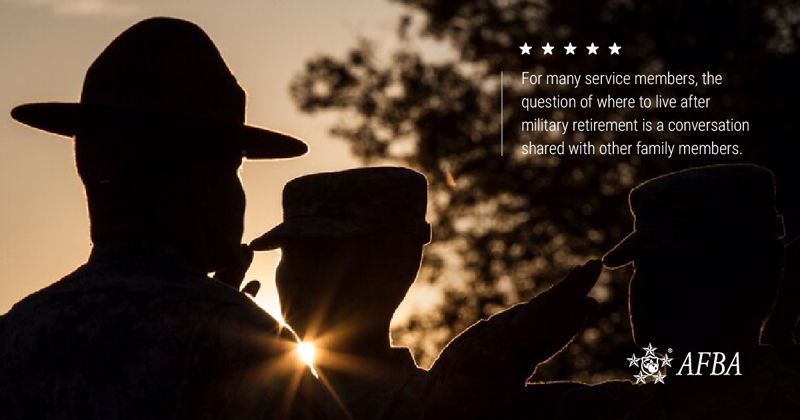
For many service members, the question of where to live after military retirement is a conversation shared with other family members. Military spouses and children often have input on where they might like to set down roots. You may also want to consider how close you’d like to be to extended family members. Moving back to your hometown or choosing a new city to call your own both have their advantages.
Take advantage of available resources
It might seem like you have an endless list of choices for where to live after military retirement. To help make the search and decision-making process easier, utilize the resources available to you. There are plenty of resources online to help you visualize what life might be like in different parts of the country. You can also explore the VA’s Transition Assistance Program (TAP) and connect with military installations in your current and future locations to learn more about relocation support.
The Military Family Advisory Network (MFAN) recently published the results of its 2019 Military Family Support Programming Survey.
First presented during a virtual data release event on June 23, 2020, the responses from nearly 8,000 members of military families were analyzed and divided into four sections:
- Health and well-being.
- Finances, housing and moving.
- Employment and transition
- Modern military family dynamics.
The biennial study's main findings highlight some of the most common challenges and experiences of military families and those transitioning from military service to civilian life.
Active duty spouses and veterans sought flexible employment
Active duty spouses noted that they looked for employers who were understanding and flexible, in general. Specific requests included an appreciation for the demands of military life as well as adaptable schedules, leave policies and remote work options.
Military veterans also desired flexibility, but a few other priorities came first. They primarily sought employers who valued their service in the armed forces and acknowledged their unique skills, and who offered a positive work environment.
While the top reason to leave the service was becoming eligible for military retirement benefits, the next most common reasons to transition out of the military were:
- Issues with leadership or the work climate.
- Family or lifestyle reasons.
- Career limitations.
Couples cited marital stresses
Only small percentages of respondents said their marriages have not been impacted (14.4%) or have grown stronger (13.7%) as a result of a spouse's military service. Negative effects were more commonly cited. Specifically, the following effects on marriage were reported by between 27% and 30% of respondents:
- General stress and strain on the marriage.
- Specific difficulties and challenges.
- Separation and absences.
In addition, 8 in 10 respondents recognized the existence and impacts of intimate partner violence among the military community. More than half (56.7%) reported that it is a common issue.
Parents identified limitations around child care and educational support
As for child care, over three-quarters of military parents said the search has been difficult or very difficult. Many respondents desired a wider variety of child care options, additional care flexibility and more affordable services.
Two in five respondents said they could not think of or access any helpful educational support for their children. Specifically, parents in the military community felt that there was a lack of support for special needs and learning needs in general. Some also agreed that more transition support and curriculum continuity would improve the quality of their children's' education.
Many lacked emergency savings
For the majority of active-duty families, the civilian spouse took on financial responsibilities including managing the day-to-day budget and overseeing larger financial decisions. The roles were largely reversed for veterans and their families.
However, nearly one-quarter said they had no plan whatsoever for addressing a financial emergency. Many respondents cited having less than $500 in an emergency fund or no savings at all, including:
- 22.2% of military retiree families with a pension.
- 27.4% of active duty military families.
- 49.2% of veteran families with no pension.
And yet, most would recommend military life
The top two reasons for not recommending military life included the fact that such a career can negatively impact one's family and add stress and instability to one's life.
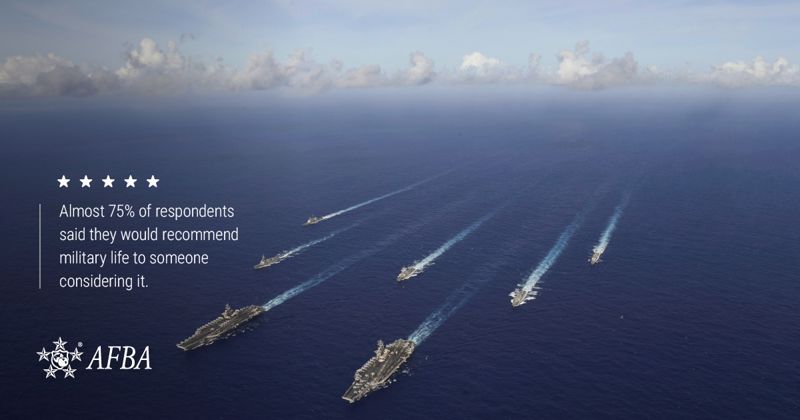
But, in spite of all the aforementioned challenges, roughly three in four (74.5%) respondents said they would recommend military life to someone considering it. The top three reasons included access to a rewarding and secure career in the military, the honor associated with doing one's civic duty and advantageous salaries and benefits.
Considering all the challenges military families may face together, financial matters might not always be top-of-mind. But the burden of debts and late payments can have a negative impact on mission readiness, relationships, future opportunities and decision-making processes.
Personal finance is undoubtedly an important part of life. With the federal tax deadline extended to July 15, 2020, this summer is a good time for families to check in on their financial progress and revisit goals.
These tips for boosting financial literacy, growing savings and reducing debt can help military personnel and their families achieve financial stability.
1. Explore and utilize resources from MilitaryConsumer.gov
Jointly created by the Federal Trade Commission and the Department of Defense, MilitaryConsumer.gov is a resource center for all matters related to personal finance for military servicemembers and families. Topics range from buying and financing a vehicle, using allotments, improving your credit rating and recovering from identity theft. Since each toolkit and guide is specifically designed with military life in mind, this site can be a great starting point when you're looking for helpful, actionable information.
2. Make military-specific deductions when you file your taxes
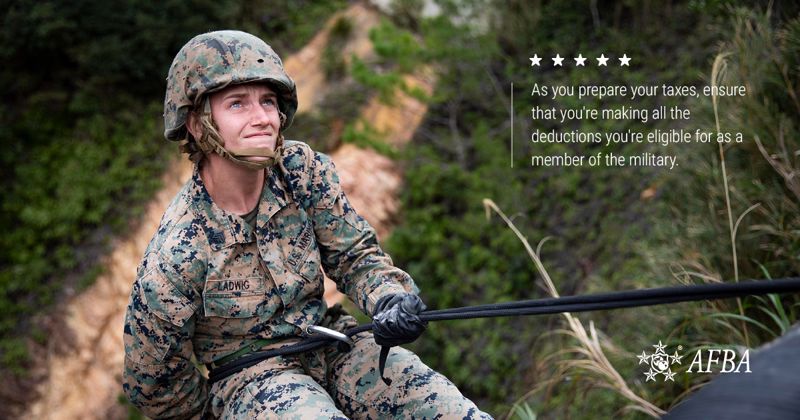
As you prepare your taxes, ensure that you're making all the deductions you're eligible for as a member of the military. Possible deductions include the cost of uniforms, moving expenses and civilian job search costs, to name a few.
There are other ways to get strategic with your tax liabilities. For instance, while you're serving, you and your spouse can establish your residency in a tax-free state so that, regardless of where you're stationed, you will benefit from substantial income tax breaks.
3. Contribute regularly to your retirement savings as soon as possible
The sooner you start making significant contributions to your retirement fund, the larger your savings will grow by the time you reach retirement age. Because many military service members don't stay in the armed forces long enough to become eligible for a pension, it's advisable to make your own contributions early and all throughout your career.
One military-specific option to explore is the Thrift Savings Plan (TSP), a defined contribution plan for retirement savings. Through this plan, members of the uniformed services can make traditional pre-tax or Roth after-tax contributions — or both. The Roth TSP option is similar to a Roth 401(k) in that there are no income limits.
4. Plan out how you'll use or transfer your education benefits
Student debt is one of the biggest financial burdens many families in the U.S. experience. Military members who are eligible for the substantial college tuition benefits available through the Post-9/11 GI Bill should carefully consider how this benefit can be used to further their own career or that of a family member. Servicemembers and veterans who don't plan to go back to school should find out how to transfer these tuition benefits to a spouse or child.
5. Familiarize yourself with the financial programs available to you
There are a number of advantageous savings and investment options available to members of the armed forces. It's a good idea to familiarize yourself with all of these programs so that you can start saving and seeing growth early on. For example, you may be eligible to receive 10% annual interest on savings up to $10,000 through the DOD's Savings Deposit Program (SDP). This growth rate is unlike any traditional savings plan you'll find in the civilian world.
Another example is a new program launched in October 2019 through which you may be able to receive free electronic credit reporting services from one of the major credit reporting agencies while serving on active duty. This is a helpful resource to help you monitor for fraud and improve your credit score.
Remember that these types of programs may evolve or be expanded over the years. Make it a habit to check back in and ensure that you're getting the most out of the opportunities available to you.
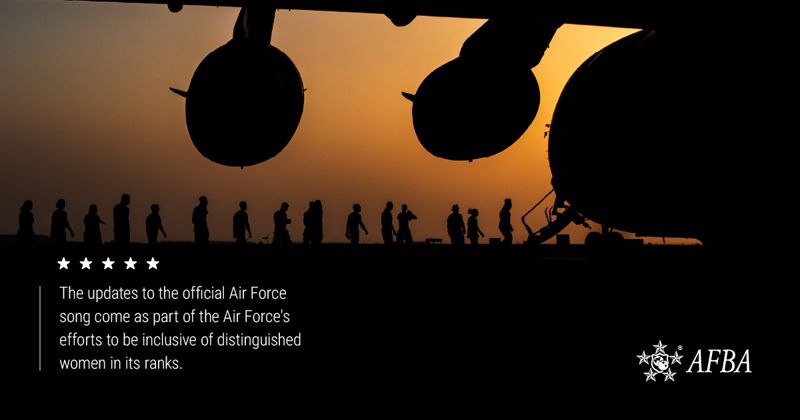
Lyrics to the official Air Force song that formerly recognized the contributions of male airmen only have been rewritten to be gender-neutral. This change comes as part of the Air Force's efforts to be inclusive and to acknowledge the distinguished women airmen in its ranks.
Updates made eighty-one years after the song's initial composition
The song is officially titled "The U.S. Air Force" but is more commonly known by its first line, "Off we go, into the wild blue yonder."
It was originally written to help establish a sense of camaraderie and identity for the U.S. Army Air Corps in the late 1930s. Since the Corps did not have the budget to commission such as song, the publisher of a magazine called "Liberty" established a songwriting contest in 1938 with a $1,000 prize. The winning submission came in a couple of days before the final deadline from a musician and civilian pilot, Robert M. Crawford. Too young to enlist during World War I, he later flew for the U.S. Army Air Forces' Air Transport Command during the Second World War.
This is not the first time the song has been modified in its 81-year lifetime to better reflect the force and its servicemembers. Before the Air Force was its own independent branch, the song was titled "The Army Air Corps." It was changed to "Army Air Forces" during World War II, and the title and lyrics were rewritten once again in 1947 upon the establishment of the U.S. Air Force.
"Off we go, into the wild blue yonder" is also the U.S. Air Force Academy's official school song and is frequently sung at sporting events and during graduation ceremonies. According to Air Force Times, the U.S. Military Academy at West Point and the U.S. Naval Academy already modified their lyrics over a decade ago to better reflect the presence and contributions of women cadets.
Half a dozen gendered reference rewritten
After a series of updates that began in February 2020, half a dozen changes have now been made across the song's four verses. In the popular opening verse, "At 'em boys" is now "At 'em now, give 'em the gun." In the second verse, the phrases "Minds of men," "Hands of men" and "Souls of men" have been updated to create three updated lyrics:
- "Brilliant minds fashioned a crate of thunder."
- "Valiant hands blasted the world asunder."
- "Boundless souls dreaming of skies to conquer."
In the third verse, the lyric formerly ending in "of his brother men who fly" now goes, "To a friend we send a message of the brave who serve on high." Additionally, "men" has been changed to "those" in the verse's triumphant conclusion, "A toast to the host of those we boast, the U.S. Air Force!" And, in the final verse, "Flying men" has been removed in favor of "Fly to fight, guarding the nation's border."
Gender-neutral lyrics acknowledge that one in five airmen are women
According to Air Force demographic data, women could first begin pilot and navigator training in 1976 and 1977, respectively, and were not able to complete fighter pilot training until 1993. Nowadays, approximately one in five Air Force active-duty servicemembers are women — 68,470 women airmen total, as of January 2020. Among them, 806 serve as pilots; 347 are navigators, and 233 are air battle managers for Air Force.
Although the name given to servicemembers — airmen — remains awkwardly gendered, the Air Force considers this a step in the right direction.
"These new lyrics speak more accurately to all we do, all that we are and all that we strive to be as a profession of arms," Air Force Chief of Staff Gen. David L. Goldfein said in a news release. "They add proper respect and recognition to everyone who serves and who has served."
The oldest and most senior branch of the United States military in order of precedence, the U.S. Army actually predates the U.S. itself. Congress established the First Continental Army on June 14, 1775, more than a full year before the signing of the Declaration of Independence, to recruit professionally trained soldiers that could combat the British “Redcoats” in the Revolutionary War.
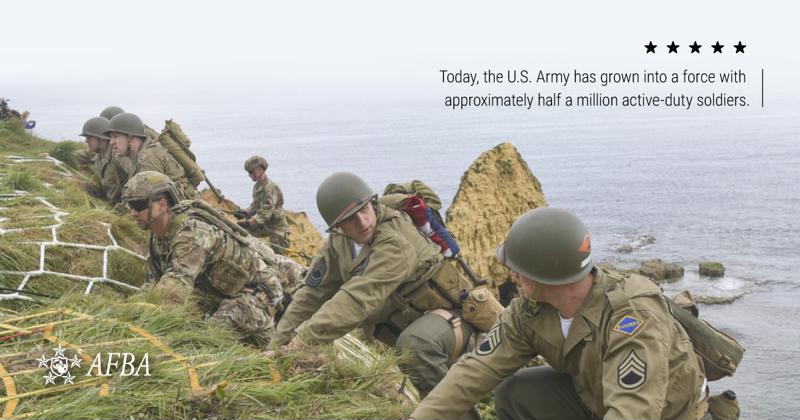
In the centuries since then, America’s Army has grown into a fighting force with approximately half a million active duty soldiers. And on Sunday, June 14, 2020, the U.S. Army will observe its 245th birthday, affording military servicemembers and civilians alike an opportunity to celebrate the branch’s rich history and continued role as a force for good in the world.
How to celebrate the U.S. Army’s birthday in 2020
Celebrations of the U.S. Army’s birthday will look much different this year due to the current pandemic. The Army’s birthday is not an official state or federal holiday, meaning government offices and private places of business remain open on June 14th, while Army and Department of Defense agencies typically choose to celebrate the occasion at the base or local level with special events, ceremonies, and social occasions. Additionally, a wreath will be laid at the Tomb of the Unknown Soldier in Arlington, Virginia, in celebration.
The USO, AMVETS, The American Legion, VFW, and other military service organizations also usually observe the holiday on a local or agency-wide level each year. If you would like to know if and how the birthday is being celebrated in your community, you can reach out to the local chapter of your preferred Veterans Service Organization.
One unique annual celebration is the Army Birthday Ball, which is usually held at military bases, community centers, civilian hotels, and other applicable sites around the world. This black-tie formal event features military members in full-service dress, also known as “Dress Blues” or “Mess Dress,” and includes a long list of traditions that are intended to pay respect to those who sacrificed life and limb to serve and to welcome the newest members of the service and salute the future of the Army at large.
 “The appearance of U.S. Department of Defense (DoD) visual information does not imply or constitute DoD endorsement.”
In that spirit, one of the most popular traditions at the ball is the cutting of the Army birthday cake, in which the oldest serving soldier and the youngest serving soldier use a ceremonial saber to cut the first slice. Another common tradition is the receiving line, in which Army leaders personally greet each attendee entering the ballroom, and the giving of toasts to the United States, military families and to fallen comrades, the latter toast one that is always respectfully answered in silence.
This year, the 245th U.S. Army Birthday Ball was due to be held in Washington D.C. Saturday, June 13. Due to coronavirus, however, the event has been canceled.
Additionally, private citizens can always organize events in their own community or find ways to celebrate with friends and family. The 245th anniversary of the U.S. Army provides a wonderful opportunity to both reflect on the centuries of sacrifice that have come before, and celebrate the bright future that lies ahead for America’s fighting force.