
According to the Department of Defense, there were 1.3 million members of the armed forces as of March 2020. A recent study dives deeper into who these people are, where they come from and how popular beliefs about their origins and reasons for enlisting may be further off than many might think.
 “The appearance of U.S. Department of Defense (DoD) visual information does not imply or constitute DoD endorsement.”
Widely held misconceptions
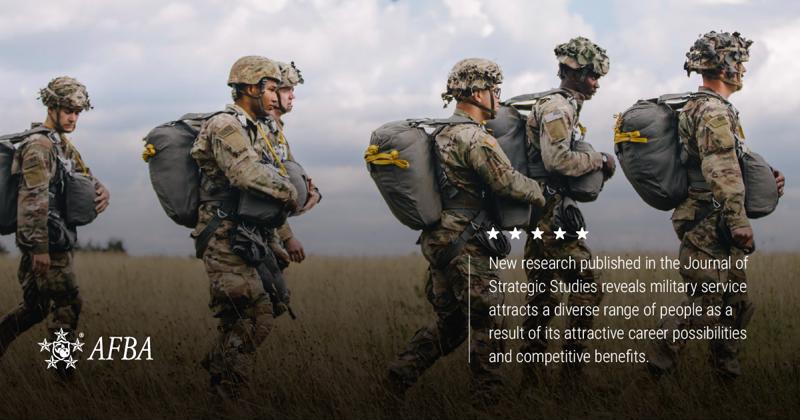
Since service in the armed forces became voluntary in 1973, after the draft was abolished, many Americans believed it would attract primarily disadvantaged groups and young people with limited prospects. However, new research published in the Journal of Strategic Studies reveals that this stereotype does not reflect reality. The study shows that military service attracts a diverse range of people as a result of its attractive career possibilities and competitive benefits.
The study, titled “A mercenary army of the poor? Technological change and the demographic composition of the post-9/11 U.S. military,” debunks the myths that often permeate academic and mass media publications. It explains that many assume that the majority of enlisted personnel come from poor rural communities or economically disadvantaged urban environments, who see the armed forces as an “escape” or “sanctuary.”
As the researchers pointed out, this is not only a problematic stereotype, but it also implies that the demographic makeup of those out on the front lines is disproportionate to the U.S. population as a whole — hence the “rich man’s war, poor man’s fight” perspective.
Class-based conclusions
The researchers tested two assumptions. The first — the opportunity cost theory — “implies that individuals from more disadvantaged socio-economic backgrounds, lacking the skills to compete in the job market, have more to gain and less to lose from joining the military.”
However, according to their findings, the majority of recruits have in fact come from the middle class, with above-average levels of affluence. Contrary to popular belief, the poorest (and wealthiest) communities are underrepresented in the armed forces.
The study concludes that “men and women who serve are likely to embody the values and culture of the median voters. This affects not only the nature of the military itself, but also the calculations in terms of costs and benefits of democracies electing to go to war.”
Skill-related findings
The second assumption — the de-skilling hypothesis — suggests “that increasing reliance on advanced technology has relieved the military from employing highly skilled personnel, thus allowing for the recruitment of less talented individuals.”
On this point, the researchers found most recruits exhibited average cognitive skill levels. However, lower-income individuals with higher intelligence levels — and, by extension, better career prospects — were more likely to enlist.
The researchers conclude that the increased use of technology in the military has actually increased, rather than decreased, the need for highly skilled recruits. They argue that the continued sophistication and complexity of military tactics, tools, threats, and technologies have in fact raised the bar for the recruitment process.
These new understandings help “explain why the U.S. military has displayed high levels of military effectiveness in recent conflicts, an outcome that advanced technology alone cannot account for.”
That the U.S. military is not a last-resort employment destination but rather a selective employer offering attractive career opportunities suggests that each branch will need to maintain a competitive position in the job market. The researchers forecast additional spending, higher compensation and other incentives.

Military service members, firefighters and power industry workers regularly go into the line of duty outfitted in flame-resistant or fire-resistant (FR) clothing. Contractors have embraced innovative textiles to keep uniforms — and the people who wear them — safe. Here is a look at the occupational hazards that necessitate FR clothing and what FR uniforms must do.
Occupational risks
The mission of a firefighter necessitates clothing that can hold up to intense heat and raging flames. FR turnout gear and station wear must reliably offer high levels of thermal protection. But first responders are not the only brave professionals who require carefully engineered protective apparel.
Whether handling ammunition or withstanding enemy fire, the nation's military service members are constantly in harm's way. They need uniforms that enable them to do the work that must be done, without compromising their health and safety.
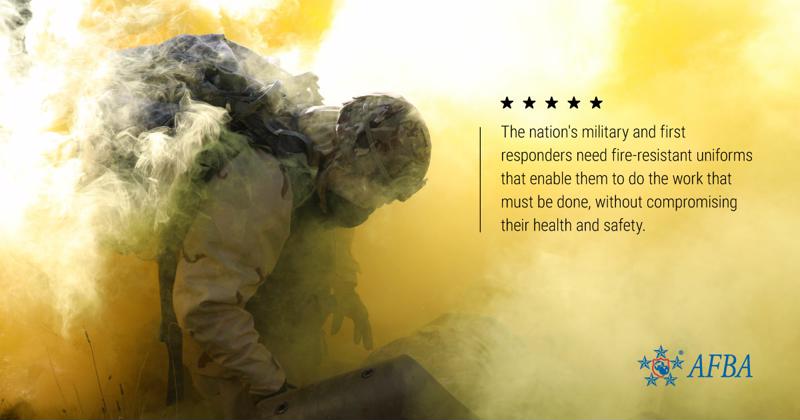
But, according to FR uniform manufacturer DRIFIRE, unsuitable textiles had been putting service members at risk. In 2007, two Marines were killed during a roadside bombing incident when their undergarments melted onto their skin. These garments were polyester — a plastic material which ignites, melts and drips when exposed to heat. Even when a uniform's outer layers are fire-resistant, improper base layers can still pose serious hazards. DRIFIRE notes that the U.S. Marines approached their company for a safer solution following this incident.
In the electric power industry, FR apparel is just as essential. According to the Occupational Health and Safety Administration (OSHA), the heat of an electric arc can exceed the surface temperature of the sun. Even a split-second blast can cause severe or fatal injuries. Combustible dust, flash fires and other unforeseen accidents mean that workers should be properly dressed at all times.
The role of fire-resistant clothing
Working hand-in-hand with OSHA, the Department of Defense and the National Fire Protection Association, the protective apparel industry has made significant strides since the early 2000s.
Workers facing heat, fire and electrical hazards are now required to wear FR clothing from head to toe, and from their undergarments to their outermost jackets. When layered properly, FR apparel provides a higher level of protection that is greater than what's offered by each individual piece.
For anyone serving in the armed forces, on an emergency response team or in the power industry, specialty clothing made from FR textiles is one important component of the personal protective equipment (PPE) that is worn.
For the greatest protection and comfort in the line of duty, fire-resistant uniforms should be:
- Inherently flame-resistant, meaning that the FR properties will not wash away or wear out. Rather than being finished with an FR treatment, the fibers and weave structure must offer the flame resistance themselves.
- Self-extinguishing to prevent the spread of fire, reduce the risk of burns and give workers time to return to safety.
- No-melt and no-drip to avoid bonding to the skin and causing severe burns.
- Low-smoking and non-toxic to prevent smoke-related injuries as the garment self-extinguishes.
- Slightly loose-fitting (but not excessively baggy) to create an insulating layer of air between each piece of clothing and the skin that helps resist the heat.
- Comprehensive with different pieces that are worn together, from the undergarments, middle layers and outerwear to headgear, additional uniform components and weather-related accessories.
- Moisture-wicking and fast-drying to help regulate body temperatures and keep workers as comfortable as possible in hot, stressful and physically demanding situations.
- Antimicrobial to prevent the growth of bacteria inside the uniform.
- Compliant with industry requirements.
Fibers that are prone to melting and dripping such as polyester, rayon, nylon and acetate are generally not utilized for FR clothing. Although natural fibers like cotton and wool will burn to ash rather than melt, they aren't entirely suitable either as they are not self-extinguishing.
Instead, companies in the protective apparel industry have developed and patented specialty textiles. These consist of a blend of unique fibers and innovative weave structures that meet the many demands of the field and keep service members and industry workers who wear FR clothing safe.
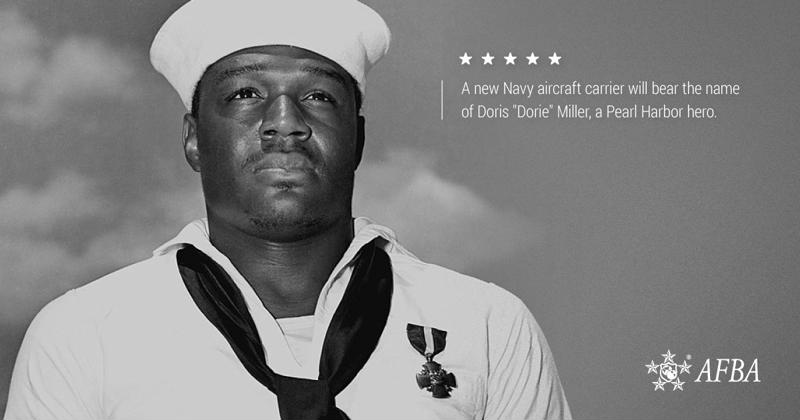
On Martin Luther King Jr. Day, 2020, Acting Navy Secretary Thomas Modly christened a new Navy aircraft carrier in honor of the African American WWII hero Doris "Dorie" Miller. The ceremony was held in Pearl Harbor, the site where Miller demonstrated combat valor that earned him the Navy Cross in 1941.
Miller's service in the racially segregated Navy
Born in 1919 as the grandson of enslaved laborers, Dorie Miller was raised in the segregated community of Waco, Texas. After dropping out of high school in order to help his family make ends meet, Miller looked to the armed forces for a source of steady work. In September 1939, at 19 years old, he enlisted in the U.S. Navy.
At that time, African American men who wished to enlist had to attend a racially segregated boot camp and were restricted to serving in the role of messman. Black mess attendants essentially worked as servants to white officers. They were responsible for shining shoes, making beds, doing laundry and waiting tables. And, instead of wearing buttons with the Navy's insignia on their uniforms, men like Dorie Miller were given uniforms with unmarked buttons.
On the basis of race, these mess attendants were ineligible for promotion or special training. And the only interaction black Navy servicemembers were allowed to have with gunnery was to feed ammunition to primarily white gunners.
Becoming a Pearl Harbor hero
Miller was transferred to Pearl Harbor aboard the battleship West Virginia, due to growing pressure between U.S. and Japanese forces.
Dorie Miller was below decks doing laundry the morning of Dec. 7, 1941 when the Japanese Imperial Navy launched a surprise attack. He immediately sought an assignment and was tasked with carrying his mortally wounded commanding officer, Capt. Mervyn Sharp Bennion, to shelter.
While the battleship sustained continued torpedo damage and heavy air fire, Miller started feeding ammunition into a machine gun, under orders from a junior commissioned officer. Noticing an unattended second gun, Miller jumped into action, launching fire on the Japanese planes overhead with absolutely no training or experience.
According to Navy Times, Miller later recalled that "when the Japanese bombers attacked my ship at Pearl Harbor I forgot all about the fact that I and other Negroes can be only messmen in the Navy and are not taught how to man an antiaircraft gun."
After exhausting his store of ammo, Miller proceeded to rescue other Sailors from the waters and decks as they were engulfed in flames. He was one of the last three men to exit the West Virginia.
Miller's heroism soon circulated in stories out of the Navy's press office, although his name remained unattached to his actions. Eventually, after much debate, Miller was awarded the Navy Cross in May 1942, becoming the first African American Sailor to be recognized with the medal. He then conducted a war bond tour, speaking across the country and urging black communities to support the war effort.
Miller's death and legacy
On Nov, 24, 1943, Miller was aboard the escort carrier Liscome Bay, which was loaded with massive quantities of oil, bombs, and ammunition. After being hit by a Japanese torpedo, the ship exploded, killing Miller in action.
While Miller's actions and memory did not end racism and segregation in the U.S. Navy, they did serve as a catalyst for lasting change. After his death, the Navy launched a program that graduated 13 African American officers in 1944. In 1973, a new Navy destroyer was named in Miller's honor to carry on his legacy.
"He died as he lived, an American sailor defending his nation, shoulder to shoulder with his shipmates, until the end," Modly said during the recent aircraft carrier naming ceremony. "Dorie Miller stood for everything that is good about our nation. His story deserves to be remembered and repeated wherever our people continue to stand the watch today."
On March 5, we commemorate the Navy Seabees by remembering their heritage and extensive contributions to Naval history.
Who are the Navy Seabees
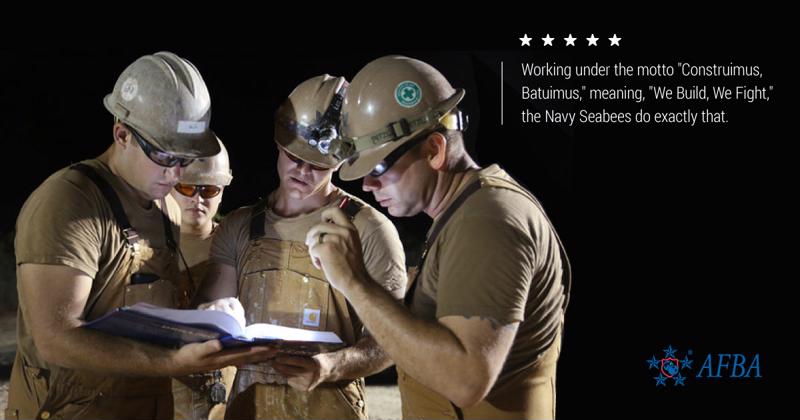
Working under the motto "Construimus, Batuimus," meaning, "We Build, We Fight," the Navy Seabees do exactly that.
The Seabee designation refers to enlisted members and officers assigned to the U.S. Naval Construction Battalions, the Naval Construction Force (NCF) and enlisted members in the Navy's occupational field 7 (OF-7).
The unit's unusual name comes from the pronunciation of C.B. for "Construction Battalions." This has inspired the Seabee logo, which depicts a buzzing bee wielding construction tools.
Since WWII, Navy Seabees have been part of every major conflict the U.S. military has participated in. They have also dedicated their unmatched trade skills and military prowess to protect our nation and further humanitarian efforts, even in times of peace.
How the Seabees began
The Naval Construction Battalions were born out of a long tradition of utilizing Sailors' building skills to construct and maintain bases. But the Seabee unit was not formalized until the Second World War.
During WWII, the U.S. had contracted some 70,000 construction workers who were located at shore bases around the globe. But the use of civilian labor in international war zones was highly problematic. As civilians, these tradespeople had no legal protections and could not defend themselves against enemy attack. If they were to fight back, they would be classified as guerrillas and could be subject to battlefield execution, according to international law.
To address the need for skilled tradespeople with military might, Admiral Ben Moreell put forth an innovative proposal on Dec. 28, 1941. Moreell conceived of a new type of military unit that possessed the necessary construction trade skills and the flexibility to participate in a wide variety of large-scale projects.
On Jan. 5, 1942 the Bureau of Navigation granted Moreell the power to recruit construction workers for three newly created Naval Construction Battalions. U.S. Civil Engineer Corps officers were granted command authority over the enlisted members and officers of these units.
During recruiting, the emphasis was put on technical skills, so the earliest Seabee population skewed much older than the average Navy recruit. Experienced in more than 60 trades, some of the first Seabees had honed their craft working on highways, subways, quarries, dams, docks and skyscrapers. But they also received advanced military training, which came in handy during frequent interactions with the enemy.
The Seabee name was officially adopted on March 5, 1942 — hence the birthday commemoration on this date. By the end of WWII, roughly 325,000 enlisted members and nearly 8,000 officers called themselves Seabees. Together, they participated in building more than 400 bases which helped pave the way to an Allied victory. Initially considered part of the Navy Reserve, this militarized construction unit became a permanent part of the Navy in 1947, so that they could serve in peacetime as well as wartime.
Remembering Seabee contributions to Naval history
While most Seabees are part of Naval Construction Battalions or the NCF, the unit has and continues to serve in additional capacities.
Notably, during WWII, Seabees served on Naval Combat Demolition Units and were among the first ashore at Normandy on D-Day, being responsible for dismantling the German-built barriers designed to prevent amphibious landings. Other Seabees have worked tirelessly throughout the Korean War, Vietnam War, Desert Shield and Desert Storm.
Throughout their history, special units have been assigned to complex projects that call for advanced, highly specialized trade skills. Seabees have also made contributions to the U.S. Marine Corps and are consistently involved in public works projects, disaster recovery initiatives and humanitarian efforts.
On the March 5, we recognize and honor the men and women of the Navy Seabees.
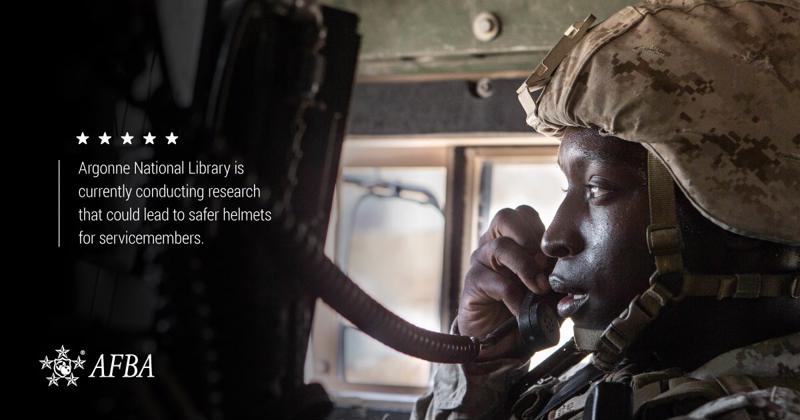
The most detailed study of the human skull is currently underway at Argonne National Laboratory in Illinois. The ongoing scientific research, which began in June 2019, may lead to the development of safer ballistic helmets for U.S. armed forces.
In partnership with the Army Research Laboratory (ARL), the helmet safety research project is being led by a research group based at the Advanced Photon Source (APS), a U.S. Department of Energy Office of Science User Facility at Argonne.
High-powered X-rays make new skull insights possible
The sensitive, highly powered beams available at APS are central to better understanding the microstructure of the human skull.
"By putting these [X-ray beams] on the bone, we can then see things about the bone in the skull that we couldn't with other techniques," beamline scientist and group leader Jonathan Almer, Ph.D., said in a National Defense Magazine interview. "That allows us to do things with time and space scales that you couldn't do with laboratory X-rays."
More specifically, APS' X-ray analysis is helping researchers understand the directionality of the skull bones' crystalline collagen structure. With this information, they can better understand what happens to these microscopic components following a blunt force impact. Knowing precisely how the energy disperses and how it modifies the bones themselves can enable helmet designers to develop more effective protections.
Researchers strive for more accurate models of bone behavior
The researchers have been working with cadavers and preserved skull samples that were fractured in previous ARL studies. These samples exhibit the effects of a bullet as well as a helmet on the skull.
"Bullet to helmet to skin to skull to brain," ARL team lead Karin Rafaels explained in an Argonne press announcement. "We have to get the models right all the way through — for our Army mission and for our understanding of bone in general."
The models in question are computer models used to inform helmet design. The bones in the skull are constructed differently from load-bearing bones like the femur, which tend to fracture in predictable ways. And yet, it is these bone behavioral models that helmet design has relied upon. The researchers are eager to develop new, more accurate models representative of the skull itself based on their X-ray imaging experiments.
This level of detail has already proven to be enlightening. "Even in quick reconstructions of the data, we could already see differences between the structures of the femur compared to the skull," Rafaels added.
Implications for military helmet design
According to Rafaels, with the assistance of APS' powerful imaging technology, the researchers "can see if there are preferable loading pathways, or ways to distribute or direct the force of the impact, so that we can design our helmets to take advantage of the skull's crystal structure."
Popular Mechanics compared the skull's collagen structure and likely behavior to that of woodgrain and gemstones: These materials will split easily along the grain but are more resilient when approached across the grain. The helmet of the future may be able to distribute the energy of an impact in a way that takes advantage of these characteristics.
As Almer noted, "By better understanding the mechanics of the skull, we can then design helmets that would generally be better" for use in the U.S. military, which requires hundreds of thousands of helmets to keep its servicemembers safe. The ideal product is a stronger but more lightweight helmet that can be reliably and economically mass-produced.
This study's findings may also be helpful to the sporting world, Almer added, where enhanced sports helmet safety also remains an important yet elusive objective.
American families will gather around the dinner table to celebrate Thanksgiving on Nov. 28, 2019. Meanwhile, many of the 1.4 million servicemembers currently on active duty won't be able to enjoy the comforts of home.
This year, we give thanks to the brave servicemen and women who protect our country on Thanksgiving Day and every day.
Thanksgiving traditions
Over the years, military members have celebrated Thanksgiving in a variety of ways.
President George Washington instituted a "day of public thanksgiving" on Oct. 3, 1789. Similar days were observed during the Revolutionary and Civil Wars, but the holiday as we know it wasn't instituted until 1863.
President Lincoln's Thanksgiving Proclamation made it clear that those at home and abroad are welcome to take part: "I do therefore invite my fellow citizens in every part of the United States, and also those who are at sea and those who are sojourning in foreign lands, to set apart and observe the last Thursday of November next, as a day of Thanksgiving and Praise."
During World War I, service organizations arranged Thanksgiving banquets, football games, and entertainment for military personnel to enjoy. After Armistice Day, those deployed in France enjoyed a distinctly American meal with French families.
From World War II onward, fall feast ingredients have been shipped or sourced locally so that military units around the world can observe and enjoy the holiday — even when such logistics seem impossible.
In November 1944, 1.6 tons of fresh turkey were plated up for Soldiers fighting in the European Theater of Operations. During Operation Desert Storm in 1990, President George H.W. Bush, sat down to Thanksgiving dinner with the troops stationed in Saudi Arabia.
It's now a military tradition that senior leaders dish out the Thanksgiving meal, when and wherever possible. Following a series of standardized recipes, each branch hosts Thanksgiving feasts on-base where the menu includes L-161-00 (roast turkey), I-013-00 (pumpkin pie) and Q-069-02 (marshmallow sweet potatoes). Veterans and guests are typically welcome to join.
Alternatively, servicemembers may sit down for a meal with a local family and share their beloved American customs wherever they are.
What you can do this Thanksgiving
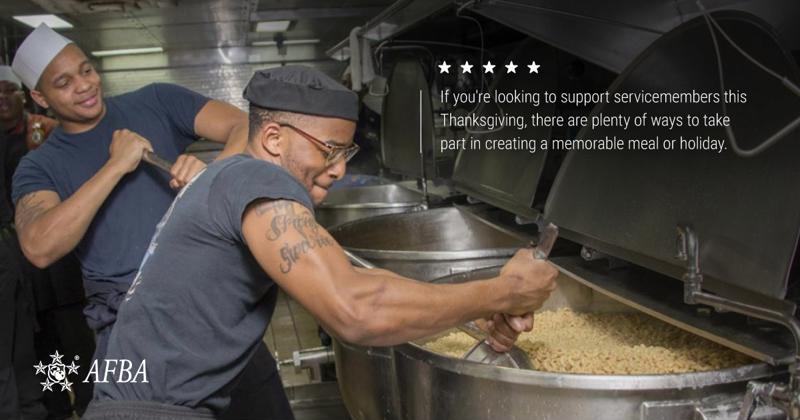
If you're looking to support servicemembers this Thanksgiving, know that there are plenty of ways to take part in creating a memorable meal or holiday.
Invite any servicemembers you know to join you for Thanksgiving dinner, or join an "adopt a servicemember" program to host someone in your area. Connect with the Morale, Welfare and Recreation (MWR) office at a nearby base or reach out to the USO or the Armed Services YMCA to learn about holiday programs and opportunities to give back.
In a story for Military.com, one military spouse wrote, "the inherent stress of inviting more than 40 soldiers … who were unable to travel home was more than balanced by the laughter and gratitude they shared with us."
This Thanksgiving, active-duty servicemembers will be thinking of nearly 2 million family members back home. Holidays can be difficult during a loved one's deployment, so extend some warmth and welcome a military family into your home.
Operation We Are Here publishes a list of locations opening their doors to military families for Thanksgiving dinner — see if you can volunteer to serve up turkey, stuffing and pie.
You can also support servicemembers abroad. Send a Thanksgiving card or care package to servicemen and women overseas or donate goods to a charitable organization that's arranging holiday shipments.
Finally, remember to include the brave men and women of the armed forces in your thankful thoughts this year.
Michigan business owner Meredith Rogan has found a creative way to support service members.
"When we [would] do the pledge of allegiance or sing the national anthem and there were vets in the audience," she remembered, "I would look at them in awe, like they did something I know I can't do. And I have always been looking for something to do to give back to them."
Rogan co-owns Joy Abendmode Bridal Boutique with her sister Diana in Royal Oak, Michigan. This November, the salon is partnering with Brides Across America (BAA) to give free wedding dresses to military and first responder brides.
"If you are a first responder, if you are a veteran and if you are a spouse of one of these people you are important, and we think that we think that deserves recognition," Rogan said in a local news interview.
Operation Wedding Gown
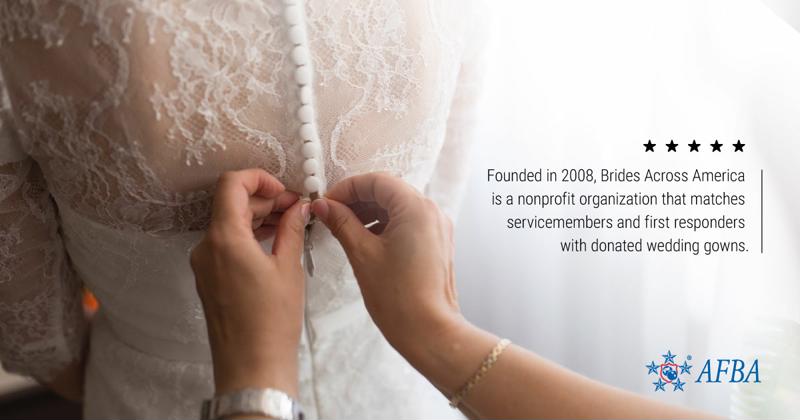
Founded in 2008, Brides Across America is a nonprofit organization that hosts dozens of "Operation Wedding Gown" events across the country. So far, BAA has matched up 24,000 brides with donated wedding dresses and arranged free weddings for 22 couples.
To participate, either the brides or their fiancés must be military service members, veterans or first responders. BAA caters to those planning weddings within the next year and a half. They also work with couples who were legally married in civil ceremonies and are now planning formal celebrations.
At Operation Wedding Gown events, dresses are available on a first-come, first-served basis. A variety of styles and sizes are available thanks to donations from retailers, designers and individual sponsors, but the boutiques do all they can to help brides find gowns they love.
In July 2019, Something New Boutique in Colorado Springs, Colorado, gave away some 30 wedding gowns valued at $1,000 to $4,000 while Ashley Grace Bridal in Lynchburg, Virginia, had 70 gowns available during their July giveaway.
Military and first responder brides get the VIP treatment
Vera Wang, wedding dress designer to the stars, partnered with BAA on her namesake brand's 30th anniversary in fall 2019. She styled 10 couples and their wedding parties in Vera Wang attire — and gifted the couples jewelry, stationery and bedding from the brand's various product lines.
The designer personally attended all of the fittings and gave brides the full VIP treatment. In interviews with WWD, brides called the experience "surreal" while BAA founder Heidi Janson considered the collaboration "a dream come true, a fairy tale."
"Many military women lose their femininity being consumed by their careers," one giveaway winner's submission noted. "I want her to see that she should be just as passionate about herself as she is with keeping our country safe."
How to partner or participate with Brides Across America
BAA's Operation Wedding Gown giveaway events are held in July and November in honor of Independence Day and Veterans Day, respectively. BAA also hosts events on the first Friday of every month at its headquarters in Andover, Massachusetts.
To participate, couples can find local events and register through BAA's website. The boutiques ask to see proof of service and identification and will then assist brides in choosing a dress from the available selection. There is a tax-deductible registration fee to cover administrative expenses and costs of the event, and dress alterations are covered by the brides themselves.
For those looking to give back, there are a few ways to get involved with Brides Across America. Individuals can donate new and used wedding gowns as long as they're in good condition. BAA also accepts donated rings and jewelry, veils, wedding favors, gift cards and other special occasion gowns. Bridal salons can register to host future events, as well.
Joy Abendmode Bridal Boutique is currently gearing up for three days of appointments with military and first responder brides. "They served us; it's time for us to serve them," Rogan explained.
Posttraumatic stress disorder, also known as PTSD, is a mental disorder that can develop after someone has been forced to experience a traumatic event, such as the conditions of battle and warfare. Although a psychological condition, there are severe physical risks associated with PTSD, as sufferers are at a heightened risk of self-harm and suicide.
Good mental health has always been one of the first casualties of war, but society's understanding of PTSD has changed considerably over the years. In World War I, soldiers suffering from various nervous and mental symptoms were said to be suffering from "shell shock." In World War II, the diagnosis was changed to "combat stress fatigue."
PTSD became an official psychiatric diagnosis in 1980, which was strongly influenced by the experiences and conditions of U.S. military veterans of the Vietnam War. A study conducted in the late 80s determined 15% of Vietnam veterans were suffering from PTSD, and today the VA estimates that 30% of Vietnam vets have had PTSD at some point in their lifetime.
About 12% of Gulf War veterans have PTSD, while somewhere between 11 and 20% of soldiers who fought in Operations Iraqi Freedom and Enduring Freedom are estimated to be afflicted with the condition.
These numbers are alarming, and speak to the importance of providing mental health resources to our nation's soldiers. And on June 27, advocates are especially emphatic in making that point.
How to advance the cause of PTSD awareness
PTSD Awareness Day can trace its origins back to the tragedy of Staff Sergeant Joe Biel, a North Dakota National Guard member who took his own life in 2007 following two tours in Iraq. SSgt. Biel, who suffered from PTSD, committed suicide after his return from duty to his home state.
In 2010, Senator Kent Conrad led the effort to get official recognition of PTSD via a "day of awareness," and SSgt. Biel's birthday, June 27, was chosen as the official PTSD Awareness Day, according to Military Benefits. In 2014, the Senate expounded upon the annual observance by designating the full month of June as National PTSD Awareness Month.
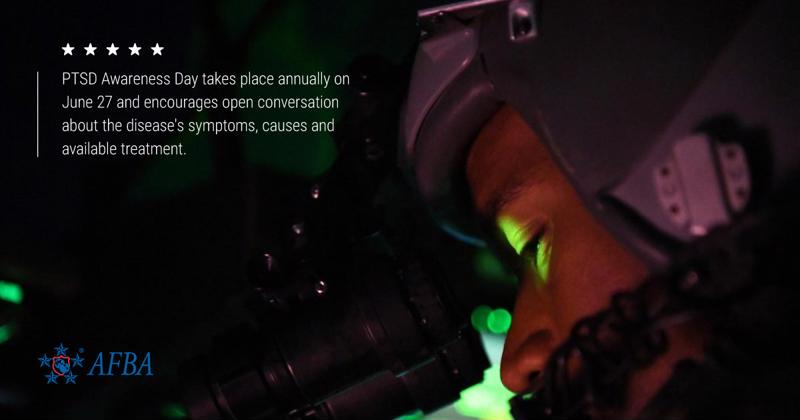
Today, individuals primarily observe PTSD Awareness Day by encouraging open conversations about the disorder, with frank and informative discussions of its causes, symptoms and available treatment methods. Despite the fact that it has been an official medical diagnosis for nearly four decades, PTSD is still frequently misunderstood, particularly by those who have only seen it portrayed in movies and other pop culture dramatizations.
To aid in this effort, the Department of Defense publishes circulars, articles and other materials designed to better educate and inform military members and their families about PTSD. Furthermore, the VA's website has lots of articles and resources dedicated to PTSD, and when retiring military members fill out their VA claim forms, there is an option to be evaluated for PTSD.
If you or someone you know is potentially suffering from PTSD, it's important to look for the warning signs. Though not always the case, common non-specific symptoms include irritability, depression and, particularly prevalent in veterans and active military members with the condition, something known as "hypervigilance" or "hyperarousal." Repeatedly experiencing a traumatic event through flashbacks, nightmares and persistent memories is another symptom of PTSD. The biggest red flag is suicidal ideation, and anyone experiencing such thoughts should immediately seek help.
The mental scars accrued in combat are often far more difficult to heal than the physical wounds, but there is always hope for recovery. PTSD Awareness Month is the perfect time to make sure that message reaches everyone who needs to hear it.
This year, the United States Coast Guard Auxiliary celebrates a major milestone with its 80th anniversary on Sunday, June 23, 2019.
In the last eight decades, Auxiliarists have grown to become a vital component of the U.S. Coast Guard, and today the USCG Aux boasts 26,000 serving out nation in 825 local units with 1,800 vessels and 160 aircraft in between them.
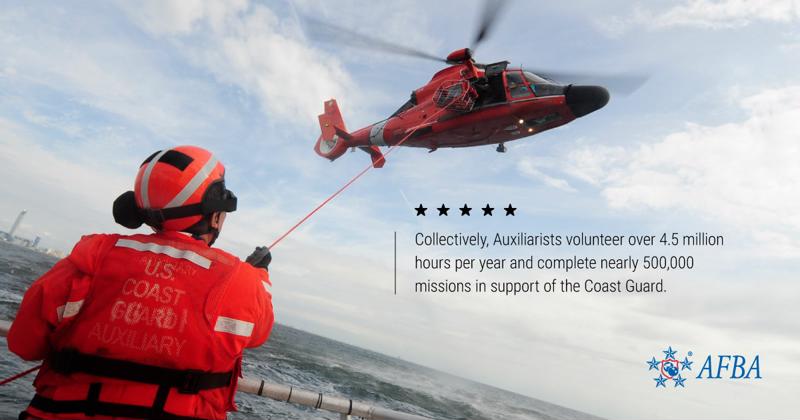
Collectively, Auxiliarists volunteer over 4.5 million hours per year and complete nearly 500,000 missions in support of the Coast Guard, saving approximately 500 lives, assisting 15,000 distressed boaters and conducting over 150,000 safety examinations of recreational vessels.
To understand how the U.S. Coast Guard Auxiliary got its start, and how its role has expanded over the past 80 years, it's helpful to examine the civilian auxiliary's rich history.
Looking back on eight decades of being "Semper Paratus"
What is today the Auxiliary began life as the Coast Guard Reserve, which was authorized by an act of Congress on June 23, 1939. A response to the increase in the number of recreational boaters in America, the move gave the Coast Guard a legislative mandate to use civilian volunteers to promote safety on and over the high seas and the country's navigable waters. At its creation, the Coast Guard Reserve was a non-military service comprised of unpaid, volunteer citizens who owned motorboats or yachts.
Two years later, Congress amended the 1939 act by passing the Auxiliary and Reserve Act of 1941 on Feb. 19. The new legislation designated the Reserve as a military branch of the active service, and designated civilian volunteers as the Auxiliary.
Today, Feb. 19 is formally recognized as the birthday of the Coast Guard Reserve, and June 23 is celebrated as the birth of the Coast Guard Auxiliary.
When America entered World War II, many Auxiliary members became temporary members of the Coast Guard Reserve. As many as 50,000 Auxiliarists joined the war effort, guarding waterfronts, carrying out coastal picket patrols and rescuing survivors from scuttled ships, among many other heroic acts. Many of the Auxiliary members had their private vessels pressed into service, as well.
Once the war was won, Auxiliarists returned to their recreational boating safety duties, which included a renewed interest in safety education. It was in 1952 that the Auxiliary first observed "Safe Boating Week," which has since grown to become an international campaign led by the National Safe Boating Council.
In 1976, a study commissioned by the Coast Guard concluded that the Auxiliary was one of the Guard's, and the country's, greatest assets.
"In summary, we consider the Auxiliary the greatest economical resource readily available to the COGARD," the study's authors wrote. "It performs in an outstanding manner and its personnel are among the most professional group of volunteers in the nation."
Twenty years later, Congress expanded the Auxiliary's role to allow members to assist in any Coast Guard mission, except those that involved direct law enforcement and military operations. This enabled Auxiliarists to begin examining commercial fishing vessels, flying in C-130 aircraft and working in Coast Guard offices, among other new prerogatives.
Today's Auxiliary members also perform free Vessel Safety Checks, teach boating safety to boaters of all ages, perform harbor and pollution patrols and serve an important role in the Coast Guard Search and Rescue team.
As an all-volunteer unit, Auxiliarists are said to save U.S. taxpayers millions of dollars every year through their acts of service, which include lifesaving rescue missions on our nation's waters. As the United States Coast Guard Auxiliary celebrates its 80th birthday, there's never been a better time to thank the tens of thousands of members who help keep our nation and its citizens safe at sea.
The oldest and most senior branch of the United States military in order of precedence, the U.S. Army actually predates the U.S. itself. Congress established the First Continental Army on June 14, 1775, more than a full year before the signing of the Declaration of Independence, to recruit professionally trained soldiers that could combat the British "Redcoats" in the Revolutionary War.
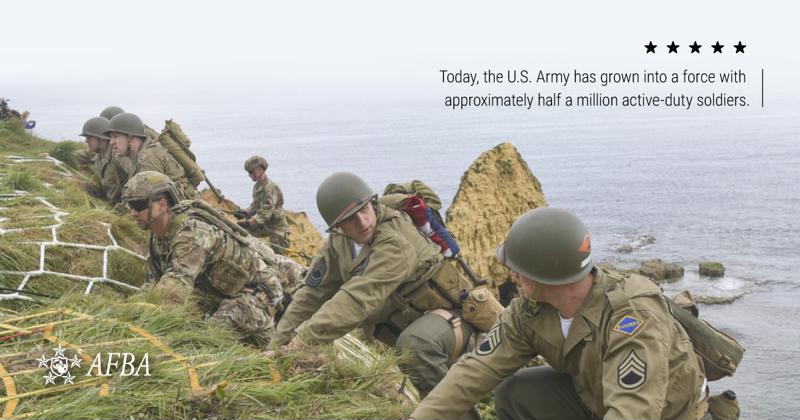
In the centuries since then, America's Army has grown into a fighting force with approximately half a million active-duty soldiers. And on Friday, June 14, 2019, the U.S. Army will observe its 244th birthday, affording military servicemembers and civilians alike an opportunity to celebrate the branch's rich history and continued role as a force for good in the world.
How to celebrate the U.S. Army's birthday in 2019
The Army's birthday is not an official state or federal holiday, meaning government offices and private places of business remain open on June 14th, while Army and Department of Defense agencies typically choose to celebrate the occasion at the base or local level with special events, ceremonies and social occasions.
The USO, AMVETS, The American Legion, VFW and other military service organizations also usually observe the holiday on a local or agency-wide level each year. If you would like to know if and how the birthday is being celebrated in your community, you can reach out to the local chapter of your preferred Veterans Service Organization.
One unique annual celebration is the Army Birthday Ball, which is held at military bases, community centers, civilian hotels and other applicable sites around the world. This black-tie formal event features military members in full-service dress, also known as "Dress Blues" or "Mess Dress," and includes a long list of traditions that are intended to pay respect to those who sacrificed life and limb to serve, and to welcome the newest members of the service and salute the future of the Army at large.
In that spirit, one of the most popular traditions at the ball is the cutting of the Army birthday cake, in which the oldest serving soldier and the youngest serving soldier use a ceremonial saber to cut the first slice. Another common tradition is the receiving line, in which Army leaders personally greet each attendee entering the ballroom, and the giving of toasts to the United States, military families and to fallen comrades, the latter toast one that is always respectfully answered in silence.
This year, the 244th U.S. Army Birthday Ball will be held at the Washington Hilton Hotel in Washington D.C. on the evening of Saturday, June 15, and to commemorate the 75th anniversary of the Normandy invasion, will feature a theme of "honoring the call to service from D-Day to Today." Similarly, on June 14, all U.S. Army veterans and active duty personnel will receive free admission to the National D-Day Memorial in Bedford, Virginia.
Several other high profile military celebrations will be taking place that weekend, as well. Different chapters of the Association of the United States Army will be holding their own Birthday Balls in various venues across the country on June 14 and 15. Additionally, Fort Knox will be hosting a birthday bash on June 14 that includes a variety of community events, all of which will be open to the general public.
Additionally, private citizens can always organize events in their own community, or find ways to celebrate with friends and family. The 244th anniversary of the U.S. Army provides a wonderful opportunity to both reflect on the centuries of sacrifice that have come before, and celebrate the bright future that lies ahead for America's fighting force.