
Do you know what type of compensation you're eligible for as an active-duty servicemember? There are many possibilities based on your experience, assignments, location and more. Here, we'll break down the different kinds of military pay to help you get started on your financial planning for the future
Active duty basic pay
This is the primary form of income for active duty servicemembers and is similar to a civilian's paycheck. The government sends checks for basic pay every month, and servicemembers can expect an annual increase if approved by Congress. This is similar to a tenure-based raise or benefits increase that must be approved by upper management. This year, servicemembers saw their basic pay increase by 2.4 percent as of their Jan. 12 paycheck.

Other types of pay and allowances
Servicemembers often get other forms of compensation depending on various factors, including but not limited to:
- Professional skills.
- Area of assignment.
- Marital status.
- Types of duties performed.
It must be noted that the military provides general categories for two types of compensation:
Pay
Pay is generally subject to taxes and included in the taxable income reported to state and federal governments.
- Assignment Incentive Pay (AIP): Those who serve under unusual circumstances – such as involuntarily extended stay in Iraq, Afghanistan and even South Korea – may get financial compensation for their trouble.
- Career sea pay: Granted to active-duty sailors who have spent at least three years at sea. Amounts are based on the person's rank, and an additional $100 per month is granted for each subsequent month.
- Diving pay: Officers whose duties involve diving can receive up to $240 per month. Enlisted members with similar duties may receive up to $340 per month.
- Enlistment and reenlistment bonus: Those who initially enlist or extend their period of active duty are eligible for an Enlistment or Reenlistment bonus. The amount varies by skills and department but can be as much as $40,000.
- Foreign language proficiency pay: Those who maintain proficiency in certain languages (chosen by military departments) may receive a monthly payment of up to $1,000.
- Hardship duty pay (HDP): HDP-L payments, ranging from $50 to $150 are for officers and personnel serving in designated locations. HDP-M payments are for performing designated missions that involve recovering the remains of U.S. servicemembers.
- Hazardous duty incentive pay: Members who work in certain hazardous situations – including demolition, working with toxic fuel, flight deck operations and more – are authorized to receive $150 per month.
- Hostile fire and imminent danger pay: Servicemembers working in imminent danger zones are authorized to receive a $225 monthly payment.
- Involuntary separation pay: Members who are involuntarily and temporarily unable to serve (for reasons other than misconduct) and have served at least six – but no more than 20 years – of active duty are eligible for a special lump-sum.
- Medical pay: Medical specialists (doctors, dentists, nurses, pharmacist, physical therapists, radiation specialists, optometrists and others) are entitled to a variety of special pays.
- Special duty assignment pay: Servicemembers who perform duties with a high level of responsibility or that are extremely difficult can get a monthly payment ranging from $75 to $450.
Allowance
Allowance is not subject to taxation and not included in annual taxable income.
- Basic allowance for housing (BAH): Members not assigned to government quarters get a monthly allowance calculated to equalize out-of-pocket housing expenses, regardless of location. By 2019, members should only have to pay 5 percent of such costs from their own funds.
- Basic Allowance for Subsistence (BAS): Each month, officers get $254.39 and enlisted members authorized to mess separately get $369.39 to offset the cost of meals.
- Clothing Allowance: Officers get an initial uniform allowance, payable only once. Clothing replacement allowances are granted to members who must either wear civilian-type or special military clothing.
- Cost of living allowance for the continental United States (CONUS COLA): Servicemembers living in designated high-cost areas within the U.S. receive an allowance to offset non-housing costs. Most payments range from $20 to $300; sums are based on rank, dependent status, location and years of service.
- Dislocation allowance (DLA): Active-duty personnel dealing with a permanent change of station may have some of their moving expenses reimbursed. The amount depends on the member's grade and whether they have dependents.
- Family separation allowances (FSA): Only members with dependents may receive this allowance. There are three types: FSA-R (when dependents don't live nearby and the government won't expense their transportation), FSA-S (when the member is aboard a ship that is continuously away from more than 30 days) and FSA-T (when the member is on TDY or away from the permanent duty station for over 30 days).
- Overseas station allowances: This series of payments helps offset the costs for food, lodging and similar expenses when servicemembers are assigned outside the U.S. It consists of four components: cost of living allowance, overseas housing allowance, temporary lodging allowance and interim housing allowance.
- Temporary lodging expense (TLE): If a servicemember and/or dependents must stay in temporary lodgings while moving because of a permanent change of station, TLE partially offsets this cost and meal expenses.
Understanding your pay and allowances is the first step toward planning for your financial future. Armed Forces Benefit Association can help you with the rest.

Armed Forces Day is fast approaching. It's celebrated on the third Saturday in May, a month filled with holidays dedicated to various servicemembers: Military Appreciation Month, Memorial Day, Victory in Europe Day, Military Spouse Appreciation Day and more. Celebrations are typically local and include parades, social events and sometimes sales. This year, Armed Forces Day falls on May 19.
Armed Forces Day celebrates a significant event in history: the unification of the separate branches of the military. Before the end of World War II, the War Department and the Naval Department acted separately, and the secretary of each organization reported directly to the president.
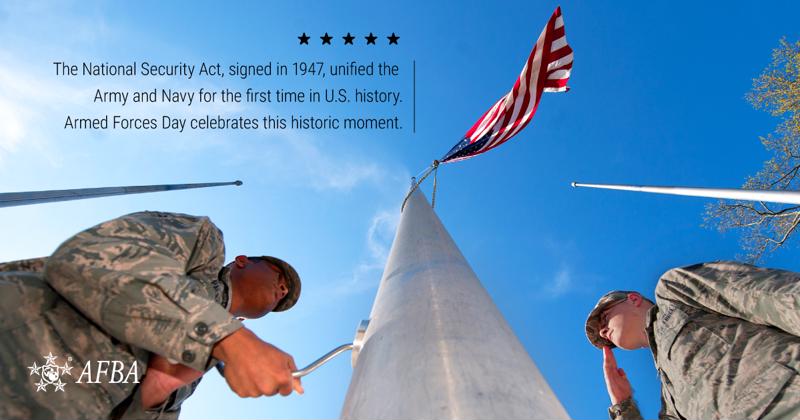
At the end of the war, President Harry Truman proposed a unified department to handle all aspects of national defense, believing this would cut back on wasteful spending and encourage interdepartmental collaboration. He signed the National Security Act in 1947, creating the National Military Establishment to unite the Army and Navy. In addition, the law created the U.S. Air Force (which had been known as the Army Air Forces), the Central Intelligence Agency, the National Security Council, the National Security Resources Board and the Joint Chiefs of Staff.
In charge of the National Military Establishment was a single Secretary of Defense. The establishment was then renamed the Department of Defense on August 10, 1949.
That same year, Defense Secretary Louis Johnson announced the creation of Armed Forces Day to replace separate celebrations for the Army, Navy and Air Force. This goal wasn't exactly achieved, as each branch of the military still has its own day of recognition. That said, Armed Forces Day remains an opportunity for all servicemembers and civilians to celebrate the role of the military in upholding the American way of life.
Secretary Johnson had the support of President Truman, per the Department of Defense, speaking on the holiday during his Presidential Proclamation on Feb. 27, 1950.
"Armed Forces Day, Saturday, May 20, 1950, marks the first combined demonstration by America's defense team of its progress, under the National Security Act, towards the goal of readiness for any eventuality," he said, according to the DoD. "It is the first parade of preparedness by the unified forces of our land, sea, and air defense."
Despite being held in such high regard, Armed Forces Day didn't become a national holiday until President John F. Kennedy declared it so in 1961.
Celebrating Armed Forces Day
The first holiday in 1950 had air shows, receptions, open houses and parades. It was also celebrated internationally; servicemembers in Berlin had their own festivities. Every year has a theme, and the first was "Teamed for Defense" to express the unification of all military forces. This first holiday was also an opportunity for civilians to learn more about the goals and achievements of the military.
Other themes for Armed Forces Day include:
- Freedom.
- Patriotism.
- Liberty.
- Freedom Through Unity.
- Guardians of Peace.
- Appreciation of a Nation.
- Arsenal of Freedom and Democracy.
- Deter if Possible, Fight if Necessary.
- Lasting Peace.
- Dedication and Devotions.
This year's theme is "All Across America," per the DoD, showcasing the ways servicemembers work for civilians while on American soil. The theme coincides with the department's This Is Your Military initiative and #KnowYourMil hashtag, which aim to display the positive truth of military life.
This Armed Forces Day, let's take time to celebrate the unified military and all the ways servicemembers have protected American freedoms. Civilians can share personal stories of the servicemembers and veterans in their lives on social media by contributing to the #KnowYourMil campaign.
Valentine's Day is fast approaching. No doubt you've noticed all the heart decorations, fancy boxes of chocolate and displays of roses in practically every store. If you or your loved one is stationed overseas, however, this holiday is more bittersweet than romantic.
Luckily, there are ways you and your loved one can celebrate the holiday despite living so far apart. Here are five tips for celebrating Valentine's Day during deployment:

1. Create a handmade card for your loved one
Nothing says "I love you" more than the personal touch of something handmade. A crafted valentine will mean much more to your loved one than something bought from Target or Walgreens. Possible materials for your project include:
- Cardstock (much sturdier and sleeker than construction paper).
- A bone folder (for a crisp, professional-looking folded edge).
- An Xacto knife (makes cutting curves much easier).
- Stencils or a calligraphy pen (for crisp lettering).
Additionally, there are many online resources, including DIY and crafting blogs, to help you create a professional-looking valentine.
2. Hold an unboxing Skype session
If you and your sweetheart plan to send packages or gifts to each other, schedule a time to meet on Skype, FaceTime or another video conference platform. Save your presents for your virtual date, then open them in front of each other. This way, the two of you can share the magical moment of seeing a gift for the first time, in real time.
3. Host a Gal/Palentine's party for other military spouses
It may be next to impossible to get ahold of your loved one on February 14. In that case, spend time with your friends or associates who are in a similar situation. Host an outing or dinner for people whose loved ones are also deployed servicemembers. You can simply meet up at a bar after work or arrange an elaborate weekend potluck.
Though the mood of the event won't necessarily be romantic, it'll be a great chance for everyone to talk about their thoughts and feelings in regard to being apart from the person they love. Having a deployed spouse or significant other is a unique struggle, and it's good to express these feelings with people who truly understand.
4. Get active
Sometimes, Valentine's Day is the absolute last thing you want to think about. After all, you may tell yourself, what's the point of acknowledging the holiday if you can't be with the person you love?
If you feel this way, spend February 14 exploring a new or favorite physical activity. Sign up for a high-intensity workout like spinning, rebounding or weightlifting. Alternatively, you can take a relaxing walk around a local park. The goal here is to stave off a holiday-induced depression by getting your heart rate up and your endorphins flowing. Even just leaving the house can lift your spirits a bit.
5. Spend the holiday with your children
Valentine's Day isn't just about romantic love; it's also about family relationships. If you're a parent, spend today celebrating in the love of your children. Arrange a special treat for them – cupcakes, a trip to the movies, or a video conference with their deployed parent. Take them out to their favorite restaurant, buy them chocolates or let them stay up a bit past their bedtime.
At some point, you can have a conversation about the parent overseas. Kids often don't have the words to express their complex emotions, but talking with you can help them process what they're feeling.
Keeping love alive despite the distance
Being separated from a loved one is incredibly difficult, but there are still ways to keep your relationship healthy. Use any of these five tips to celebrate the year's most romantic holiday with your significant other, your friends or your children.

Some active-duty servicemembers living off base saw their housing allowance increase slightly, while others saw no change at all this January 1. As Military.com reported, the Basic Allowance for Housing increased an average of 0.7 percent – the equivalent of $10 per month – at the start of 2018. Individual increases varied depending on a servicemember's location, pay grade and whether or not he or she has dependents.
That said, the increase only applies to servicemembers stationed in certain military housing areas. Local BAH rates will fall in 128 of the 301 locations. However, no current recipient will see their allowances decrease unless they're demoted, their number of dependents changes or they move to a new location.
"We do not penalize members who have already gone to a location, signed a lease and then rates happen to decrease," said Summer Britford, a chief with the Defense Travel Management Office. "Incoming members do have access to lowered [rental] costs so they do experience those decreases."
That latter statement doesn't exactly align with the expenses experienced by many servicemembers and civilians. As Military.com pointed out, the BAH adjustments haven't matched changing rent and utility costs. That said, the new rate does agree with the Defense Department's decision to reduce housing allowances overall, leaving servicemembers responsible for some expenses once again.
A brief history of housing allowances
Originally, allowances were only designed to cover approximately 80 percent of servicemembers' housing costs, leaving them responsible for the remaining 20. However, according to Military Benefits, the Defense Department began increasing allowance rates in the late 1990s to keep them in line with nationwide rental costs. By 2005, housing allowances covered 100 percent of housing costs for servicemembers.
In 2015, however, the DoD reduced BAH rates to cover 99 percent of these costs. The department also began excluding rental insurance from rate calculations at that time. The next year, the DoD determined that BAH rates would be set at 95 percent, falling at a rate of 1 percent per year over four years. The current rate covers 96 percent of housing costs; it will drop again for a final time next year.
Defense officials wish to use the millions of dollars saved by reduced BAH rates for other needs as defense budgets tighten and the country struggles to eliminate the deficit.

Other housing allowance 'solutions' could hurt servicemembers
While the DoD works internally to find the right housing allowance balance, other organizations have come up with their own ideas. As a separate Military.com article revealed, The Heritage Foundation proposed a reduction of housing allowances in the 2018 budget.
"[The housing allowance] is not military compensation," the report read, according to Military.com. "Housing allowances should be based on the amount of money that service members must pay to obtain adequate housing. Service members are not entitled to, nor should they have any expectation, that money above what they pay for housing can be retained as 'extra compensation.'"
The report implies that servicemembers receive allowances that cover more than the cost of housing in their area; however, BAH rates are designed only to cover a portion of these expenses. While this suggestion wasn't included in the budget, think tanks and government officials will likely continue to adjust BAH rates to the detriment of active servicemembers.
This past September, a female Marine Corps became the first woman infantry officer after successfully completing the Infantry Officer Course, the Marine Corps announced in a press release. Commonly referred to as the IOC, the intensive 13-week course is regarded as one of the toughest in the military. An average of 10 percent of students fail to pass the first day, which includes a skills assessment and a combat endurance test consisting of hikes and an obstacle course. Of the female officer's class, only 88 out of 131 students graduated.
The IOC is designed to teach and assess infantry and ground intelligence officers in the leadership, character and infantry skills necessary to serve in the position. As the Washington Post noted, the course takes an incredible amount of stamina and strength, requiring students to have the ability to carry up to 152 pounds of equipment.
"I am proud of this officer and those in her class who have earned the infantry officer MOS," Marine Corps Commandant Gen. Robert Neller said of the woman, who asked to remain anonymous, in the press release. "Marines expect and rightfully deserve competent and capable leaders, and these IOC graduates met every training requirement as they prepare for the next challenge of leading infantry Marines; ultimately, in combat."
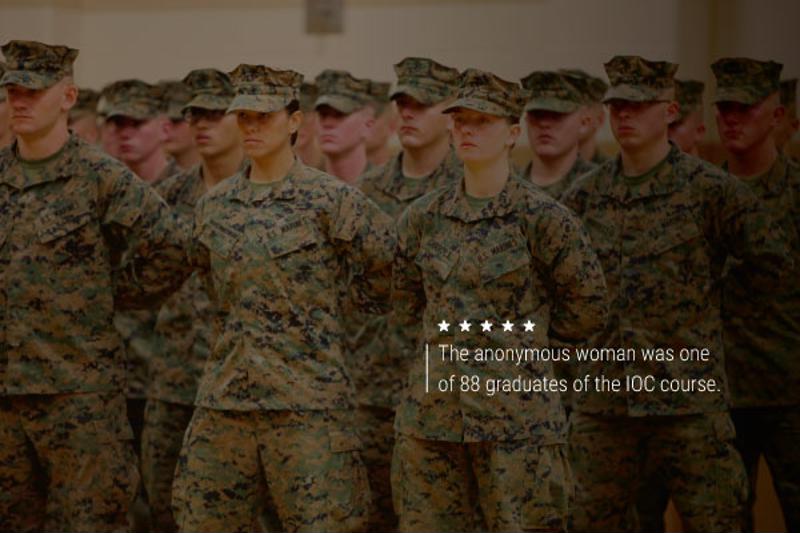
The reasoning behind the woman's decision to keep her identity private is unknown, but some speculate she requested so in order to best attend to her new position. Former Marine Corps helicopter pilot Kyleanne Hunter, who currently serves as a member of the Pentagon's Defense Advisory Committee for Women in the Services, told the Washington Post that the anonymous woman faces unparalleled performance pressures, especially from critics who want her to fail.
"Too much attention can take away from her operational requirements," Hunter told the newspaper. "Her first challenge is going to be to remain anonymous, for lack of a better term, and just do her job."
The infantry officer will also need to win over the people under her command, which may prove difficult as the Marine Corps has historically been resistant to gender integration.
Accepting gender diversity in military branches
The Marine Corp first opened the IOC to women in 2012 as part of its research on how to introduce women into all-male units. That same year, 75 percent of surveyed active-duty marines said they were opposed to complete gender integration, per the Washington Post. Ninety percent expressed concern about possible relationships forming within units, and more than 80 percent of male respondents were concerned about false sexual allegations, fraternization and women getting preferential treatment.
Furthermore, sexual harassment also served as a barrier to gender equality within the military branch. Earlier this year, news broke of a private Facebook group where male Marines were sharing nude photos of female servicemembers, often identifying them by name, rank, location or social media handle and leaving explicit comments. According to Reveal News, which broke the story, over 30,000 men were members of the group.
These issues have not stopped the Marine Corps or other military branches from seeking greater gender diversity, however, nor did it dissuade some female servicemembers from high-ranking positions. In 2015, the Pentagon officially opened all combat jobs to women. Since then, four other women, not including the recent female graduate, attempted the IOC. Although none of the four completed it, their determination signals a shift in attitudes regarding who should and who should not serve in the military.
Moving is expensive, especially for military families. Servicemembers, their spouses and their children are typically asked to move around the country – and even internationally – several times throughout their tenure. Each time, the spouse has to find a new job, which further increases expenses if that job requires a professional license or similar documentation. Previously, spouses would have to pay for the costs of obtaining a new license out of pocket, placing a burden on lawyers, nurses, teachers and people in similar positions. These costs are often a last-minute detail military families may not consider until starting the job hunt.
Thanks to a proposal in the 2018 National Authorization Act, however, military families may not have to worry as much about these costs.
Financial assistance for new licenses
The 2018 NDAA, which must still be passed by Congress, would give the Department of Defense and the Coast Guard permission to reimburse military spouses up to $500 for "transfer fees" – essentially, money to help cover the cost of exams, certificates, licenses and other such professional expenses.
According to Military.com, the idea was originally proposed by New York Representative Elise Stefanik-R.
"Military spouses serve too, and this update will help alleviate unnecessary stress and expenses, help ease the transition, and will give these spouses and their families some deserved predictability," Stefanik told Military.com.
The proposal could indeed be hugely beneficial. According to Brooke Goldberg, head of military spouse programs at the Military Officers Association of America, approximately half the spouses her organization survey require a professional license for their career. Not only could the proposal assist a significant number of military families, but the $500 can significantly reduce expenses. Although the cost of obtaining a new license can reach thousands of dollars per move, even a portion of that amount reduces a family's financial burden.
To be eligible for the reimbursement, the spouse must be forced to get a new license in his or her existing career field due to a permanent change-of-station move. However, the proposed NDAA doesn't detail how spouses should apply for reimbursement and, as noted previously, still needs to be passed by the House and Senate.

Proposal praised by military career advocates
Unsurprisingly, this portion of the bill was met with much enthusiasm.
"Anything that facilitates an opportunity to make life easier for military spouses to stay in their desired industry … is a step in the right direction," said Elizabeth O'Brien, director of spouse programs for Hiring our Heroes, according to Military.com.
While the government is required to pay for moves, families still face financial strain – especially if they're forced to move frequently. If they choose a do-it-yourself move, the government will reimburse them 95 percent of what it would cost the organizing body – not the family – to hire commercial help. Alternatively, families can allow the government itself to pack, ship and unpack their items.
With either choice, there are often up-front cash payments that leave families strapped until the next payment comes through. Additionally, the reimbursement may not cover all moving expenses, such as gas or lodging, or families may break government-mandated weight restrictions and be liable for the excess. Such financial strain is then increased when the spouse reapplies for licensure.
While $500 toward the cost of a new license doesn't completely alleviate the moving burden, any amount can help. Military spouses sacrifice a lot to support servicemembers, so support from the government is a welcome form of assistance.
Thanksgiving is a time for families, but not everyone gets to celebrate the holiday with their loved ones. Thousands of active duty military members may be forced to celebrate the holidays overseas, and those in the states may not be able to make long-distance trips.
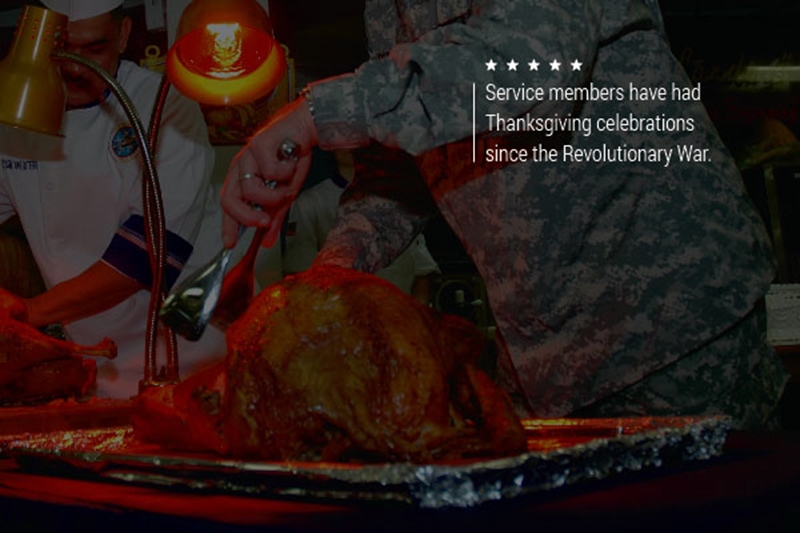
These circumstances haven't stopped them, however, as active duty military members have held Thanksgiving celebrations since the Revolutionary War.
A history of military Thanksgiving
According to the independently owned Military Benefits, servicemembers celebrated days of Thanksgiving during both the Revolutionary and Civil Wars. Although the holiday as we know it didn't officially come into being until 1863, these celebrations were held in hopes of unifying the U.S. during its most divided times.
During World War I, independent service providers like the Red Cross and the YMCA began organizing dinners for soldiers, and French families invited servicemembers into their homes after Armistice Day. During World War II, Thanksgiving meals were either shipped to soldiers or sourced locally.
Modern military traditions
Today, active duty personnel celebrate Thanksgiving in a number of ways. Junior servicemembers, many of whom are away from home for the first time, generally receive a dinner provided by senior leaders.
Those stationed in the U.S. mostly spend the holiday on their base. Sometimes they are invited to dinner by local families or houses of worship. Experienced servicemembers who have families nearby may even invite their juniors to dinner.
"Many hold special services or events for veterans and active duty military."
In addition, many local and national organizations hold special services or events for veterans and active duty military. For example, Operation Homefront provides free dinners to military personnel and their families through its Holiday Meals for Military. This tradition began after a soldier, shopping for groceries with his wife and infant, tried to purchase food for their Thanksgiving dinner in 2008. The total exceeded the amount they had on hand, but an executive behind them paid for the groceries in full. Since its inception, Holiday Meals for Military has provided dinners for almost 70,000 such families.
Paradies Lagardere, a travel retailer, also extends holiday services for military members and veterans. The company's Treat Our Troops program routinely offers free meals to servicemembers visiting its airport restaurants.
Meanwhile, servicemembers stationed abroad usually celebrate the holiday on base. According to Task and Purpose, while each branch of the military creates its own Thanksgiving menu, they all choose from a single set of standardized recipes, so an army soldier will have the same style of turkey and gravy as a member of the Coast Guard. In addition, today's servicemembers have the benefits of technology like Skype and Facetime, so they can still see and speak with their loved ones even if they can't visit in person.
That said, sometimes servicemembers will have a less traditional Thanksgiving and participate in local cultural activities instead. They'll eat a holiday meal with local dishes or participate in other cultural traditions.
Coping with Thanksgiving deployments
Spending Thanksgiving overseas isn't as bad as it sounds. An article on the U.S. Department of Veterans Affairs shared first-hand accounts of the experience, and many veterans remembered their holidays positively.
"I spent two Thanksgivings in Fallujah and they weren't bad at all," said Anthony Schmiedeler. "You had your brothers to the left and right which might as well be family. And the leadership did everything they could to give us a proper Thanksgiving meal with all the fixings. I'm grateful."
While Thanksgiving in the military differs from civilian life, the spirit of the holiday remains the same.
Are you a soldier who likes playing video games? If you're an active duty servicemember, chances are the answer is yes, as video games are a popular past time for those serving in the Army. Now, the military will be leveraging soldiers' love and aptitude for video games with Operation Overmatch, an online game that will contribute to the development of the future fighting force.

What is Operation Overmatch?
Operation Overmatch, initiated by the U.S. Army Capabilities Integration Center, is an online, multi-player game. Its goal is to boost combat effectiveness. This endeavor {Operation Overmatch} is an online gaming environment whose goal is to create two-way communication between soldiers on the one side and the developers, engineers and scientists on the other side.
While it might seem like the Army is merely providing people with a new game to play, there's a real-world component to Operation Overmatch. The army reported that it is actively seeking soldiers to play and provide feedback.
"The army is actively seeking soldiers to play the game."
"Soldiers have the advantage of understanding how equipment, doctrine and organization will be used in the field – the strengths and weaknesses," explained Michael Barnett, chief engineer at the Army Game Studio and project lead for Operation Overmatch. "And they have immediate ideas about what to use, what to change and what to abandon – how to adapt quickly."
The service's Training and Doctrine Command and Army Game Studio has been developing the game since 2016. Soldiers will get to beta-test machines they pilot in the game and see if weapon and armor concepts are worth pursuing before the Army orders real-life prototypes.
The game will allow players to select among thousands of options for certain predetermined capabilities, such as weapons, caliber and robotics, and use these in an "adversary threat platform" to determine effectiveness. After playing the game, the soldiers should provide feedback on the concept and capability of the prototypes and how they would likely play out on the battlefield.
For now, developers are still in early stages, but beta-testing is scheduled to begin in October. However, while soldiers will get a chance to play, the game is focused more on gear than tactics, and the viability of proposed or experimental weapons.
Applying video game skills to the real world
Some people might be wary about using skills learned in video games in real-life combat situations. Others might even be skeptical that there are any skills to develop by playing video games.
According to data from Pew Research Center, 26 percent of all adults thought most video games were a waste of time, while slightly fewer respondents (24 percent) thought the opposite. A similar disconnect can be seen among people who believe video games develop strategic thinking and problem-solving skills.
However, a recent study showed that playing video games strengthens a range of cognitive skills, according to the American Psychological Association. The study found that three-dimensional environments and the need to solve complex puzzles necessary to successfully navigate video games improved a host of skills, including:
- Spatial navigation
- Reasoning
- Memory
- Perception
"This has critical implications for education and career development, as previous research has established the power of spatial skills for achievement in science, technology, engineering and mathematics," said Isabela Granic, PhD, the lead author of the article.
Another finding unearthed by the researchers was that the ongoing failures that accompany video game trials and tribulations help build emotional resiliency.
By helping to further strengthen these cognitive skills, problem-solving abilities and building resilience in the face of failure, video games make the perfect tool for soldiers. When mixed with the prototyping options available for new gear, these training capabilities should serve to further strengthen our military.
If you're a servicemember called up to active duty service or long-term deployment, you'll no doubt have a lot of important financial and legal questions: What will happen to my current rental agreement or mortgage? How will I handle any ongoing legal disputes, including court appearances?
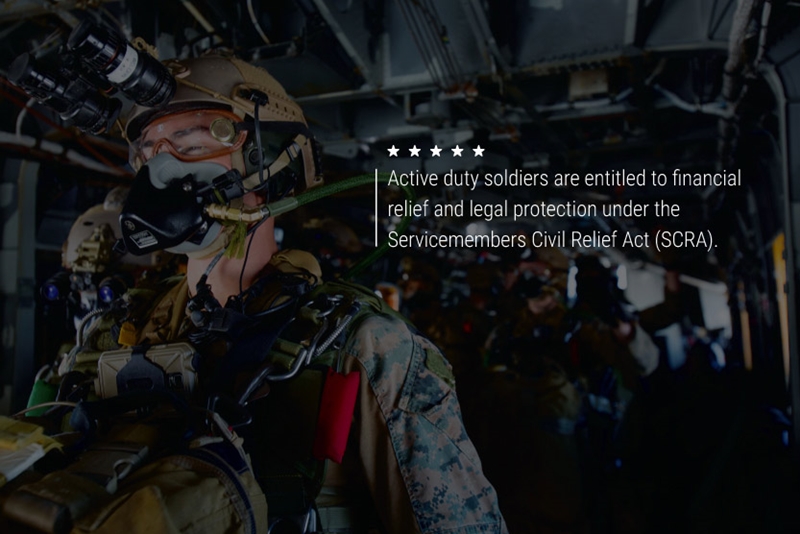
Thankfully, you are entitled to financial relief and legal protection under the Servicemembers Civil Relief Act (SCRA). It's critical that you understand how this law impacts your rights and responsibilities so you can take full advantage of its benefits.
What is the Servicemembers Civil Relief Act?
In 2003, Congress passed the SCRA to protect soldiers, sailors, airmen, marines, coast guardsmen and commissioned officers in the Public Health Service and National Oceanic and Atmospheric Administration from being the subject of a lawsuit while engaged in active duty and for one year following it.
"The act's origin can be traced back to the Civil War."
The act's origin can be traced back to the Civil War, when Congress exempted Union soldiers from legal action while serving in the war. Since then, the law has existed in one form or another until it settled into its current form in 2003.
At its core, the SCRA is designed to ensure that active duty soldiers can focus all of their attention on serving their country and devote their entire energy to the defense needs of the nation without having to worry about a car lease or the interest rate on their credit card during this time.
The benefits of SCRA
Much like most laws, the SCRA is a long, complex document full of legalese. While it has an abundance of provisions, these are the key points that you should know:
- Interest rate cap – You can cap any interest rate at 6 percent for any credit card, mortgage or other loan you or your spouse obtained prior to entering active duty status.
- Property lease termination/automobile lease cancellation – You generally have the ability to leave a residential or business property lease or cancel a car lease without penalty.
- Judicial relief – You have the option to postpone any court appearances for a civil case or civil administrative proceeding. This does not apply to any criminal court proceedings.
- Eviction protection – You and your immediate family are protected against eviction from housing due to nonpayment of rent. The monetary limit of the rental protection available changes every year, and was $3,584.99 per month or less in 2017, according to Military.com.
- State tax relief – If your service or deployment relocates you to a different state, your domicile or legal residence for tax purposes does not change. This means you are only responsible for paying state taxes wherever your home is, and not in every state you're relocated to during your service.
Since it deals with legal proceedings and financial obligations, SCRA is a complicated piece of public law. Therefore you should always ensure you speak with an Armed Forces Legal Assistance Attorney before you seek any relief or waive any of your rights under this act.
Many people join the armed forces as a stepping stone to obtaining a college degree with the help of the G.I. Bill. While this is an excellent way to get the financial assistance you need to pursue your dreams of a higher education, sometimes a Bachelor's Degree isn't enough.
To assist soldiers with long-term academic goals, in 2012 the School of Advanced Military Studies developed a program that combines a professional army education program and a doctoral degree. Located in Fort Leavenworth, Kansas, the School created the Advanced Strategic Planning and Policy Program, or ASP3, that lets military officers study history, strategic theory and planning. Although there are only 60 officers currently participating in the program, there's plenty of room to grow.
Why should you get a PhD?
In the past, a Bachelor's Degree would give you a competitive edge in the job market once you transition into civilian life. In some cases, even other post-graduate programs like an MBA or a Master's degree won't suffice in the modern job market.
Obtaining a PhD with the ASP3 allows you to not only further your educational pursuits, but it also provides a pathway to development from a field-grade officer to a strategic planner and future senior military leader.
Not only does a doctorate give you a solid educational foundation and support for your future experiences, it also gives you a personal sense of accomplishment. This is especially true for people who enjoy surmounting challenging situations and for those who truly enjoy the learning-teaching process.
A PhD program is also a great route if you're interested in innovating and inventing new concepts, processes and fields of study.
"The ASP3 program is a promising career path for bright officers."
How do you know if you should get a PhD?
While earning a PhD will certainly help you obtain a higher-paying job, it isn't a path for everyone.
You'll be required to conduct countless hours of research and write a comprehensive thesis. However, if you have the ambition and the commitment, the program is a promising career path for bright officers who want to progress to the next level of leadership and still hold a command position.
Speaking with the U.S. Department of Defense's new teams, Army Col. Oscar Doward Jr., commander of the U.S. Army Central's 2503rd Digital Liaison Detachment, explained his reasoning for pursuing a PhD at the School of Advanced Military Studies.
"Applying for the program was an opportunity for me to earn a [doctorate], a desire I've always had," said Doward. "I also saw it as a great opportunity to have an effect on the strategic policy level."
Currently, Doward is writing his dissertation on "African-American officer development and evolution in the Army during the 20th century, focusing on the period between World War I and the Korean War."
Although juggling your military and academic responsibilities can be difficult, it opens the door to a number of great opportunities. But by taking a good look at where you want to be in five or six years time you can draft a plan of action that puts you on a route to getting your PhD while you're in the armed forces.