
Black History Month is a time to reflect on the many strides and accomplishments of African Americans. The Tuskegee Airmen are arguably the most famous group of black Americans to achieve success in the military. At a time when the U.S. was tainted by legal and institutional racism, the Tuskegee Airmen rose above their setbacks and left a legacy like few others.
America's first black military pilots
The Tuskegee Airmen formed the 332nd fighter group and the 477th bombardment group of the U.S. Army Air Corps, the precursor to the U.S. Air Force. They fought in World War II at a time when many people thought African Americans weren't patriotic, courageous, intelligent or skillful enough to serve in the military. Yet the Tuskegee airmen proved them wrong, and the group wasn't just made of pilots. Mechanics, nurses, cooks and other support members were also part of the Tuskegee group, and all were important to their numerous victories.
The history of the group starts in 1938. That year, President Franklin D. Roosevelt announced an expansion of the civil pilot training program. However, due to the strict and segregated nature of the military, the NAACP and various black newspapers began pressing to make sure African Americans would be included, according to The History Channel. In response, FDR announced the AAC would also train black pilots. All training would be conducted at the Tuskegee Army Air Field, which was under construction at the time of the announcement. This field was located in the heart of the Jim Crow south, where racism was particularly rampant. Yet African American graduates came from all over the country to participate in the training course.
The first class consisted of 13 students, five of which completed it.
Actions in World War II
Tuskegee pilots made up the 99th pursuit squadron, which was deployed to North Africa in April 1942. Unfortunately, they were forced to use second-hand P-40 planes, putting them at a disadvantage in combat. The group was then transferred to Italy, where they shot down 12 German fighters in two days.
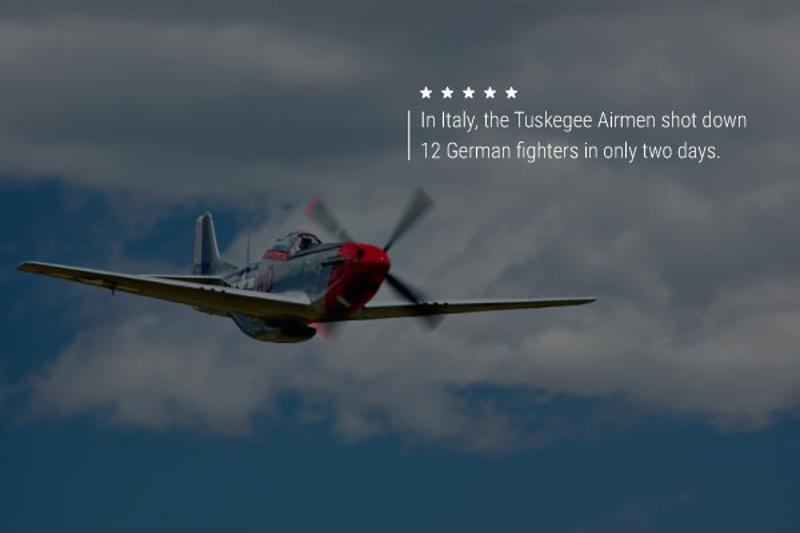
In February 1944, the 99th joined the 100th, 301st and 302nd fighter squadrons to form the new 332nd fighter group. Their mission was to escort the heavy bombers of the 15th Air Force, and they painted the tails of their P-51 Mustangs red for identification purposes. This earned the group the nickname of the Red Tails, and they became the most famous group of the Tuskegee airmen.
The end of a war, the start of a legacy
The 332nd flew its last combat mission on April 26, 1945 – just two weeks before the German surrender. Their incredible accomplishments proved that black Americans had the skills, bravery and patriotism necessary to serve in the armed forces.
Yet despite their success, the airmen returned home to face the same racism and prejudice they had experienced before leaving. That being said, their actions were important for the eventual racial integration of the military in 1948.
These days, African Americans make up 17 percent of active-duty servicemembers, according to numbers from Pew Research. Overall, 40 percent of the military consists of racial or ethnic minorities. Clearly, the Department of Defense has come a long way since the days of the Tuskegee Airmen.
Have you ever wondered why Presidents' Day is celebrated on the third Monday of February? What about its name: Is the holiday celebrating all presidents or just George Washington's birthday?
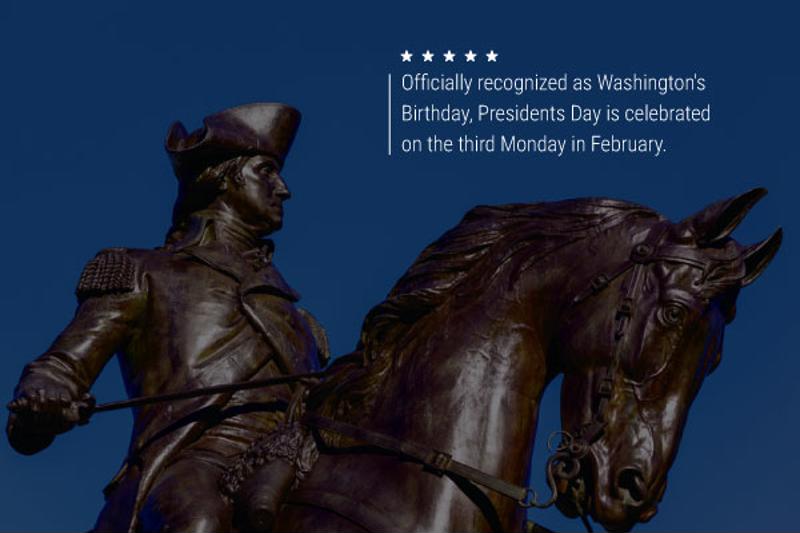
In fact, Presidents' Day is still officially referred to as "Washington's Birthday" by the federal government. This was the holiday's intended purpose; after Washington's death in 1799, people turned his birthday, February 22, into a day of remembrance. It was a fitting tribute for the man recognized as the most important figure in American history.
The holiday wasn't officially recognized by the federal government until the late 1800's. In the 1870s, Senator Steven Wallace Dorsey of Arkansas proposed the idea, and President Rutherford B. Hayes signed the holiday into law in 1879.
At this time, the holiday was still celebrated on Washington's official birthday. It wasn't until the late 1960s that the date changed.
Giving Americans more three-day weekends
In the 1960s, Congress recognized a problem plaguing U.S. businesses and workers. Because many federal holidays fell on specific dates, they days they were celebrated shifted from year to year. One holiday could fall on a Tuesday one year and a Friday the next. As such, American workers weren't consistent with their time off, and absenteeism became an issue.
To solve the problem, Congress proposed the Uniform Holiday Act. The law would shift several federal holidays from specific dates to specific Mondays, creating more three-day weekends for workers. The reasoning was that having more consistency among federal holidays between the years would reduce the number of employees missing work.
President Richard Nixon signed an executive order in 1971 making the Uniform Holiday Act permanent, officially shifting Washington's Birthday to the third Monday in February. However, this put it close to the birthday of another significant president: Abraham Lincoln. Additionally, another U.S. president had a birthday in February: William Henry Harrison. This confused the public, who were no longer sure if the holiday celebrated one president or many. In fact, some members of Congress wanted the day to act as a combination of Washington's and Lincoln's birthdays.
Although the federal name never changed, people began referring to Washington's Birthday as Presidents' Day, and most people think of it as a celebration of all of the nation's presidents.
The importance of America's first commander in chief
Although most people picture extended weekends and retail sales when discussing Presidents Day, the holiday is primarily about America's first commander in chief. The fact that President Washington has a holiday devoted to him and him alone is nothing short of significant. In fact, he is one of only two people to have a federally recognized holiday in his honor. The second is Dr. Martin Luther King, Jr.
Presidents' Day celebrates the nation's first commander-in-chief, President Washington. Thanks to his leadership during the American Revolution, the U.S. military was able to successfully defeat the British empire, allowing the nation to declare independence.
Washington's devotion to the nation and the military started long before his presidential appointment. In fact, he was first appointed as commander in chief in 1775 when he lead the Continental Army, more than a decade before he became president.
Washington left quite a legacy with the U.S. military. He brought attention to the causes that sustain the nation's servicemembers to this day: freedom and liberty.
As such, not only should we recognize President Washington during this holiday, but we should also honor the servicemembers who carry out his legacy.

This past year, a series of Navy-related disasters prompted much deliberation over the processes and inefficiencies within the military branch. As CNN summarized at the end of November, six such incidents occurred during the span of 2017. The two most major resulted in the deaths of numerous sailors.
To recap, the USS Fitzgerald collided with a Philippine container ship in the early morning of June 17, 2017, just off the coast of Yokosuka, Japan. The damage was extensive; according to the Navy Times, the Philippine vessel was more than four times the size of the Fitzgerald. The latter ship was penetrated below the waterline, flooding two crew sleeping spaces, a radio room and a machinery space. In addition, the captain's cabin was crushed. Seven crew members died from the flooding, and the commanding officer and two sailors were injured.
A few months later, on the morning of August 21, the USS John McCain crashed into a Liberian oil tanker off the coast of Singapore. Again, machinery, communications and crew sleeping rooms were flooded. Though the ship was able to sail to the Changi Naval Base in Singapore, 10 U.S. sailors were killed during the incident.
As a result of these incidents, as well as the others that only caused damage but no loss of life, Navy Secretary Richard V. Spencer launched a Strategic Readiness Review. Completed under the supervision of retired Admiral Gary Roughed and utilizing the consulting services of over a dozen companies and organizations, the resulting report pointed to a significant decline in Navy readiness and capability since the end of the Cold War.
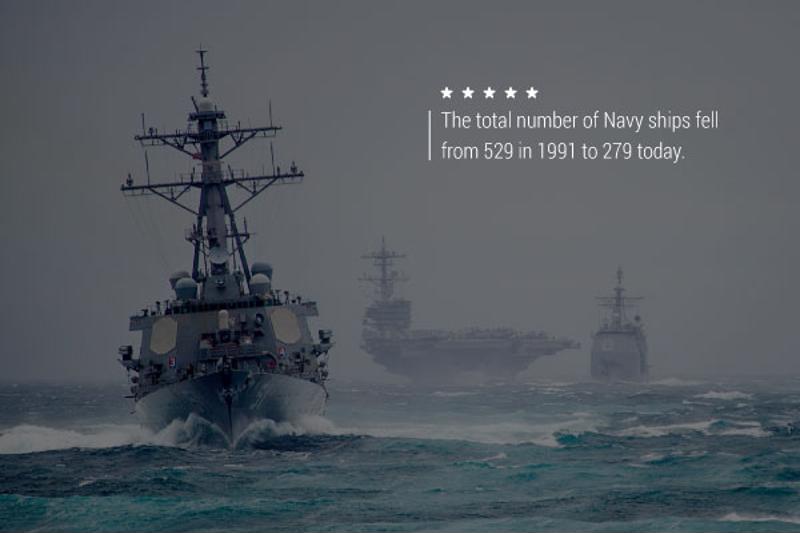
Part of this decline, the report noted, was due do diminishing quantities of ships and servicemembers. The total number of Navy ships fell from 529 in 1991 to 316 in 2001; it currently sits at 279. However, the same 100 ships have been continuously deployed throughout the decades, placing a strain on the military branch.
"Within the fleet, often the only option to meet those growing demands has been short-term trade-offs in training, manning and maintenance," Spencer said to reporters, according to Military.com.
In short, as Navy resources were depleted, servicemembers began lowering their standards and accepting errors and near-misses. This casual mindset led to the numerous crashes and collisions seen last year.
This review isn't the first to point to such problems within the Navy. According to a separate article from Military.com, a similar report from the Government Accountability Office discovered nearly 40 percent of the necessary certifications for Navy ships based in Japan were expired. Furthermore, smaller crew sizes increased the workloads of the sailors who remained, sometimes forcing them to work more than 100 hours per week.
Improving Navy protocol
Overall, the Strategic Readiness Review recommended 23 actionable ways to improve the Navy and reduce future collisions and servicemember deaths. Among the suggestions were better training and restructured career paths that would provide sailors with more practical experience. In this way, they would be better at spotting and averting potential disasters before they occur.
The theme of better training for servicemembers appeared time and again throughout the prior year as reports of the various crashes emerged in the news. As CNN noted, the crew of the Fitzgerald failed to recognize the warning signs of an impending crash until it was far too late. Similarly, as Ars Technica detailed, insufficient training and confusion over the user interface of the McCain's navigation system led to the collision with the Liberian tanker.
Hopefully, the results of the Strategic Readiness Review will compel the Navy to fix the indicated issues and improve the safety of its sailors.
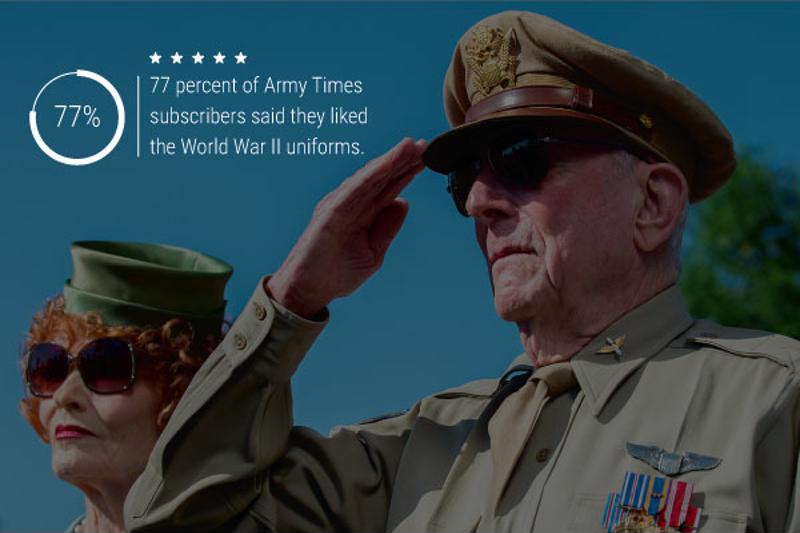
Army servicemembers may soon have new uniforms inspired by those of World War II. Sergeant Major of the Army Dan Dailey began his push to bring back the iconic attire back in May, Army Times reported. He believes the pinks and greens, as the uniforms are called, are perfect for boosting morale among servicemembers and civilians.
"That was the uniform of the 'Greatest Generation,'" Dailey told Army Times. "There was a lot of prestige and honor associated with that. The American public identified with that uniform."
Dailey also noted the revised pinks and greens would give the army a daily uniform more appropriate for business rather than combat.
In May, Dailey first made his case during a uniform board meeting with the results of a survey sourced exclusively from Army Times subscribers. About 28,000 readers received the survey, and approximately 5,000 of them responded. Their answers showed overwhelming support for the proposed change:
- 77 percent said they liked the uniforms.
- 59 percent said they preferred the pinks and greens to current uniforms.
- 72 percent said they would like the option to wear pinks and greens.
First round of prototypes unveiled in October
Several months after what turned out to be a successful board meeting, the uniforms are now close to finalization, according to Military.com. Dailey unveiled the first round of prototypes during the Association of the United States Army's annual October meeting. This version had multiple options for the jacket, trousers and shoes. Dailey noted that the final prototypes would be more historically accurate and closely align with what General George C. Marshall wore when serving as the Army's chief of staff during World War II, noting that they will have khaki shirts, brown leather shoes and belted jackets. They will also be made from higher-quality materials and designed for functionality, fit and endurance.
Dailey added he is very aware of the cost of redesigning and implementing new uniforms. He acknowledged that such changes use taxpayer funds and indicated he is adamant about making sure the decision is the correct one before proceeding.
If the new pinks and greens are approved, the occasion will mark the second major dress uniform change in 10 years. The current Army Service Uniform debuted back in 2014, but many considered it to be too formal for everyday office wear.
That said, the amount of support the new uniforms have garnered indicates both servicemembers and the American public are on board with the changes.
Army still debating while Dailey keeps up support
The Army isn't expected to make a final decision on the new uniforms until spring 2018, according to Task and Purpose. Still, Dailey remains a public advocate, wearing them again during the annual Army-Navy football game on December 9. He also tweeted about the event, exclaiming that the uniforms brought good fortune and helped secure an Army win.
Dailey's enthusiasm reiterates his belief that the new uniforms, which will be as historically accurate as possible, would be great tools for boosting resolve. At a time when Army servicemembers are stationed across the globe, the uniforms will be a universal symbol that commands respect while also keeping the wearer looking sleek.
"This is the symbol, for me, of the American soldier," Dailey said according to Task and Purpose. "Still to this day, people can remember what a soldier looked like in the pinks and greens."

National Day of the Deployed is a time to recognize and honor the sacrifices of servicemembers and their families. However, it didn't begin as a national holiday. It came from the mind of a resident of North Dakota named Shelle Michaels Aberel, who had a cousin – LTC David Hosna – stationed in Iraq. In 2006, Aberel approached then-governor John Hoeven to create a state holiday recognizing deployed servicemembers. Convinced, Hoeven officially declared Hosna's birthday, Oct. 26, as Day of the Deployed.
The idea quickly spread across the country, and now all states recognize Oct. 26 in some fashion. During this day, people at home are encouraged to support servicemembers by sending care packages and letters of encouragement.
This year's Day of the Deployed is particularly noteworthy, however. According to Pew Research Center, the number of U.S. military personnel stationed overseas is the smallest it's been in decades.
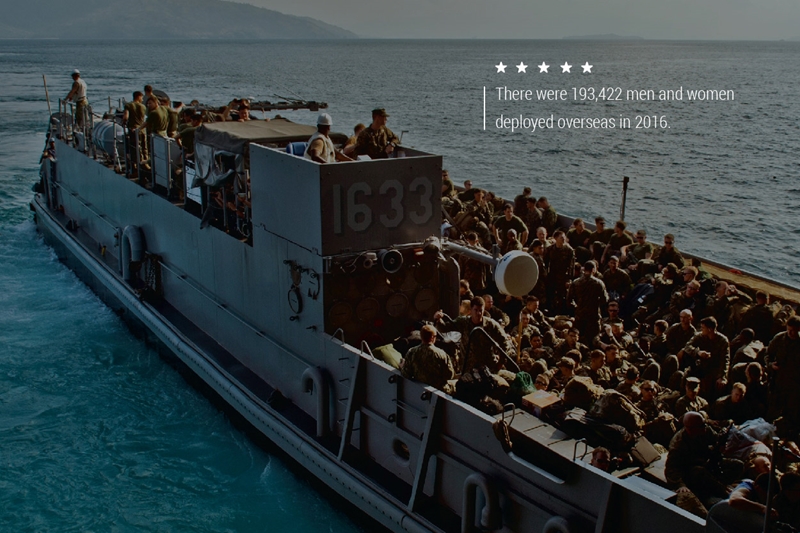
Overseas servicemembers at a historic low
The research organization analyzed information from the Defense Manpower Data Center, concluding that the military has the smallest number and share of active-duty military members stationed internationally since at least 1957. As of last year, there were 193,422 men and women deployed overseas, equating 15 percent of active duty military personnel. Last year, 2016, was the first time this figure fell below 200,000 in at least 60 years.
There doesn't appear to be one factor contributing to this decline, as even countries with the largest U.S. military presence saw their numbers fall. Germany, for example, currently has 34,602 U.S. servicemembers, making it second to Japan as the country with the greatest number of personnel stationed outside the U.S. However, this figure is down from a peak of 274,119 in 1962. Similarly, South Korea currently has 24,189 servicemembers, which is around one third of its peak of 71,043 in 1957. In terms of dates, the gap between peak and current numbers is much shorter for Afghanistan, which had 82,174 servicemembers in 2011 and 9,023 last year.
Will the number of overseas deployments continue to fall?
While Pew Research didn't provide an explanation for why overall deployment numbers fell so low, an increasing need for local military presence could continue the trend. As CNN recently reported, relief efforts for Hurricanes Irma and Maria are forcing military planners to reevaluate their overseas deployment schedules for the next few years. Those with knowledge of the situation didn't give specific details due to security concerns, but they did discuss a few ideas publicly.
"We are ready to go even to the point that it's going to impact the deployments, perhaps, of some of these troops overseas next year because we've interrupted their preparation," said Defense Secretary James Mattis when testifying before the Senate Armed Services Committee, according to CNN. His statement confirmed the military was willing to remain in Puerto Rico as long as necessary.
According to CNN, the military hopes for no more than a two-week setback in Afghanistan deployments. As a result, however, servicemembers scheduled to return home might not be able to depart until their replacements arrive. Additionally, they may be forced to leave their equipment until an aircraft can return to retrieve it at a later date.
The proposition further highlights the need for Day of the Deployed. Even a two-week wait is agonizing for servicemembers who are forced to spend more time away from their homes and loved ones. Individuals at home can show their support by sending packages or messages to those stationed overseas or by raising awareness about Day of the Deployed in their communities and on social media.
A growing number of cities and states are celebrating Indigenous Peoples Day, created to highlight the legacy of Native Americans. Falling on the second Monday in October (this year, Oct. 9), Indigenous Peoples Day was first recognized in 1992 by the state of South Dakota and the city of Berkeley, California. It has since spread to include Los Angeles, Seattle, Minneapolis, Phoenix, Denver and the states of Alaska and Vermont, in addition to other places.
This Oct. 9, we'd like to celebrate Indigenous Peoples Day and reflect on the great achievements our current and former native servicemembers brought to this country.
An indigenous history of the U.S. military
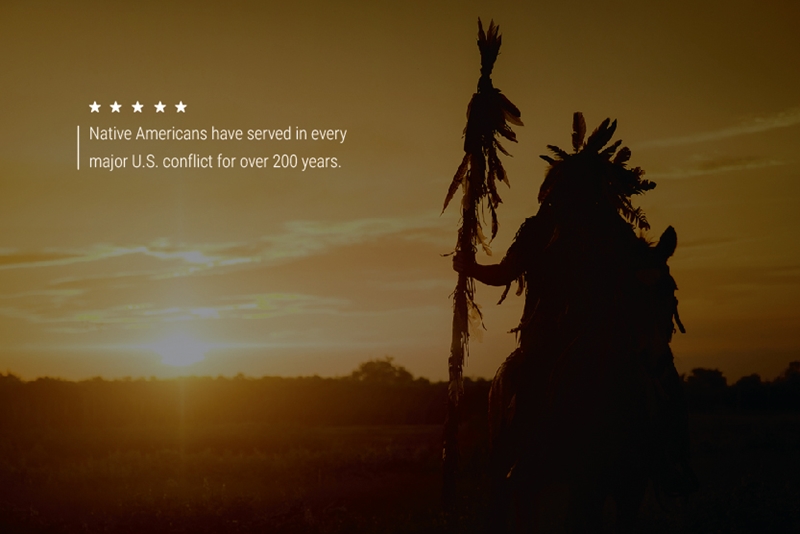
Writing for the Huffington Post, Kevin Gover, a citizen of the Pawnee Tribe of Oklahoma and Director of the Smithsonian National Museum of the American Indian, shed light on the impact Native Americans have had on the U.S. military. Members of this group have served in every major American conflict for over 200 years and have joined the military in greater numbers per capita than any other ethnicity. This means they served even before they were given the legal to right to vote as American citizens, displaying an honorable dedication.
In fact, as Indian Country Today pointed out, American Indians served as volunteers throughout much of their history with the military. The WWI code talkers and other servicemembers couldn't have been drafted as they weren't considered U.S. citizens. They weren't granted such status until the Nationalities Act of 1940 amended earlier citizenship and immigration law. Once they had the option, 99 percent of all eligible native men registered for the draft by January of 1942.
"The code talkers are arguably the most famous example of American Indians serving in the military."
The code talkers of World Wars I and II are arguably the most famous example of American Indians serving in the military. Their native languages were incredibly valuable, helping American forces exchange information without it being decoded by the enemy. Cryptography was another option, and while the practice of encoding and decoding messages was certainly useful, it was also time-consuming, and such codes could be broken. The strength of Native American languages was that only a select number of people could speak them. What's more, only a few of the languages were ever written down, meaning the only people who could translate them were native speakers.
Additionally, Native American sometimes had to put their dedication to the U.S. against the best interest of their native nations. For example, they served on both Confederate and Union sides of the Civil War, knowing whichever was the victor would determine the fate of their people in addition to slavery.
Notable Native American servicemembers
Though their actual numbers have been smaller than other ethic groups, Native Americans in the military have certainly accomplished enough to achieve recognition. In fact, a member of the Pawnee nation was the first American Indian to be awarded the Congressional Medal of Honor. This happened in 1869, just eight years after the honor was first established.
Since then, a number of Native Americans have received the medal. One of the most recent was Master Sergeant Woodrow Wilson Keeble, a WWII and Korean War veteran of a Sioux tribe known as the Sisseton Wahpeton Oyate of the Lake Traverse Reservation, according to the California Indian Education organization. Master Sergeant Keeble received his medal approximately 16 years after his death, awarded by President George W. Bush in 2008.
Another notable Native American serviceman was Private First Class Charles George, a Cherokee from North Carolina. George also received the Medal of Honor posthumously, having thrown his body on a grenade to save his comrades. Such acts of selflessness are common among American Indian and Alaskan Native servicemembers, and it would take an entire book to honor them all. That, in essence, is why it is important to remember their sacrifice this Indigenous Peoples Day.
Startups created by young entrepreneurs are solving some of the world's most complex issues. These fledgling companies have brought innovative thinking and methods to financial technology, health care, city planning and many other industries. As such, it's only natural that the Department of Defense would start to show interest. If the initial developments from Hacking for Defense are anything to go by, that interest will lead to positive results.
Enterprising students solve DOD issues
The Hacking for Defense program, commonly referred to as H4D, first began as a 10-week pilot course in 2016 at Stanford University. It has since spread to a total of nine colleges nationwide, including:
- Stanford University
- Georgetown University
- Columbia University
- The University of Southern California
- The University of California at San Diego
- Boise State
- The University of Pittsburgh
- James Madison University
- The University of Southern Mississippi
Several other schools are currently developing the program within their own institutions, Wired reported. H4D was started by Steve Blank, creator of the Lean Startup movement, and two retired Army colonels: Joe Felter and Peter Newell. The program's goal is to help students learn entrepreneurship skills while solving complex military problems and engaging in public service.
H4D connects teams of students with sponsors inside the DOD and intelligence communities, including the CIA, the National Security Agency and others. The students get real-world experience solving problems as a startup would, while sponsors get answers to their most troublesome dilemmas and, as an extra bonus, learn Lean Startup methodology.
One such hurdle, Wired detailed, was inefficiencies in evaluating prospective Navy SEALS. Students were tasked with making the process less time consuming, and part of their research involved going through recruit training in Coronado, California. Ultimately, the group of four created an app that streamlined recruit assessments.

Benefiting students and military
H4D grants students the opportunity to work on stimulating projects with real-life results before they graduate. They become a part of something bigger than themselves while preparing for work in a field that will be endlessly stimulating.
"The U.S. government doesn't have dog-friendly offices or competitive pay, but they have an endless list of interesting problems that no tech company can match," program co-creator Blank said to Bloomberg.
As Bloomberg noted, technology is quickly becoming one of the primary weapons used by adversaries of the U.S. There's no doubt the military and DOD will want the country's best and brightest working on these threats.
That said, students who participate in H4D aren't required to work for the government after graduating. They're free to seek jobs at Facebook, Google or any other tech industry leader or startup if they choose. Additionally, according to Voice of America, H4D attracts a number of international students.
"I was surprised by the number of foreign students from Singapore, China and India who were just interested in learning the same methodology and take it home from wherever they are," Blank told the news publication.
Meanwhile, sponsors are introduced to some of the latest innovations in technology and problem solving. The military lags behind most industries in these areas yet arguably needs them most. For example, one H4D team introduced wearable tech to improve casualty care triage. According to an article from the U.S. Army, the students created sensors that automatically collect and transmit data while the patient is on the battlefield, allowing doctors and nurses to more efficiently prioritize.
While the long-term effects of H4D remain to be seen, the short-term evidence is incredibly promising. The program will likely continue spreading to more schools and attracting an even greater number of students.
Are you a soldier who likes playing video games? If you're an active duty servicemember, chances are the answer is yes, as video games are a popular past time for those serving in the Army. Now, the military will be leveraging soldiers' love and aptitude for video games with Operation Overmatch, an online game that will contribute to the development of the future fighting force.
What is Operation Overmatch?
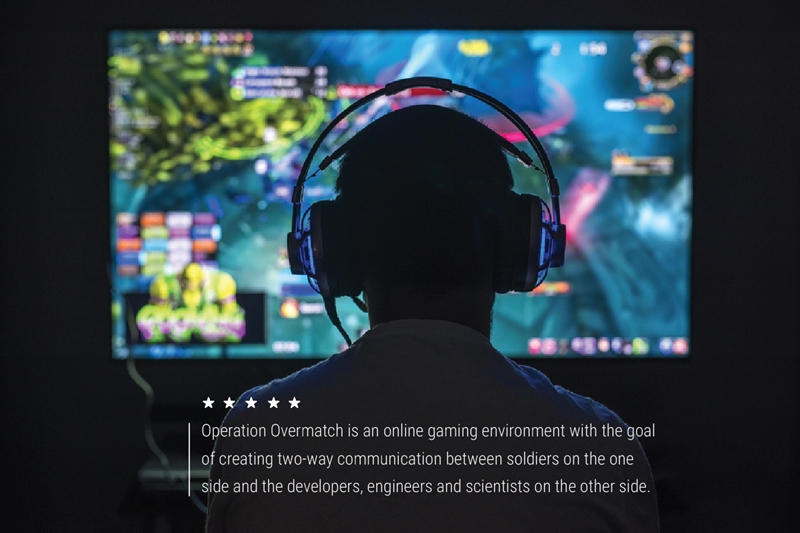
Operation Overmatch, initiated by the U.S. Army Capabilities Integration Center, is an online, multi-player game. Its goal is to boost combat effectiveness. This endeavor {Operation Overmatch} is an online gaming environment whose goal is to create two-way communication between soldiers on the one side and the developers, engineers and scientists on the other side.
While it might seem like the Army is merely providing people with a new game to play, there's a real-world component to Operation Overmatch. The army reported that it is actively seeking soldiers to play and provide feedback.
"The army is actively seeking soldiers to play the game."
"Soldiers have the advantage of understanding how equipment, doctrine and organization will be used in the field – the strengths and weaknesses," explained Michael Barnett, chief engineer at the Army Game Studio and project lead for Operation Overmatch. "And they have immediate ideas about what to use, what to change and what to abandon – how to adapt quickly."
The service's Training and Doctrine Command and Army Game Studio has been developing the game since 2016. Soldiers will get to beta-test machines they pilot in the game and see if weapon and armor concepts are worth pursuing before the Army orders real-life prototypes.
The game will allow players to select among thousands of options for certain predetermined capabilities, such as weapons, caliber and robotics, and use these in an "adversary threat platform" to determine effectiveness. After playing the game, the soldiers should provide feedback on the concept and capability of the prototypes and how they would likely play out on the battlefield.
For now, developers are still in early stages, but beta-testing is scheduled to begin in October. However, while soldiers will get a chance to play, the game is focused more on gear than tactics, and the viability of proposed or experimental weapons.
Applying video game skills to the real world
Some people might be wary about using skills learned in video games in real-life combat situations. Others might even be skeptical that there are any skills to develop by playing video games.
According to data from Pew Research Center, 26 percent of all adults thought most video games were a waste of time, while slightly fewer respondents (24 percent) thought the opposite. A similar disconnect can be seen among people who believe video games develop strategic thinking and problem-solving skills.
However, a recent study showed that playing video games strengthens a range of cognitive skills, according to the American Psychological Association. The study found that three-dimensional environments and the need to solve complex puzzles necessary to successfully navigate video games improved a host of skills, including:
- Spatial navigation
- Reasoning
- Memory
- Perception
"This has critical implications for education and career development, as previous research has established the power of spatial skills for achievement in science, technology, engineering and mathematics," said Isabela Granic, PhD, the lead author of the article.
Another finding unearthed by the researchers was that the ongoing failures that accompany video game trials and tribulations help build emotional resiliency.
By helping to further strengthen these cognitive skills, problem-solving abilities and building resilience in the face of failure, video games make the perfect tool for soldiers. When mixed with the prototyping options available for new gear, these training capabilities should serve to further strengthen our military.
Many people join the armed forces as a stepping stone to obtaining a college degree with the help of the G.I. Bill. While this is an excellent way to get the financial assistance you need to pursue your dreams of a higher education, sometimes a Bachelor's Degree isn't enough.
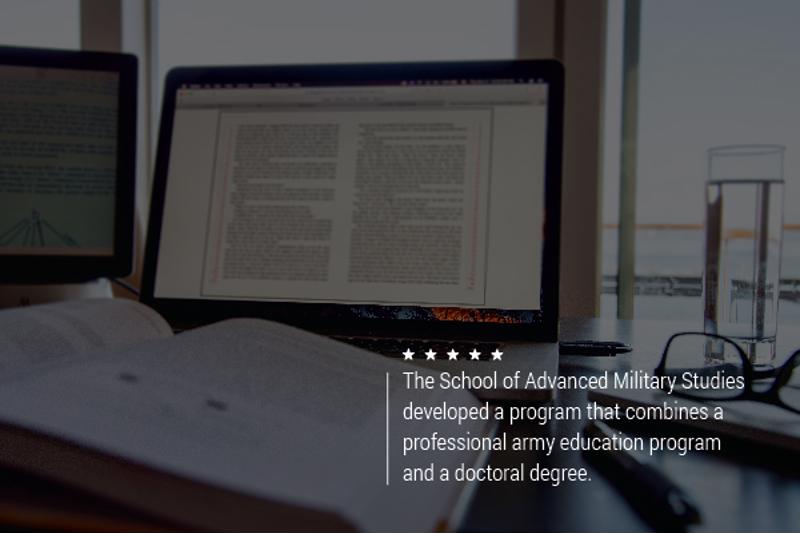
To assist soldiers with long-term academic goals, in 2012 the School of Advanced Military Studies developed a program that combines a professional army education program and a doctoral degree. Located in Fort Leavenworth, Kansas, the School created the Advanced Strategic Planning and Policy Program, or ASP3, that lets military officers study history, strategic theory and planning. Although there are only 60 officers currently participating in the program, there's plenty of room to grow.
Why should you get a PhD?
In the past, a Bachelor's Degree would give you a competitive edge in the job market once you transition into civilian life. In some cases, even other post-graduate programs like an MBA or a Master's degree won't suffice in the modern job market.
Obtaining a PhD with the ASP3 allows you to not only further your educational pursuits, but it also provides a pathway to development from a field-grade officer to a strategic planner and future senior military leader.
Not only does a doctorate give you a solid educational foundation and support for your future experiences, it also gives you a personal sense of accomplishment. This is especially true for people who enjoy surmounting challenging situations and for those who truly enjoy the learning-teaching process.
A PhD program is also a great route if you're interested in innovating and inventing new concepts, processes and fields of study.
"The ASP3 program is a promising career path for bright officers."
How do you know if you should get a PhD?
While earning a PhD will certainly help you obtain a higher-paying job, it isn't a path for everyone.
You'll be required to conduct countless hours of research and write a comprehensive thesis. However, if you have the ambition and the commitment, the program is a promising career path for bright officers who want to progress to the next level of leadership and still hold a command position.
Speaking with the U.S. Department of Defense's new teams, Army Col. Oscar Doward Jr., commander of the U.S. Army Central's 2503rd Digital Liaison Detachment, explained his reasoning for pursuing a PhD at the School of Advanced Military Studies.
"Applying for the program was an opportunity for me to earn a [doctorate], a desire I've always had," said Doward. "I also saw it as a great opportunity to have an effect on the strategic policy level."
Currently, Doward is writing his dissertation on "African-American officer development and evolution in the Army during the 20th century, focusing on the period between World War I and the Korean War."
Although juggling your military and academic responsibilities can be difficult, it opens the door to a number of great opportunities. But by taking a good look at where you want to be in five or six years time you can draft a plan of action that puts you on a route to getting your PhD while you're in the armed forces.
Post-traumatic stress disorder is a pervasive affliction that affects active duty military members, veterans, first responders and even government contractors working in combat zones.
Spreading awareness of PTSD
"In 2010 Congress designated June 27 as PTSD Awareness Day."
In 2010, Congress designated June 27 as PTSD Awareness Day to promote visibility and effective treatment for the affliction. Four years later, Congress set aside the entire month of June for National PTSD Awareness. The goal is to increase knowledge among the public about issues related to PTSD, to encourage those suffering from this affliction to seek help and to provide insights into caring for family members coping with PTSD.
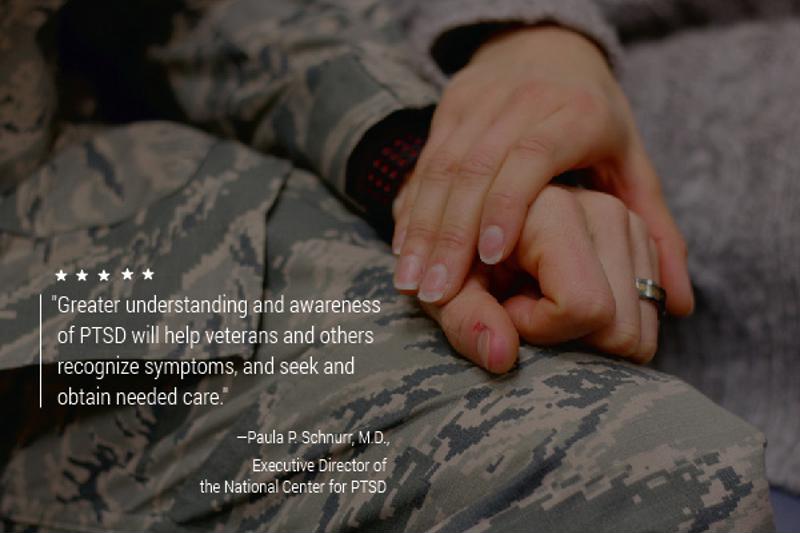
"Greater understanding and awareness of PTSD will help veterans and others recognize symptoms, and seek and obtain needed care," explained Paula P. Schnurr, M.D., executive director of the National Center for PTSD.
During June, government agencies, advocacy groups, medical associations and other PTSD-related associations come together to boost awareness for the condition.
How common is PTSD?
The nature of the environments where military members and first responders work puts them in precarious and sometimes life-threatening situations and the lingering trauma can have a big impact on their lives. These traumatic events can lead to:
- Nightmares.
- Flashbacks.
- Trouble sleeping or concentrating.
- Negative feelings.
Often people experiencing PTSD think they're alone, but the truth is it is far more widespread than many might believe. Veterans often have higher incidences of having stress disorders. According to VA statistics, veterans with PTSD account for:
- Between 11 and 20 percent of soldiers who served in Operations Iraqi Freedom and Enduring Freedom.
- Around 12 percent of Gulf War (Desert Storm) veterans.
- An estimated 30 percent of military members deployed in the Vietnam War.
While veterans comprise a large percentage of those with PTSD, first responders are also regularly exposed to the types of traumas that lead to stress disorders. A recent report published by the International Association of Fire Fighters found that firefighters and paramedics suffer from PTSD at similar levels to veterans.
Writing on the American Military University's website In Public Safety, faculty member Michelle Beshears explained how police officers often experience cumulative PTSD – the result of repeated stress-related incidents.
Further, PTSD is not strictly limited to the military and first responders. The VA also noted that roughly 7 to 8 percent of the U.S. population will experience PTSD at some point. In a year, approximately 8 million U.S. adults have PTSD. However, many won't seek treatment for a number of reasons.
What you can do to help
If you know anyone who might be suffering PTSD, be sure to offer support. While not everyone will want to discuss the issue, it's important to let them know you're available to help.
If a dialogue about the person's PTSD opens up, encourage him or her to seek treatment. There are a variety of centers and organizations that offer options for assistance and care.
Congress mandated the formation of the VA's National Center for PTSD in 1989 to address the needs of veterans with military-related PTSD. They have extensive research, education material and training opportunities for advancing the social welfare and clinical care of veterans with stress disorders.
In addition, non-governmental groups like Operation We Are Here provide an extensive directory of resources for those who have experienced a traumatic incident. From anonymous self-assessments and financial assistance to veteran service organizations and reintegration sources, there are plenty of options available to help.
By spreading awareness and contributing to ongoing treatment efforts, everyone can lend a hand in combating PTSD.