
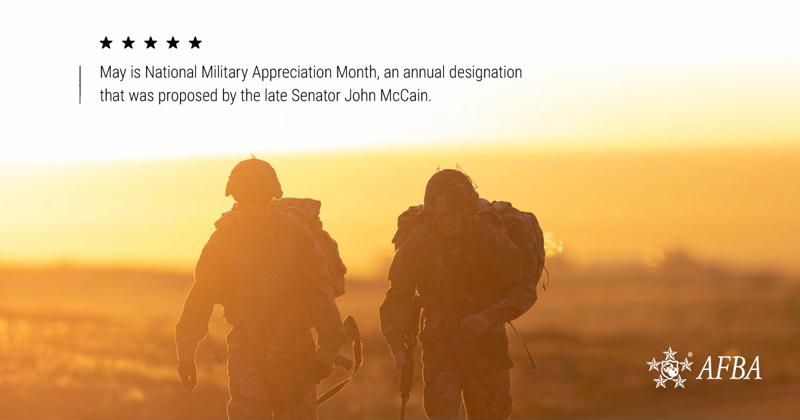
In 1999, the late Senator John McCain, himself a former naval pilot and prisoner of war in Vietnam, introduced legislation to designate the month of May as National Military Appreciation Month. Each and every year for the past two decades, the Senate and House of Representatives have adopted resolutions urging the President to issue a proclamation that calls on the people of the United States to recognize and honor U.S. service members as "an act of national unity."
There are a variety of ways for ordinary Americans to heed this call and pay tribute to the brave men and women who serve our country at home and abroad. From recognizing the many national days of observance that take place throughout the month, to performing individual acts of kindness for service members, here are some of the best ways to demonstrate your gratitude this National Military Appreciation Month.
National observances during National Military Appreciation Month
NMAM kicks off each year on May 1 with Loyalty Day, a special day set aside "for the reaffirmation of loyalty to the United States and for the recognition of the heritage of American freedom." First celebrated in 1921, Loyalty Day was made an official recurring holiday by Congress in 1958, and has been recognized with an official proclamation every year by every president since Dwight Eisenhower.
Every May also presents the opportunity to commemorate Victory in Europe Day, which occurred on May 8, 1945, and represented the end of World War II in Europe. This year, VE Day will fall on Wednesday, May 8, and will mark the 74th anniversary of Germany's unconditional surrender to America and the allied forces.
VE Day is shortly followed by Military Spouse Appreciation Day, which traditionally occurs on the Friday before Mother's Day. On May 10, 2019, Americans will honor military spouses with appropriate ceremonies and activities, and recognize the crucial part that military families have to play in strengthening our Armed Forces.
Celebrated the third Saturday in May every year, and this year on May 18, Armed Forces Day is a time reserved for citizens to come together and thank our military members for their service. This holiday celebrates every member of every branch of the U.S. military: the Army, Navy, Air Force, Marines and Coast Guard.
The last Monday of May is reserved for Memorial Day, a federal holiday meant to commemorate the men and women who died while in military service. This year, Memorial Day falls on May 27, 2019, and events are scheduled to take place throughout the country, with military parades happening in many cities and towns.
How to demonstrate your gratitude this May
There are many individual gestures you can make during NMAM, either in conjunction with one of the individual national observances, or simply as a random act of gratitude.
If there is a specific service member or military family in your life, you can let them know you appreciate their sacrifices with a gift, a thank you card or simply by taking the time to tell them. Offering to cook dinner for a military family or handle their chores on Military Spouse Appreciation Day is a good way to show you care. Similarly, calling and thanking a service member on May 18 is a great way to truly celebrate Armed Forces Day.
If you would like to reach out to service members you are not personally acquainted with, remember that a care package is always welcome. Operation Support Our Troops America has a program that ships boxes full of comfort items to men and women serving abroad, and you can find ways to donate, volunteer or join the mission on their website.
You can also do it on your own. The U.S. Postal Service offers a free "Military Care Kit" with all of the necessary supplies for sending packages overseas, including boxes, packing tape and customs forms. Get your free kit shipped to you by visiting the USPS website.
The brave men and women of the U.S. Armed Forces protect our nation day in and day out, and are deserving of our respect and thanks all year long. But National Military Appreciation Month should inspire us to make a special effort to show our appreciation and display conspicuous acts of gratitude.

Less than two weeks after the youngest of America's military reserve components celebrated its birthday, now the oldest member of the family is preparing to observe its own anniversary.
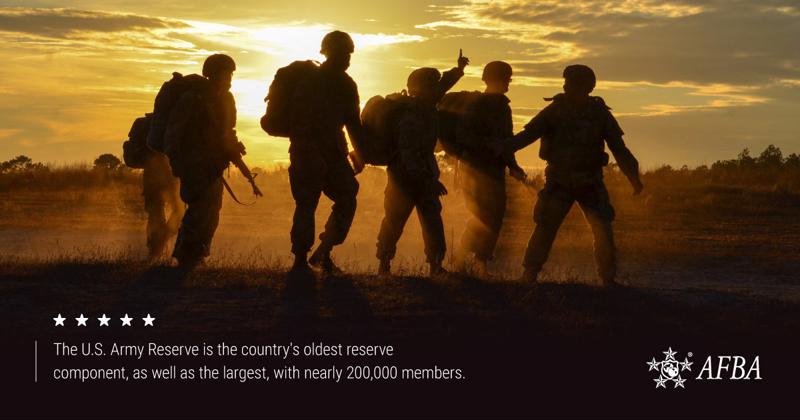
On April 14, 2019, the United States Air Force Reserve turned 71 years young, and on April 23, the U.S. Army Reserve will celebrate 111 years of age. In addition to being the country's oldest reserve component, the USAR also holds the distinction of being the largest, with nearly 200,000 members.
With more than ten decades of existence to draw from, the U.S. Army Reserve has a rich historical tradition that is worth remembering and honoring as the nation celebrates its most recent anniversary.
Army Reservists crucial to US military operations since WWI
Though officially only 111 years old, the Army Reserve could legitimately trace its roots back as far the French and Indian War of the mid-1700s. Until the 19th century, America did not require a large standing army, and so relied heavily on the militias of individual states.
It was not until April 23, 1908, that Congress first created a Federal Reserve Force. As a response to mobilization and preparedness issues that the country had experienced during its wars of the 1800s, the United States created the first reserve force to exist under direct command and control of the federal government, known then as the Medical Reserve Corps.
A few years later, the "Preparedness Movement" led by former President Theodore Roosevelt would help secure passage of the National Defense Act of 1916, which created the Officer's Reserve Corps, the Enlisted Reserve Corps and Reserve Officers' Training Corps. When war was declared the following year, the ranks of the Officer Reserve Corps swelled dramatically.
In total, the Army mobilized nearly 90,000 Reserve officers during World War I, roughly a third of whom were medical doctors, which quadrupled the Army's capacity to care for the sick and wounded.
Following the Great War, Congress used the National Defense Act of 1920 to reorganize the U.S. land forces by authorizing a Regular Army, a National Guard and an Organized Reserve, which encompassed the Officers Reserve Corps and Enlisted Reserve Corps and provided a peacetime pool of trained Reserve officers and enlisted men.
This proved to be a wise decision when America was once again plunged into a global conflict. According to the USAR, roughly one quarter of all Army officers who served in World War II came from the Organized Reserve, and from 1943 to 1944, Reserve officers constituted over half of all officers killed in action.
Having further established their importance in WWII, the Organized Reserve was rewarded with retirement and drill pay for the first time in 1948. Two years later, Reservists were again called into action, with more than 240,000 Army Reserve Soldiers serving in active duty during the Korean War. It was also during that conflict that Congress officially changed the Organized Reserve Corps into the United States Army Reserve, and divided the new organization into a Ready Reserve, Standby Reserve and Retired Reserve.
According to Military.com, the USAR was only mobilized twice during the subsequent Cold War: from 1961-1962, when over 68,500 Army Reserve Soldiers responded to the Berlin Crisis, and from 1968-1969, when nearly 6,000 were called into action as part of the Vietnam War.
In recent years, though, the U.S. Army Reserve has become more essential than ever to our nation's military operations across the globe. Both the Army Reserve and the Army National Guard have been routinely called upon to serve both locally and globally, though primarily in Iraq and Afghanistan. Since September 11, 2001, over 200,000 Army Reserve Soldiers have been activated in the Global War on Terrorism, outnumbering the number of Reservists in WWII.
Simply put, the nation cannot go to war without its Army Reserve Warrior Citizens, all of whom are owed a debt of gratitude as we celebrate the protection they have provided for well over a century.
On April 14, 2019, the United States Air Force Reserve will turn 71 years young.
Last year, the Air Force Reserve held a cake-cutting ceremony at the Pentagon in honor of its 70th anniversary. Now that the military organization is turning 71, you may marvel at its advanced age, but it is actually the youngest of all the various reserve components. At 110 years old, the U.S. Army Reserve is the oldest of the bunch, followed by the 104-year-old Navy Reserve, the 102-year-old Marine Corps Reserve and the 78-year-old Coast Guard Reserve. Even the Air National Guard is one year younger than the Air Force Reserve.
Despite being the youngest sibling in the family of reserve corps, the Air Force Reserve has piled up an impressive number of accomplishments over its more than seven decades of history.
Over 70 years of distinguished service
Although the reserve component traces its lineage back over a century to the Reserve Airpower that was established by the National Defense Act of 1916, the official birth date of the U.S. Air Force Reserve is April 14, 1948. That's the date when the Army Air Corps Reserve was transferred to the Air Force, officially creating the Air Force Reserve as a separate component. The air reserve was formally established by President Harry Truman, who was seeking to create a program similar to one established during WWI, in which Reservists stood ready to serve during wartime.
The Air Force Reserve replaced Continental Air Command, which inactivated in 1968, at which point AFRES assumed command of all personnel, equipment and aircraft previously assigned to ConAC.
In 1970, Secretary of Defense Melvin Laird adopted the Total Force concept, which Secretary of Defense James Schlesinger declared policy in 1973. Once implemented, the Air Force Reserve became a multi-mission force, flying the same modern aircraft as the active Air Force and being held to the same readiness standards and inspections as regular Air Force units.
During the Cold War, Reservists continually volunteered for both military and humanitarian efforts, from the Israeli Airlift of 1973 to the resupply and evacuation missions undertaken in the aftermath of 1989's Hurricane Hugo.
Within days of Saddam Hussein's invasion of Kuwait in 1990, Air Force Reserve airlift and tanker crews were in the air, with AFRES special operations and rescue forces and Air Force Reserve A-10s operating close to the frontlines. According to the Air Force Reserve Command, it was a Reservist who scored the first-ever A-10 air-to-air kill.
When the United States was attacked by terrorists on September 11, 2001, Air Force Reservists were quickly out in full force, with Air Force Reserve F-16 fighters flying combat air patrols over America's cities with KC-135 tanker and AWACs providing air refuelings and security.
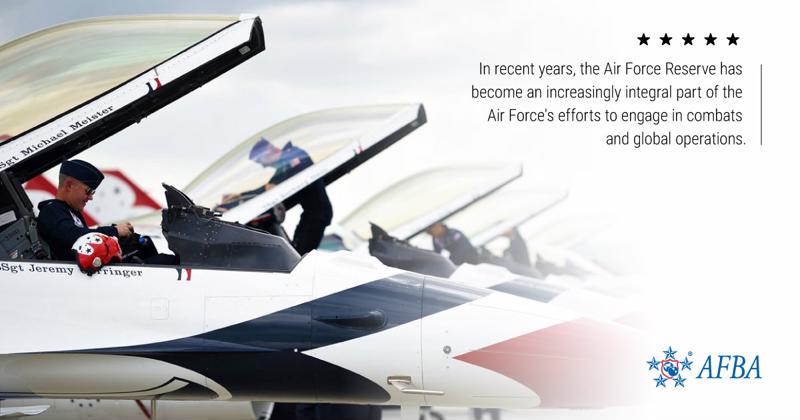
In recent years, the Air Force Reserve has become an increasingly integral part of the Air Force's efforts to engage in combats and global operations.
Today there are nearly 70,000 Citizen Airmen stationed in communities throughout the United States and overseas, serving every Combatant Command in air, space, and cyberspace.
"From the sands of Iraq to the mountains of Afghanistan from the jungles of South America to the Antarctic icecap, in the skies above the nation, inside hurricanes threatening our coastal areas and through wildfires endangering our countryside, dedicated Reservists answer the call to duty symbolizing the values of integrity, service before self, and excellence in all we do," according to the Air Force Reserve's official mission statement.
In honor of its 71 years of service to the United States, Americans everywhere should take the opportunity on April 14 to salute the U.S. Air Force Reserve for providing Citizen Airmen prepared to "fly, fight and win."
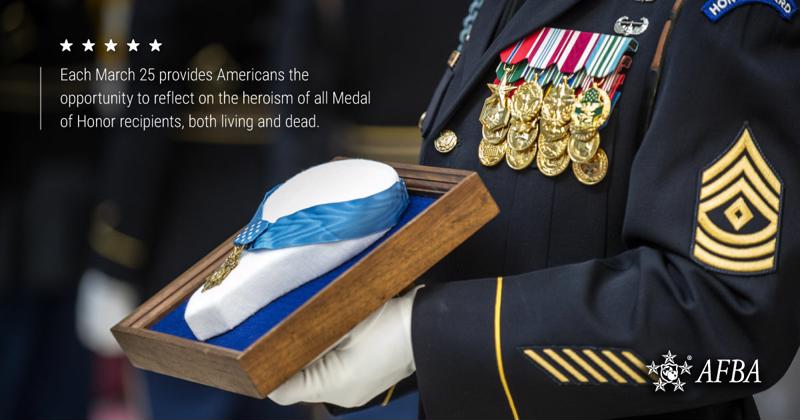
Every year on March 25, the United States of America observes National Medal of Honor Day, a time for remembering and honoring those who have earned the highest and most prestigious personal military decoration that may be awarded to U.S. military service members for acts of valor.
According to the Department of Veterans Affairs, the Medal of Honor is awarded to military members who have distinguished themselves "conspicuously by gallantry and intrepidity" that went above and beyond the call of duty.
All five branches of the military are eligible for the honor, though there are only three versions of the medal: one each for the Army, Air Force and Navy, with personnel of the Marine Corps and Coast Guard able to receive the Navy version.
To understand the significance of the MOH, as well as the reasoning behind its annual holiday on March 25, it helps to educate yourself on the history of this incomparable honor.
Over 150 years of recognizing our nation's finest
Though there were several precursors to the MOH, including the George Washington's Badge of Military Merit and a Fidelity Medallion presented to three persons who helped capture a spy associated with Benedict Arnold in the 1700s, it was not until 1862 that the Navy Medal of Honor was created, quickly followed by the Army Medal of Honor, according to the Congressional Medal of Honor Society. The Air Force did not design its own MOH until 1963, over a century later.
On April 11, 1862, a group of Union soldiers led by civilian spy James J. Andrews boarded the train General disguised as a group of new recruits traveling north from Georgia to join the Confederate army. During a breakfast stop, Andrews' Raiders uncoupled the passenger cars and took off with the General, traveling seventy miles on the Western and Atlantic Railway, along the way cutting telegraph wire, uprooting railroad tracks and setting bridges on fire, according to the National Archives.
The group was eventually captured and Andrews was executed by the Confederacy, along with seven of his fellow Raiders. Twelve remaining members of the group were taken prisoner, six of whom were exchanged within a year.
On March 25, 1863, those six exchanged soldiers were summoned to the secretary of war's office, where Edwin M. Stanton greeted them as heroes and surprised them with medallions.
"Congress has by a recent law ordered medals to be prepared… and your party shall have the first," Stanton said upon presenting the first ever Medals of Honor.
Then and now
In the 156 years since that initial ceremony, there have been more than 3,500 Medals of Honor awarded to America's bravest soldiers, sailors, airmen, marines and coast guardsmen. Among the thousands honored, there are currently 72 living recipients of the MOH. Ranging in age from 29 to 98, the list of living recipients includes four heroes who earned their Medals of Honor in World War II, five who fought in the Korean War, 50 in the Vietnam War, and 13 in the War in Afghanistan.
In 2016, Congress authorized the VA's National Cemetery Administration to issue, upon request, a medallion, headstone or marker signifying a Veteran as a recipient of the Medal of Honor. Two years later, during a private ceremony at West Grove Cemetery in Lexington, Mississippi, the first Medal of Honor Medallion was placed upon the private headstone of Pfc. Milton L. Olive III, a decorated war hero who fought in Vietnam.
"Private First Class Olive was posthumously awarded a Medal of Honor for his service during the Vietnam War after he heroically used his body to cover a grenade to save the lives of his fellow soldiers," said VA Secretary Robert Wilkie. "The Medal of Honor Medallion illustrates VA's commitment to ensuring all who see this symbol will know of the courageous sacrifice of our nation's distinguished service members."
Each March 25 provides Americans the opportunity to reflect on the heroism of all Medal of Honor recipients, both living and dead.
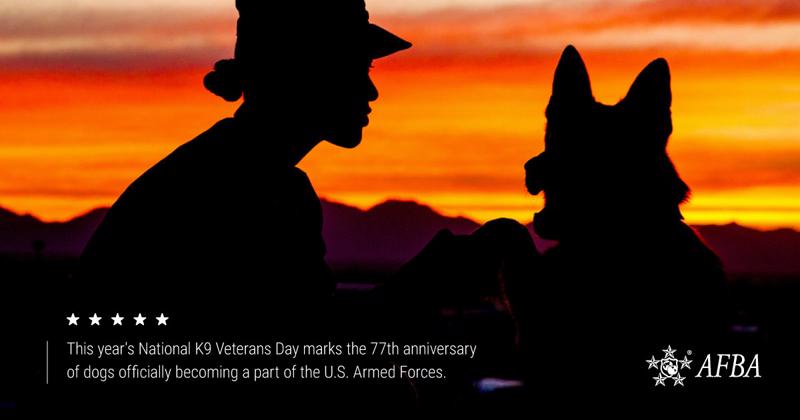
On Wednesday, March 13, patriots and dog lovers alike can join together in saluting our nation's four-legged heroes for National K9 Veterans Day.
This year's holiday will commemorate the 77th anniversary of dogs officially becoming a part of the U.S. Armed Forces. According to Military.com, it was on March 13, 1942, that the Army first began training for its new War Dog Program, known also as the "K-9 Corps."
The United States Postal Service is among those paying tribute, having recently announced a new booklet of 20 stamps that "honors the nation's brave and loyal military working dogs."
According to the USPS, each block of four stamps features one stamp each of the four breeds chosen for inclusion in the booklet: German shepherd, Labrador retriever, Belgian Malinois and Dutch shepherd.
The patriotic stamps were designed by art director Greg Breeding, and created by the Los Angeles-based DKNG Studios. The stylized digital images feature red, white, blue and gold coloring, along with illustrations of dogs wearing tactical service vests. In the background of each stamp is the detail of a white star. A full white star on a gold background also appears on the center of each block.
Though an official release date for the military dog stamps has not yet been revealed, the Postal Service did promise that more details on dates and locations for the first-day-of-issue ceremonies would be forthcoming.
A distinguished breed of service
Though the K-9 Corps dates back to WWII, military dogs have been serving in the U.S. military since World War I. The most famous canine veteran of the Great War was a Staffordshire terrier mix named Stubby, who saved many sleeping soldiers by barking and waking them during a German mustard gas attack. According to History.com, Stubby went on to serve in 17 battles and survive at least two major injuries, including shrapnel in his chest and leg, before becoming the first dog to be given the rank of Sergeant in the U.S. Armed Forces.
When Sergeant Stubby died in his sleep at the age of 10 in 1926, his remains were gifted to the Smithsonian Institution where they continue to be displayed today.
Examples of canine heroism can be found in more recent conflicts, as well. Just this past November, an Army Ranger dog named Maiko was killed in action during a skirmish in Afghanistan, according to Stars and Stripes. The 7-year-old military working dog was leading Rangers into a compound when he was fired upon by a militant, revealing the militant's position and saving the lives of other soldiers, who then targeted that position.
There is a memorial in Holmdel, New Jersey, that recognizes such sacrifices. Although the War Dog Memorial was originally built to remember only those dogs that served in Vietnam, it now honors all dogs that have served in the United States military.
Today an estimated 2,300 military working dogs serve on U.S. bases worldwide, performing dangerous tasks alongside their human counterparts. These canine warriors often use their noses and smaller sizes to engage in search and rescue missions that more traditional service members are less equipped to complete.
"These military dogs, and search-and-rescue dogs, are putting themselves on the line. They're out in the front lines," Diane Whetsel, head of the Sage Foundation that works to help fund medical services for military dogs, told CNN.
While it may be true that "all dogs go to heaven," surely a special place there is reserved for all of the pups that we remember and pay tribute to on National K9 Veterans Day.
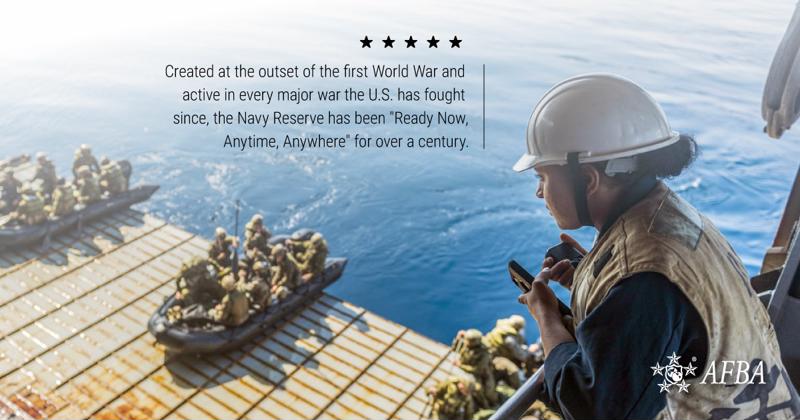
Coming straight on the heels of the United States Coast Guard Reserve's 78th birthday on Feb. 19, the U.S. Navy Reserve will celebrate its 104th anniversary on Sunday, March 3, 2019.
Created at the outset of the first World War and active in every major war the U.S. has fought since, the Navy Reserve has been "Ready Now, Anytime, Anywhere" for over a century.
More than 100 years of service
Reservists have been important to America ever since the days of the Revolutionary War, when in 1775 the first citizens took to the sea to fight the British, even before the Continental Congress had created the Continental Navy.
Yet the present institution was not officially formed until March 3, 1915, when legislation was passed to create what was then known as the Naval Reserve Force.
The Reserve resulted from the efforts of Secretary of the Navy Josephus Daniels and his assistant, a young Franklin D. Roosevelt, who lobbied Congress for funding after the outbreak of World War I in 1914. Once the United States entered the war in 1917, American reservists served in the cockpits of biplanes and hunted down German U-boats.
Despite the dire financial situation the U.S. found itself in during the Great Depression, the Naval Reserve managed to find funding and actually expand with the creation of the Naval Aviation Cadet program and the Naval Reserve Officer Training Corps. This put the Reserve in a strong position once World War II broke out in 1939, and by 1941 nearly all of its members were serving on active duty. Later that year, it was reservists who fired the first U.S. shots of the second World War, when sailors from Minnesota serving aboard the USS Ward sunk a Japanese mini-submarine outside the entrance to Pearl Harbor.
Following the attack on Pearl Harbor and America's entrance into the war, the Navy swelled from a force of 383,150 to one of more than 3.4 million. The vast majority of them were reservists, five of whom would go on to serve as U.S. presidents: John F. Kennedy, Lyndon Johnson, Richard Nixon, Gerald Ford and George H.W. Bush. Jimmy Carter also served in the Reserve before becoming Commander in Chief, though he did so after the conclusion of WWII.
The Cold War that followed sent naval reservists to Korea and Vietnam, and the organization expanded once more during the defense build-up of the 1980s. In the next decade, over 21,000 reservists supported Operations Desert Shield and Desert Storm.
Recognizing the work of today's reservists
In 2005, the Naval Reserve changed to the Navy Reserve.
Since Sept. 11, 2001, there have been more than 70,000 mobilizations of Selected Reservists, and over 4,500 deployments by reservists serving on Full-Time Support. Today there are over 100,000 reservists serving as either the Selected Reserve (SELRES) or Individual Ready Reserve (IRR) Sailors, amplifying the Navy's core capabilities, such as forward presence, deterrence, sea control, humanitarian assistance and disaster response.
According to Military.com, on any particular day, a full quarter of the Navy Reserve is hard at work delivering global operational support to our fleet and combat forces.
On Sunday, March 3, Americans should heed the words of Admiral William J. Fallon, who once urged the nation to "remember that the Reserves, which represent twenty percent of our warfighting force, are absolutely vital to our Navy's ability to fight and win wars now and in the future."
Black History Month can trace its origins back 50 years, to when black educators at Kent State University first proposed the idea in February 1969. The following year, the public research college in Northeastern Ohio observed the first Black History Month, which since then has expanded across the United States, as well as to Canada, the United Kingdom, the Netherlands and Ireland.
While African Americans have made countless positive contributions to our country's cultural, economic and political fabric, their service in our nation's armed forces deserves special recognition. From the 5,000 black soldiers who fought during the Revolutionary War to the Tuskegee Airmen who piloted bombers in WWII, African Americans have been serving the United States since it's inception, even at times when the U.S. failed to serve them.
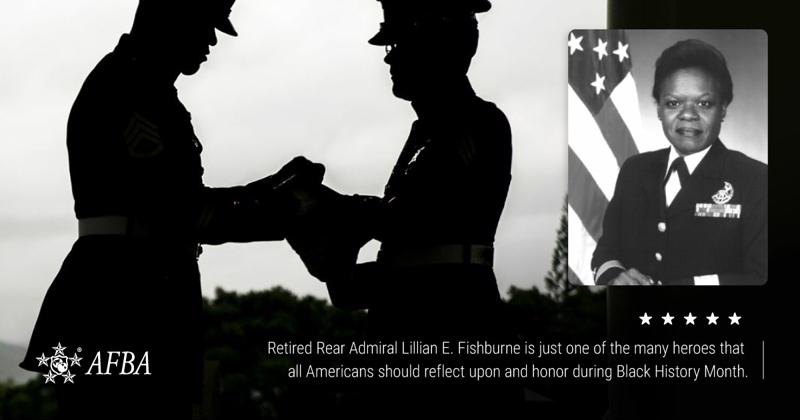
And of the many pioneering black servicemen and women worthy of praise, special attention should be given to Lillian E. Fishburne, who in 1998 became the first African-American woman to hold the rank of Rear Admiral in the United States Navy.
The life and career of Rear Adm. Fishburne
Lillian Elaine Fishburne was born into a naval family in Patuxent River, Maryland, on March 25, 1949–just one year after the integration of minorities and women in the military.
Fishburne was raised in Rockville, Maryland, by an active-duty father who never doubted his daughter's military ambitions. After obtaining a Bachelor's degree in Sociology from Lincoln University in 1971, she spent two years at the Women Officers School at Newport, Rhode Island, becoming an ensign after graduating in February 1973.
According to Black Past, Fishburne's first naval assignment was serving as a personnel and legal officer at the Naval Air Test Facility in Lakehurst, New Jersey. She went on to act as an Officer Programs recruiter in Miami, then as the officer in charge of the Naval Telecommunications Center at the Great Lakes, Illinois Naval Base.
Fishburne then went back to school for another two years, earning her Master of Arts in Management from Webster College in St. Louis, Missouri. She spent the next two years at the Naval Postgraduate School in Monterey, California, graduating with a Master of Science in Telecommunications Systems Management in 1982.
Thanks to appointments to positions such as executive officer at the Naval Communications Command in Yokosuka, Japan, and special projects officer for the Navy's Command, Control, and Communications Directorate, Fishburne was eventually selected for the Industrial College of the Armed Forces.
After becoming Chief of the Command and Control Systems Support Division in Washington, D.C., and commanding the Naval Computer and Telecommunications Area Master Station, Eastern Pacific, in Hawaii, Fishburne made history by attaining the rank of Rear Admiral on Feb. 1, 1998, and was promoted by President Bill Clinton.
A legacy of heroism
Fishburne retired in February 2001, with a long list of decorations that included the Defense Superior Service Medal, Legion of Merit, two Meritorious Service Medals, two Navy Commendation Medals, and the Navy Achievement Medal.
During a 1998 ceremony to honor Fishburne, along with other military members, Secretary of Defense William Cohen delivered a speech in which he quoted novelist and retired Air Force Maj. Albert Murray as saying, "Heroism… is measured in terms of the stress and strain it can endure, and the magnitude and complexity of the obstacles that it overcomes… which bring out the best in [heroes]."
"Considering the stresses and strains endured by African-Americans in the defense of our country, it's little wonder that we have so many heroes among us," Secretary Cohen added, according to Military.com.
Retired Rear Admiral Lillian E. Fishburne is just one of the many heroes that all Americans should reflect upon and honor during Black History Month.
When President Trump first suggested the creation of a Space Force during a March 2018 speech, the grand and seemingly sci-fi proposal was met with mockery in some corners.
Some of the more serious criticisms of the idea came from the Air Force Association, which voiced objections based on the “indivisible” nature of air and space and the high cost of creating a separate military branch. The AFA instead suggested merging the current air and space forces of the United States into something called the “United States Aerospace Force.”
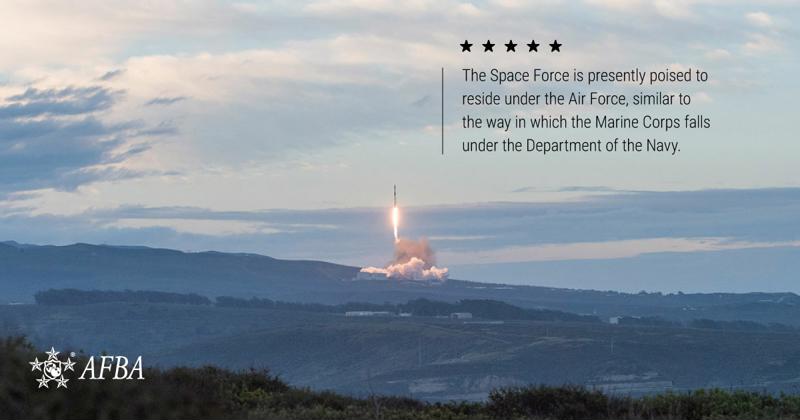
Though it now appears the Aerospace Force counterproposal will not come to fruition, after months of deliberation, the Space Force is presently poised to reside under the Air Force, according to Defense News.
Sixth branch of military would fall under Department of the Air Force
A draft of a legislative proposal set to be put forward with the fiscal year 2020 budget states, “There is established a United States Space Force as an armed force within the Department of the Air Force,” reports Defense News.
The relationship will be similar to the way in which the Marine Corps falls under the Department of the Navy.
The new, sixth branch of the military will be overseen by two newly created roles, the undersecretary of the Air Force for the Space Force and a Space Force chief of staff. The latter will sit on the Joint Chiefs of Staff, joining the Military Service Chiefs from the Army, Marine Corps, Navy and Air Force, and the Chief of the National Guard Bureau.
Though no one has gone on the record to outline the details of the legislative draft, the existence of the draft was at least confirmed by a statement from Lt. Col. Joe Buccino, who said, “In concert with White House guidance, we are moving forward with a legislative proposal for Space Force.” The proposal is reportedly set to be submitted to the Office of Management and Budget for inclusion in the Department of Defense budget sometime soon.
 “The appearance of U.S. Department of Defense (DoD) visual information does not imply or constitute DoD endorsement.”
New proposal seen as big win for Air Force
This decision represents a major victory for the Air Force, which took issue with President Trump’s earlier statement that the two branches would be “separate but equal.”
At the time, the creation of a new bureaucracy was opposed by now-former Defense Secretary Jim Mattis and active Air Force Secretary Heather Wilson. Though the latter eventually announced her support for the creation of a Space Force, it seems clear that the Air Force would like to continue to have a say in the area of military space, as the branch currently manages a three-star Space Command headquartered at Peterson Air Force Base in Colorado.
Of course, just because the Air Force is satisfied with the new proposal does not mean that Congress will be, and political opposition could still keep Space Force from launching.
Representative Adam Smith of Washington, the incoming chairman of the House Armed Services Committee, has previously voiced opposition to the high cost of creating a separate service, reports ABC News. Estimates vary, as the Air Force projected that a new service could cost $13 billion over the first five years, while Deputy Secretary of Defense Patrick Shanahan put the figure at less than $5 billion.
For now, it remains uncertain whether Space Force will ultimately become a separate branch of the United States military or a new branch under the Air Force.
Wright-Patterson Air Force Base in Dayton, Ohio, has a rich history as a proving ground for various major developments.
The base was built on and partially named after land that was once used by local inventors Wilbur and Orville Wright to test and perfect the world's first successful airplane. During World War II, German aircrafts were sent back to the laboratories for analysis. Beginning in the late 1940s, Wright-Patt's Air Technical Intelligence Center began its infamous investigation into reports of UFO sightings. In the late fifties, the base was the site of medical examinations to determine the final selection of the Mercury astronauts who eventually landed on the moon. Thousands of aeronautical inventions have been birthed at the base, including advanced gas turbine engines, aircraft electronic controls, stealth technology and precision-guided bombs.
And this year, Wright-Patterson Air Force Base designed and tested one of its latest innovations: better-fitting Air Force maternity uniforms.
Time for change
Earlier this fall, the base published calls for volunteers who were willing to wear the new maternity service dress shirt. At the time, officials told Military.com that they were looking for around 30 to 50 pregnant airmen to participate in the wear test.
"The greater the number of participants the more accurate the results, due to the ability to fit many different body types and stages of pregnancy," said base spokesman Daryl Mayer.
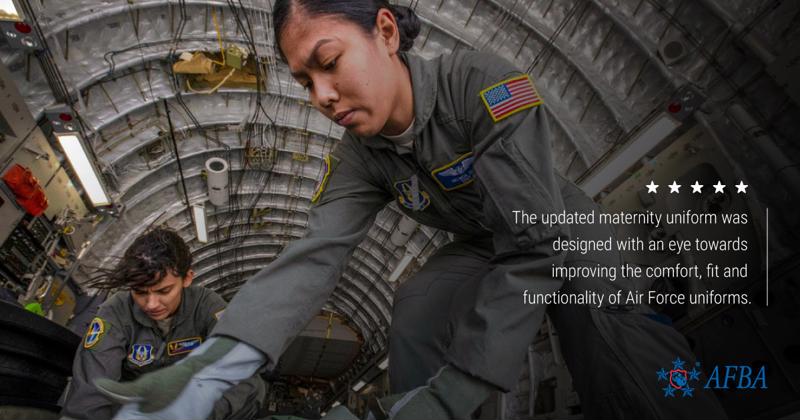
The updated maternity uniform was designed with an eye towards improving the comfort, fit and functionality of Air Force uniforms. As such, the new shirt now features darts on the front and back for a more fitted appearance, and is also made of a stretchier material that boasts better stain resistance and more opacity.
Whether the shirt hits its target of providing enhanced comfort will be determined by the volunteers, who were asked to fill out questionnaires at the end of the experience.
"The feedback from the fit/wear participants will be utilized to make any final adjustments to the fit or design of the improved maternity shirt," said Mayer. "This participant feedback ensures that we have a final product that meets the user's needs."
A wave of potential updates
This new maternity shirt is just the latest installment in a number of uniform changes that the Air Force has recently implemented to meet the needs of pregnant troops and new mothers alike. Last November, pregnant airmen at Wright-Patt were testing a maternity airman battle uniform. The camouflage maternity uniform, which featured pants with a full-stretch panel and an adjusted chest fit for the blouse, was so comfortable, according to Air Force Capt. Mollie Eshel, that her co-workers didn't even notice she was pregnant until her 34th week.
Talk about a successful camo outfit!
Many storied or technologically-advanced developments have come out of Wright-Patt over the years, but updated uniforms for expectant mothers actually serve a rather valuable and unheralded purpose.
"Women suffer in silence on many of the uniforms that don't fit. And they've never fit," said Air Force Chief of Staff Gen. David Goldfein. "The amount of money that women are spending altering essentially a men's uniform to fit a female frame is unsatisfactory. So we're going to get at this."
Working with only a $1.7 million budget and 18 staff members, the relatively small uniform office headquartered at Wright-Patterson Air Force Base is tasked with the order to "get at this." When you consider that the team is responsible for outfitting hundreds of thousands of Air Force personnel serving all over the globe – and above it – it's hard not to respect their service.
A monumental weekend for military anniversaries is fast approaching. Not only is Armistice Day celebrating its centennial on Sunday, November 11, but Saturday, November 10, marks the 243rd birthday of the United States Marine Corps.
While the former event will be observed by many of the nations that were involved in World War I, the latter will be a distinctly American affair, as it has been ever since the first formal ball was held in 1925.
History of the Marine Corps birthday
The birth of the Marines actually predates the birth of the United States.
On November 11, 1775 – eight months before the Declaration of Independence – the Second Continental Congress established the Continental Marines. The legislature's resolution decreed, in part, "That two Battalions of marines be raised, consisting of one Colonel, two Lieutenant Colonels, two Majors, and other officers as usual in other regiments; and that they consist of an equal number of privates with other battalions." The Congressional Act also stipulated that these "American Marines" be comprised of, "good seamen, or so acquainted with maritime affairs as to be able to serve to advantage by sea when required; [and] that they be enlisted and commissioned to serve for and during the present war between Great Britain and the colonies, unless dismissed by order of Congress."
Samuel Nicholas, the first Commandant of the Marines, held a recruiting drive at Tun Tavern, a Philadelphia brewery now regarded as the birthplace of the Corps.
After the American Revolutionary War ended in 1783, the Continental Navy was disestablished, and consequently, so were the Continental Marines. The military branch was reestablished 15 years later, on July 11, 1798, when President John Adams signed the "act for establishing and organizing a Marine Corps."
For over 100 years, July 11th was considered the official Marine Corps birthday, and it passed with little fanfare. That all changed in 1921, when Major Edwin North McClellan, who was then in charge of the USMC's History Division, sent a memorandum to Commandant John A. Lejeune urging him to declare the Marines' original birthday of November 10th a Marine Corps holiday to be celebrated by the Corps.
On November 1, 1921, Lejeune so decreed in Marine Corps Order 47, which read in part, "In memory of [the many who have served as Marines] it is fitting that we who are Marines should commemorate the birthday of our corps by calling to mind the glories of its long and illustrious history."
What's in store for Marine Corps birthday 2018
The first Marine Corps birthday ball was held in 1925, though it wasn't until 1952 that Commandant Lemuel C. Shepherd, Jr. formalized and standardized the celebratory traditions still observed today.
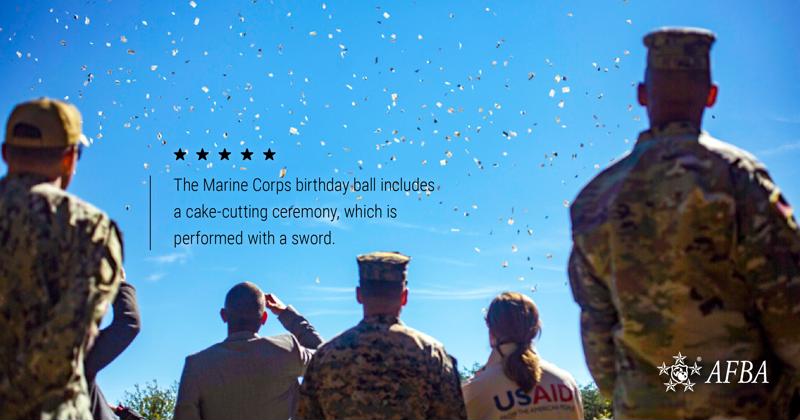
The most iconic aspect of the ball is the birthday cake-cutting ceremony, which is performed with a sword. The first three slices of cake are given to the guests of honor, the oldest Marine present and the youngest Marine in attendance.
A more recent tradition has been the annual release of a filmed Marine Corps birthday message, and this year's edition is a particularly stirring example. The seven-minute video is narrated by Gen. Robert Neller, Commandant of the Marine Corps, who describes the unique journey that every Marine takes before, during and after their service.
Also featured in the film is retired Sergeant Major John Canley, who was awarded the Medal of Honor last month for acts of heroism he committed 50 years ago. Canley, who used his brother's paperwork to enlist in the Marines while only 15 years old and remained in the service for 28 years, was recognized for the actions he took while serving as a Company Gunnery Sergeant during the Battle of Hue in 1968, which included carrying wounded soldiers to safety and taking charge after his commanding officer was severely injured.
Canley was singled out for praise in Commandant Neller's official birthday message, which also noted that this year marks the centennial anniversary of both the Battle of Belleau Wood and the Corps' first female enlistees. The 2018 Commandant's Marine Corps Birthday Ball will be held on Saturday, November 10, at the Washington Hilton in D.C., and will pay tribute to these major milestones.