
Cybersecurity attacks are getting increasingly sophisticated. According to Symantec's 2018 Internet Security Threat Report, the number and complexity of major hacks are growing. Hacks on internet-connected devices increased 600 percent, while crypotjacking (hacking a device to mine digital currency without the owner's knowledge or consent) grew a whopping 8,500 percent. Even mobile devices aren't safe, as targeted malware more than doubled.
This means that organizations of all types need to take cybersecurity seriously if they haven't done so already. The consequences can be dire, especially for government contractors.

Risks are on the rise
To understand how much damage could occur from a single hack – as well as the most likely threats – consider the recent news that hackers connected to the Chinese government stole 614 gigabytes of data from a private contractor.
As The Washington Post first reported, the target was a contractor working for the Naval Undersea Warfare Center, an organization that researches and develops underwater materials such as weapons and submarines. The contractor was not identified, but among the data stolen were plans for a supersonic anti-ship missile that would be added to U.S. submarines by 2020. Hackers also stole radio information, data from signals and sensors.
These details are bad enough, but what makes the situation most upsetting is the fact that the data stolen, when collected as a unit, could be considered classified but was stored on the contractor's unclassified network.
Unfortunately, this hack is not an isolated incident. A report from BitSight, a cybersecurity firm, found that a number of government contractors suffered data breaches between Jan. 1, 2016 and Feb. 1, 2018. While the actual percentages of contractors that disclosed one or more breaches are technically small – healthcare/wellness was the largest at 8.2 percent – even a small number of contractors could hold highly sensitive data that could be detrimental to the U.S. if it ends up in the wrong hands.
The report also noted that contractors fall far behind government agencies in terms of security. Interestingly, those in manufacturing, engineering and technology did worse than companies in business services, aerospace/defense and healthcare/wellness.
Protecting against security threats
Per The Washington Post, Defense Secretary Jim Mattis asked the Pentagon's inspector general's office to focus on cybersecurity issues affecting government contractors. Given these recent events, it's also a good idea for contractors to make sure they adhere to data security best practices.
BitSight identified several areas where contractors fail in that regard. For example, almost 20 percent of aerospace/defense and technology contractors use outdated internet browsers, which leaves them vulnerable to a number of different hacking strategies.
Here are a few simple ways contractors can start improving their security.
- Keep internet browsers and software updated: Developers constantly release new versions that protect against known security issues. Using outdated browsers and software leaves contractors unprotected against the latest threats.
- Train employees on common cybersecurity risks: Contracting staff should know never to give their credentials to an unauthorized party. They should also be trained to spot hackers pretending to be reputable organizations in order to access sensitive information, a technique known as phishing.
- Limit access to sensitive data: Only a handful of people should be able to view classified data.
- Terminate user sessions after a set period of inactivity: This way, unauthorized users are less likely to see classified information.
- Secure wireless access with encryption and authentication: This can prevent unauthorized users from spying on contractor networks.
- Encrypt data: If hackers manage to access a network, encrypting any data transmitted makes it harder for them to decipher information.
For more information, government contractors should visit the National Institute of Standards and Technology's page on cybersecurity.

This past February, President Donald Trump and Congress ended weeks of turmoil after agreeing to a bipartisan budget package. That agreement extended the continuing resolution until March 23, when a bill was passed that ended the financial back-and-forth seen over the previous months and funded the government through Sept.30, 2019 – the end of that fiscal year.
This resolution authorized a significant amount of spending. Most of it was allocated to the Department of Defense, but many civilian agencies gained as well. This information should come as great news to government contractors, as the bill lifted the sequester on government spending and gives them more stability. It also eliminated the possibility of a government shutdown – which, as Washington Technology pointed out, has already happened twice this year – for 18 months. Contractors can now breathe a sigh of relief, knowing they won't have to worry about such uncertainty again until the end of September 2019.

A breakdown of the bill
By fully repealing the sequester through fiscal year 2019, the budget bill effectively boosts government spending for the DoD by $54 billion for both FY18 and FY19, per the law firm Venable LLP. Furthermore, it includes an additional $31 billion above the sequester cap for FY18.
The repeal also brings $37 billion to civilian government agencies across both fiscal years, plus $31 billion above the sequester gap for FY19. Per Venable LLP, the total non-defense funding cap is $117 billion higher than what the Trump administration requested for the FY18 budget. Some are concerned that these agencies won't find use for these funds, but Congress attempted to allay these fears by pledging certain amounts to various initiatives, including:
- $20 billion for infrastructure, including surface transportation, clean drinking water, rural broadband, energy infrastructure and rural water and wastewater.
- $6 billion to help solve the opioid epidemic and assist with mental health care.
- $5.8 billion for the Child Care Development Block Grant program.
- $4 billion for initiatives that help make college more affordable (including those helping teachers, firefighters and police officers).
- $4 billion to improve VA clinics and hospitals.
- $2 billion for research at the National Institutes of Health.
Congress also directed some of this funding to initiatives that will increase emergency response and further invest in healthcare. FEMA, for instance, will receive $23.5 billion, while the Army Corps will get $15 billion. Furthermore, the bill allocates $28 million in community development block grands for economic revitalization, housing, infrastructure repairs and more.
To help people in areas affected by last year's numerous natural disasters, Congress committed $4.9 billion in Medicaid funds for Puerto Rico and the U.S. Virgin Islands. Another $2.36 billion was granted to Florida disaster assistance.
The healthcare commitments included more than $7 billion in funding for community health centers, $253 million over two years for teaching health centers and $620 million over two years for the National Health Service Corps.
Benefiting from the recent budget bill
While the budget is definitely good news for government contractors, these businesses must still face competition with each other. It's true that there is more money to go around, but contractors aren't guaranteed a portion unless they prove their usefulness to the government.
As such, these organizations should position themselves as the best resources to solve the various civilian issues listed above, as well as those faced by the DoD. Successfully securing contracts is all about marketing and cost-effective pricing.
That said, the end to the financial uncertainly that prevailed over the past few months is nothing short of great news.
The world of government contracting naturally comes with a certain amount of financial instability. Thankfully, many experts predict that 2018 will be a good year for the contracting field. Plenty of people assumed the numerous government shutdowns would be disastrous for contractors, but that turned out not to be the case. In fact, something close to the opposite happened: Congress approved a spending plan that included a huge budget increase for the Department of Defense, leading analysts to speculate that much of this money will be spent on contractors.
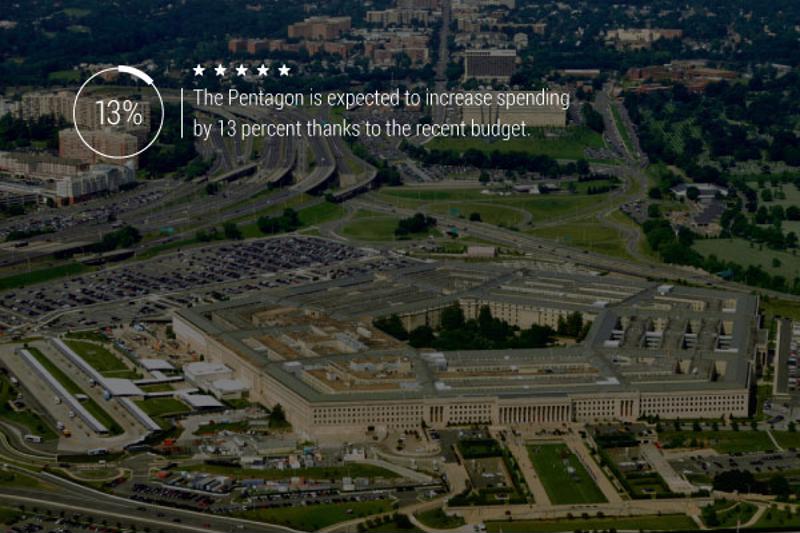
According to the Washington Post, the current budget, which lifts the 2013 sequestration, should increase Pentagon spending by 13 percent. Some analysts believe that money will be spent on the innovation or modernization of the Pentagon's (and other government offices') IT infrastructure. Such an update is long overdue and would bring the U.S. government more in line with every other industry.
Furthermore, this type of spending would take advantage of D.C.'s substantial tech base. Last year, real estate company Cushman & Wakefield identified D.C. as the third-best tech city in the nation – right behind San Jose and San Francisco/San Mateo. Clearly, there's a lot of opportunity for these businesses to profit from the anticipated spending.
As for the specific type of tech progress the government will invest in, it seems nothing is off limits. Speaking with the Washington Post, John Wood, CEO of data security company Telos, noted that the government is quickly switching to cloud-based software. Meanwhile, Deloitte Consulting Managing Director Michael Isman predicts automation, digital reality and blockchain data storage will all catch the government's interest.
What tech contractors must consider
Last year, the government purchased fewer tech services as new appointees adjusted to their positions. Now, as the administration settles into its second year, such growth will likely pick back up.
Unfortunately, this means contractors will presumably become more attractive targets for data breaches. Theft of a single contractor's data could have huge, irreversible consequences.
What's more, these companies are no stranger to breaches. A report from BitSight, a cybersecurity firm, revealed 4.3 percent of technology contractors reported at least one data breach over the past two years. Such attacks often take months – possibly even years – to detect, and many are never discovered at all. This means that there's a possibility that more tech companies have been hacked than the report suggests.
"Not only can these breaches often affect government and private sector employees, they may expose data that is fundamental to national security," wrote the authors of the BitSight report.
Because of the potential for increased spending coupled with the threat of data breaches, tech contractors must be more committed to digital security than ever before. Not only will doing so keep sensitive information private, but it could give these companies a leg up against their competitors.
One way contractors can get ahead is by using less common or accessible service providers for hosting, domain and email services. Amazon Web Services and similar cloud companies are a favorite of tech companies in all sectors, meaning data thieves expect them to hold tons of valuable information.
That said, even if contractors don't change vendors, they must take other measures to prioritize security.
Government spending in 2018
While the anticipated tech spending is still just a prediction, it stands to reason that tech contractors will benefit from the increased budget. That said, competition will grow more fierce, too, meaning businesses must bring their A-game to secure government contracts.
This past summer, the U.S. Department of Veterans Affairs and the U.S. General Services Administration partnered to better help VA buyers find veteran-owned small businesses for government contracting purposes. On July 10, the two parties signed a memorandum of understanding allowing veteran-owned and service-disabled veteran-owned small businesses already listed in the VA's Verified Vendor database to be included in GSA's VA Advantage with an icon identifying them as VIP. This designation will make it easier for VA acquisition professionals to find and utilize such vendors, as the icon makes VIP veteran contractors more visible on VA Advantage.
"Gaining verified VA VIP status provides access to important resources for veteran-owned businesses," Acting Deputy Commissioner of GSA's Federal Acquisition Service Mary Davie explained in a statement. "The MOU provides VIP veteran contractors with valuable increased visibility to vendors through GSA's VA Advantage."
Jane Frye, the VA's Logistics and Senior Procurement Executive and Deputy Assistant Secretary for Acquisition, added that the icon program enhances the longstanding partnership between the two government agencies. It will also make it easier for VA employees to make better-informed purchasing decisions and fulfill their mission of assisting veterans.
The new changes fall under the umbrella of the Veterans First Contracting Program. Veteran-owned venders must first complete the verification process before they can participate.

Veteran's First Verification Program
The Vets First Verification Program is a cautionary measure designed to guarantee only veteran-owned businesses receive set-aside funds. The VA provided the following checklist to help veteran business owners prepare for verification:
- Veteran status: Business owners must meet the definition of "veteran" (a person who served on active duty with the Air Force, Army, Coast Guard, Marine Corps or Navy and was discharged or released under conditions that were not dishonorable) or "service-disabled veteran" (a veteran with either a disability determination from the Department of Defense or a disability rating letter issued by the VA).
- Ownership: A majority of the business (at least 51 percent) must be directly and unconditionally owned by at least one veteran or service-disabled veteran.
- Control: Veteran owners must have full control over various aspects of the business, including but not limited to strategic policy and daily management.
- Prequalification: While not required, veterans who utilize prequalification resources may have their applications processed more quickly.
To qualify, eligible government contractors must approach the Center for Verification and Evaluation and receive verification through the MyVA Verification Process, which includes three mandatory and one optional step:
- Prequalification: This optional step helps potential veteran contractors assess their eligibility and learn about available resources. It may also shorten processing time.
- Intake: Applicants create a profile in VetBiz VIP and are contacted by an Intake Analyst, who explains the process and next steps, and a Case Analyst, who manages the application.
- Pre-application review: The Case Analyst briefly inspects the veteran's application and conducts public research on the business and its owner. He or she informs the applicant of any discrepancies or areas of noncompliance and advises correction.
- Assessment: The Case Analyst thoroughly reviews all documents and, if necessary, requests clarification or advises the applicant to address areas of noncompliance.
- Decision: A federal employee reviews the case and approves or denies the applicant.
Although the process is extensive, it's necessary to ensure only qualified veterans receive verification. Combined with the icon program outlined in the MOU, VIP veteran government contractors have increased visibility and, therefore, another chance to serve their country.
Recent budget cuts and travel restrictions have negatively affected the ability of government agencies to find and partner with vendors in a variety of ways. For instance, these factors lead to the cancelation of annual outreach events like GSA Expos, meaning contractors have less chance to interact with agency representatives and promote their benefits.
As a result, hopeful contractors must work even harder to enter into such partnerships. If you fall into this category, here's a brief guide detailing how to win government contracts:
Get noticed
The best way to secure a contract is to increase your chances of being noticed by your target agencies. If this is your first time trying to partner with a government organization, Cayenne Consulting suggested subcontracting with a firm that's already done so. Collaborating with other groups reduces your risk, and building positive relationships with these vendors increases your chances of securing a private contract.
Also, be sure to register in the System for Award Management if you haven't done so already. This gives government agencies access to all of the information they need, including the services or product your company offers, the type of business you run, the size of your organization and specific points of contact.
Finally, you should obtain a GSA Schedule. These also boost your chances of securing a contract; according to Federal Schedules, Inc., many agencies only place orders through this program. GSA Schedule Contracts have predetermined prices, warranties and other terms and they comply with all laws and regulations, simplifying the contracting process on behalf of the government.
Know your target contracts
The better you know specific agencies and contracts you want to obtain, the more effectively you can market your business. Make note of your target's selection criteria, key decision makers, anticipated competitors, locations and other factors. D.C.-area PR firm Boscobel Marketing Communications recommended setting up Google Alerts so you can stay up to date on any news about your preferred agencies, their contracts and their decision makers.

In addition, don't be shy about promoting your success stories. If you've successfully partnered with other contractors, feel free to mention these collaborations when relevant. Publish case studies on your company website and share snippets of glowing customer reviews on social media.
Don't forget to position your business as a thought leader. Write articles or white papers with unique takes on recent news or market trends, and publish these pieces on your website or channels like LinkedIn and Medium.

Get certified by a state or national entity
Government agencies love certifications, as they allow them to easily evaluate a business. Decision makers are assured that certified vendors adhere to certain practices, standards or regulations.
Some Small Business Administration certifications are specifically set aside for small businesses, especially those run by specific demographics:
- The Woman Owned Small Business program is for companies controlled primarily by women.
- The 8(a) program is for companies controlled primarily by minorities.
- The HUBZone program is for businesses in economically disadvantaged areas.
- The Service Disabled Veteran Owned Small Business Concern program is for companies owned mainly by vets wounded during their service.
The process of securing a government contract is filled with bureaucracy and competition. Depending on the agency in question, you may face dozens or even hundreds of other vendors fighting for the same arrangement. To come out on top, you need to have a proven product or service, be skilled at promoting your company and obtain certification or some other recognition that makes a decision-maker's job easier.
Defense obligations to buy goods and services have followed a downward trajectory over the past few years. In this current market, it's crucial that government contractors take the necessary steps to increase their visibility through marketing and networking endeavors in order to grow their operations.
The most recent data from the U.S. Government Accountability Office revealed that defense spending on government contracts dropped nearly 32 percent between fiscal year 2011 and 2015, from $399.4 billion to $273.6 billion. Meanwhile civilian obligations remained fairly steady at an average $128.3 billion over this same time period.
Faced with declining agency spending, government contractors need to ensure they're putting themselves in a position to succeed. This task involves establishing a smart growth strategy and implementing it through to the finish. Consider these four smart tips for growing your government contracting business:
1. Draft a plan
The first step to any successfully growth strategy involves crafting a master plan. Without a clear route to follow, you won't be able to track your progress and you may ultimately find your company lost in a maze of bureaucracy and red tape. A three- to five-year plan will help you acquire the right contracts for long-term growth.
"A three- to five-year plan will help you acquire the right contracts for long-term growth."
What are your main goals? To gain more government contracts? To increase the scope of your current contracts? To move into a new sector and leverage your skills and experience there?
Once you identify your objectives, you can fine-tune your strategy by working backwards and adding the steps necessary to reach your goal. Include incremental growth milestones along the way so that you can still reach smaller aims along the route.
Remember, while it's always important to follow through with the original plan, you'll also need to be ready to pivot if circumstances required it, so flexibility is also crucial.
2. Consider acquiring GWACs/IDIQs
Government-Wide Acquisition Contracts (GWACs) or Indefinite Delivery/Indefinite Quantity (IDIQ) contracts are a great way to grow a government contracting business. Both of these are multiple-award contracts (MACs) that allow government agencies to use to purchase an unlimited number of services or products from contractors over a specified period.
As noted by Multibriefs: Exclusive, half of all services and products procured by the government since 2011 have been obtained through GWACs, IDIQs or blank purchase agreements (BPAs). Although the overall number of MACs has declined from 2,892 in 2012 to 2,653 in 2016, mature GWACs/IDIQs have surged in market share since 2013.
3. Diversify your practice area
As noted above, defense contracts have been on a downward trajectory over the past few years. While the new administration's budget might reverse this course, there's a chance that this trend will continue.
If you're currently focused primarily in this space, it could be wise to diversify your practice areas into complementary lines of business. While you might not be able to grow all of these at the same time, having additional areas will help keep your business growing if federal buying stalls in your sole practice sector.

4. Build relationships
Networking is key in any business, no matter which sector you operate in. Government contractors are no different, and building solid working relationships will be crucial for growing your business.
Creating working relationships with government agencies and officials will help keep your business top of mind when new contracts are announced, ensuring your bids remain competitive. However, it's also important to nurture relationships with other mid-tier businesses, as this can create strong ties for teaming or joint venturing, which is another way to make your company more likely to win contracts.
A May 2017 survey of government contractor sales expectations set a new record high score for respondents' confidence for the coming 12 months. Respondents cited an improving economy that is allowing them to focus on increasing public sector sales and marketing investment. With growing confidence in the government contracting sector, vendor sentiment in this market looks good for the upcoming year.
How confident are government contractors?
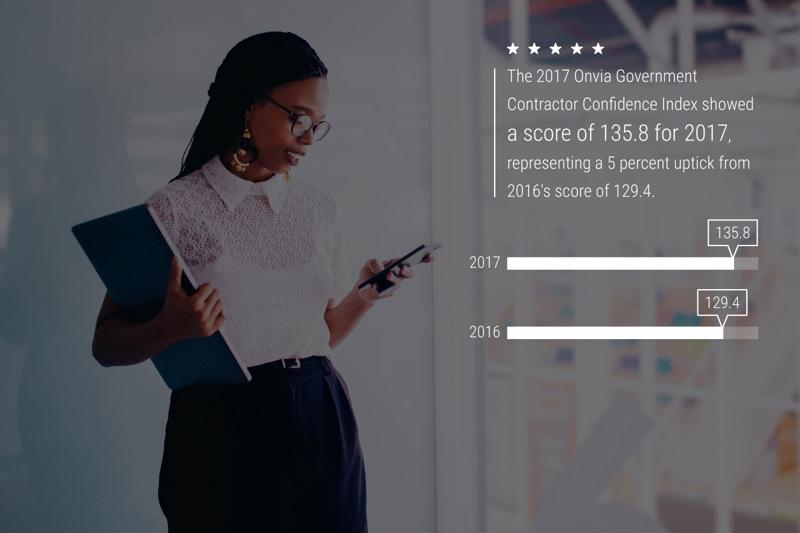
The 2017 Onvia Government Contractor Confidence Index (GCCI), now in its third year, showed a score of 135.8 for 2017, representing a 5 percent uptick from 2016's score of 129.4. With an upper range of 200, any score higher than 100 typically indicates government contractors can look forward to an expanding market for their services.
"The 2017 GCCI provides a view into why government vendors are feeling optimistic about their prospects for increased sales," explained Paul Irby, business-to-government market analyst for Onvia. "The 5 percent increase in this year's score was driven most notably by 21 percent improvement in expectations for overall agency spending and 8 percent improvement in the outlook for funding in specific departments."
The GCCI surveyed 424 companies who sell to federal, state, local and education agencies on their opinion for how the next 12 months will fare compared to their self-reported performance over the past year.
The index questioned these companies on how agency budgets are likely to impact their sales and how public sector sales grow. GCCI asked how respondents felt about the upcoming year for:
- Outlook for individual agency department budgets.
- Outlook for overall agency budgets.
- Expected increase in sales.
Nine factors were considered as the top drivers of growth, including:
- Overall economy.
- Overall agency budgets.
- Allocation of funding by agency department.
- Company sales and marketing budget.
- Cooperative purchasing.
- Contract requirements.
- Government regulations.
- Competition for agency contracts.
- Labor market constraints.
Among these factors, overall economy, overall agency budgets, allocation of funding by agency department and government regulations saw the most positive increases at 26.7 percent, 14 percent, 8.9 percent and 7.6 percent, respectively.
When asked which government market would have the greatest potential for growth in the next two to three years, 40.8 percent said federal, with 29.2 percent saying local, 21.9 percent saying state and 8.2 percent saying education.
What this means for government contractors
While the 2017 GCCI represents a marked improvement over the uncertainty surrounding the election-year index of 2016, it's still merely a gauge of expectations, so the reality of the matter may be subject to change. However, if these predictions hold true, then government contractors will be facing very favorable conditions in the coming year.
"Government contractors will need to step up their marketing endeavors to more agencies."
To take advantage of the current positive environment, government contractors will need to step up their marketing endeavors to more agencies. This will ensure that contractors are building brand awareness and generating buzz about their capabilities to attract more businesses and sign more lucrative contracts.
With the federal fiscal year approaching at the end of September, American City and County recommended being more strategic about spending marketing dollars at upcoming events, whether they are conferences, trade shows, seminars, agency briefings and more. Be sure to target events with producers that are focused on the public sector, especially those sponsored by a government agency. It's also wise to be wary of event producers that only visit government markets occasionally, as these most likely won't have the greatest connections to agencies.
In some cases, contractors can pursue government work from agencies or in areas they previously did not focus on in the past. They can take this moment as an opportunity to expand their operations and generate more revenue by moving into new fields. This might also require increasing sales staff to target different market segments and achieve these objectives. While it can be risky to move into a new sector, the rewards can be more than worth it.
With government contractors' confidence reaching record highs, now is the perfect time for identifying new growth opportunities and pursuing lucrative new contracts.
Contracting work with the government is the bread and butter of many companies. For those that contract with the U.S. Department of Defense, a new federal security directive will now require all contractors to either implement a robust cybersecurity plan to protect their digital data, or have a detailed plan in place for doing so by December 2017. Failure to comply will prevent companies from contracting with the DoD.
What's this new federal directive?
In December 2016, the National Institute for Standards and Technology, an agency under the U.S. Department of Commerce, released NIST Special Publication 800-171, "Protecting Controlled Unclassified Information in Nonfederal Systems and Organizations."
Dubbed "NIST 800-171" or simply "rule 171," the directive covers whether a company has the IT safeguards and security measures necessary to protect any classified data in order to conduct business with the federal government.
This covers every type of company contracting with the government, from defense engineering firms to janitorial services. And this isn't strictly limited to contractors – it also covers subcontractors. In practice, any company that has access to classified government information that needs to be protected.
In addition to rule 171, the DoD has also issued another clause that is likely to impact government contracting, the Defense Acquisition Regulations System (DFARS) Clause 252.204-7012, "Safeguarding Covered Defense Information and Cyber Incident Reporting." This clause covers implementing adequate security measures on all covered information systems owned, operated or utilized by the contractor.

How should government contractors respond?
With these new rules set to go into effect in 2018, it's imperative that government contractors have a plan in place to implement all of the technology.
Speaking with GovTech, Shawn Walker, vice president and co-founder of Secure Cyber Defense LLC, noted this directive impacts any company with classified information issued by the government and that it will take some time to implement.
"Starting from nothing, it will probably take six to 12 months to get all the technology in place to be able to say you're compliant," said Walker. "To put the plan together may take 30 to 60 days."
Companies can't simply wait until the last minute and cobble together a statement about a plan of action. Instead, they should start early and ensure they've accurately covered the list of 110 requirements outlined in the rule.
Steps to take
First, contractors should familiarize themselves with NIST 800-171 and the new DFARS clause, as these will be paramount in discerning how the directives apply to their firm and how they will affect operations and resources. Noncompliance with these new rules may cause the government contractors to forfeit their chances for a government partnership, so be sure to leave no stone unturned when reviewing the new rule and clause.
Next, perform a risk assessment of the organization based on the directive's requirements. The U.S. Department of Homeland Security provides a handy guide for conducting a thorough risk assessment, called the Cyber Security Evaluation Tool (CSET). According to its website, this tool provides contractors with a "systematic and repeatable approach for assessing the security posture of their cyber systems and networks."
Once risks are assessed, develop a plan of action and milestones for the company. This will serve as the guideline and map for every step, task and policy the organization implements to meet compliance.
Consider getting medium-assurance certification from the Information Assurance Support Environment, which allows for outside entities to securely communicate with the DoD and authenticate to DoD information systems.
With a carefully crafted plan of action, government contractors can tackle the new cybersecurity regulations with ease.
While it can be difficult to know all of the ins and outs, working as a government contractor can be a worthwhile and lucrative endeavor. This line of work requires navigating a labyrinth of bureaucractic red tape. Signing a contract with the government requires careful compliance and fulfilling of obligations. Although maintaining compliance can be costly, not remaining compliant can be even more expensive.
Since 2009, the cost of doing business with the federal government has increased 72 percent according to the latest annual survey from the American Express OPEN for Government Contracting initiative, Government Executive reported. Companies trying to get a chunk of the approximately $90 billion in contracts awarded by the government will have to work harder and spend more time and money to win these bids. On average, firms spent approximately $148,124 in 2016 trying to obtain a federal contracting opportunity.
Thankfully, with some careful planning and attention to details, small business owners can lessen the burden necessary to obtain these contracts. Whether you're already involved in government contracting or seeking to work with them, consider these Do's and Don'ts:
Preparing to contract with the government
Do register with Central Contractor Registry at the System for Award Management.
Don't forget to keep your data on the SAM current.
Do check out the U.S. Small Business Administration and register as a small business if you qualify.
Do prepare your product or service by visiting the NAICS.
Don't forget to regularly check Fed Biz Opps for new opportunities.
Do obtain a DUNS number from Dun & Bradstreet.
Do review and research the government agency you're contracting with on the Federal Acquisition Regulation.
Working with the government
Don't schedule any meetings with contracting officers until you've reviewed all the websites and researched what the agency needs.
Don't use any workers or staff members that might not pass the background checks for security clearance.
Do use energy-efficient equipment and products, and promote the fact that you do.
Don't try to bid on jobs that exceed the capabilities and qualifications of your firm.
Do allocate the appropriate resources for creating and implementing a robust compliance program.
Don't submit documentation without all the proper signatures, certifications, bonds or other required information.
Do be open and honest with the contracting officer about your firm's capabilities and experience.
Don't try to underbid what the job costs just to try and secure the contract – you'll need to cover your overhead and still turn a profit in the end.
Following Compliance
Don't forget to follow all recordkeeping requirements.
Do communicate with the contracting officers regularly to notify them of any changes and to keep them abreast of the status of the project or delivery dates.
Don't try to outsource or subcontract your government contract without first seeking approval from the agency you contracted with.
Do regularly inspect the work as your firm progresses through the contract as you don't want to find out once you're finished that a part of it is not compliant with the contract.
Although it might seem overwhelming, with some diligent effort and a solid plan in place, government contracting can be a great opportunity for any firm.
The latest installment in the "Star Wars" franchise seems to be on everyone's minds lately. The seventh film "The Force Awakens" broke many box office records by making a cosmic $247 million opening weekend, as reported by Vanity Fair. Yet, the pop culture phenomenon has reached past the entertainment industry and begun to inspire military leaders.
The Morning Ticker reported that the U.S. military has hired contractors to develop a laser defense system not unlike the ones used in the sci-fi saga. The lasers would be used to defend against attacks by air, land and sea.
Though the technology is in the early stages, and the final product will look nothing like the laser weapons in "Star Wars," the military has some interesting projects in the works. Fox News wrote that some of the contractors hired have been working on things like a drone-slaying laser, all-terrain vehicle-mounted lasers and aircraft-mounted lasers. The news source also reported that there was a project dedicated to laser-equipped boats called Area Defense Anti-Munitions, or ADAMs for short.
All of the technologies are still in the testing phase.