
Police officers put their lives on the line every day to protect communities and keep the peace. Yet, it can be a bit of a thankless job, which is why the third Saturday of September is now recognized nationally as "Thank a Police Officer Day." Showing appreciation for law enforcement can go a long way in boosting the morale of officers. Residents, businesses and civic organizations can all participate on "Thank a Police Officer Day," as there are many creative ways people across the country are getting involved. To start, here's some more information about the date and how it is observed.
First event held in 2012
"Thank a Police Officer Day," sometimes also called "National Tell a Police Officer 'Thank You' Day," was begun in 2012 by the Whole Truth Project, an organization that describes itself as "serving and protecting those who serve and protect our communities." The Whole Truth Project itself was begun by Andrew Hale, a Chicago-based attorney who represented law enforcement in several different high-profile cases. Hale, in announcing the inaugural "Thank a Police Officer Day" in 2012, said he was inspired to create the event to honor and recognize the service of police officers.
"We want people to show their appreciation for the job that the brave men and women of law enforcement do every day," Hale said. "Having represented police officers for several years, I know the difficult job these men and women undertake every day and I think we often take our police officers for granted. We must show support and appreciation for those that serve and protect us."
Hale's other motivation in starting the "Thank a Police Officer Day" campaign was the negative headlines that had come to dominate the news and headlines and public perception of police.
"Unfortunately the bad tends to stand out and make more interesting news stories," Hale said to HuffingtonPost. "Mistakes and problems tend to be more dramatic, attention-getting, adrenalin-fueling — far more than the calm, peaceful good deeds police officers do every day."
Many creative ways to say thanks
While "Thank a Police Officer Day" is a relatively recent observation, support for the cause has been seen across the country in many different ways. Some of those examples include Sylacauga, Alabama, where local residents, businesses, houses of worship and civic organizations were encouraged to affix a blue ribbon to their doors to "Paint the Town Blue." In Fairfax County, Virginia, officers discovered small rocks painted with messages of affirmation and appreciation in blue paint.
"You don't know what someone's going through and what sort of circumstances they're dealing with or facing and what kind of day they're having," Julie Trace, the rock painter, told the local CBS affiliate. "It could just help them in the moment to put a smile on their face or if they're facing something really big in their life."
As demonstrated, there are several opportunities to get creative with expressing your thanks, but some ideas for "Thank a Police Officer Day" on Sept. 21 include:
- Paying it forward if you see a police officer in line for coffee, or donating a cup on the house if you own a business.
- Attending, hosting or organizing an event.
- Wearing blue or decorating your house with blue lights.
- Sending a thank-you card to your local police department.
- Making goodie bags and dropping them off at the nearest station.
Police officers regularly put themselves in danger to ensure the safety of the communities they serve; a small "thank you" can go a long way on "Thank a Police Office Day."

Conventional logic may hold that a wet winter should be enough to ward off the threat of wildfires, especially in California. However, while winter precipitation has done wonders to reverse the state's drought conditions, it's not having the desired effect as a natural guard against wildfires.
If anything, the wet winters that California is experiencing recently have exacerbated the risk of wildfire, with lush vegetation regrowing rapidly, only to be burnt again. Additionally, a new body of evidence is increasingly pointing toward an abrupt turnaround in the relationship between preceding winters and wildfire seasons — as in, no matter how snowy and rainy the winter is, it's not reducing the threat of wildfires.
As these trends continue to develop, first responders in and around the state are starting to prepare for wildfires year-round.
'The new normal'
The wildfire watch is kept throughout the year in California, meaning first responders have to be ready 24/7/365. After a 2018 that saw the state's deadliest fire and numerous other destructive and high-profile blazes, California government and first responders are adjusting.
"This is the new normal," then Gov. Jerry Brown had said in December 2017. "We're about ready to have firefighting at Christmas. This is very odd and unusual."
April showers may bring May fires
The 2018-2019 winter season has been a long one for California, stretching into May, according to the Los Angeles Times. The extended winter has brought much-needed precipitation to the state. It's also done an excellent job at nourishing the grounds that were charred just months ago, allowing flora to regrow at a rapid pace. However, the return to green is anything but welcome by wildfire experts, who warn the thriving brush is just kindling waiting to burst as soon as the intense, dry air comes in.
"The good news is we need the water, but the bad news is it's building the fuel load for what has always been our fire season," Bill Patzert, a local weather expert and former climatologist with the Jet Propulsion Laboratory, told the LA Times.
Some plants regrow faster after a fire, which makes it worse when they dry out under oppressive summer heat and arid conditions. The dead grass and brush creates the ideal fuel bed, allowing wildfires to spread and grow quickly. The Washington Post has also reported on the increased risks brought on by wet winters, and the more expansive forest management the state must undertake.
Increased moisture does not decrease wildfire risk
For centuries, wet California winters were scientifically linked to reduced wildfire risk. Researchers recently looked at this connection and found between 1600 and 1903, rainy winters brought on by the North Pacific jet stream were followed by low wildfire activity; conversely, dry winters begot higher wildfire activity. But after 1904, the association started to weaken, according to the paper published in the Proceedings of the National Academy of Sciences.
Now, the link may be erased entirely.
"The moisture availability over California is still strongly linked to the position of the jet stream, but fire no longer is," said co-author Valerie Trouet, an associate professor of dendrochronology at the University of Arizona Laboratory of Tree-Ring Research. "I didn't expect there to be no relationship between jet stream dynamics and fire in the 20th century. I expected it to be maybe weaker than before, but not to completely disappear."
As historical trends reverse and the risk of wildfire continue to rise, first responders will need to prepare to meet the demands of that "new normal."
Seven college students studying at Colorado State University-Pueblo have found a way to integrate NASA technology into a brand new product that takes the concept of a "security blanket" to a whole new level.
Though the prototype looks like nothing more than a simple green blanket with a silver circle design in the center, the invention may one day become an essential public safety tool, and has already succeeded in earning the CSU-Pueblo engineering undergrads a trip to the Johnson Space Center in Houston and a prestigious award.
The design integrates the NASA concept of a "portable wireless signal booster" into a lightweight, practical, waterproof nylon blanket that could easily be stuffed in a backpack or attached to camping gear. The students sewed a stamped copper Fresnel lens between two sheets of water-resistant fabric, creating a multipurpose product that can be used as a passive antenna able to boost incoming electromagnetic signals, or radio waves, up to 10 decibels in areas of low coverage.
"This will boost the signal on your cell phone," Kenneth "Kordell" Roberts, a three-year industrial engineering student at Colorado State University-Pueblo, explained to The Pueblo Chieftain. "If you are backpacking or hiking out in the wilderness, normally there would be no signal. But this will help."
Roberts and fellow students Alex Goodwin, Daniel Hoyle-Aguon, Connor Foust, Julian Fierro, Shermann Mcdermott and Wyatt Farris created the signal-boosting blanket as a way to assist first responders fighting wildfires and search and rescue teams attempting to locate lost hikers.
"We targeted more of search and rescue, wildfire firefighters and those types of markets where you would have a great need for something that was very lightweight and that was able to help increase your signal," Roberts explained. "They are not going to want to carry an active signal boosting system, because those weigh 20, 30, 40 pounds. We thought it would be good to create a product that would be very lightweight that can also provide these benefits."
Potentially life-saving invention earns students NASA internships, awards
In recognition of their genius innovation, the CSU-Pueblo students received an invitation to the NASA MITTIC Technology Transfer competition at the Johnson Space Center in Houston this past March.
The contest's entrants were tasked with designing a commercially viable product by implementing one of about 20 different NASA intellectual properties, which included the signal booster. The students then had a month to develop a 12-page concept paper which included planning and the development of a prototype. After submitting their paper to NASA, the students were named to the list of top 10 finalists and invited to spend four days touring the NASA facilities in Houston, listening to guest speakers and networking with other students and professionals in their field.
"We also continued to work on our prototype and the 10-minute presentation we did there. It was almost like a 'Shark Tank' pitch of the product we made," said Connor Foust, a second-year mechatronics engineering student at CSU-Pueblo.
Of the seven students that worked on the project, only four were able to make the trip to Houston, per NASA contest rules. Of those four, three were awarded prestigious NASA internships, according to La Voz Bilingüe, Colorado's longest-running bilingual newspaper.
"Two of them will be going to Ames Research Center in California's Silicon Valley," Dr. Jude DePalma, the students' engineering professor, told the newspaper. "It's life-changing for those students."
Additionally, student group leader Kenneth Roberts was recognized by NASA with the competition's Outstanding Leader Award.
The invention has clearly already made a difference in the lives of these students, but could one day help save the lives of countless others, as firefighters and other first responders use the technology to rescue those in danger.
If you've ever wanted to go on a ride along with first responders, but without exposing yourself to the very real and present dangers faced by those who bravely risk their lives responding to emergency rescue calls, you now need only a basic cable subscription to accomplish your dream.
The new documentary television series "Live Rescue" gets up close and personal with real first responders across the country, providing live look-ins at the life-threatening situations they encounter on a nightly basis.
'Live PD' spinoff 'Live Rescue' airing Monday nights on A&E
In March, the A&E channel announced that it was following up its immensely popular "Live PD" series with the spin-off show "Live Rescue."
"Live PD" follows police officers across the country as they perform their nighttime patrols, broadcasting live select interactions they have in the course of duty. The show is hosted by ABC News chief legal affairs anchor Dan Abrams, who is joined in the studio by police and crime analysts. Throughout each episode, viewers are treated to footage from live video feeds for eight different law enforcement agencies.
The series premiered on the network in 2016, and has since aired 200 episodes over the past three years, in the process becoming one of cable's most-watched programs. In 2018, "Live PD" was the most-viewed show of the year on DVR, video on demand and over-the-top media services, topping every chart except, ironically, the live-viewing category.
"Live PD" can also lay claim to being cable's No. 1 justice series, and the No. 1 show on cable on Friday and Saturday nights.
Looking to replicate that success by focusing on a similar yet different breed of hero, A&E ordered eight two-hour episodes of "Live Rescue" from Big Fish Entertainment, the same MGM Company behind "Live PD."

"'Live Rescue' is the next incarnation of our groundbreaking partnership with Big Fish Entertainment, following the brave paramedics and first responders who risk their lives every day to keep us safe despite the challenges of their jobs," said Elaine Frontain Bryant, Executive Vice President and Head of Programming for A&E. "The team at Big Fish has assembled a best-in-class production team of broadcast news veterans and we are looking forward to adding 'Live Rescue' to the A&E portfolio of brave storytelling."
To host the new program, A&E tapped veteran journalist Ashleigh Banfield, whose previous credits include "CNN Newsroom" and HLN's "Primetime Justice with Ashleigh Banfield." In a commercial for "Live Rescue," Banfield says "everyone should know what first responders go through, and now you can."
The first episode debuted live at 9:00 pm ET on Monday, April 22. Banfield was joined in-studio by analysts Dan Flynn, a nationally registered paramedic and registered nurse in New Orleans, Louisiana, and Titus Tero, a nationally registered paramedic for the City of New Orleans EMS.
With the aid of 32 roaming cameras, the trio was able to keep tabs on the exploits of seven different agencies in cities across the country, including the St. Louis Fire Department. The real-time documentary reality series will have three film crews placed on two ambulances and one fire engine every Monday night of the show's initial eight-week run, according to the St. Louis Post-Dispatch.
"Both EMS and fire do a phenomenal job of keeping the city safe every day," department spokesman Garon Mosby told the Post-Dispatch. "We think this is an opportunity to show the world how good they are."
The results of Super Bowl LIII, which saw the New England Patriots win their sixth title overall and their third in just the last five years, left some football fans overjoyed and others highly annoyed. But there was one group of patriots celebrated at this year's Super Bowl that everyone should be able to appreciate, regardless of their team loyalties.
During the big game, Verizon debuted another entry in its "The Team That Wouldn't Be Here" ad campaign, titled "The Coach That Wouldn't Be Here: Anthony Lynn." The 60-second spot, which reportedly cost over $10 million to air, features Los Angeles Chargers head coach Anthony Lynn speaking to a group of first responders and telling them the story of the time his own life was saved by police officers and paramedics who came to his aid after a "horrible" car accident.
In the video, Lynn describes how in 2005 he was struck by a car traveling at 50 mph. He credited the first responders who came to the scene of the accident with saving his life.
At one point, three of the first responders in the crowd identified themselves as the individuals who had first arrived at the scene of Lynn's accident, causing him to become visibly emotional. With tears in his eyes, Lynn embraced the first responders and thanked them for being his guardian angels.
Company also funding new public safety tech
According to Verizon, over 40 million people in America wouldn't be alive today if not for the efforts of a first responder.
To show its gratitude, the cell phone service provider pledged to support first responders in a variety of ways, including through the website AllOurThanks.com. Verizon asked users to visit the website, promising that for every share of the content, the company would donate $1, up to $1.5 million, to First Responders Outreach.
Verizon also offered a special discount available only to first responders, which included lower prices for one of its service plans, as well as a $100 prepaid card per new phone line for those who switched, bought or activated a new smartphone.
The most notable commitment, though, is Verizon's 5G First Responder Lab, a "first-of-its-kind innovation incubator" that will provide first responder technology companies with access to 5G technology they can use to develop, test and refine 5G solutions for public safety. On March 6, 2019, Verizon announced the five participating companies for the first cohort of the 5G First Responder Lab: Adcor Magnetic Systems, Aerial Applications, Blueforce Development, Kiana Analytics and Qwake Technologies.
"5G is transformative and will bring new possibilities in technology," said Nick Nilan, director of public sector product development for Verizon. "The companies chosen for the 5G First Responder Lab could bring unseen, potentially life-saving innovations to public safety."
Located in Verizon's 5G DC Lab at Alley in Washington DC, the 5G First Responder Lab will ultimately bring together a total of 15 innovators in three separate cohorts over the course of one year, with the goal of developing public safety solutions. Each three-month cohort will allow five first responder technology developers to have access to the lab and its 5G network to assist them in their mission.
First responders put their lives on the line, rushing into dangerous fires, accidents, emergencies and natural disasters before anyone else.
Yet the immense physical risks involved in being a first responder are in many cases less severe than the danger of psychological scarring.
An alarming report commissioned by the Ruderman Family Foundation recently revealed that first responders are more likely to die by suicide than in the line of duty, according to WGN.
The study found that the mental health effects of experiencing or witnessing trauma, grisly accidents, shootings and more has led to a rate of PTSD and depression for police and firefighters that is five times higher than the civilian population.
It's a disturbing national trend, and one that will be difficult to eradicate, but at least one state is seeking a legislative cure for the problem.
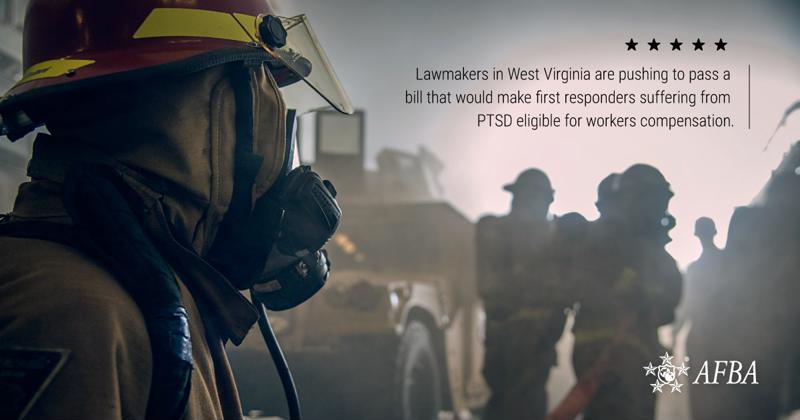
West Virginia legislators trying to provide workers comp to first responders with PTSD
Lawmakers in West Virginia are pushing to pass a bill that would make first responders suffering from PTSD eligible for workers compensation.
The issue is sadly relevant to Bob Coleman, a retired firefighter who lost his son, Chris, to suicide last year. At the time of Chris' death, he was following in his father's footsteps as a first responder with the Huntington Fire Department.
"We hope that no other family has to go what we went through," Coleman told WOWK. "A physical injury is compensatable but a mental injury should be, too. Us first responders…. firefighter, EMS, police… we see things that we can't unsee."
That sentiment was echoed by Ceredo Fire Chief Dave Caudill, who spoke with WVAH about the stressful situations first responders deal with constantly, and the corresponding mental toll.
"Everybody can't do first responder work because you see a lot of stuff that really you shouldn't have to see," Caudill told the local news outlet. "I've actually seen situations over the years where you have somebody who's never really dealt with that before get into that situation and… that's the end of their career."
Such occurrences could be higher than the average person might suspect: A study conducted by the University of Phoenix found that 85 percent of all first responders deal with some sort of mental illness at some point during their career.
Bills introduced in both House and Senate
The effort to better care for the mental wellbeing of first responders appears to have the support of many local lawmakers, as legislators in both the House and the Senate have introduced bills that would provide worker compensation to first responders diagnosed with PTSD.
"This is a life or death issue," Cabell County Delegate Chad Lovejoy, who sponsored the House's version of the bill, told WOWK. "We have men and women whose lives are being taken, sometimes at their own hands, sometimes by coping mechanics. This is not a small undertaking, but this could really save some lives."
According to the language of the legislation, a first responder would need to be diagnosed with PTSD by a licensed psychiatrist, and the traumatic incident must have occurred on the job.
Although a similar bill was unsuccessfully introduced last session, Lovejoy remains optimistic that this new attempt will have a different result.
"More people have come on board," Lovejoy said. "I think we have seen the trend here and more people recognize how big of a problem this actually is."

The deadliest and most destructive wildfire in California history, Camp Fire caused at least 86 civilian fatalities, injured 12 civilians and 5 firefighters and wiped out thousands of homes and other structures.
Yet while many tragic stories came out of the recent California wildfires, the natural disaster also served to highlight the truly inspiring level of commitment and heroism that our nation's first responders are capable of achieving.
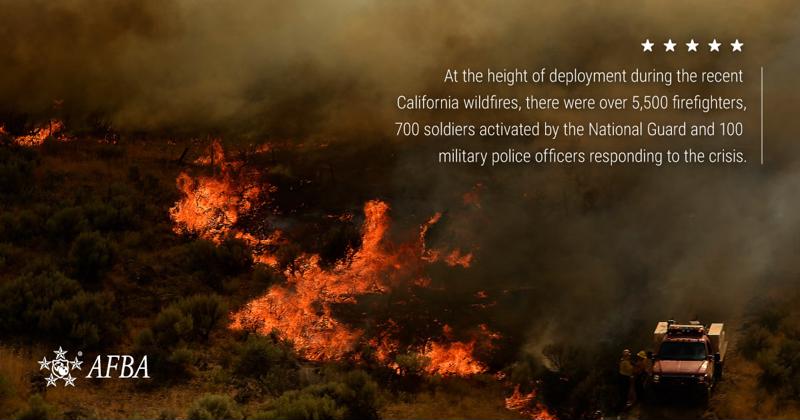
At the height of deployment, there were over 5,500 firefighters, along with 700 soldiers activated by the National Guard and 100 military police officers, many of whom went above and beyond the call of duty.
Many first responders help others despite own losses
Many of the first responders who worked to contain the blazes and assist those endangered or displaced by the disaster served in spite of the fact that they themselves had lost their homes in the fire.
According to CNN, four days after Camp Fire began, there were more than 50 firefighters working to contain the fire that had already destroyed their own homes. Similarly, more than 30 sheriff's deputies reported for duty even though they too had lost their homes, according to the Butte County Sheriff's Office.
Several tales of selflessness have emerged, including one of a first responder who engaged in a firefight that was just blocks away from his own home, unsure whether his house was itself burning, or whether his fiancée had gotten out.
Police Sergeant Jarrod Hughes at least had time to get his son and animals out of his home and to safety when the fire got closer, but immediately afterwards he got his uniform and patrol car and headed back to help.
"It's my community. It's where I grew up. It's something I absolutely had to do," Hughes explained to CNN affiliate KTXL. "There was no question about it. It was get my family to safety so I can get in and get back up there and help everybody else."
Leland Ratcliff, captain of the US Forest Service's Feather River Hotshot crew, had a similar rationale for choosing to evacuate neighbors when he still had keepsakes and other valuable items he could have been rescuing from his own home.
"We just do what we do because we like it. We like helping people," Ratcliff said when asked about the bravery of first responders. "The adrenaline rush and helping people. We like making a difference."
First responders still serving during the holidays
As one would expect, the first responders called to action during the California wildfires didn't take any time off for the holidays.
On the contrary, many were still serving on Thanksgiving, and in some cases, literally serving meals to those living in tents after Camp Fire destroyed their homes.
"To me this is almost like… I'd rather be here," firefighter Jim Irving told CBS. "You know it's helping other people and that's part of what Thanksgiving's about."
Irving had already spent weeks on the fire when he decided to provide meals to strangers instead of having dinner with his family.
On a holiday devoted to the concept of gratitude, the sacrifices of first responders like Irving did not go unappreciated by those who benefited.
"I thank every one of them as soon as I meet them," said wildfire victim Ron White, who lost his home and his father's home in Camp Fire. "I think that these are absolutely wonderful people. They deserve every consideration that they can get."
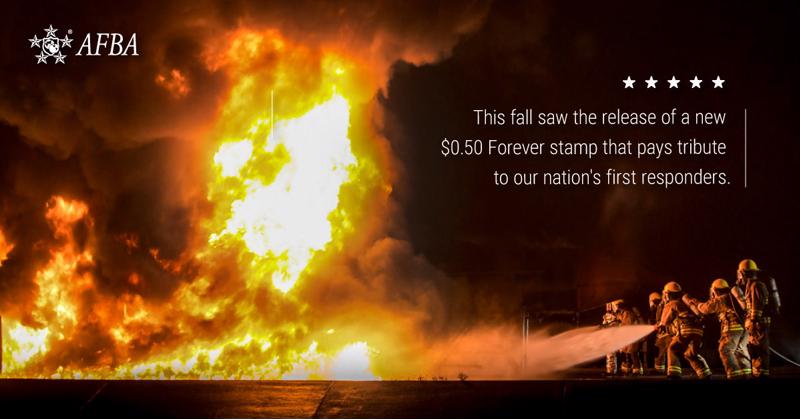
This fall saw the release of a new $0.50 Forever stamp that pays tribute to our nation's first responders.
According to the United States Postal Service, the new Honoring First Responders stamp is meant to recognize "the men and women who respond to critical situations with skill, dedication and uncommon bravery."
The stamp's design represents a collaboration between art director and designer Antonio Alcala, designer Ricky Altizer and artist Brian Stauffer. The latter has achieved worldwide recognition for his iconic magazine covers and other contributions to major magazine publications such as Time, The New York Times and The New Yorker.
The digital illustration Stauffer, Alcala and Altizer created for the stamp depicts three first responders forming a patriotic red-white-and-blue visual as they rush into a cloud of smoke that represents unknown danger. All three are shown in profile, facing right, looking towards the crisis to which they are hurrying to respond.
The first figure on the left is a red fireman carrying an ax, who is following behind a grayish-white EMT carrying an emergency bag, who is herself trailing a blue law-enforcement officer leading the way with a flashlight.
Special ceremony held for stamp's release
In September, a special first-day-of issue ceremony for the Honoring First Responders Forever stamp was held at the Aerial Fire Depot and Smokejumper Center in Missoula, Montana. The venue was chosen because of its status as the nation's largest training center for firefighters who combat wildfires by parachuting into remote areas of national forests.
"Our nation's first responders rush into life-threatening situations for the benefit of others," said Guy Cottrell, the Postal Inspection Service's Chief Postal Inspector and the dedicating official at the ceremony. "The Postal Service is pleased to honor their skill, dedication and unfailing bravery with this stamp."
The U.S. Postal Service says the intention of the stamp is to honor all types and varieties of first responders, ranging from those who serve small townships or are part of the federal government to those who volunteer and those who serve as a full-time job. The agency is also encouraging enthusiasts to use the hashtags #HonoringFirstResponders and #FirstRespondersStamps when discussing the stamp on social media.
If you would like a block of Honoring First Responders Forever stamps to use when sending out your holiday cards this season, you can purchase the stamps through the Postal Store at usps.com/shop, by phone at 800-STAMP24 (800-782-6724) or in-person at Post Office locations nationwide.
The Southeastern United States has recently been battered by two hurricanes in as many months, beginning with the damage done to the Carolinas in September by Hurricane Florence, and escalating with the devastation wrought in Florida and Georgia in early October by Hurricane Michael.
And while many sad stories have come out of these two storms, the aftermath has also had the effect of highlighting the exceptional work done by the thousands of first responders who’ve volunteered or been pressed into service during this tumultuous period.
Region weathers some of the worst storms in recent memory
Though classified as a Category 4 major hurricane during peak intensity in early September, Florence had dissipated to a Category 1 when it made landfall on Wrightsville Beach, North Carolina, on September 14. Despite the downgrade in severity, Florence still possessed strength sufficient to uproot trees and cause mass power outages throughout the Carolinas over the next several days. The storm also spawned widespread freshwater flooding, producing as much as 35 inches of rainfall in some areas. In all, a total of 53 deaths have been attributed to the storm.
Less than one month after Hurricane Florence had finished its slow yet destructive crawl across the Southeastern U.S., the region was suddenly hit by the historic Hurricane Michael. When the Category 4 hurricane made landfall near Mexico Beach, Florida, on October 10, it became the strongest storm on record in the Florida Panhandle. With maximum sustained winds of 155 mph – just 2 mph short of a Category 5 designation – Hurricane Michael also gained the dubious distinction of being the most intense landfalling U.S. hurricane in nearly 50 years. The impact was felt not just in Florida, but in Georgia, Virginia and parts of the Carolinas where wounds from Florence were still fresh.
The number of fatalities caused by Hurricane Michael stood at 36 some 10 days after landfall, though many more individuals remained missing and unaccounted for.
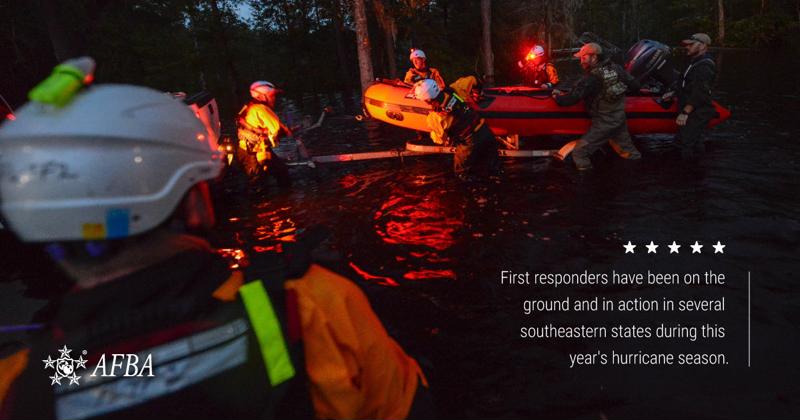 Hurricanes Florence and Michael led to many first responders stepping up to help their fellow citizens.
Area witnesses some of the best the country has to offer
While it is heartbreaking to reflect upon the loss of life caused by these two storms, the pair of tragedies has also produced many inspirational stories of first responders from both near and far descending upon the affected areas.
Just as the last of Hurricane Michael was finally dissipating on October 16, Forbes contributor Don Yaeger recalled sharing a flight with several dozen first responders on their way to his home state of Florida. When Yaeger asked a Sheriff’s Officer from Iowa if he was going there to help any family or friends living in the panhandle, the man answered, “I don’t know anyone there, I just know this is where I’m supposed to be.”
Fox 29 News Philadelphia reported on a Pennsylvania task force that spent 19 days assisting those in need in the wake of Hurricane Florence. Then, just days after the elite group of urban rescuers and paramedics had returned home to the Keystone State, the arrival of Hurricane Michael had them once again traveling over 1,000 miles south for another two-week deployment.
While the many first responders who came from miles away to lend a hand made truly admirable sacrifices, perhaps even more extraordinary were those who helped out despite being themselves victims.
CNN reports that in Panama City, Florida, one of the towns hit hardest by Michael, many local first responders were dealing with their own property damage and displaced families while still honoring their commitment to the wider community.
“While we’re here at work we’ve kind of got to put those emotions and things that are going on in our personal lives aside, because we have to worry about what’s going on here,” said Panama City Battalion Chief David Collier, whose own home was damaged in the storm. “We have to worry about our own personnel and the citizens we’re trying to protect.”
The full, lasting impact of Hurricanes Florence and Michael is still unknown, and will almost certainly bring more bad news further down the road. But we can all be grateful for the first responders who were on-hand to keep the immediate impact from being any worse.
To pay tribute to America’s first responders, the annual postseason college football game played at Dallas’ Cotton Bowl Stadium has been renamed the SERVPRO First Responder Bowl. The bowl game formerly known as the Heart of Dallas Bowl will be broadcast by ESPN under its new name at 12:30 p.m. C.T., on December 26, 2018.
Police officers, firefighters, EMS workers, search and rescue, dispatchers, federal agents and specialized military personnel will be among the first responders honored at the event, according to the Journal of Emergency Medical Services. Additionally, game tickets for first responders will be underwritten by corporate sponsors.
“This is an exciting change, and we are humbled by the fact that an actual bowl game has been named exclusively for the first responders of this country,” said Dallas Fire-Rescue Fire Chief David Coatney.
Sentiments echoed by the city law enforcement officials
“We are truly honored to have a bowl game here in Dallas named after the hard working men and women serving and protecting communities across this country,” said Dallas Police Chief U. Renee Hall. “It always feels great to be recognized, and I know our officers and firefighters are touched by this overwhelming show of support.”
The TicketCity Bowl was played at the Cotton Bowl Stadium in Dallas as a physical replacement for the Cotton Bowl, which left its namesake arena for nearby Arlington’s AT&T Stadium in 2010. The game was renamed the Heart of Dallas Bowl presented by PlainsCapital Bank for the 2013 and 2014 contests, and has been known as the Zaxby’s Heart of Dallas Bowl for the last four years.
The new title is the result of an agreement between ESPN Events and SERVPRO, a fire and water restoration company headquartered in Gallatin, Tennessee.
“We are proud to present the SERVPRO First Responder Bowl dedicated to honoring some of the hardest working men and women in our country” said SERVPRO CEO Sue Steen. “We recognize the dedication and selfless acts of our First Responders and are honored to help highlight and celebrate the commitment of these everyday heroes.”
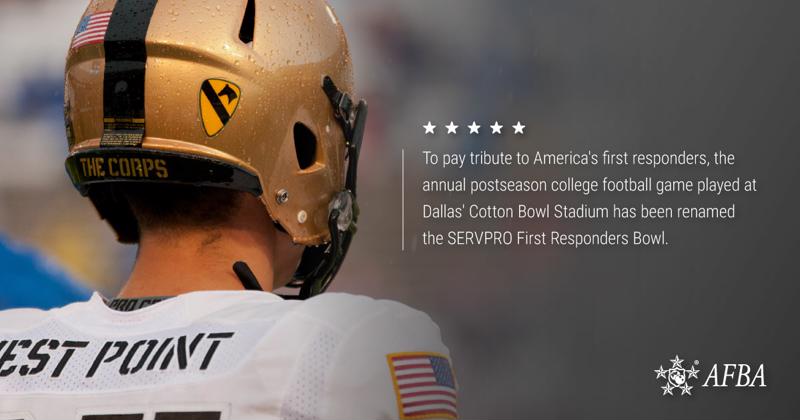 The SERVPRO First Responder Bowl will join the Lockheed Martin Armed Forces Bowl and the Military Bowl as the three college bowl games that pay tribute to our nation’s bravest men and women.
“We are truly grateful for all first responders’ sacrifice and service,” added Brant Ringler, Executive Director of the SERVPRO First Responder Bowl. “It is a tremendous privilege to honor these brave men and women who protect our communities 24/7/365.”
The 2018 SERVPRO First Responder Bowl will be the ninth edition of this bowl game, and yet another entry in the rich, 89-year history of college football at Cotton Bowl Stadium, which also famously hosts the annual State Fair Classic and Red River Showdown. The venue was also the longtime home of the Southern Methodist University Mustangs, and became known as “The House That Doak Built” in the 1940s, in reference to the large crowds drawn by SMU running back Doak Walker.
The SERVPRO First Responder Bowl will join the Lockheed Martin Armed Forces Bowl on December 22 and the Military Bowl Presented by Northrop Grumman on December 31 as the three college bowl games that pay tribute to our nation’s bravest men and women. Fans interested in attending the Armed Forces Bowl in person can purchase tickets now.