
Donating blood is a way to give back to your community that can make a massive difference in someone's life. According to the New York Times, U.S. blood banks are experiencing their biggest shortage in a decade. This is partially due to the fact that there are many misconceptions around donating blood in the midst of the COVID-19 pandemic. Today, we will address some of the biggest myths surrounding the topic.
Donating blood is still possible
Many people might think that donating blood is not even possible because of the restrictions around hospitals. While there is some truth to this, there are still ways to give. There are different organizations that offer available locations where you can schedule an appointment to donate. Here are some examples:
- Red Cross: The Red Cross has a website where you can enter your zip code and find a blood drive near you.
- Association for the Advancement of Blood & Biotherapies: This link will help you find a permanent location near where you live.
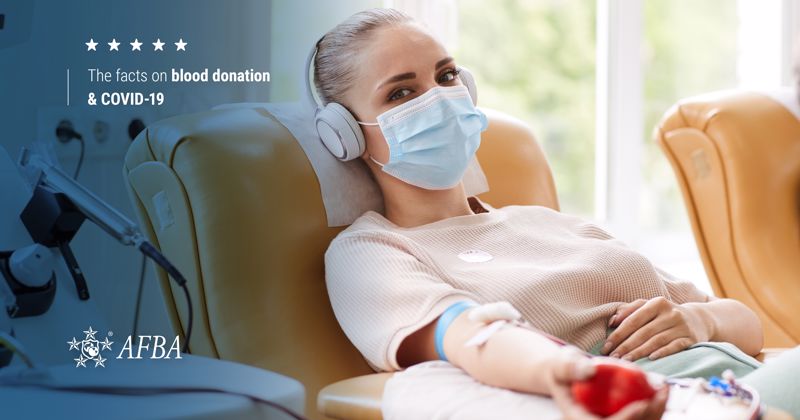
Passing the requirements is simple
Some people are nervous to donate because they are unsure if they qualify to do so. Here are the qualifications for whole blood donations according to Red Cross:
- Be at least 17 years old.
- Weigh at least 110 lbs.
- Not be on the following medications according to blood assurance.org
- Accutane.
- Antibiotics *Donors who are taking antibiotics are eligible to donate 24 hours after their last dose.
- Antiplatelet Medications.
- Blood thinners (such as Coumadin, Heparin, Lovenox, Warfarin).
- Bovine insulin.
- Hepatitis B Immune Globulin.
- Human-derived growth hormones.
- Find the full list on blood assurance.org.
Please note that all people who have taken a licensed vaccine, for COVID-19 or otherwise, are able to donate blood. The American Red Cross says that there is no deferral time for the COVID-19 vaccine manufactured by AstraZeneca, Janssen/J&J, Moderna, Novavax, or Pfizer.
Those who have had the virus can donate
A major myth that we want to bust today is that those who have had the virus can't donate their blood. This is absolutely not true. The FDA recommends that "individuals diagnosed with COVID-19 or who are suspected of having COVID-19, and who had symptomatic disease, refrain from donating blood for at least 10 days after complete resolution of symptoms."
This means that, even if you have had the virus, you are still eligible to donate blood to those who may need it as long as the donation happens at least 10 days after the symptoms have gone away. COVID-19 can not be transferred through a blood transfusion according to the FDA. Their website reported, on January 11, 2022, that "there have been no reported cases of transfusion-transmitted coronavirus, including SARS-CoV-2, worldwide."
Taking precautionary measures is important
While there are important precautionary measures to take in order to prevent COVID-19, blood donation is still necessary and possible. Here are some of the most important things that the Stanford
Donation Center is doing to maintain a safe blood donation environment, for example:
- Appointments are necessary.
- Equipment is sterilized, and most is single-use only.
- Hand sanitizers are placed throughout donation sites.
- Increased spacing between donors.
- Team members wear face masks while interacting with donors during the entire donation process.
- Team members at collection sites are fully vaccinated against COVID-19.
Because blood donations had previously relied heavily on mobile drives on college campuses and high schools, the pandemic has severely impacted donation levels. Find a location near you and learn more about donating today.
It's that time of year again! It's the season where you brainstorm the best holiday presents for the loved ones on your list, which can be tricky. You want to get them something they will love from a place that you don't mind supporting. This holiday season, consider buying something special from a veteran-run business. Not only are you sure to find something unique, but you will also be giving your money to a company that is owned by an American veteran. Here is our 2021 veteran-owned holiday shopping guide.
Black Rifle Coffee Company
This veteran-owned company is very popular and well known for its delicious blends of coffee. You can also purchase apparel, coffee bundles, mugs, cups, tumblers and so much more. They roast their coffee beans five days a week in their Manchester, TN and Salt Lake City, UT locations. When you buy one of Black Rifle Coffee Company's products, you support the veteran founders and contribute to their philanthropic endeavors. According to their website, they focus on, "serving this great country and are committed to supporting veterans, law enforcement, and first responders."
R. Riveter
This company is owned by the wives of two veterans, so when you shop on their website, you are supporting a veteran family. R. Riveter is co-owned by military spouses Lisa Bradley and Cameron Cruse and there are plenty of well-designed, gorgeous bags and purses to choose from. According to the website, the different "parts and pieces (of the bags) are made remotely across the country to provide military spouses with mobile, flexible income opportunities."
R. Riveter supports active-duty and veteran families so you know that your hard-earned money is going to a good cause. Not only that, but you will receive the perfect gift for that patriotic man or woman on your list. Be sure to check out their website for their 12 Days of Holideals for a bargain!
Stubble + 'Stache
The founder and owner Nick Karnaze served over seven years as an officer in the United States Marine Corps and is now a veteran. Nick created this beard and skincare company in remembrance of the combat death of his good friend and fellow special operations Marine Justin Hansen. Stubble + 'Stache has superior formulas and special ingredients as well as many different product options for the bearded man in your life.
Bottle Breacher
Former Navy SEAL, Eli Crane created Bottle Breacher to provide a one-stop shop for anyone shopping for an American patriot. The online store offers hand-crafted, "personalized man-gifts" but they also have a great selection of holiday presents and stocking stuffers for every patriotic person on your gift list. Their hero product is a .50 caliber shell that has been crafted into a bottle opener. Bottle Breacher has the option to add customized engraving and personalized gift wrapping.
These are all great options for a potential holiday gift and would support American veterans in their post-service entrepreneurial efforts. If you are a veteran or someone you know is, be sure to urge them to check out the Small Business Association funding for veteran-owned small businesses. This year, consider buying from a veteran and offer your patronage as a token of appreciation for their sacrifices.
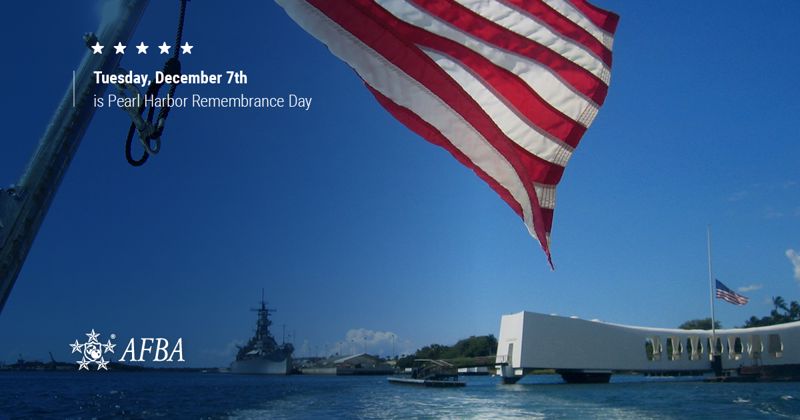
National Pearl Harbor Remembrance Day is on December 7th and was created to honor the men and women who lost their lives on the same day in 1941 during the attacks on Pearl Harbor, Hawaii. Each year, veterans, families, and American citizens gather to commemorate the 2,403 service members who were killed in the Japanese attack. Let's take a look back and learn a little more about why this day is so important.
Leading up to December 7
The Imperial Japanese Navy Air Service conducted a surprise strike that cost thousands of Americans their lives. Because most of the U.S. battleships in the Pacific at the time were located in the same Pearl Harbor port, they were a perfect target for the Japanese.
That fateful Sunday morning would "live in infamy" as stated by President Franklin D. Roosevelt. The radar station operators spotted a few unidentified planes that turned out to be the Japanese bombers.
According to the Navy ship deck log's running record, the attacks began around 7:55 AM and the main engines on the USS Arizona and the USS Oklahoma needed emergency repairs because they were among the first to be hit. From there, the USS Maryland, the USS California, the USS Solace and many other ships which were hit had logs that contributed to our current knowledge of the tragic day. With the chaos the day brought, the sequence of events is not perfectly known.
Because the attack was a surprise, there was an element of confusion at play that contributed to the response. The attack ended up lasting two hours and much of the U.S. Pacific Fleet was destroyed. This included 8 battleships, 3 cruisers, and 188 airplanes that were ruined and many lives lost. During the attack, despite the chaos and confusion, the U.S. military fought with extreme bravery to save their fellow men and salvage the damaged ships. Following the Japanese surprise, the United States declared war on Japan and was fully engaged in World War ll.
According to the Navy's military history website, fifteen U.S. Navy veterans were awarded the Medal of Honor, ten of whom sacrificed their lives in the Pearl Harbor attacks.
A day in remembrance
On August 23, 1994, congress created Pearl Harbor Remembrance Day and designated December 7th of every year as a day to honor the tragic losses of the attack in Oahu, Hawaii. Nationally sanctioned events occur every year in remembrance. The final event is a commemoration ceremony held at the Pearl Harbor National Memorial.
This year marks the 80th anniversary of the terrible and tragic attack on Pearl Harbor. The commemoration ceremony will be held at Joint Base Pearl Harbor-Hickam. This year's theme is Valor, Sacrifice, and Peace and will work to educate future generations not only about the attack but about the subsequent war. Aside from the main ceremony, there are different events leading up to December 7th that include ceremonies on the USS Nevada, USS Utah, and USS Oklahoma, which are open to the public.
This year, take the time to consider the implications of the attacks on Pearl Harbor and the over 2,000 lives lost that day or even attend the virtual panels that are available.
Since the start of the COVID-19 pandemic, scientists and researchers were hard at work trying to develop a vaccine for the virus. On December 11, 2020, the Food and Drug Administration (FDA) enacted the first emergency use authorization (EUA) for the administration of a vaccine to prevent COVID-19. The Pfizer-BioNTech COVID-19 Vaccine was the first to find approval, with Moderna not far behind on December 18, 2020. The single-dose Johnson & Johnson vaccine was approved on February 27, 2021.
Since then, 55.67% of Americans have received full vaccination against the COVID-19 virus (as of October 2021). However, some citizens still have questions about the safety and efficacy of the vaccine. Let's take a look at what it took to create a safe and effective tool in the battle against the deadly virus, as well as the FDA's approval process.
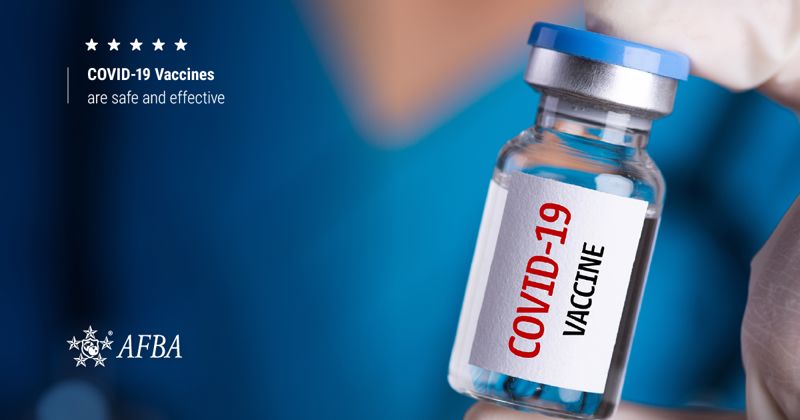
Preparation
Despite the fact that no one could have predicted the pervasive and world-altering COVID-19 pandemic, previous deadly coronavirus diseases like Middle East Respiratory Syndrome (MERS) and Severe Acute Respiratory Syndrome (SARS) laid the groundwork for the newest flu vaccines. In fact, scientists have been studying virology and respiratory communicable diseases for decades. According to the American Medical Association (AMA), prior research and vaccine developments aided in the speedy development of COVID-19 vaccines.
Because of the vaccinations that were created to aid in previous outbreaks, scientists were able to use the information to get a jump-start on the COVID-19 vaccine. Since the first SARS outbreak in 2003, vaccine researchers have been hard at work developing the most effective ways to prevent dangerous respiratory viruses. So while the development of the COVID-19 vaccination may have seemed alarmingly quick to the general public, it had actually been in the making for over a decade. Here is the typical, heavily regulated FDA process for developing the vaccine:
- Research and discovery
- Pre-clinical
- Phase 1 trial
- Phase 2 trial
- Phase 3 trial
- License and application to the FDA
The effectiveness of the COVID-19 vaccine
The FDA has strict guidelines for approving any kind of medication, especially vaccinations. Even when it comes to emergency approval, there are continual and ongoing reevaluations as the FDA notes its effectiveness in the real world. Here are some factors that the FDA looks for when evaluating "real-world vaccine effectiveness":
- Population host factors: This is how the vaccine impacts people who may have not been included in the trials.
- Virus factors: Potential variants and changes to the original virus.
- Programmatic factors: How well the vaccines are administered and whether the population is adhering to guidelines.
So how effective is the COVID-19 vaccine? The Centers for Disease Control (CDC) reports that those who took both doses saw a reduction in their risk of COVID-19, including severe illness by 90% or more.
How safe is the COVID-19 vaccine?
Because the new vaccine has been developed using research that has been tried, tested and successful for decades, the vaccines are extremely safe. According to the CDC, the COVID-19 vaccine has undergone some of the most rigorous and strict testings in the Center's history. Even still, they undergo intensive monitoring to ensure that the vaccines remain safe and effective.
Millions of people have been safely vaccinated and we are already seeing positive results in communities that have been responsive. According to the U.S. Department of Health & Human Services, vaccinations have led to the prevention of "265,000 COVID-19 infections, 107,000 hospitalizations, and 39,000 deaths among Medicare beneficiaries between January and May 2021."
Both the CDC and the FDA have made research and testing information public in an attempt to dispel any potential vaccine hesitancy. Even if you have already had COVID-19, vaccinations are necessary to help build protection and boost herd immunity.
Worried about getting sick after vaccination? Fear not. According to the CDC, "none of the COVID-19 vaccines contain the live virus that causes COVID-19 so a COVID-19 vaccine cannot make you sick with COVID-19." However, consult your physician to find out more about the possible side effects and your vulnerability level.
To learn more about the safety and efficacy of the COVID-19 vaccine, visit the CDC or the FDA's websites.
As the COVID-19 pandemic continues to negatively impact the U.S., the Pentagon is taking steps to keep its employees safe and to set a good example for the rest of the country.
The facility updated its mask guidelines for the facility in the month of July, and mask mandates were added not long after. The Pentagon changed its rules in order to comply with the CDC and direction from the DoD.
How the mask mandate has changed
According to the DoD, the Pentagon’s Director of Administration & Management has made it mandatory to “wear a mask in an indoor setting in installations and other facilities owned, leased or otherwise controlled by DoD in the Pentagon Reservation.” All service members, federal employees, onsite contractor employees and visitors must follow these guidelines, even if they are fully vaccinated.
The original mask mandate and all subsequent updates issued by Deputy Pentagon Press Secretary Jamal Brown have been published in a document called the “Updated Mask Guidance for the Pentagon Reservation.” The goal of the guidelines is to protect government employees and to set a good example for the rest of the nation, through the CDC suggested guidance.
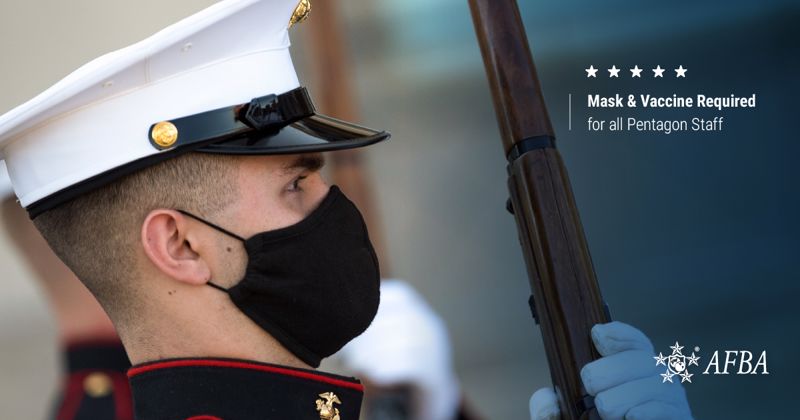 The appearance of U.S. Department of Defense (DoD) visual information does not imply or constitute DoD endorsement.
The CDC guidelines
The Pentagon’s updated mask requirements came only a day after the CDC changed and updated its mask suggestions and mandates. The mandate requires people in “substantial or high transmission” areas to wear a mask, and that includes the Pentagon and several military bases. The new mandates came as a result of the pervasive Delta variant. Here are some of the most notable changes that the updated CDC mandate made that the Pentagon followed:
- Mask suggested for even those who are vaccinated.
- Masks recommended, regardless of transmission level.
- Testing and isolation suggested for those before and after travel.
Pentagon aims to protect employees with new safety guidelines
On August 23, 2021 Defense Secretary Lloyd Austin made it mandatory for all active service members and Pentagon employees to be vaccinated as well. This came on the heels of the FDA approval of the Pfizer-BioNTech vaccine.
With the combination of the vaccination and updated mask mandates, the DoD and the Pentagon are taking steps to stop the spread of coronavirus and its variants. There is no excuse for visitors, as the memorandum says, “Personnel coming on to the Pentagon Reservation or other facilities who do not have a mask may be provided one by DoD.”
As the world continues its struggle against the COVID-19 virus, the U.S. DoD will lead the battle against the pandemic on its bases and facilities.
The United States has participated in every Olympic Games since 1896, but 2021 marked the first time a U.S. service member won a gold medal at any Olympic event. 1st Lt. Amber English made history on Monday, July, 26, 2021 at the 2020 Tokyo Olympic Games by winning first place in the shotgun skeet event. Not only did she win a gold medal, she set an Olympic record by hitting 56 of 60 targets.
The US Army in the Tokyo Olympics
English is not the only service member to make the trek to Tokyo to represent the U.S. and its military in the Olympic games. The U.S. military attracts some of the country’s most talented individuals, so it is common for these individuals to find themselves qualifying for the Olympics.
In fact, the Army has a World Class Athlete Program (WCAP) that helps train high-level athletes, known as Soldier-Athletes, for international competitions with the ultimate goal of qualifying for the Olympic and Paralympic games. The WCAP has produced 446 soldiers who have participated in the games, earning 111 medals since 1948.
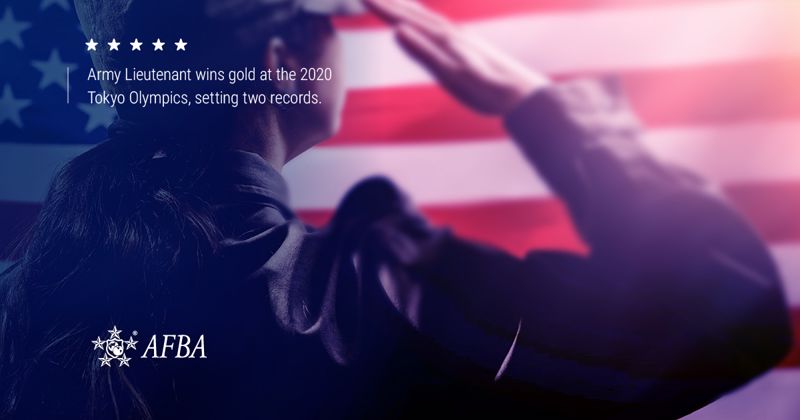 Army Lieutenant wins gold at the 2020 Tokyo Olympics, setting two records.
In the 2020 Olympic games, WCAP trained and sent 9 Soldier-Athletes to Tokyo to represent the U.S. The participants include:
- 1LT Amber English: Shooting – Skeet
- SSG Naomi Graham: Boxing – Middleweight
- SSG Nickolaus Mowrer: Shooting – 25m Air Pistol & 50m 3-Position Rifle
- SSG Sandra Uptagrafft: Shooting – 25m Air Pistol & 25m Sport Pistol
- SGT Amro Egleziry: Modern Pentathlon – Individual Event
- SGT Ildar Hafizov: Wrestling – Greco-Roman
- SGT Samantha Schultz: Modern Pentathlon – Individual Event
- SPC Alejandro Sancho: Wrestling – Greco-Roman
- SPC Bernard Keter: Track – 3,000m Steeplechase
The road to gold
After English brought home the gold, Defense Secretary Lloyd Austin wrote a congratulatory tweet to her that read, “Your country is extremely proud of you today, and I’m so glad you’re representing us.”
English’s journey to setting a record and making history as the first U.S. service member to take the No. 1 spot was not an easy one. After barely missing out on qualifying for the 2016 Olympics on her own, she worked diligently to make the 2020 shotgun team. She joined the Army in 2017 and was able to utilize the military’s training resources. In 2018, English took bronze in the World Championships and continued to prove herself a skilled marksman.
Shooting runs deep in her veins, as English comes from a family of successful shotgun competitors. Both sides of her family participated in shooting events. Her father and her uncle made it to the Olympics in the running shotgun event, while her mother and aunt shot rifles in college. Her father’s passing in 2016 served as inspiration for her to join the Army.
In a 2020 article, English said, “I knew I had to completely change everything I was doing in my life – I joined the Army, moved (from Colorado Springs, Colorado) down to Fort Benning (Georgia) and surrounded myself with a seriously winning atmosphere, so it paid off.”
The 2020 Olympic games are anything but usual, but English was able to prove her marksmanship regardless of the circumstances.
The Fourth of July is arguably the most patriotic and exciting of the summer holidays. Americans look forward to the extended weekend, cookouts, and an evening of beautiful fireworks. The root of the July Fourth holiday lies in the passing of the Declaration of Independence by the Continental Congress in 1776. The original 13 colonies declared their autonomy from Great Britain and created the earliest version of the United States of America, which is certainly worth commemorating.
A brief history of America
Every proud American has a general idea why the fourth day of July is so special in U.S. history, but the ins and outs of our independence is not as cut and dry as you may think. In fact, this time in American history is so nuanced that there are historians who spend their entire careers studying the Declaration of Independence and the Revolutionary War. The average person does not need to have that level of dedication, but it may be worth taking the time to refresh your Independence Day knowledge.
A first draft
A year after the Revolutionary War began, the Continental Congress was receiving increased pressure to vote on the issue of independence. Initially the war had begun because the colonies were fighting for their rights and had no intention of declaring independence, but there was growing support for complete separation a year later. Because of this, a committee focused on the issue was formed in order to draft a formal statement. The committee was made up of Thomas Jefferson, John Adams, Roger Sherman, Robert R. Livingston, and Benjamin Franklin.
Signing the declaration
After about a month of working on the document, Congress formally declared independence on July 2 via a democratic vote. John Adams even noted that the second day in July would go down in American history. However, July Fourth became the official date of ratification on the declaration, and the signing wasn’t completed until August 2. In the end, 52 people signed the Declaration of Independence.
244 years of celebrating
While John Adams was two days off, he was correct when he said Independence Day would be marked with fireworks and celebrations annually. Several days after the first Independence Day, public readings were held in Philadelphia’s Independence Square to the sound of church bells and music.
The following year at the Independence Day celebration, Congress adjourned in Philadelphia and marked the occasion with fireworks, bells, and music, just like those public readings in 1776.
At first, the tradition was mostly recognized in Philadelphia, but soon other towns and cities took up celebrating the holiday. On September 3, 1783, the Revolutionary War ended and America became its own country when the Treaty of Paris was signed by representatives of King George III.
In 1870, Congress officially passed a law making Independence Day a national holiday. At that time, Americans were spread across the continent, but even pioneers on the western frontier managed to gather together to celebrate the new federal holiday. In 1938, Congress made it a paid holiday for federal employees, reaffirming the importance of the day in American history.
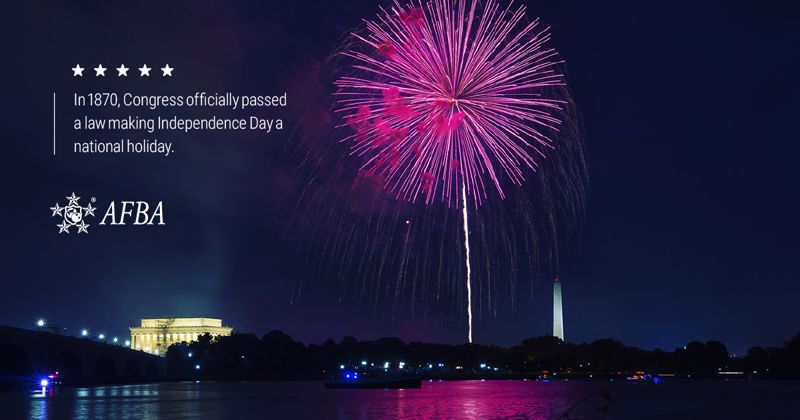 “The appearance of U.S. Department of Defense (DoD) visual information does not imply or constitute DoD endorsement.”
Today, Americans mark the patriotic holiday by with red, white, and blue decorations, watching parades, and celebrating the freedoms afforded us so many years ago. Fireworks are still a huge part of the occasion, with 33% of people plan on marking the day with beautiful pyrotechnics.
This year, while you celebrate with family and friends, be sure to take a moment to reflect on everything that has happened in order to allow us the American freedoms we enjoy today.
Each year in April, families, communities and people of all stripes come together to celebrate military children and applaud them for surmounting unique challenges.
The Department of Defense Education Activity (DODEA) commemorates this month with its "Purple Up!" campaign, in which people wear and display the color purple to show support for the children of soldiers. The military chose this color with the reasoning that purple combines each branch's colors into one, since the Air Force, Navy and Coast Guard all use shades of blue, the Army uses green and the Marines use red.
Month of the Military Child: A backstory
Established by former Defense Secretary Caspar Weinberger in 1986, the Month of the Military Child has since become an annual tradition for military families deployed worldwide. More than 1.7 million total force-dependent children across the globe face obstacles unlike most others their age. Wearing purple helps let them know you care.
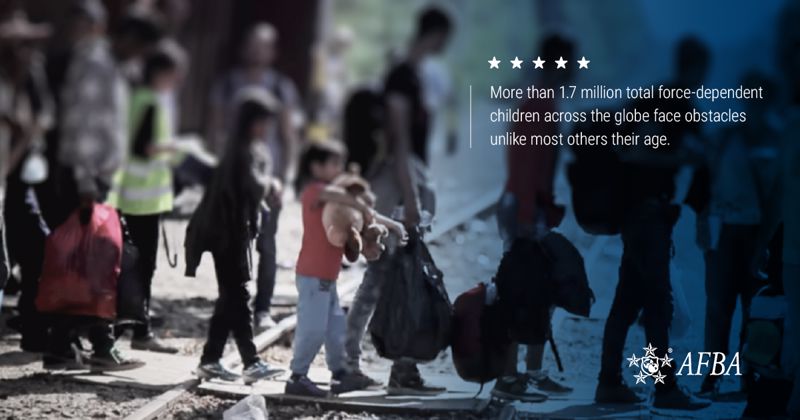
While the entire month of April is set aside to celebrate children of soldiers, the military also designates a single day during the month as "Purple Up! For Military Kids" Day. This typically falls halfway through the month, at or around April 15 each year.
Many military-related private organizations put a special emphasis on the programs they administer and provide downloadable toolkits and other resources for military children and families.
Additionally, participating Exchange restaurants worldwide will often offer free treats or other specials for any child who wears purple during the month.
How you can Purple Up! this April
Although schools and workplaces are not closed for Purple Up! Day, there are still plenty of creative ways to observe this important occasion. Many military bases and communities celebrate with special events, such as contests, parades, fairs and seminars all centered around the central message of supporting military children.
In addition to wearing purple throughout the month, anyone not currently stationed at a military base can consider trying some of these activities to observe the Month of the Military Child:
- Work with local schools, governments, businesses and organizations to raise awareness of this observance.
- Spread the word by using the #purpleup hashtag on social media or putting up purple flyers in community centers.
- Write a letter to your local newspaper that recognizes and celebrates military children.
- Create an award, or use one created by Blue Star Families, to let a military child know that they're awesome.
- Print out and pass around Purple Up! labels from the Military Child Education Coalition.
If you're already involved with the local schools and organizations, consider holding an award ceremony for military children. Be sure to include recognition of military children during morning announcements and have members or students tie purple ribbons around trees outside.
For more ways to celebrate our country's youngest heroes, check out these 50 additional ideas from the Military Child Education Coalition.
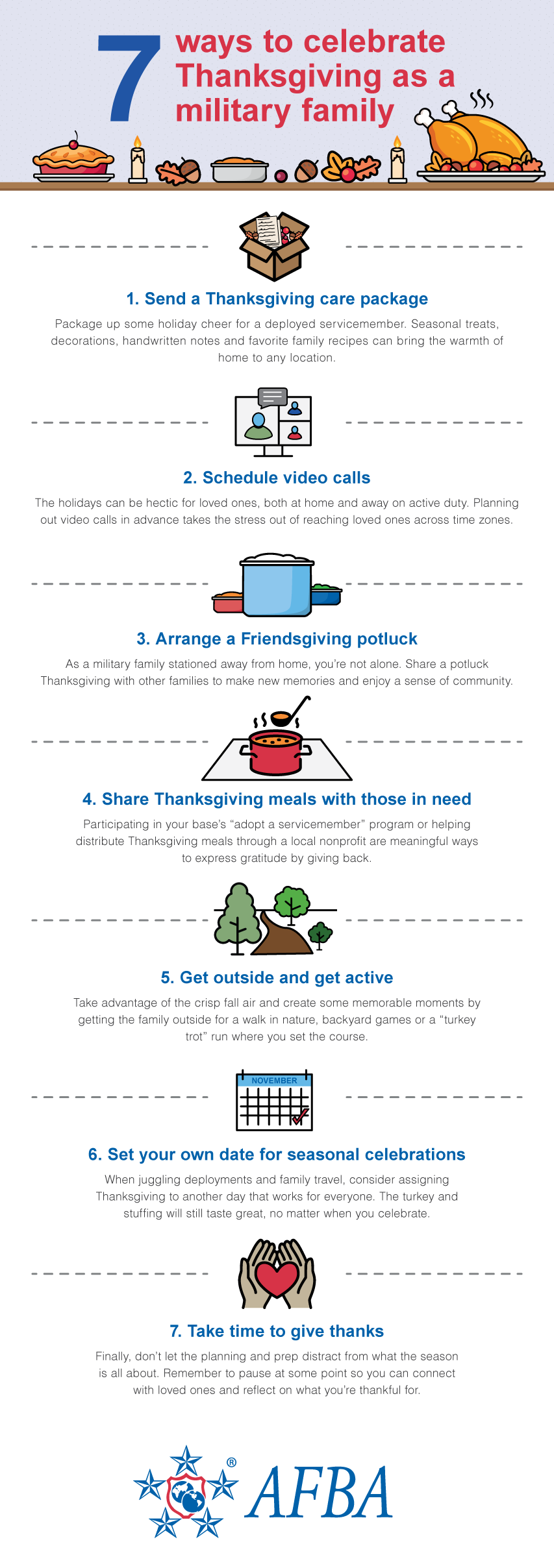
Happy Thanksgiving! Check out our tips for enjoying the holiday with your military family.
7 Ways to Celebrate Thanksgiving as a Military Family