
Tens of millions of Americans have smartphones these days, and many use them with increasing regularity to do everything from checking their email to making online purchases. However, what people often don't think about when they use these devices is the ways in which they may be at risk for hacking attacks, or worse. As such, it's often a good idea for smartphone users to acquaint themselves with some standard security measures to better protect their personal and even financial information.
The most important thing people can do when trying to secure a mobile device is to have a lock screen passcode, according to a report from the security firm Malwarebytes Labs. This is because, if a person's phone is lost or stolen, and they aren't protecting their screens with a complex passcode of some kind, all the information they have on their phones – contact information for friends and family, personal data, financial apps, etc. – will all be at a stranger's fingertips. Most crooks would be unable to get past even this most basic form of security.
This same precaution can also be true of individual apps, because many allow users to set another password within them, the report said. That, too, just provides an additional layer of protection.
Moving beyond passwords
However, sometimes even that might not be enough to make sure sensitive data is protected on mobile devices, the report said. In addition, it can be wise for consumers to download antivirus apps that further protect a phone in the same way their desktop brothers protect computers. The good news here is that many of these apps are free, and provide additional security against everything from downloaded malware apps to hacking attempts.
Further, there are some non-standard websites that allow users to download mobile apps, and they should be avoided at all costs, the report said. Apple does a good job of vetting all apps that get onto its App Store, while Android phones have less (although some) protection in this regard. Certainly, any app downloaded from a relatively unknown site poses a security threat, sometimes even if antivirus apps are also installed.
Bad browsing habits
Finally, it's also important for consumers to keep in mind that any information they enter on a phone – PIN codes, passwords, financial data, etc. – can be intercepted if they're connected to a WiFi network. However, as long as they're only using cellular data, they are likely to be perfectly safe. That's because their phones have a unique one-to-one connection with the cell network that is overridden by connecting to WiFi. For this reason, whenever a person attempts to enter sensitive information, they should only do so when off WiFi, and if that site uses HTTPS protocols that provide an extra layer of security.
By following these simple steps, and using a bit of common sense about not revealing passwords or other sensitive information in most circumstances, consumers will be able to significantly shield themselves from mobile security threats of all stripes.
Tens of millions of Americans use social media sites on a daily basis, but experts say that these people often don't do enough to protect themselves when doing so. As a consequence, they may leave themselves open to a myriad of problems that can arise, including identity theft, if they share too much information. For this reason, it's often a good idea for people to revisit the best practices for using social media in a way that allows them to have as much fun as they want while also protecting themselves.
The biggest step in this regard is to make sure privacy standards for each of a person's accounts are as hefty as their social networks will allow, according to a report from Drexel University's College of Computing and Informatics. That means keeping Twitter accounts set to private, and limiting the amount of information being shared on Facebook to "friends only." Otherwise, just about anyone may be able to find personally identifying information about a person, their whereabouts, or even details of their financial lives.
"While social media use is safe for the most part, sharing personal information online does come with an element of risk," said Denise Agosto, a professor at the Drexel University College of Computer and Informatics.
Be more careful
In addition, many users would simply be wise to not even share personal information when they do trust people, the report said. This isn't to say those people can't be trusted, but their accounts can be hacked or at least accessed by others, which in turn may give those third parties the ability to view plenty of profiles. Consequently, not publishing data such as email addresses, phone numbers, home addresses, birthdays, and so on is often a good idea regardless of privacy settings.
In addition, those who want to connect with friends but don't want to be found quite so easily often set up accounts under assumed names, or simply use their middle names as their last names, just to make themselves a little more difficult to track down, the report said. For instance, many teachers do this so their students can't look them up online.

Just be prudent
Furthermore, many people find themselves guilty of "over-sharing" on social media, which basically means that even if they're protecting a lot of personal information, they might still post status updates and the like that reveal data they may not want out there, the report said. This can be especially true when embarrassing information gets posted as a result of indiscretion. A good general rule is, "If you wouldn't tell this to a stranger, you shouldn't share it online."
Finally, basic account security standards, such as having a long, complex password – and changing that login information on a regular basis – also apply on social media. All this can go a long way toward not only protecting online information, but also avoiding real-world headaches.
The Navarre Press reported that May has been recognized as Military Appreciation Month since Congress first designated it as such back in 1999, and has been successful in bringing communities together in the years since. The source pointed out that there have been countless examples of extreme heroics and selflessness among the nearly 1.5 million individuals who currently serve in the armed forces, while communities should take this opportunity to recognize the veterans in their local areas.
Events have been hosted across the nation throughout the past two weeks, and more are certainly to follow in the remaining days of Military Appreciation Month. From governors and state senators passing new legislation to assist veterans to relatively simple recognition programs and events, civilians will have a wealth of opportunities to support veterans and active duty service members throughout the coming months.
South Dakota's big statement
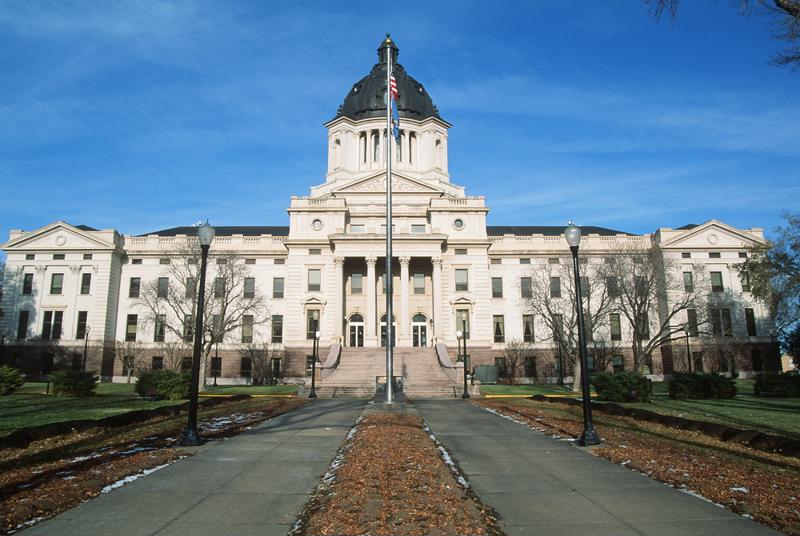
The Rapid City Journal recently reported that South Dakota Governor Dennis Daugaard spoke to the reasons behind May acting as Military Appreciation Month across the nation, and urged the state's residents to honor those who have or are serving in the armed forces. The source pointed out that Armed Forces Day and Memorial Day both fall within the days of May, and act as an even greater chance for communities to rally around their veterans.
"The vigilance of the members of the Armed Forces has been instrumental to the preservation of freedom, security and prosperity enjoyed by the people of this great nation," Governor Daugaard stated in his proclamation last week, according to the news provider. "The success of the Armed Forces depends on the dedicated service of its members and their families."
High-ranking politicians in Washington, D.C., Utah and elsewhere have put forth similar proclamations to kick off and recognize Military Appreciation Month. Another well-known figure took to writing a blog post regarding his backing of this month's appreciation events.
A message from Chuck
Chuck Norris recently published an opinion piece in WND regarding some of the reasons he believes May has been designated to honor veterans and service members. The renowned action-movie actor noted that he served as an Airman First Class in the U.S. Air Force, and that his experiences while on active duty shaped many of his life's core missions and goals.
Norris also took the opportunity to point out the increasing division between military and civilian life, and the need to bring the groups a bit closer together in the near future. He argued that the tiny percentage of the population that serves now – 0.5 percent – compared to the 12 percent who did for World War II might be one of the sources of misunderstandings and division.
Communities that pull together behind their veterans will be making a big difference, as service members act as champions for their neighbors and fellow Americans throughout and following their time on active duty. May is the perfect month to increase these types of efforts.
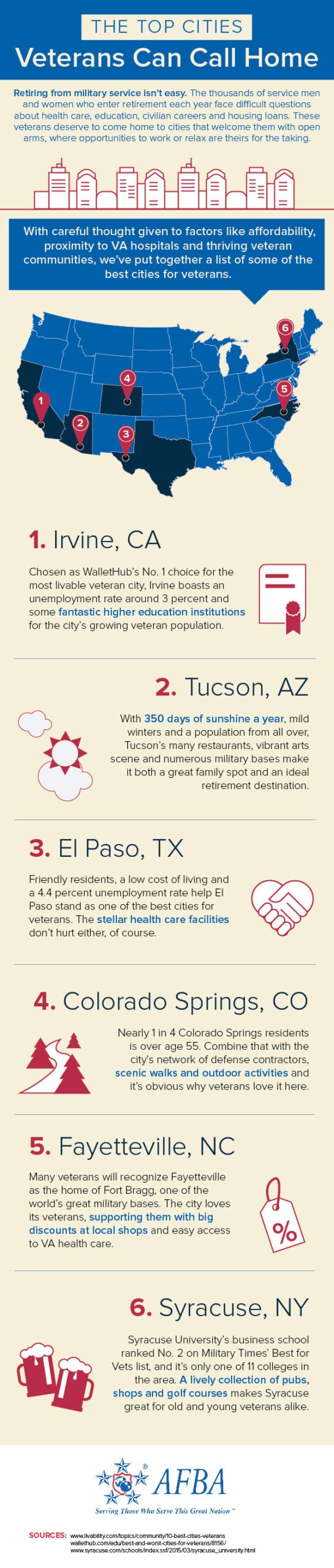
There are few life changes bigger than that involved in transitioning from military service to the civilian world. The thousands of servicemen and women who do it each year know it isn’t easy to trade the uniform for a dress shirt and tie, or base housing for a private home or apartment.
Questions over health care, education, employment and much more have to be answered, preferably a few months before actually being discharged. One way to make the transition to a life after service easier is if servicemembers know they’re coming home to cities that welcome them with open arms, where opportunities to work and relax are theirs for the taking.
What would such cities look like? Which factors would determine their suitability for veterans? Affordability is obviously a key concern. Housing, including single family homes, condos and apartments, would have to be within an achievable price range, with guarantees that prices wouldn’t skyrocket in the next few years. That rules out some major cities but opens plenty of other options nationwide.
Proximity to Department of Veterans Affairs hospitals and care providers is obviously essential. Veterans need to have immediate access to medical support, both of the physical and emotional kind, so that rules out deep, rural areas and urban areas with only limited facilities.
Here’s another factor to consider – a sense of community. One of the great benefits of military service is the camaraderie and fellowship of being with like-minded men and women united in a patriotic effort. Many veterans miss that sense of togetherness when they leave, but they don’t have to. Veterans communities exist all over the country, and they’re often just as important to the happiness and well-being of retired servicemembers as a quality hospital or bright employment outlook.
Considering these requirements and many others, here’s a list of some of the best cities for veterans.
French representatives, on March 10, honored three Boston-area veterans for their service during World War II, reported The Boston Globe. Former U.S. Army personnel James Baker, Leo De Filippo and Michael Maglio were nominated to the Legion of Honor, receiving the rank of chevalier.
"Their struggle and efforts occurred at an extremely hard and dark time in both French and European history," Valéry Freland, the Consul General of France in Boston, said soon after presenting the awards. "By celebrating their courage this morning, both the French Republic and the people of France remember the American soldiers who helped them recover their freedom, their pride, and their honor."
Baker, 91, worked as a military truck driver in southern France during the conflict. De Filippo, 96, helped operate a power plant and Maglio, 95, was a cook.
The ceremony took place at the Chelsea Soldiers Home in Chelsea, Massachusetts.
"For me, the real heroes are in France," Maglio said in an interview with a local ABC affiliate. "My friends, my brother friends, I will always remember them."
The Legion of Honor is France's highest award, reported USA Today. Famed military leader Napoléon Bonaparte established the honor in 1802. More than 10,000 American artists, servicemembers and thinkers have received the award over the years. A large portion of these recipients were World War II veterans who helped liberate France from Nazi Germany.
Many feel the award strengthens the relationship between the U.S. and France.
"It shows the enormous gratitude of the French Republic to Americans," Lawrence Kritzman, a professor of comparative literature at Dartmouth College and Legion of Honor recipient, told the publication. "There are times in the media of misrepresentation of the relationship and even in the greatest of relationships there are moments of disappointment, but it doesn't mean that the sense of recognition and gratitude is not there."
On Feb. 25, over 100 community members attended a funeral for two Louisiana veterans, reported the The Times-Picayune. Neither man had living relatives.
Claudie Ray Shiflett enlisted in the Army in 1959 at the age of 19. According to friends, he was stationed in Europe for two years and during that time worked as a military electrician. Shiflett was honorably discharged in 1965. He died Dec. 15. Shiflett was 74.
John Henry Huber joined the Army in 1964 at the age of 17. Huber served in the Vietnam War and was honorably discharged in 1969. He died Nov. 28. Huber was 69.
Both men lived out their post-service years in the New Orleans suburbs of Slidell and Metairie, respectively.
Friends, community members and local veterans honored the men during a brief service at Southeast Louisiana Veterans Cemetery in Slidell, reported The New Orleans Advocate. Members from a number of nearby veterans groups also showed up to pay their respects. The Women Veterans of Louisiana and the Marine Corps League both sent representatives. Cemetery employees organized the service and collaborated with St. Tammany Parish President's Veterans and Military Affairs Advisory Council to publicize it via social media.
"The turnout was unbelievable," Stephen Austin, a lawyer and one of Huber's friends, told The Times-Picayune. "This is far more than I expected. I think he would have been very pleased."
Members of the Patriot Guard Riders, a local veterans motorcycle club, led the funeral procession. Ex-servicemembers commemorated the men with a three-volley rifle salute while a lone bugler played Taps. Austin accepted his friend's burial flag while St. Tammany Parish President Pat Brister received Shiflett's. She plans to put the flag on display at the St. Tammany Courthouse in Covington, Louisiana.
Over 30 employees at the Veterans Affairs Medical Center in Cincinnati say the hospital is in disarray, reported ABC affiliate WCPO and the Scripps News Washington Bureau. Many of the allegations center on Dr. Barbara Temeck, the hospital's acting chief of staff. The whistleblowers accuse Temeck of instituting cost-cutting measures that have drastically impacted their ability to serve local veterans.
"Things I've observed at the Cincinnati VA are just not up to standard," Mike Brooks, a registered nurse at the VA Medical Center and Navy veteran, said in an interview with the television station. "It bothers me because I know the veterans who deserve the best care we can give them are being put at risk."
Under budget, underperforming
According to the whistleblowers, Temeck reduced the number of orthopedic services offered at the medical center, cut staffing for emergency airway specialists and forced surgeons to reuse questionable surgical equipment. They say she also illegally prescribed opioids and drew an annual salary of $194,343 as a cardiothoracic surgeon while never performing an operation.
Temeck wouldn't comment on the allegations.
Federal and state intervention
Sen. Rob Portman, R-OH, on Feb. 17 asked the inspector general at the Department of Veterans Affairs to look into the allegations, reported The New York Times.
"These allegations are deeply disturbing. Those who have served their country in uniform are entitled to the best possible medical care," Portman wrote in a letter to the agency.
The House Committee on Veterans' Affairs says it will investigate the hospital, as well.
The administration reacts
The VA on Feb. 13 asked officials at its offices in Pittsburgh to evaluate the veracity of the allegations and expressed concern.
"VA takes any allegations of conduct that negatively affect the care of veterans, or that is against our values, very seriously," the agency told Reuters.
Therapists are using virtual reality technology to treat veterans with post-traumatic stress disorder, reported Tech Insider. In this jarring form of therapy, former servicemembers suffering from the condition immerse themselves in familiar battlefield scenes via videogame-like virtual reality simulators. According to the National Center for PTSD, this technique is quickly taking hold within the psychological community. At least two Department of Veterans Affairs medical centers currently use virtual reality simulators to treat patients.
Confronting the past
According to The Wall Street Journal, veterans who regularly undergo this unique treatment regimen see tangible results. Marine Chris Merkle, a veteran of the Iraq War, began virtual reality therapy in the summer of 2013. Merkle had tried normal talk therapy and it didn't work – he couldn't unpack those memories in a silent, sterile office. So, he visited the VA Long Beach Healthcare System and enrolled in its fledgling virtual reality program.
During Merkle's first session, a therapist asked him to describe his hardest day in Iraq, reported Wired. Within minutes, the former platoon sergeant, wearing a virtual reality headset and clutching a plastic M-16, was once again experiencing war. He was with his men in the back of a truck in Nasiriyah, Iraq. Bullets hit Merkle's open-air transport. Buildings in the distance burned. It all seemed so real.
"As you walk through, you talk it through," Merkle told the magazine. "It's almost like opening a filing cabinet. Suddenly I'd be able to remember names. I'd remember details of what people looked like; what insurgents looked like."
These realistic simulations allowed Merkle to encounter the darkness head-on and sort through the situations that filled him with anxiety and rage.
"I tried a lot of things, but when I tried virtual reality it was like a toxic release," Merkle said in an interview with The Wall Street Journal. "You're not just talking to a therapist on a couch. You're in that event, you're reliving those moments."
Working off established techniques
PTSD sufferers often feel they are frozen in time, reported Al Jazeera America. They recall traumatic situations in violent, hazy spurts that leave them grasping for details and meaning. Most PTSD treatments center on strategies that enable patients to fully relive disturbing memories and evaluate the emotions that accompany those recollections. Virtual reality technology is particularly useful in these situations, as it can render personalized reconstructions.
"We teach them how to control breathing, heart rate, respiration, sweat gland response, and teach them some processes to control automatic thoughts," Dr. Brenda Wiederhold, president of the Virtual Reality Medical Institute in Belgium, told the news agency. "It keeps them from becoming overwhelmed by the emotion."
Some critics say this brand of treatment is too intense for many patients. Others believe it's a gimmick that repackages gaming as therapy.
Proponents point to several studies that have assessed the efficacy of virtual reality therapy and found it to be a viable methodology. Therapists who work with the technology see results daily.
Dr. JoAnn Difede, a PTSD researcher at NewYork-Presbyterian Hospital/Weill Cornell Medical Center, used virtual reality therapy to treat survivors of Sept. 11 and told The Wall Street Journal about a particularly obstinate patient who had deep reservations about the technique.
"She looked at me and said, 'This looks like a cartoon,'" Difede said in an interview with the newspaper. "But when she put the headset on, she started to cry, and she started to tell me her story with a degree of emotion that I had not seen in eight weeks of treatment with her."
Officials from the Department of Veterans Affairs on Feb. 1 released building plans for a proposed addition to its West Los Angeles housing community for disabled and homeless veterans, reported the Los Angeles Times. The blueprint calls for almost 2,000 supplementary apartments and support rooms. The new addition would also include a cafe, cinema, gym and library. VA officials say the first stage of the project could open as early as next year. The proposed veterans colony is part of the city's larger effort to fight homelessness. According to the Department of Housing and Urban Development, more than 40,000 homeless live in Los Angeles County, 4,000 of which are military veterans.
Housing the homeless
The city in September announced plans to combat its homelessness problem, reported The New York Times. The plan set aside $2 billion to address the issue over the next decade.
"This is the highest priority that we have, to make sure that nobody is living on the streets and nobody is without a home," Mayor Eric Garcetti said in a press conference soon after the Los Angeles City Council approved the initiative.
However, the city will not have to dip into these funds to build out its VA campus. The Senate in January authorized the agency to grant Los Angeles $35 million in federal funds for the project, reported Southern California Public Radio. The House of Representatives must still approve the funding.
Putting an end to the war
The American Civil Liberties Union in 2011 sued the VA on behalf of the Vietnam Veterans of America who accused the government agency of mismanaging its vast campus, reported the Los Angeles Times. Last January, the federal government settled the suit out of court and promised to develop a blueprint for additional on-campus housing. These latest plans are a product of that settlement.
"This is the first tangible proof that veteran homelessness is on its way to becoming an oxymoron in Los Angeles," attorney Mark Rosenbaum, one of the lawyers who represented the Vietnam Veterans of America in its case against the VA, said in an interview with the newspaper.
Working out the details
Much of the project involves restoring a number of historic buildings that dot the VA's 388-acre West Los Angeles campus.
"The campus has a number of beautiful old buildings, that are outdated and underutilized," Milo Peinemann, senior director at New Directions for Veterans, a nonprofit that helps build housing for homeless ex-military personnel, told Southern California Public Radio.
The buildings, while beautiful and conveniently located, pose a unique challenge to builders. Most of them require serious structural improvements to meet Los Angeles' rigorous seismic ordinances. And, many still show damage from a 6.7-magnitude earthquake that rocked the San Fernando Valley in 1971. The quake killed 64 people, injured another 2,543 and caused $553 million in damage, reported the Los Angeles Times.
"The next big California earthquake is a question of when, not if," Sen. Dianne Feinstein, D-Calif., who helped authorize the funds for the project, said in a statement. "These projects are also critical to meeting health care and housing needs for veterans throughout California."
Veterans in Vermont are taking part in a unique rehabilitation program, reported The Associated Press. Ex-military personnel in the state meet weekly to participate in outdoor activities sponsored by the Killington-based nonprofit organization Vermont Adaptive Ski and Sports which offers a variety of sports programs for individuals with physical and psychological disabilities. The organization hosts skiing sessions in the winter and hikes, mountain bike treks and kayaking trips in the spring and summer.
Many participants suffer from post-traumatic stress disorder and say the outings provide a relaxing respite from disturbing memories.
"It woke up a part of me," Bryan Ashley-Selleck, a Gulf War veteran, told the wire service. "Doing all these things like skiing, and kayaking and fly-fishing, it takes me back to like being a kid again. It stops all the thoughts and you're mindful and it feels good."
The National Center for PTSD encourages those dealing with the disorder to develop an exercise regime and, through the Department of Veterans Affairs, offers nationwide sports therapy programs. Additionally, the VA in December granted $376,000 to Disabled Sports USA's Warfighter Sports program. DSUSA serves over 300,000 veterans in 20 states.
Benefits seen from nerve-wracking yet controlled situations
State agencies and third-party organizations sponsor similar programs in cities across the country. The city of Albuquerque, New Mexico in December launched Warrior Sports, a year-round program that hosts athletic outings for local veterans, reported the Albuquerque Journal.
Todd Vance, an Iraq War veteran, runs a mixed martial arts organization for former military personnel, reported an NBC affiliate in San Diego. The company, called Pugilistic Offensive Warrior Mixed Martial Arts, helps veterans deal with PTSD and other conditions through vigorous combat training. Vance says putting ex-military personnel in nerve-wracking yet controlled situations helps them re-establish control over their emotions. In short, if they can take a punch in the ring and calmly conceive an effective counter move, they can handle everyday situations.
"You have to cognitively make decisions while you're extremely stressed out," he told NPR. "I think that transfers directly over to, 'I'm at the stop light, why is that guy staring at me?' I'm going to stop, take a breath, calm down, assess the situation, as opposed to, 'I'm stressed, I react, and now I'm in jail.' It teaches everybody to slow down, take a breath and take things from there."