
Now that your time in the military has come to an end, you may be concerned about your next steps. Civilian life seems daunting, but it doesn’t have to be. With a solid strategy and the support of family and friends, you can feel just as fulfilled as you did during your service.
Here’s what to do when your time in the military has come to an end and you’re ready to create a civilian life that you love:
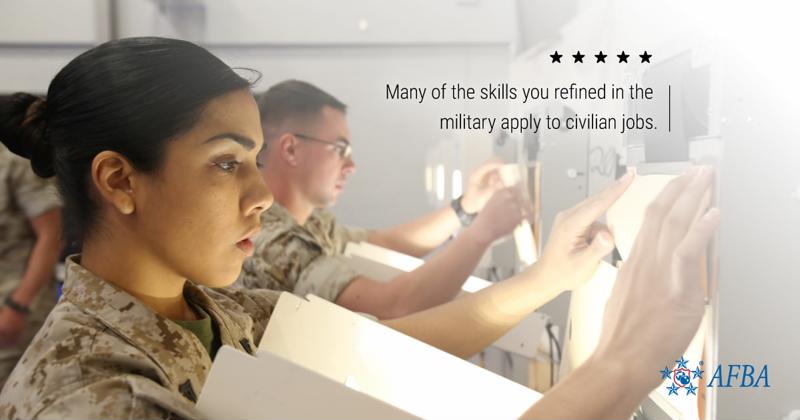 The knowledge you’ve gained through your military experience can be directly applied to civilian responsibilities.
Know your value
Now that you’re not in the Armed Forces, you may feel like you have no skills that apply to the civilian job market. That idea couldn’t be further from the truth. The military, in fact, gave you qualities that are impossible to acquire in any other format. You learned soft skills like teamwork and communication as well as specific knowledge related to technology, machine maintenance and medical care.
Consider how your military experience translates to the modern job market. Doing so helps you find an appropriate employer and make the transition easier. Make a list of all your skills and research what jobs apply to them. If, for example, you served in a leadership position in the military, you could be a great fit for management or corporate training.
Remember that jobs are not careers
A career is your passion, while a job is a stepping stone. Jobs give you financial stability while you search for (or develop the skills for) your dream career.
You may have to work whatever jobs you can find after retiring from the military, and they may make you feel discouraged, apathetic or even depressed about your situation. Don’t let this discouragement consume you. Your first post-military job doesn’t have to be your career, and you can use the experience you get to help you find a better position.
Review your finances
Check all of your bank accounts and credit statements to see how much money you have and how much you need. At minimum, you should have a checking account with money already deposited, a savings or emergency account with a year’s worth of expenses, and a retirement account. If you don’t have any of these, don’t panic, but create them as soon as you can.

Also, look over your debts and start taking measures to pay off all that you owe. There are several debt relief programs specifically for servicemembers and veterans, including:
- The Servicemember Civil Relief Act, which regulates interest rates for credit cards, auto loans and other financial services.
- The Military Lending Act, which keeps interest rates for credit products from exceeding 36 percent.
- The Veterans Housing Benefit Program, which offers veterans home loans with low interest rates.
You can also use a credit counseling service to help you manage your debt and boost your credit, allowing you to make major purchases like cars and homes.
Know your health insurance options
A medical crisis can strike anyone at any time, making health insurance a necessity. Luckily, you’re eligible for TRICARE between your military retirement and before getting a new job. The Continued Health Care Benefit program is another temporary coverage option, but you’ll need to find your own health care eventually. Look into possible VA benefits, and try to find a job with employer-provided insurance options.
Connect with your family and build a network
Having personal freedom may feel odd after years of taking and giving commands. It’s not uncommon for veterans to feel depressed after the rigid structure of the military, which is why a support network of peers and loved ones is so essential. Make connections with other veterans, open up to your family, and consult a therapist if you need to.
You may suffer some growing pains when transitioning to life after the military, but you’ll come through with the right plan.
To learn more about preparing for retirement, download our 2018 Financial Planning Guide.
When people hear the words “Memorial Day,” they often think of sales and three-day weekends. While the holiday is a nice way to welcome warmer weather, it’s important not to forget the day’s history and meaning.
Memorial Day was first celebrated after the end of the Civil War, which concluded May 5, 1868. It was started by an organization of Union veterans known as the Grand Army of the Republic. Maj. Gen. John A. Logan, the head of this organization, declared what was then known as Decoration Day would be observed May 30. Celebrations involved laying flowers on the graves of dead soldiers.
There are two possible reasons for the choice of date. The U.S. Department of Veterans Affairs suggested that May 30 was a day when flowers were likely blooming across the nation, so everyone could participate. Meanwhile, the History Channel noted that May 30 is one of the rare spring days that wasn’t the anniversary of a major Civil War battle.
 Memorial Day is celebrated on the last Monday in May.
Recognizing fallen soldiers before Memorial Day
Regardless of the true reason, it’s likely that Maj. Gen. Logan got the idea for such a holiday from other groups. One of the first such commemorations was organized by recently freed slaves as a way of thanking Union soldiers.
Near the end of the war, thousands of captured Union servicemembers were transferred to camps in Charleston, South Carolina. Conditions at one of the camps were so bad that over 250 prisoners died from disease or exposure, and their bodies were simply buried in a mass grave. After the confederate surrender on May 1, 1865, over 1,000 former slaves, accompanied by a few white Charlestonians and regiments of the U.S. Colored Troops, gathered in the camp to consecrate a new, proper burial for the soldiers.
Another commemorative service was sponsored by a Mississippi women’s group. On April 25, 1866, these women visited cemeteries in Columbus to decorate the graves of both Confederate and Union soldiers who died during the battle at Shiloh.
With so many separate memorials occurring across the nation, it’s difficult to determine which city is the true birthplace of Memorial Day. Many claimed the title, but President Lyndon Johnson and Congress ultimately decided that Waterloo, New York was the official place of origin in 1966.
Memorial Day was finally expanded to commemorate all soldiers after World War I. Congress declared it a federal holiday in 1971, transitioning the date to the last Monday in May and unofficially launching the tradition of the three-day weekend.
Memorial Day in 2018
Today, many people use Memorial Day to celebrate the unofficial start of summer. Pools open, barbecues are fired up, and people everywhere take road trips. AAA expects over 41.5 million Americans will travel for this year’s holiday, with the busiest days being May 24 and 25.
The holiday is also incredibly commercial. A quick online search reveals page after page of sales advertisements. While sales are great for the economy, people shouldn’t forget the true reason for the holiday.
The real symbolism of Memorial Day is much deeper than a discount. It commemorates all of the fallen soldiers who fought for this country.
Armed Forces Day is fast approaching. It's celebrated on the third Saturday in May, a month filled with holidays dedicated to various servicemembers: Military Appreciation Month, Memorial Day, Victory in Europe Day, Military Spouse Appreciation Day and more. Celebrations are typically local and include parades, social events and sometimes sales. This year, Armed Forces Day falls on May 19.
Armed Forces Day celebrates a significant event in history: the unification of the separate branches of the military. Before the end of World War II, the War Department and the Naval Department acted separately, and the secretary of each organization reported directly to the president.
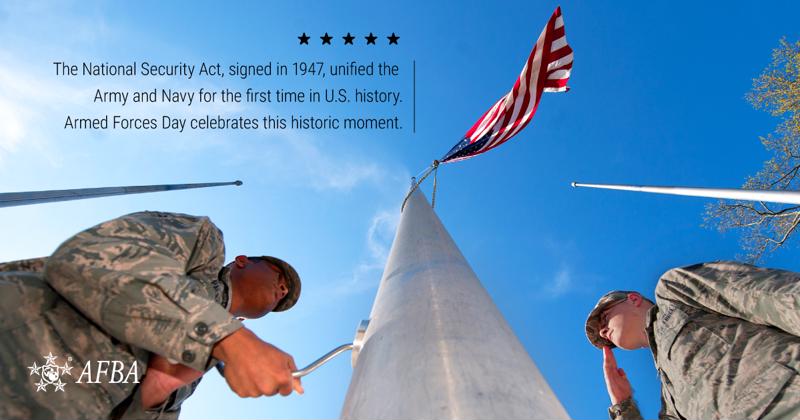
At the end of the war, President Harry Truman proposed a unified department to handle all aspects of national defense, believing this would cut back on wasteful spending and encourage interdepartmental collaboration. He signed the National Security Act in 1947, creating the National Military Establishment to unite the Army and Navy. In addition, the law created the U.S. Air Force (which had been known as the Army Air Forces), the Central Intelligence Agency, the National Security Council, the National Security Resources Board and the Joint Chiefs of Staff.
In charge of the National Military Establishment was a single Secretary of Defense. The establishment was then renamed the Department of Defense on August 10, 1949.
That same year, Defense Secretary Louis Johnson announced the creation of Armed Forces Day to replace separate celebrations for the Army, Navy and Air Force. This goal wasn't exactly achieved, as each branch of the military still has its own day of recognition. That said, Armed Forces Day remains an opportunity for all servicemembers and civilians to celebrate the role of the military in upholding the American way of life.
Secretary Johnson had the support of President Truman, per the Department of Defense, speaking on the holiday during his Presidential Proclamation on Feb. 27, 1950.
"Armed Forces Day, Saturday, May 20, 1950, marks the first combined demonstration by America's defense team of its progress, under the National Security Act, towards the goal of readiness for any eventuality," he said, according to the DoD. "It is the first parade of preparedness by the unified forces of our land, sea, and air defense."
Despite being held in such high regard, Armed Forces Day didn't become a national holiday until President John F. Kennedy declared it so in 1961.
Celebrating Armed Forces Day
The first holiday in 1950 had air shows, receptions, open houses and parades. It was also celebrated internationally; servicemembers in Berlin had their own festivities. Every year has a theme, and the first was "Teamed for Defense" to express the unification of all military forces. This first holiday was also an opportunity for civilians to learn more about the goals and achievements of the military.
Other themes for Armed Forces Day include:
- Freedom.
- Patriotism.
- Liberty.
- Freedom Through Unity.
- Guardians of Peace.
- Appreciation of a Nation.
- Arsenal of Freedom and Democracy.
- Deter if Possible, Fight if Necessary.
- Lasting Peace.
- Dedication and Devotions.
This year's theme is "All Across America," per the DoD, showcasing the ways servicemembers work for civilians while on American soil. The theme coincides with the department's This Is Your Military initiative and #KnowYourMil hashtag, which aim to display the positive truth of military life.
This Armed Forces Day, let's take time to celebrate the unified military and all the ways servicemembers have protected American freedoms. Civilians can share personal stories of the servicemembers and veterans in their lives on social media by contributing to the #KnowYourMil campaign.

President Donald Trump's 2019 federal budget proposal would increase the budget for the Department of Veterans Affairs by $198.6 billion, according to Military Times. That part of the proposal drew widespread support, particularly from veterans advocates.
A detailed breakdown of the proposal indicates a comprehensive strategy to address the issues that affect today's veterans, including:
- $1.6 billion in funding for support services that assist at-risk and homeless veterans.
- $1.2 billion allocated to modernize veterans' electronic health records.
- $727 million dedicated to medical and prosthetic research.
- $511 million to fund gender-specific healthcare services for female veterans.
- $381 million to find and support alternative pain management methods that reduce veteran reliance on opioids.
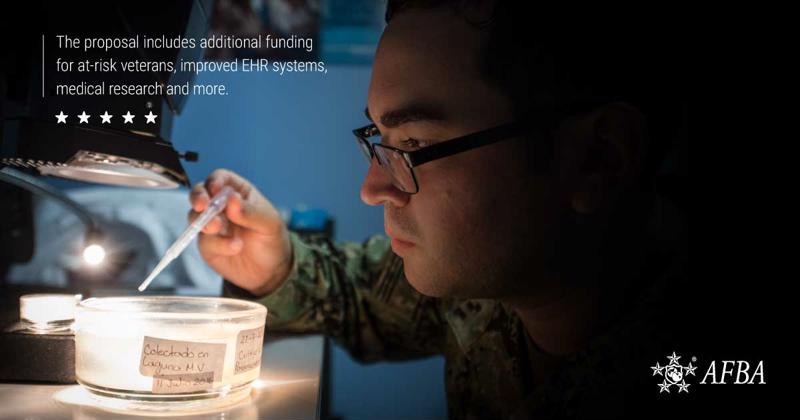
If passed, the proposal would be a significant increase in VA funding occurring as budgets for other departments are constrained. The VA budget was less than $49 billion in fiscal year 2001, per Military Times, and reached $93.7 billion in fiscal 2009. Similarly, President Trump allocated more money to the VA just last year when he signed the VA Choice and Quality Employment Act. This bill received widespread bipartisan support and, again, praise from veterans's advocate groups.
The act allocated $3.9 billion in funding to support the Veterans Choice Program, which was nearly bankrupt at the time, according to Stars and Stripes. The majority of the funding – $2.1 billion, to be precise – was designated for the Choice program to help veterans find care provided outside VA clinics and hospitals. The remaining $1.8 billion will be used to hire more staff, improve existing VA facilities and open 28 new clinics.
"This bill will ensure veterans will continue to have the ability to see the doctor of their choice," Trump said. "So important. Our great veterans deserve only the best and that's what they're getting."
The future of the VA budget – what would the money be spent on?
In all likelihood, the allocated funding will be, in some ways, spent on health-related technology. This theory is based on a recent report reviewed by the Federal Times which found the VA is on course to be the top agency for government health IT spending within the next five years. By 2020, the VA will account for 40 percent of such spending. Currently, the Department of Health and Human Services is the top health IT spender, but the Affordable Care Act mitigated those expenses somewhat.
Much of what will cause the VA to overtake the HHS is a new electronic health records system that the former plans to implement. Last year, then-Secretary of Veterans Affairs David Shulkin announced the agency would use the same platform as the Department of Defense to better allow both agencies to transfer health records as needed. This would make the transition from active servicemember to veteran much easier from a healthcare perspective, as it would eliminate the need for doctors and servicemembers to fill out separate forms with the same information.
"Our new electronic health records system will enable VA to keep pace with the improvements in health IT and cybersecurity, which the current system, VistA, is unable to do," said Scott Blackburn, the VA's acting Chief Information Officer.
The initial rollout of the new EHR system is expected to begin June 2019, which aligns with the above budget proposal and the prediction that VA health IT spending will soon increase. Per a separate Federal Times article, project is expected to cost $10 million and would be the biggest EHR system implementation in history.

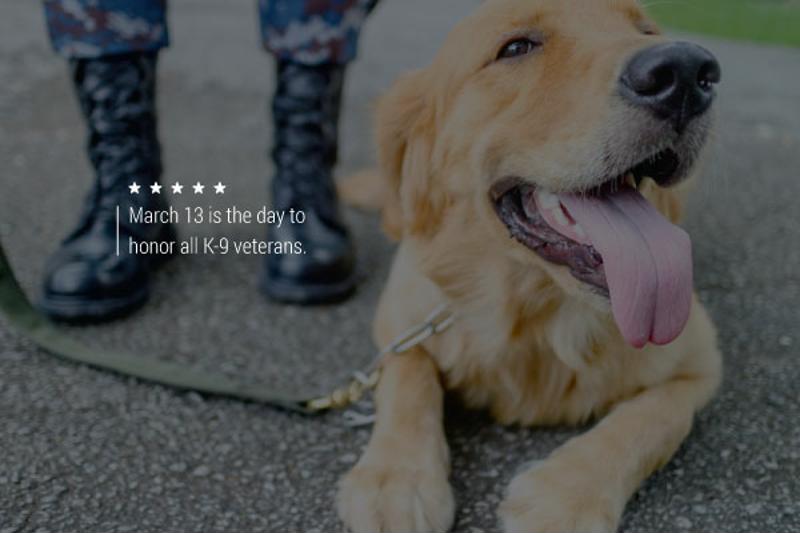
Dogs are more than our best friends; they're also one of our greatest protectors. Nowhere is this statement more true than within the military and first responder groups across the country. Countless K-9 units of four-legged heroes have worked alongside human companions to protect American citizens.
Joe White, a retired working dog trainer, believed these animals deserved recognition. He advocated for March 13 to become an official holiday known as K-9 Veterans Day. Former Florida governor Charlie Crist agreed with White, making Florida the first state to acknowledge the holiday. According to the Defense Media Network, White was proud to see the dogs honored and sent Crist a heartfelt email.
"Dogs have served with honor throughout the history of our country's birth and growth, and have served at many jobs in all of our wars," White's email read. "They, too, served, bled and died for our freedom."
White is completely correct; the nations K-9s have done incredible things in the name of freedom. Join AFBA in celebrating K-9 Veterans Day by learning about the history of these courageous animals.
A brief history of trained service dogs
The U.S. Army first began training dogs for military purposes on March 13, 1942, as part of the War Dog Program, also known as the K-9 Corps. What started as nine trained dogs grew to more than 10,000 before the end of World War II.
Still, these were only the first official dogs to serve in combat. U.S. military forces used dogs in an unofficial capacity years before. One of the original and most famous was Sgt. Stubby, a stray terrier mix who was unofficially adopted by a soldier named Robert Conroy. Their bond grew so strong that Conroy and his fellow soldiers smuggled the dog onboard the SS Minnesota as the unit was deployed to Europe in October 1917. Although he was discovered, Stubby won the heart of Conroy's commanding officer with a well-timed salute.
Stubby initially served as the unit's mascot, providing emotional support to the soldiers. On February 5, 1918, however, Stubby displayed his bravery by following Conroy across a battlefield under constant fire. The unit soon realized Stubby could hear artillery and smell gas before either hit – a talent that kept soldiers safe and prevented the enemy from gaining the upper hand. Stubby even sniffed out a German spy wearing an American uniform. For his bravery, Stubby was promoted to sergeant, granted several medals and got to meet three First Ladies.

Sgt. Stubby may have been the first to be formally recognized, but he certainly wasn't the last. Smoky the Terrier served an important role during World War II. Found in a foxhole, Smoky became one of the first therapy dogs and visited injured soldiers. She also helped her owner's unit string communication wire across an old Japanese airfield. The area lacked telephone poles, and digging new trenches for the wires would have exposed them to the enemy. Instead, they used Smoky to pull the string through old pipes.
"You couldn't get a dog in a thousand to go through a dark tunnel like that that they'd never seen before," Cpl. Bill Wynne, Smoky's owner, told NPR. During the war, Wynne purchased Smoky from her original rescuer for six dollars. "But she was well-trained in obedience, and she did it because I asked her to. She trusted me."
K-9 units today
These days, K-9 units are some of the most revered servicemembers and first responders around. Yet many people wonder what happens after they've served their time. Although many die in combat, the 2016 National Defense Authorization Act allows retired military dogs to come home and gives their handlers first priority for adoptions. Similarly, many police canines are adopted out or retire to live with their handlers – a fitting, comfortable end to several years of service.
Female veterans face unique struggles after their service – some of which mirror the complications they faced in the military. Thankfully, a growing number of resources from the public, government and other vets are emerging to help them.
One such resource comes in the form of a woman named Diane Ahrens of East Dundee, Illinois. A former servicemember herself and owner of Piece-A-Cake Bakery, Ahren has helped coordinate baby showers for Chicago-area expecting veterans for the past three years.
A growing event to support pregnant veterans
According to the Chicago Tribune, attendance at the baby shower events has grown steadily each year.
"The first year we only had four signed up and by the time of the shower, we had 11 or 12," Ahrens told the newspaper. "Last year, we had 25. This year, we're working toward 30."
The bakery provides desserts, while other restaurants offer entrees. In addition, the attendees receive free baby essentials, which are provided by donations and community partnerships. This year, fundraising efforts and help from a local Kohl's Cares group collected $5,000 in toys, formula, car seats, diaper bags and other items.
Ahren herself is no stranger to the struggles of an expecting veteran; she got pregnant approximately 30 years ago after serving in the Marines. Afterward, Ahren was a single mother for seven years. Her participation in the baby shower events stemmed from her desire to help women experience the same things she did, no matter how small that help may be.
The unique struggles of female veterans
Debates have gone back and forth about women's roles in the military, but it's clear the armed forces are growing more gender inclusive. That said, certain procedures and persistent beliefs still present obstacles.
As one article on Task and Purpose detailed, most military equipment is made for a man's physique, not a woman's. Ill-fitting armor and weaponry puts servicemembers in danger, as one Navy supply officer discovered when her unit was attacked in Afghanistan. The incident left her back and neck permanently damaged – all because she wore the wrong armor. Furthermore, the lack of proper care and resources worsens the already high-stress environment of the military.
These struggles don't end after women return to civilian life. Female veterans are the fastest growing homeless population in the U.S. In addition, the U.S. Department of Veteran Affairs found women vets were 2.5 times more likely to commit suicide than their civilian counterparts.
With this in mind, current female veterans should never be afraid to seek support. Feeling that they need to adhere to a standard set for others will do them more harm than good.
Thankfully, the VA provides many services to meet women's specific needs, including maternity care and family planning. Women who are pregnant or are trying to get pregnant are encouraged to talk to their healthcare provider for prenatal and preconception, maternity and newborn care services. Veterans who are struggling to get pregnant can also contact the VA for infertility counseling, assessment and certain treatments.
The department also offers family planning services for women who want to delay motherhood for the foreseeable future. Women can choose between multiple birth control methods, including pills, shots, implants, IUDs and other devices.
Motherhood can be complicated, but the struggle for female veterans can be even greater. Thankfully, many local and national services are dedicated to giving them the support they need.
Valentine's Day is fast approaching. No doubt you've noticed all the heart decorations, fancy boxes of chocolate and displays of roses in practically every store. If you or your loved one is stationed overseas, however, this holiday is more bittersweet than romantic.
Luckily, there are ways you and your loved one can celebrate the holiday despite living so far apart. Here are five tips for celebrating Valentine's Day during deployment:

1. Create a handmade card for your loved one
Nothing says "I love you" more than the personal touch of something handmade. A crafted valentine will mean much more to your loved one than something bought from Target or Walgreens. Possible materials for your project include:
- Cardstock (much sturdier and sleeker than construction paper).
- A bone folder (for a crisp, professional-looking folded edge).
- An Xacto knife (makes cutting curves much easier).
- Stencils or a calligraphy pen (for crisp lettering).
Additionally, there are many online resources, including DIY and crafting blogs, to help you create a professional-looking valentine.
2. Hold an unboxing Skype session
If you and your sweetheart plan to send packages or gifts to each other, schedule a time to meet on Skype, FaceTime or another video conference platform. Save your presents for your virtual date, then open them in front of each other. This way, the two of you can share the magical moment of seeing a gift for the first time, in real time.
3. Host a Gal/Palentine's party for other military spouses
It may be next to impossible to get ahold of your loved one on February 14. In that case, spend time with your friends or associates who are in a similar situation. Host an outing or dinner for people whose loved ones are also deployed servicemembers. You can simply meet up at a bar after work or arrange an elaborate weekend potluck.
Though the mood of the event won't necessarily be romantic, it'll be a great chance for everyone to talk about their thoughts and feelings in regard to being apart from the person they love. Having a deployed spouse or significant other is a unique struggle, and it's good to express these feelings with people who truly understand.
4. Get active
Sometimes, Valentine's Day is the absolute last thing you want to think about. After all, you may tell yourself, what's the point of acknowledging the holiday if you can't be with the person you love?
If you feel this way, spend February 14 exploring a new or favorite physical activity. Sign up for a high-intensity workout like spinning, rebounding or weightlifting. Alternatively, you can take a relaxing walk around a local park. The goal here is to stave off a holiday-induced depression by getting your heart rate up and your endorphins flowing. Even just leaving the house can lift your spirits a bit.
5. Spend the holiday with your children
Valentine's Day isn't just about romantic love; it's also about family relationships. If you're a parent, spend today celebrating in the love of your children. Arrange a special treat for them – cupcakes, a trip to the movies, or a video conference with their deployed parent. Take them out to their favorite restaurant, buy them chocolates or let them stay up a bit past their bedtime.
At some point, you can have a conversation about the parent overseas. Kids often don't have the words to express their complex emotions, but talking with you can help them process what they're feeling.
Keeping love alive despite the distance
Being separated from a loved one is incredibly difficult, but there are still ways to keep your relationship healthy. Use any of these five tips to celebrate the year's most romantic holiday with your significant other, your friends or your children.
Some active-duty servicemembers living off base saw their housing allowance increase slightly, while others saw no change at all this January 1. As Military.com reported, the Basic Allowance for Housing increased an average of 0.7 percent – the equivalent of $10 per month – at the start of 2018. Individual increases varied depending on a servicemember's location, pay grade and whether or not he or she has dependents.
That said, the increase only applies to servicemembers stationed in certain military housing areas. Local BAH rates will fall in 128 of the 301 locations. However, no current recipient will see their allowances decrease unless they're demoted, their number of dependents changes or they move to a new location.
"We do not penalize members who have already gone to a location, signed a lease and then rates happen to decrease," said Summer Britford, a chief with the Defense Travel Management Office. "Incoming members do have access to lowered [rental] costs so they do experience those decreases."
That latter statement doesn't exactly align with the expenses experienced by many servicemembers and civilians. As Military.com pointed out, the BAH adjustments haven't matched changing rent and utility costs. That said, the new rate does agree with the Defense Department's decision to reduce housing allowances overall, leaving servicemembers responsible for some expenses once again.
A brief history of housing allowances
Originally, allowances were only designed to cover approximately 80 percent of servicemembers' housing costs, leaving them responsible for the remaining 20. However, according to Military Benefits, the Defense Department began increasing allowance rates in the late 1990s to keep them in line with nationwide rental costs. By 2005, housing allowances covered 100 percent of housing costs for servicemembers.
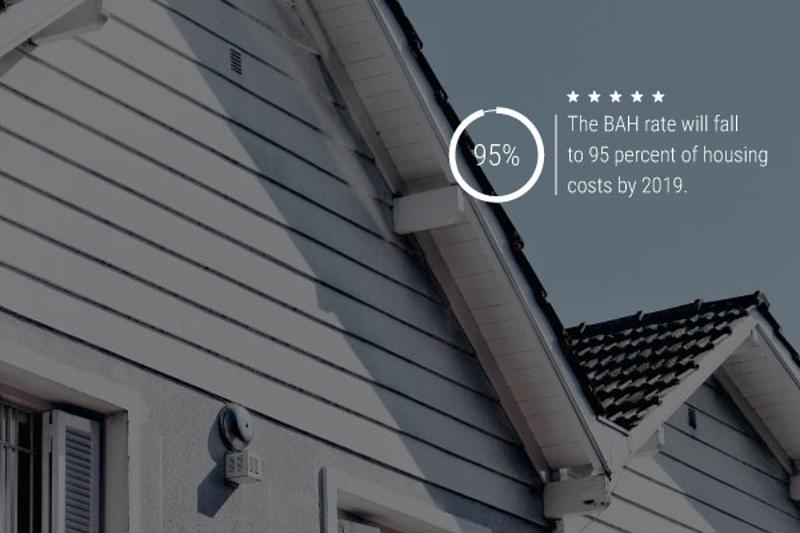
In 2015, however, the DoD reduced BAH rates to cover 99 percent of these costs. The department also began excluding rental insurance from rate calculations at that time. The next year, the DoD determined that BAH rates would be set at 95 percent, falling at a rate of 1 percent per year over four years. The current rate covers 96 percent of housing costs; it will drop again for a final time next year.
Defense officials wish to use the millions of dollars saved by reduced BAH rates for other needs as defense budgets tighten and the country struggles to eliminate the deficit.
Other housing allowance 'solutions' could hurt servicemembers
While the DoD works internally to find the right housing allowance balance, other organizations have come up with their own ideas. As a separate Military.com article revealed, The Heritage Foundation proposed a reduction of housing allowances in the 2018 budget.
"[The housing allowance] is not military compensation," the report read, according to Military.com. "Housing allowances should be based on the amount of money that service members must pay to obtain adequate housing. Service members are not entitled to, nor should they have any expectation, that money above what they pay for housing can be retained as 'extra compensation.'"
The report implies that servicemembers receive allowances that cover more than the cost of housing in their area; however, BAH rates are designed only to cover a portion of these expenses. While this suggestion wasn't included in the budget, think tanks and government officials will likely continue to adjust BAH rates to the detriment of active servicemembers.
U.S. military veterans are finding new purpose by serving their country in a different way. Though their time protecting American freedoms is up, they're now supporting medical research through the Million Veterans Program.
First veterans, now MVPs
Launched in 2011, the MVP is a voluntary research program funded entirely by the Department of Veterans Affairs Office of Research and Development. It connects military veterans with genetic researchers to help the latter study how genes affect health. In doing so, scientists believe the MVP will give insight into the hereditary aspects of diseases like diabetes, cancer and heart disease in addition to helping uncover the reasons why and how some people respond to certain medications. The research will also help scientists learn more about military-related illnesses like post-traumatic stress disorder.
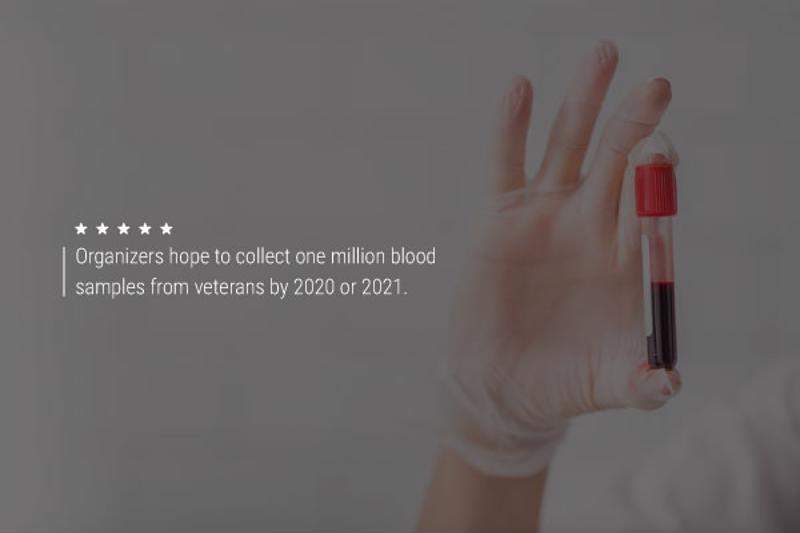
The ultimate goal of the MVP is to collect health information and blood samples from at least one million military veterans. This collection would be one of the world's largest and most racially diverse medical databases.
Veterans are not enrolled in the program automatically; they may choose to participate or, if they don't wish to join the program, keep their records private. To be part of the study, vets must fill out a survey about their current health and behaviors in addition to having a sample of their blood drawn. Furthermore, they must allow researchers to access their VA and VA-linked health information, including all past and future data. Finally, vets must agree to remain in contact with MVP organizers in the future.
Why military veterans?
Some might consider that, after years of valor and sacrifice, having veterans participate in medical research is asking too much. However, vets are the perfect sample for such studies.
Heath researchers need large sample sizes for their research but often have a hard time locating enough participants. Given that there were approximately 20.4 million veterans in the U.S. as of 2016, according to the VA, researchers can easily find enough people to provide a healthy data set.
In addition, veterans using VA services have consistent medical records, which provide for better research. The average citizen switches health providers and/or insurance companies multiple times throughout their life, so their records aren't centralized or – in some cases – even complete. Veterans, meanwhile, have decades of consistent records in one database, so health officials don't have to worry about inaccuracies.
That said, many veterans experience encounters during their service that could have had a genetic impact. Studies show chronic stress affects chromosomes in a manner that, according to the American Psychological Association, can contribute to cellular aging and increase the risk of heart disease, cancer and diabetes. MVP researchers are aware of this fact and will structure their research accordingly.
Additionally, the majority of military veterans are male, which would skew the database in terms of gender. According to the Milwaukee Journal Sentinel, women make up approximately 8 percent of current MVP participants, and organizers are working to get more female volunteers. Still, the current sample is one of the most racially diverse in the world. African-American participants make up 17 percent of the group, Hispanics 7 percent and American Indians 2 percent.
The MVP's present and future
The program currently has over 630,000 veterans, according to the Milwaukee Journal Sentinel. Organizers plan to gather the full one million genetic samples by 2020 or 2021. However, researchers have no plans to wait to get started. Eight studies are already in progress, and more are expected to begin shortly.
So far, scientists have begun or plan to start using the collected genetic samples to research:
- Mental health issues, including PTSD, substance abuse, bipolar depression and schizophrenia.
- Chronic heart and kidney disease.
- Diabetes.
- Tinnitus.
- Breast cancer.
- Age-related macular degeneration.
The breadth of conditions these genetic samples can provide insight on is yet another way for veterans to continue serving their country.
To alleviate the stress and burden of finding a new job after relocating, consider unconventional, individual work options. There are two primary avenues they can take: starting a business of their own or working remotely for an employer.

Starting a business: Your job moves with you
U.S. Veterans Magazine offered this suggestion, and it's a great way to maintain a consistent job position despite moving so often. Owning a business allows you to manage your time on your terms and alleviates the stress of finding a new employer. If you work purely from home and don't rely on outside resources or vendors, you can easily relocate your physical office.
That said, there are several things to think about before venturing into the world of entrepreneurship. First, you should consider whether you're suited to start your own company. U.S. Veterans Magazine provided a helpful self-assessment, asking readers to examine personal details like:
- Personal and business goals.
- Current funds and investment requirements.
- Existence or lack of family support.
Next, you should critically evaluate your skill set and identify what you can monetize in different locations. If you're moving to Alaska, for example, your talent for raising tropical plants probably won't be in demand. To get started, here are a few careers that are either universally in demand or don't require a local client base:
- Computer programming.
- Accounting.
- Creative services (such as copywriting or graphic design).
- Tutoring.
- Child care.
Furthermore, and perhaps most importantly, business law and taxes change between states, so relocating isn't a simple matter of moving your computer. To get a basic understanding of the scope of moving your company to a new state, the U.S. Small Business Administration provided a helpful legal guide.
Working remotely: Freedom and flexibility
Remote work, on the other hand, removes much of the complications of owning a business. Remote positions may have been hard to come by in the past, but research shows that attitudes are changing. According to Gallup, the proportion of employees who work from home grew from 39 percent to 43 percent between 2012 and 2016. This type of setup makes military spousal life much easier, allowing you to pack up and move at a moment's notice without leaving your job.
That said, you may need to convince your current employer that remote work is a good option. Point them to Gallup's State of the American Workplace study, which proves that remote work can boost employee engagement. Also note that working from home reduces employee churn and allows you to remain with the company after a move.
However, it's also a good idea to consider your current position before asking about remote work. Based on your job description, how likely is your employer to agree to let you work from home? You may be better off looking for a new company that offers a more flexible policy.
Additionally, even remote work comes with a few struggles. You'll still need to take time off for moving purposes, and you may feel disconnected from certain conversations or alienated from your coworkers. To solve these issues, ask your employer about working flexible hours – for instance, in the mornings and evenings instead of a strict 9 to 5, saving the middle of the day for the move – and travel back to the main office when you can.
Working as the spouse of a servicemember can be stressful, but these suggestions give you more control over your employment.