
A new partnership between a technology company and a wounded veterans service would provide smart glasses to former servicemembers suffering from vision problems. According to U.S. Veterans Magazine, the Wounded Warrior Program, Minton-Jones Company and Ability One vendors are working with Cyber Timez, Inc., a company that designs augmented reality applications for smart glasses, to bring these novel devices to veterans with blindness or low vision. The project would help such vets live more independent lives.
The smart glasses are equipped with a high-definition camera and an optical character recognition engine, allowing them to effectively "read" text and transmit it aloud to veterans. The sound waves go directly into the ear, so whatever the wearer is reading remains private and he or she doesn't disturb others. The glasses are also independent of the cloud, so veterans don't need an internet connection to use them.
With this technology, blind and vision-impaired veterans can effectively read signs, manuals and any other text or documents without assistance. The software can read text in over 100 languages, identify over 16 billion objects, scan barcodes to identify various products and interpret more than 1,000 colors. It even has the capacity to decipher a person's mood based on his or her face. The glasses can also magnify details up to 15 times, which can be life changing for veterans with low vision.
"Our goal with this project at the Wounded Warrior Program is to outfit thousands of American veterans and wounded warriors impacted by low vision and blindness, both men and women with smart glasses to help them find jobs, improve their quality of life and give them financial independence," said Wounded Warrior Program National Director Dr. David Godbold.
When it comes to the issues servicemembers face, most people think of amputated limbs and traumatic brain injuries rather than vision problems. However, blindness and vision impairment are both combat risks and have already affected thousands of veterans.
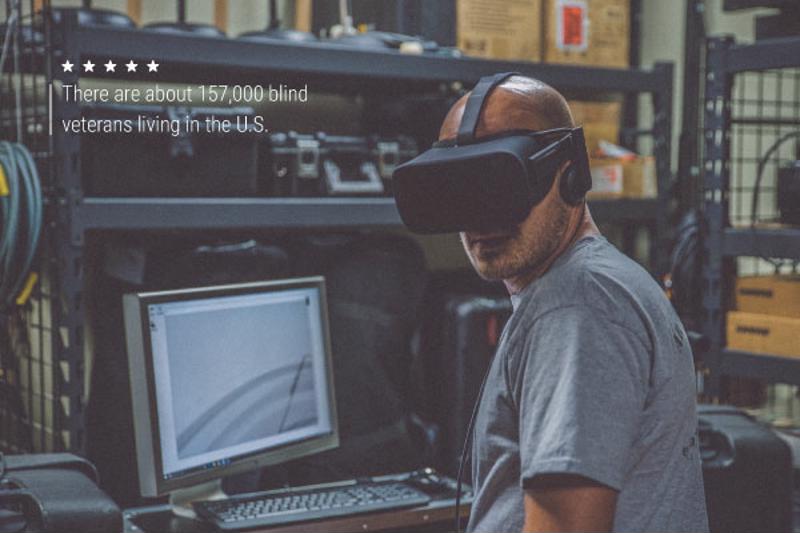
Blindness as a result of combat
According to the U.S. Department of Veterans Affairs, there are about 157,000 blind veterans living in the U.S. The VA estimates at least an additional 1 million veterans are visually impaired.
For many veterans, these disabilities are caused by standard issues such as age-related macular degeneration, diabetic retinopathy, stroke, cataracts and glaucoma. Nevertheless, their service is reason to include such naturally developing conditions under the umbrella of "veterans issues."
That said, veterans can also suffer vision problems as a side effect of traumatic brain injuries. According to the VA, blindness or low vision affects as much as 64 percent of servicemembers with TBIs.
While experiencing vision loss can be frustrating, veterans shouldn't lose hope. They can regain independence with technological innovations like smart glasses and find other assistance through organizations like the Wounded Warrior Program, the Blinded Veterans Association, the National Association of Blind Veterans and the Defense and Veterans Brain Injury Center. They should also look for rehab centers designed specifically for blind veterans, like the Gulf Coast Veterans Rehab Center in Biloxi, Mississippi. As the Associated Press reported, this specific center has helped 173 veterans reclaim their lives.
"It opens those doors for independence once again," said Facility Chief Debra Gilley, according to the Associated Press. "It's wonderful to see somebody who has been sitting at home on the couch thinking that life is not open to them anymore, and to see them out crossing the street and getting out there."
Veterans with vision problems should not seclude themselves from the world. With the help of local disability resources and ground-breaking tech, they can regain the confidence to be active in society once again.

This past September, a female Marine Corps became the first woman infantry officer after successfully completing the Infantry Officer Course, the Marine Corps announced in a press release. Commonly referred to as the IOC, the intensive 13-week course is regarded as one of the toughest in the military. An average of 10 percent of students fail to pass the first day, which includes a skills assessment and a combat endurance test consisting of hikes and an obstacle course. Of the female officer's class, only 88 out of 131 students graduated.
The IOC is designed to teach and assess infantry and ground intelligence officers in the leadership, character and infantry skills necessary to serve in the position. As the Washington Post noted, the course takes an incredible amount of stamina and strength, requiring students to have the ability to carry up to 152 pounds of equipment.
"I am proud of this officer and those in her class who have earned the infantry officer MOS," Marine Corps Commandant Gen. Robert Neller said of the woman, who asked to remain anonymous, in the press release. "Marines expect and rightfully deserve competent and capable leaders, and these IOC graduates met every training requirement as they prepare for the next challenge of leading infantry Marines; ultimately, in combat."
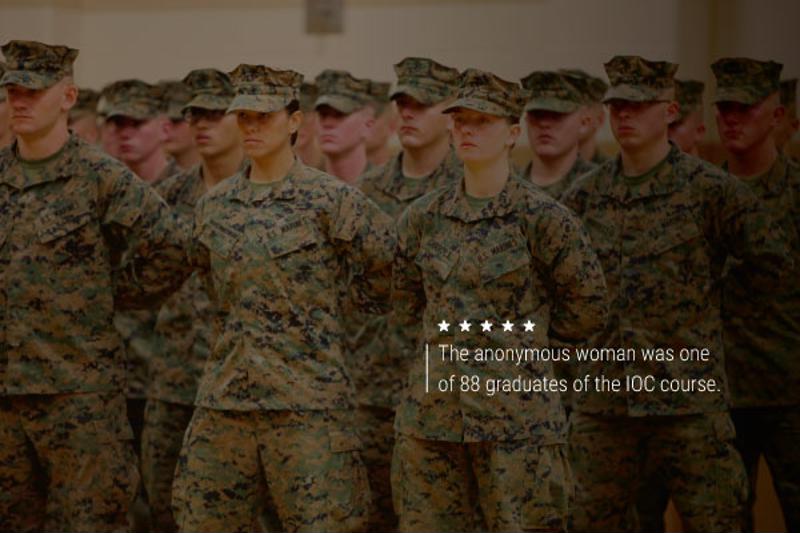
The reasoning behind the woman's decision to keep her identity private is unknown, but some speculate she requested so in order to best attend to her new position. Former Marine Corps helicopter pilot Kyleanne Hunter, who currently serves as a member of the Pentagon's Defense Advisory Committee for Women in the Services, told the Washington Post that the anonymous woman faces unparalleled performance pressures, especially from critics who want her to fail.
"Too much attention can take away from her operational requirements," Hunter told the newspaper. "Her first challenge is going to be to remain anonymous, for lack of a better term, and just do her job."
The infantry officer will also need to win over the people under her command, which may prove difficult as the Marine Corps has historically been resistant to gender integration.
Accepting gender diversity in military branches
The Marine Corp first opened the IOC to women in 2012 as part of its research on how to introduce women into all-male units. That same year, 75 percent of surveyed active-duty marines said they were opposed to complete gender integration, per the Washington Post. Ninety percent expressed concern about possible relationships forming within units, and more than 80 percent of male respondents were concerned about false sexual allegations, fraternization and women getting preferential treatment.
Furthermore, sexual harassment also served as a barrier to gender equality within the military branch. Earlier this year, news broke of a private Facebook group where male Marines were sharing nude photos of female servicemembers, often identifying them by name, rank, location or social media handle and leaving explicit comments. According to Reveal News, which broke the story, over 30,000 men were members of the group.
These issues have not stopped the Marine Corps or other military branches from seeking greater gender diversity, however, nor did it dissuade some female servicemembers from high-ranking positions. In 2015, the Pentagon officially opened all combat jobs to women. Since then, four other women, not including the recent female graduate, attempted the IOC. Although none of the four completed it, their determination signals a shift in attitudes regarding who should and who should not serve in the military.

Moving is expensive, especially for military families. Servicemembers, their spouses and their children are typically asked to move around the country – and even internationally – several times throughout their tenure. Each time, the spouse has to find a new job, which further increases expenses if that job requires a professional license or similar documentation. Previously, spouses would have to pay for the costs of obtaining a new license out of pocket, placing a burden on lawyers, nurses, teachers and people in similar positions. These costs are often a last-minute detail military families may not consider until starting the job hunt.
Thanks to a proposal in the 2018 National Authorization Act, however, military families may not have to worry as much about these costs.
Financial assistance for new licenses
The 2018 NDAA, which must still be passed by Congress, would give the Department of Defense and the Coast Guard permission to reimburse military spouses up to $500 for "transfer fees" – essentially, money to help cover the cost of exams, certificates, licenses and other such professional expenses.
According to Military.com, the idea was originally proposed by New York Representative Elise Stefanik-R.
"Military spouses serve too, and this update will help alleviate unnecessary stress and expenses, help ease the transition, and will give these spouses and their families some deserved predictability," Stefanik told Military.com.
The proposal could indeed be hugely beneficial. According to Brooke Goldberg, head of military spouse programs at the Military Officers Association of America, approximately half the spouses her organization survey require a professional license for their career. Not only could the proposal assist a significant number of military families, but the $500 can significantly reduce expenses. Although the cost of obtaining a new license can reach thousands of dollars per move, even a portion of that amount reduces a family's financial burden.
To be eligible for the reimbursement, the spouse must be forced to get a new license in his or her existing career field due to a permanent change-of-station move. However, the proposed NDAA doesn't detail how spouses should apply for reimbursement and, as noted previously, still needs to be passed by the House and Senate.

Proposal praised by military career advocates
Unsurprisingly, this portion of the bill was met with much enthusiasm.
"Anything that facilitates an opportunity to make life easier for military spouses to stay in their desired industry … is a step in the right direction," said Elizabeth O'Brien, director of spouse programs for Hiring our Heroes, according to Military.com.
While the government is required to pay for moves, families still face financial strain – especially if they're forced to move frequently. If they choose a do-it-yourself move, the government will reimburse them 95 percent of what it would cost the organizing body – not the family – to hire commercial help. Alternatively, families can allow the government itself to pack, ship and unpack their items.
With either choice, there are often up-front cash payments that leave families strapped until the next payment comes through. Additionally, the reimbursement may not cover all moving expenses, such as gas or lodging, or families may break government-mandated weight restrictions and be liable for the excess. Such financial strain is then increased when the spouse reapplies for licensure.
While $500 toward the cost of a new license doesn't completely alleviate the moving burden, any amount can help. Military spouses sacrifice a lot to support servicemembers, so support from the government is a welcome form of assistance.
Starting this month, discharged veterans will be able to identify themselves a little more easily. Instead of keeping their copy of their discharge papers, which are commonly referred to as DD-214s, they can get a photo ID card from the Department of Veterans Affairs by applying on the VA's website.
This new method results from the Veterans Identification Card Act, a law passed in 2015. Per the legislation, the VA must issue a hard-copy photo ID to any discharged veteran who applies. Representatives stated the VA will provide the cards at no cost, although the law does allow the government body to collect a fee.
The legislation makes it much safer for veterans to carry identification. Before, the only form of ID most vets had was their DD-214, which proved cumbersome for vets to keep on their persons. In addition, DD-214s contain sensitive information like birth dates and Social Security numbers. Carrying these forms around increased the risk of veterans becoming victims of identity theft or fraud.
The new cards, on the other hand, will only have the holder's name, photo and a non-Social Security identification number.
Previously, methods of identifying veterans were inconsistent across the country. Only military retirees receive a retiree card from the Defense Department, and only certain veterans can get a photo ID VA health card. Similarly, many, but not all, states allow veterans to identify themselves on their drivers licenses. This new system provides a more uniform, standardized and secure way for vets to prove their service for non-government reasons – for example, to receive military appreciation discounts from retailers.
However, not everyone is completely satisfied by the new ID option. Many veteran advocates are upset because the new cards aren't available to everyone who served.

Identifying veterans with other-than-honorable discharges
As the Army Times pointed out, the Act states that the VA must provide a new ID to any veteran who requests one and presents a document from their military personnel file or a copy of their DD-214 form. However, VA Press Secretary Curt Cashour recently confirmed that only veterans with "honorable service" will be eligible.
Advocates believe this unfairly punishes veterans suffering from mental health issues. They note that many instances of drug abuse and minor insubordination, which lead to dishonorable discharges, stem from untreated mental health issues. Additionally, as Military.com noted, LGBTQ servicemembers who were publicly outed before the repeal of "Don't ask, don't tell" were also dishonorably discharged.
"I find it incredibly frustrating, and deeply hurtful, that the VA would deny hundreds of thousands of veterans like me our very identity, after all that we know today about the nexus of PTSD and bad paper," said Kris Goldsmith, who received a dishonorable discharge. Goldsmith is the founder of High Ground Veterans Advocacy.
The decision to deny cards to vets with other-than-honorable discharges is surprising given that just this summer, the VA reversed its existing policy on mental health care. Prior to July, only honorably discharged veterans could receive these services. Now, those with so-called bad paper can receive emergency mental health support.
In the eyes of VA Secretary David Shulkin, allowing other-than-honorably discharged veterans to receive emergency room mental health services would help the VA spot untreated mental health issues and, as a result, reduce veteran suicides. Veterans advocates applauded the move, but they see the recent ID card issue as a complete about-face.
Advocates will likely continue fighting for access to the new cards. In the meantime, honorably discharged vets have a more convenient way of identifying themselves.
Thanksgiving is a time for families, but not everyone gets to celebrate the holiday with their loved ones. Thousands of active duty military members may be forced to celebrate the holidays overseas, and those in the states may not be able to make long-distance trips.
These circumstances haven't stopped them, however, as active duty military members have held Thanksgiving celebrations since the Revolutionary War.
A history of military Thanksgiving
According to the independently owned Military Benefits, servicemembers celebrated days of Thanksgiving during both the Revolutionary and Civil Wars. Although the holiday as we know it didn't officially come into being until 1863, these celebrations were held in hopes of unifying the U.S. during its most divided times.
During World War I, independent service providers like the Red Cross and the YMCA began organizing dinners for soldiers, and French families invited servicemembers into their homes after Armistice Day. During World War II, Thanksgiving meals were either shipped to soldiers or sourced locally.
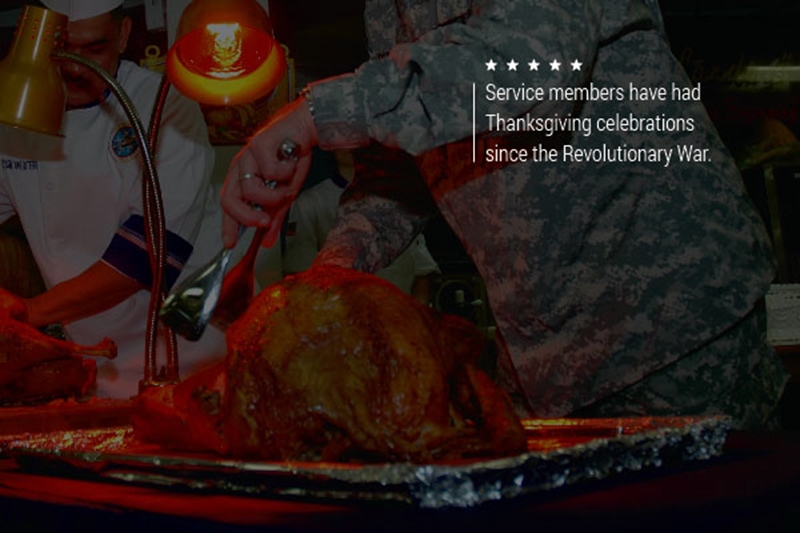
Modern military traditions
Today, active duty personnel celebrate Thanksgiving in a number of ways. Junior servicemembers, many of whom are away from home for the first time, generally receive a dinner provided by senior leaders.
Those stationed in the U.S. mostly spend the holiday on their base. Sometimes they are invited to dinner by local families or houses of worship. Experienced servicemembers who have families nearby may even invite their juniors to dinner.
"Many hold special services or events for veterans and active duty military."
In addition, many local and national organizations hold special services or events for veterans and active duty military. For example, Operation Homefront provides free dinners to military personnel and their families through its Holiday Meals for Military. This tradition began after a soldier, shopping for groceries with his wife and infant, tried to purchase food for their Thanksgiving dinner in 2008. The total exceeded the amount they had on hand, but an executive behind them paid for the groceries in full. Since its inception, Holiday Meals for Military has provided dinners for almost 70,000 such families.
Paradies Lagardere, a travel retailer, also extends holiday services for military members and veterans. The company's Treat Our Troops program routinely offers free meals to servicemembers visiting its airport restaurants.
Meanwhile, servicemembers stationed abroad usually celebrate the holiday on base. According to Task and Purpose, while each branch of the military creates its own Thanksgiving menu, they all choose from a single set of standardized recipes, so an army soldier will have the same style of turkey and gravy as a member of the Coast Guard. In addition, today's servicemembers have the benefits of technology like Skype and Facetime, so they can still see and speak with their loved ones even if they can't visit in person.
That said, sometimes servicemembers will have a less traditional Thanksgiving and participate in local cultural activities instead. They'll eat a holiday meal with local dishes or participate in other cultural traditions.
Coping with Thanksgiving deployments
Spending Thanksgiving overseas isn't as bad as it sounds. An article on the U.S. Department of Veterans Affairs shared first-hand accounts of the experience, and many veterans remembered their holidays positively.
"I spent two Thanksgivings in Fallujah and they weren't bad at all," said Anthony Schmiedeler. "You had your brothers to the left and right which might as well be family. And the leadership did everything they could to give us a proper Thanksgiving meal with all the fixings. I'm grateful."
While Thanksgiving in the military differs from civilian life, the spirit of the holiday remains the same.
Military Family Appreciation Month is this November. Designated as a time to honor the commitments and sacrifices of the families of our nation's servicemembers, the month-long celebration should serve as a reminder of the struggles and sacrifices that the spouses, children, parents and extended relatives of military personnel must go through. Whether their loved ones are stationed miles from home or awaiting orders, military families deal with unfathomable uncertainly every day. This November, take a moment to recognize their struggles and learn how to comfort them in times of grief.
How to show appreciation to a military family
Civilians can take simple yet actionable steps to show their appreciation for the various military families in their lives.
One way is to volunteer their time to help with regular chores and errands, especially if the servicemember leaves a family behind. Homes with a deployed spouse are comparable to single-parent families, as all of the primary responsibilities fall on the the remaining head of household. Even if the children are old enough to help care for themselves and their siblings, their homebound parent could use a break. Offer to give mom or dad a day off by looking after the kids or running errands; he or she will be grateful for the break.
Alternatively, you can create a care package for the family. This could be very helpful for homes that struggle financially. Put together a box of household items and food – homebaked goods are a nice personal touch – or even send a premade fruit basket. If you want to go above and beyond, organize a group event and get the entire community involved.
Finally, sometimes simply listening to their concerns is enough. Military family members go through a lot of emotional turmoil, facing unique problems that don't apply to standard civilian life. Yet they may feel guilty because they're not the ones in combat. Lend a friendly ear next time you see them.
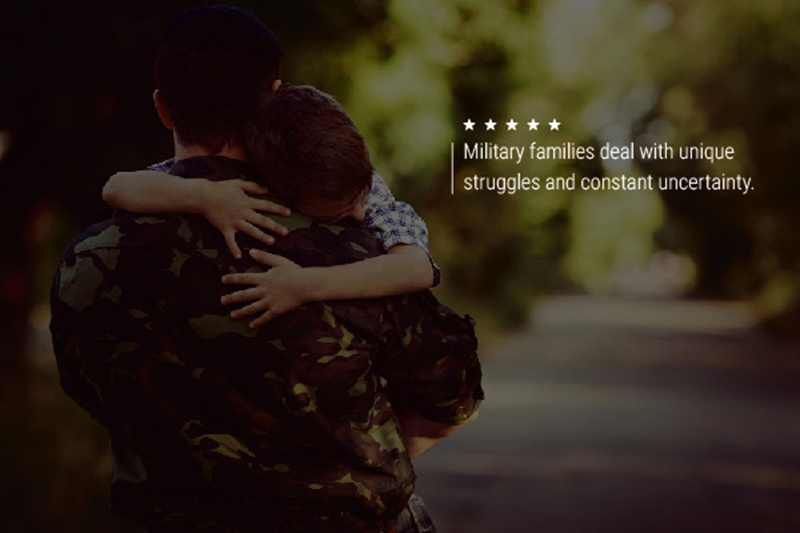
How to comfort grieving military families
If tragedy happens, it's good to know how to comfort a grieving military family. According to Joanne Steen, certified counselor and co-author of "Military Widow: A Survival Guide," the best thing to say is a simple, "I'm sorry for your loss." State the deceased's name as they were known by the family, not by their military rank. Also, specify the servicemember's relationship to the survivor – wife, husband, etc. – to personalize them.
In addition, if you feel it's appropriate, ask noninvasive questions about the deceased. Talking about their hobbies, favorite movies and similar matters helps grieving families work through their loss. If, however, the surviving family members don't want to talk, don't push them.
Our servicemembers sacrifice a lot for their country, but their families must deal with their own struggles. This November, take time to recognize them during Military Family Appreciation Month.
As businesses everywhere organize Veterans Day sales, promotions and giveaways, it's important to remember the true spirit of this national holiday. Originally, the event was named Armistice Day and commemorated the end of World War I. It's been through several changes between then and now, notably switching names in 1954, after WWII showed the nation that its predecessor was not, in fact, the war to end all wars.
Though the name has changed, the holiday's intention remains the same. Veterans Day is a time to honor the experiences and sacrifices of all of our former servicemembers. This year we switch the narrative from one that emphasizes their hardships to one that uplifts our veterans and gives them hope.
Rob Jones completes a month of marathons on Veterans Day
One inspirational story is sure to make headlines this year. As Time Magazine reported, Marine Corps veteran Rob Jones plans to complete 31 marathons in as many days – thanks to his prosthetic limbs.

In 2010, Jones, then a corporal in the Marine Corps, was looking for IEDs with a metal detector while stationed in Afghanistan. A mine exploded beneath him during the search, and both his legs had to be amputated just below the knee. Though he could no longer serve, Jones was eager to get active again after his injury. He not only relearned to walk with his prosthetic limbs but also to run, row and bike. His determination paid off; Jones won a bronze medal for rowing at the Paralympics in 2012 and biked cross country in 2013.
His current series of marathons began Oct. 12, and he'll complete his final race on Nov. 11 – Veterans Day – in Washington D.C. Jones, who noted veteran suicides are often driven by isolation and the challenge of returning to civilian life, hopes his story will inspire others who are struggling.
"Hopefully when a veteran sees that I was able to lose both legs above the knee and still have a purpose, still be a part of society, still contribute to my family, they can picture themselves doing it," he said to Time Magazine.
A retired Army specialist receives free home during Veterans Day Parade
According to a local ABC News affiliate, the 2015 San Francisco Veterans Day Parade came with a life-changing surprise for a retired army specialist. During the event, Jonathan Allen, who had to leave the military after an injury, and his wife were gifted a free house with the mortgage fully paid for. The home was donated to Military Warriors Support Foundation, a nonprofit that helps wounded servicemembers transition to civilian life, by Wells Fargo.
In order to be eligible for a free home, the Allens had to first go through a financial mentoring program. Although they were selected to receive the gift, they weren't aware of the surprise until it was delivered to them. The couple then got to ride through the parade in a horse-drawn stagecoach provided by the bank.
"It's life-changing honestly," Allen told the news affiliate. "I'm trying to make the transition out of the Military. I'm going to school, wasn't planning to get out of the Military then I got injured."
Are you a soldier who likes playing video games? If you're an active duty servicemember, chances are the answer is yes, as video games are a popular past time for those serving in the Army. Now, the military will be leveraging soldiers' love and aptitude for video games with Operation Overmatch, an online game that will contribute to the development of the future fighting force.

What is Operation Overmatch?
Operation Overmatch, initiated by the U.S. Army Capabilities Integration Center, is an online, multi-player game. Its goal is to boost combat effectiveness. This endeavor {Operation Overmatch} is an online gaming environment whose goal is to create two-way communication between soldiers on the one side and the developers, engineers and scientists on the other side.
While it might seem like the Army is merely providing people with a new game to play, there's a real-world component to Operation Overmatch. The army reported that it is actively seeking soldiers to play and provide feedback.
"The army is actively seeking soldiers to play the game."
"Soldiers have the advantage of understanding how equipment, doctrine and organization will be used in the field – the strengths and weaknesses," explained Michael Barnett, chief engineer at the Army Game Studio and project lead for Operation Overmatch. "And they have immediate ideas about what to use, what to change and what to abandon – how to adapt quickly."
The service's Training and Doctrine Command and Army Game Studio has been developing the game since 2016. Soldiers will get to beta-test machines they pilot in the game and see if weapon and armor concepts are worth pursuing before the Army orders real-life prototypes.
The game will allow players to select among thousands of options for certain predetermined capabilities, such as weapons, caliber and robotics, and use these in an "adversary threat platform" to determine effectiveness. After playing the game, the soldiers should provide feedback on the concept and capability of the prototypes and how they would likely play out on the battlefield.
For now, developers are still in early stages, but beta-testing is scheduled to begin in October. However, while soldiers will get a chance to play, the game is focused more on gear than tactics, and the viability of proposed or experimental weapons.
Applying video game skills to the real world
Some people might be wary about using skills learned in video games in real-life combat situations. Others might even be skeptical that there are any skills to develop by playing video games.
According to data from Pew Research Center, 26 percent of all adults thought most video games were a waste of time, while slightly fewer respondents (24 percent) thought the opposite. A similar disconnect can be seen among people who believe video games develop strategic thinking and problem-solving skills.
However, a recent study showed that playing video games strengthens a range of cognitive skills, according to the American Psychological Association. The study found that three-dimensional environments and the need to solve complex puzzles necessary to successfully navigate video games improved a host of skills, including:
- Spatial navigation
- Reasoning
- Memory
- Perception
"This has critical implications for education and career development, as previous research has established the power of spatial skills for achievement in science, technology, engineering and mathematics," said Isabela Granic, PhD, the lead author of the article.
Another finding unearthed by the researchers was that the ongoing failures that accompany video game trials and tribulations help build emotional resiliency.
By helping to further strengthen these cognitive skills, problem-solving abilities and building resilience in the face of failure, video games make the perfect tool for soldiers. When mixed with the prototyping options available for new gear, these training capabilities should serve to further strengthen our military.
Recently, two legacy veterans organizations elected their first female commanders. Army veteran Denise Rohan was appointed to the top position of the American Legion, an organization with 99 years of history and more than 2 million members. That same month, Delphine Metcalf-Foster was voted commander of Disabled American Veterans, which is slightly younger than the Legion and has approximately 1.7 million members. The two join Mary Stout, former female commander of the Vietnam Veterans of America, as the only women to lead a major national veteran's issues group, according to Military.com.
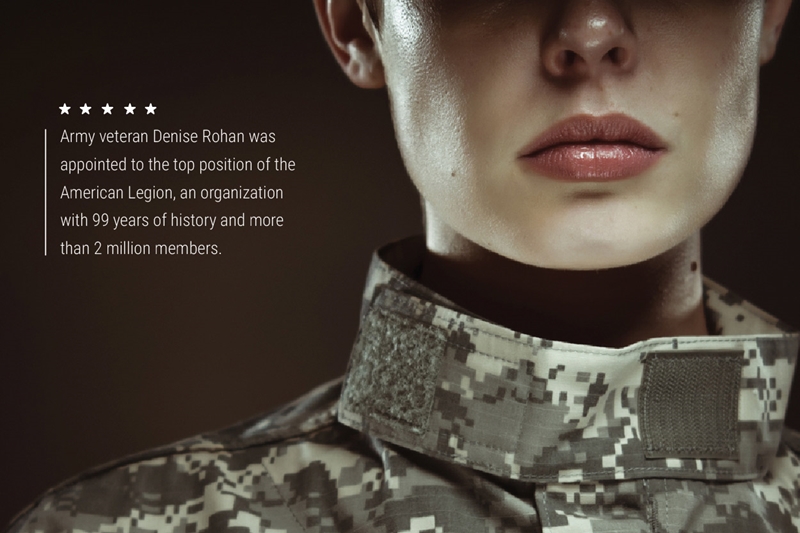
Denise Rohan: A veteran originally turned away
According to her official biography, Rohan left her Iowa hometown in 1974 to complete basic training at Fort McClellan, Alabama. She was honorably discharged in 1976, but not before meeting her husband, Mike.
During her speech at the Legion's annual convention in Reno, Nevada, this past August, Rohan recalled how she came to be a part of the organization. A recruiter came to her home in 1980 to convince her husband to join the local chapter. Rohan asked about joining herself but was told to contact the American Legion Auxiliary – a group for veteran's spouses – instead.
That incident did not stop her, however. Four years later, Rohan joined the Legion chapter in Sun Prairie, Wisconsin. She served various leadership positions before her current appointment as commander.
"When our organization was started back in 1919, our founders said, 'A veteran is a veteran,' Rohan said during her speech, according to Military.com. "So ever since then, women have been part of our organization. Women could vote for national commander of the American Legion before they could vote for president of the United States, and there are females leading this organization across the nation."
Delphine Metcalf-Foster: Advocating for women's health
Metcalf-Foster's father passed away when she was 7 years old, but his stories about his time as a Buffalo soldier stuck with her. She joined the army as a nurse at age 34, serving 21 years before suffering nerve damage in 1991. One year later, a DAV representative spoke to Metcalf-Foster and her fellow servicemembers about the organization, and she decided to join. She became the first female commander of the DAV's California branch in 2004 and, according to The Vallejo Times-Herald, was awarded Veteran of the Year by former congressional representative George Miller in 2009.
"As a female, disabled, combat veteran Delphine brings to her new position as the National Commander of DAV a truly unique set of skills and a broad base of knowledge that will be a tremendous asset to all," George Miller told the newspaper.
The issues at hand
Each of the newly elected officials will focus on specific veteran's issues during their tenure. Inspired by an incident in her own life, Metcalf-Foster said she wanted to highlight issues within the Department of Veterans Affairs that are specific to women. She once went to the VA for a knee replacement but wasn't given a female-specific prosthetic. Metcalf-Foster also plans to continue DAV's efforts to extend VA caregiver benefits to people injured before 9/11.
Rohan also intends to use her new position to further work with the VA. During an interview with NPR, she acknowledged that many veterans don't have access to proper care from the government organization, especially those in rural areas. However, she noted the Legion is opposed to privatization and would prefer to work with the VA to ensure all veterans get the care they need. She also discussed this year's theme for the Legion, which is "Family First."
The appointment of Rohan and Metcalf-Foster marks a significant moment in American veteran history. The two are evidence that women's contributions to the military are not to be discounted, and that they are just as capable and deserving of leadership as their male peers.
If you're a servicemember called up to active duty service or long-term deployment, you'll no doubt have a lot of important financial and legal questions: What will happen to my current rental agreement or mortgage? How will I handle any ongoing legal disputes, including court appearances?
Thankfully, you are entitled to financial relief and legal protection under the Servicemembers Civil Relief Act (SCRA). It's critical that you understand how this law impacts your rights and responsibilities so you can take full advantage of its benefits.
What is the Servicemembers Civil Relief Act?
In 2003, Congress passed the SCRA to protect soldiers, sailors, airmen, marines, coast guardsmen and commissioned officers in the Public Health Service and National Oceanic and Atmospheric Administration from being the subject of a lawsuit while engaged in active duty and for one year following it.
"The act's origin can be traced back to the Civil War."
The act's origin can be traced back to the Civil War, when Congress exempted Union soldiers from legal action while serving in the war. Since then, the law has existed in one form or another until it settled into its current form in 2003.
At its core, the SCRA is designed to ensure that active duty soldiers can focus all of their attention on serving their country and devote their entire energy to the defense needs of the nation without having to worry about a car lease or the interest rate on their credit card during this time.
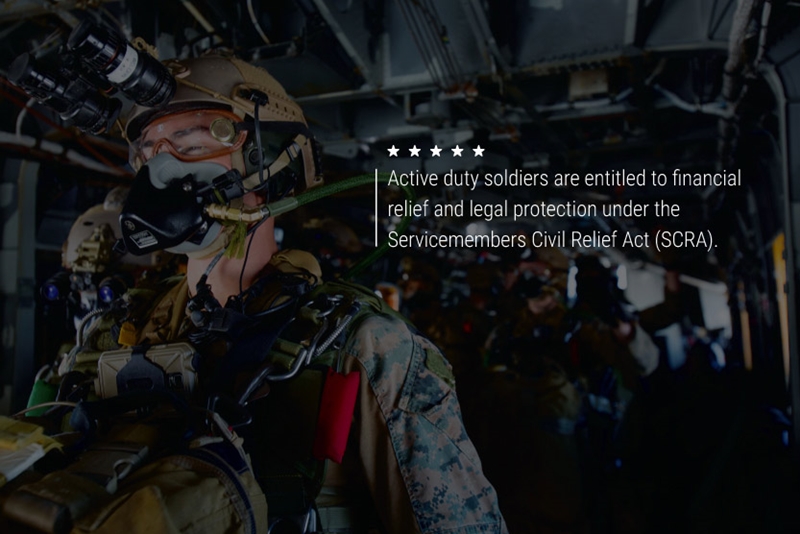
The benefits of SCRA
Much like most laws, the SCRA is a long, complex document full of legalese. While it has an abundance of provisions, these are the key points that you should know:
- Interest rate cap – You can cap any interest rate at 6 percent for any credit card, mortgage or other loan you or your spouse obtained prior to entering active duty status.
- Property lease termination/automobile lease cancellation – You generally have the ability to leave a residential or business property lease or cancel a car lease without penalty.
- Judicial relief – You have the option to postpone any court appearances for a civil case or civil administrative proceeding. This does not apply to any criminal court proceedings.
- Eviction protection – You and your immediate family are protected against eviction from housing due to nonpayment of rent. The monetary limit of the rental protection available changes every year, and was $3,584.99 per month or less in 2017, according to Military.com.
- State tax relief – If your service or deployment relocates you to a different state, your domicile or legal residence for tax purposes does not change. This means you are only responsible for paying state taxes wherever your home is, and not in every state you're relocated to during your service.
Since it deals with legal proceedings and financial obligations, SCRA is a complicated piece of public law. Therefore you should always ensure you speak with an Armed Forces Legal Assistance Attorney before you seek any relief or waive any of your rights under this act.