
Many people join the armed forces as a stepping stone to obtaining a college degree with the help of the G.I. Bill. While this is an excellent way to get the financial assistance you need to pursue your dreams of a higher education, sometimes a Bachelor's Degree isn't enough.
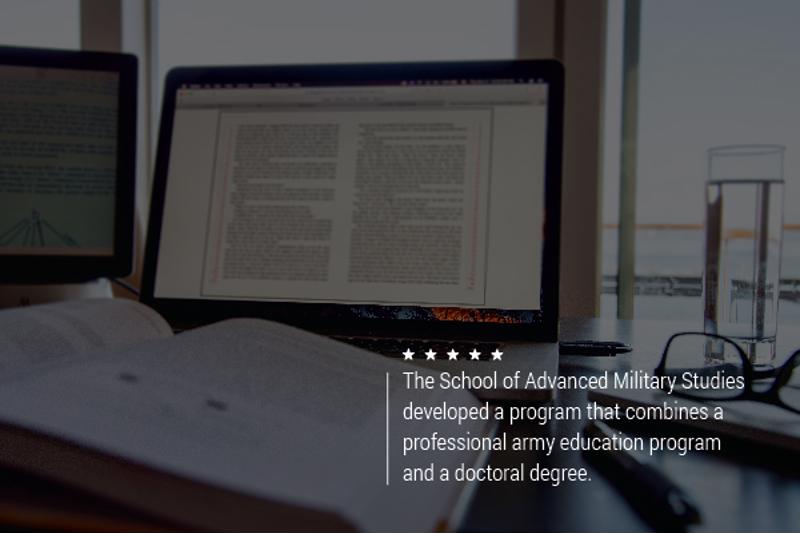
To assist soldiers with long-term academic goals, in 2012 the School of Advanced Military Studies developed a program that combines a professional army education program and a doctoral degree. Located in Fort Leavenworth, Kansas, the School created the Advanced Strategic Planning and Policy Program, or ASP3, that lets military officers study history, strategic theory and planning. Although there are only 60 officers currently participating in the program, there's plenty of room to grow.
Why should you get a PhD?
In the past, a Bachelor's Degree would give you a competitive edge in the job market once you transition into civilian life. In some cases, even other post-graduate programs like an MBA or a Master's degree won't suffice in the modern job market.
Obtaining a PhD with the ASP3 allows you to not only further your educational pursuits, but it also provides a pathway to development from a field-grade officer to a strategic planner and future senior military leader.
Not only does a doctorate give you a solid educational foundation and support for your future experiences, it also gives you a personal sense of accomplishment. This is especially true for people who enjoy surmounting challenging situations and for those who truly enjoy the learning-teaching process.
A PhD program is also a great route if you're interested in innovating and inventing new concepts, processes and fields of study.
"The ASP3 program is a promising career path for bright officers."
How do you know if you should get a PhD?
While earning a PhD will certainly help you obtain a higher-paying job, it isn't a path for everyone.
You'll be required to conduct countless hours of research and write a comprehensive thesis. However, if you have the ambition and the commitment, the program is a promising career path for bright officers who want to progress to the next level of leadership and still hold a command position.
Speaking with the U.S. Department of Defense's new teams, Army Col. Oscar Doward Jr., commander of the U.S. Army Central's 2503rd Digital Liaison Detachment, explained his reasoning for pursuing a PhD at the School of Advanced Military Studies.
"Applying for the program was an opportunity for me to earn a [doctorate], a desire I've always had," said Doward. "I also saw it as a great opportunity to have an effect on the strategic policy level."
Currently, Doward is writing his dissertation on "African-American officer development and evolution in the Army during the 20th century, focusing on the period between World War I and the Korean War."
Although juggling your military and academic responsibilities can be difficult, it opens the door to a number of great opportunities. But by taking a good look at where you want to be in five or six years time you can draft a plan of action that puts you on a route to getting your PhD while you're in the armed forces.
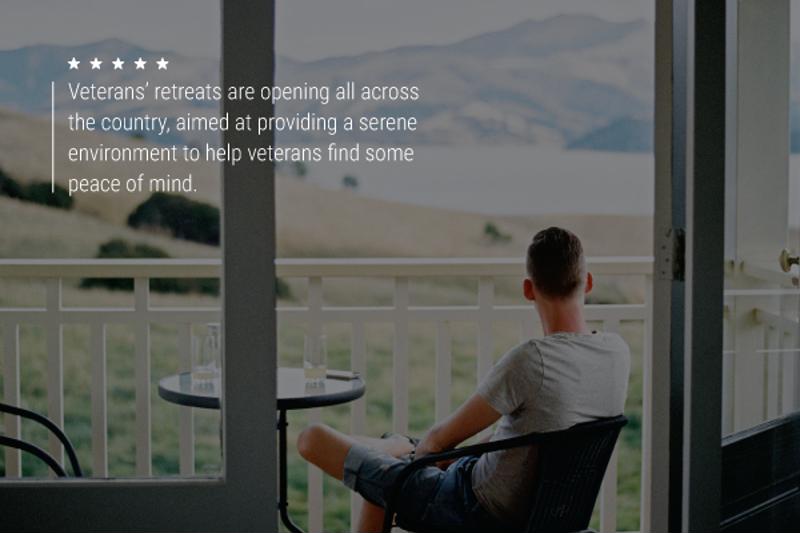
With all that veterans do and sacrifice to defend the country, these brave men and women need a place to recharge their batteries when they return home. In response to this need, veterans retreats are opening all across the country, aimed at providing a serene environment to help veterans find some peace of mind. Many communities even host fundraising events to assist veterans in covering the cost of a stay at the retreat.
Why veterans retreats are important
Being an active duty service member can be a grueling and exhausting experience. This is compounded when soldiers enter into combat zones, come under fire from enemy troops or live through other dangerous situations. Due to this, many returning troops come back from deployment with physical and emotional tolls that need to be addressed. Whether soldiers come home with a life-long disability, or suffer from Post-Traumatic Stress Disorder, it's important that they seek out the best ways to heal their body and mind.
In some instances, veterans rely on medication to help them deal with depression, anxiety, sleeplessness and physical pain. In addition to pharmaceutical solutions, veterans retreats offer a complementary way to help these individuals with the healing process.
What kinds of veterans retreats exist?
In recent years, there's been a surge in the number of retreat options for veterans, with many of them focusing specifically on a particular subset or group of veterans, such as disabled soldiers or those with families.
For instance, Operation We Are Here lists more than 60 different retreats all geared solely for veterans that provide support for caregivers, female veterans, PTSD, civilian reintegration, traumatic brain injury (TBI) and wounded warriors. These retreats come with a range of therapeutic opportunities at certain locations, including:
- Biking
- Horseback riding
- Farming
- Golfing
- Hyperbarbic oxygen therapy (HBOT)
- Healing arts (art, dance, film, theater, writing)
- Music
- Outdoor activities (white water rafting, scuba diving, sporting events, fishing, etc)
- Service dogs, therapy dogs and companion pets
- Volunteering and community service
While some veterans retreats do cost money, a large percentage of them are absolutely free for veterans, and sometimes for their families too. Each one focuses on its singular mission, which means there are specific retreats for nearly all aspects of life. Similarly, each location is unique.
"A large number of veterans retreats are actually free."
One example, Project Sanctuary, aims to help veterans transition from battle-ready to family-ready by addressing three areas: counseling, education and therapeutic recreation.
Another retreat, a 277-acre property in Franklinville, New Jersey, is currently building 60 microhousing units (tiny houses) for veterans to spend 24 months at the compound and rehabilitate themselves upon their return from deployment. The retreat, which its founder, Donnie Davis, intends to be free of charge for veterans, will also provide soldiers with work skills and the opportunity to undergo equine therapy.
Many retreats cater specifically to wounded veterans, but each one brings its own unique perspective to this endeavor. For instance, veterans who like to be active can check out Combat Veterans Sports Foundation, which provides wounded combat veterans with the opportunity to volunteer through professional sports organizations. Another, Fairways for Warriors, offers golf equipment, instructions and outings for wounded veterans and their families.
While many soldiers will no doubt say they don't know the meaning of the word "retreat" in the context of a battle, there are plenty of ways attending a retreat can help heal these individuals, both physically and emotionally.
With Independence Day upon us, Americans are hosting patriotic parades, parties and fireworks displays across the country to celebrate our nation's founding and thank our veterans for fighting for our freedom.
Why is July 4 Independence Day?
After the Revolutionary War started in April 1775, the Second Continental Congress did not vote on the issue of independence from Great Britain until July 2, 1776. Writing in his journal, John Adams, who would go on to serve as our second president, believed this day would go down as the founding of our new country, according to the National Archives. But as we all know, this isn't the case. So what happened?
Following the unanimous decision to reject British rule, the committee appointed Thomas Jefferson to draft the formal written explanation stating why the Congress voted to declare independence. Two days later, July 4, Congress ratified and issued the Declaration of Independence. In doing so, the Founding Fathers severed America's ties with the British crown and set the course for the formation of the United States.
How the army responded to news of Independence
The signing of the Declaration of Independence had a profound impact on the military at the time. The announcement changed the armed forces from a ragtag band of colonial militias into the unified Continental Army. This also reshaped their purpose, since now they were fighting against British rule and for the ideals that would come to shape our country.
"The Declaration of Independence had a profound impact on the military."
Since news traveled so slowly during the Revolutionary War era, many soldiers had to wait days and weeks to learn the Continental Congress adopted the Declaration of Independence, according to the National Museum of American History. After the 56 delegates signed that historic document, they dispatched couriers by land and sea to deliver the news to headquarters of all the Continental Army commands. While General George Washington and his troops heard the news in New York City square on July 9, it took until August 5 for word to reach troops stationed in Charleston, South Carolina.
According to the source, after hearing about the signing of the Declaration of Independence, soldiers lined up next to two rows of 13 cannons and fired 13 shots to represent each colony, followed by a fusillade. They repeated the ceremony three times. Following speeches and cheers, the soldiers would then indulge in games or drinks. In some places, such as Charleston, the troops paraded and read the Declaration aloud.
On July 15, 1776, Captain Joseph Bloomfield of the 3rd New Jersey Continental Regiment recorded in his journal the account of hearing our founding document:
"The Declaration of Independency being read, the whole present signifyed their hearty & sincere Approbation by Three Cheers and cheerfully drinking the following Patriotic Toastes, Harmony, virtue, Honor and all Prosperity to the free and independent United States of America, Wise Legislatures, brave & Victorious Armies, both by Sea & Land to the American States."
More than 225 years later, these words still ring as true as ever.
Keep our soldiers in mind this holiday
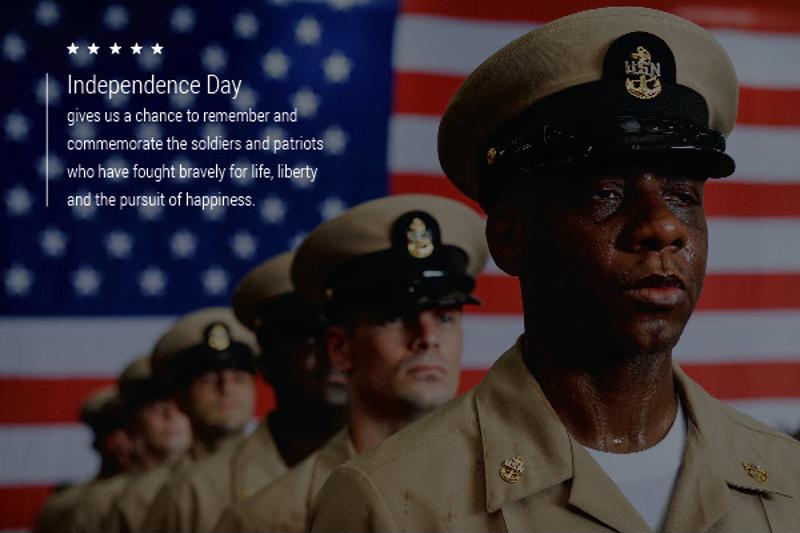
Independence Day gives us a chance to remember and commemorate the soldiers and patriots who have fought bravely for life, liberty and the pursuit of happiness. Their service since the Revolution continues to protect the values we hold dear today.
Whether it's going to a parade, hosting a celebration or attending a ceremony, remember to thank members of the armed services for fighting for our freedoms.
The U.S. Department of Defense recently introduced the new and improved Blended Military Retirement Plan. There are some significant changes to the system and calculating the difference between the old and new military retirements plan might be a difficult endeavor for current service members.
Let's shed some light on the new BRP: What is it, who's impacted by it, and how do you navigate the new system.
How big is the change?
The upgrade isn't a minor tweak of the military's current retirement system, rather it's a sweeping disruption. Anthony Kurta, who is performing the duties of undersecretary of defense for personnel and readiness, spoke with Pentagon reporters about this key step in modernizing the military's retirement system to more closely align with similar private-sector plans.
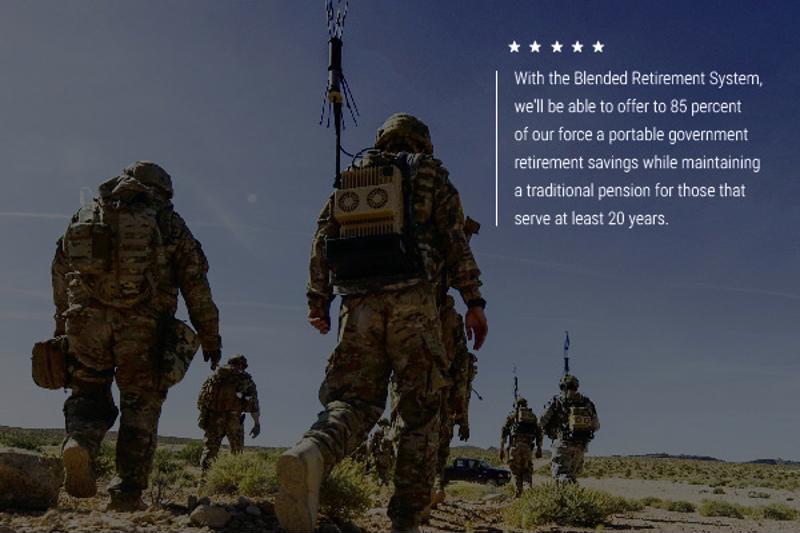
"[The new military retirement system is] one of the most significant changes to military pay and benefits that we've ever had over the past 70 years," explained Kurta. "We'll now be able to offer to 85 percent of our force a portable government retirement savings while still maintaining a traditional pension for those that serve at least 20 years."
What is the Blended Military Retirement Plan?
Now that we know it's a pretty big deal, let's dive into what the changes mean. The 2017 National Defense Authorization Act (NDAA) originally introduced the change that will affect all new entrants to the military as of Jan. 1, 2018. The change, known as the Blended Retirement System, is a dramatic departure from the military's current retirement plan. As it stands, immediately upon retirement, the military awards 50 percent of base pay as a pension for qualifying services, according to Military Times.
"The new system merges a defined benefit plan with a defined contribution plan."
However, the new Blended Retirement System merges the defined benefit plan with a defined contribution plan, which is similar to a 401(k). Dubbed the Thrift Savings Plan, this feature will add up to a 5 percent match on all personal contributions to the plan.
Who's impacted by the change?
Anyone who joined the military before 2006 is automatically grandfathered into the old system. Meanwhile, anyone who joins in 2018 or beyond will be covered by the new system. However, active duty service members with between one and 12 years must decide between either the old system or the new system. This is no easy decision, yet about 1.15 million service members, or roughly 88 percent of all active duty military, fall into this third category.
How to navigate the new system
Thankfully, active duty service members don't have to make their decision immediately – they'll have one year to make a choice on which plan they'll want to use. This provides ample time to speak with support groups, such as family and friends, consult with an accountant or other wealth management advisors and make an informed decision about the best path forward.
To assist in the decision-making process, the military rolled out a Blended Retirement Service Comparison Calculator designed to assist eligible service members in their efforts to compare and contrast the new and old systems.
It will be crucial for those active duty military members who will be impacted by this change to review the Blended Retirement System to ensure they fully understand the changes and they make the most informed decision on the fate of their retirement.
Post-traumatic stress disorder is a pervasive affliction that affects active duty military members, veterans, first responders and even government contractors working in combat zones.
Spreading awareness of PTSD
"In 2010 Congress designated June 27 as PTSD Awareness Day."
In 2010, Congress designated June 27 as PTSD Awareness Day to promote visibility and effective treatment for the affliction. Four years later, Congress set aside the entire month of June for National PTSD Awareness. The goal is to increase knowledge among the public about issues related to PTSD, to encourage those suffering from this affliction to seek help and to provide insights into caring for family members coping with PTSD.
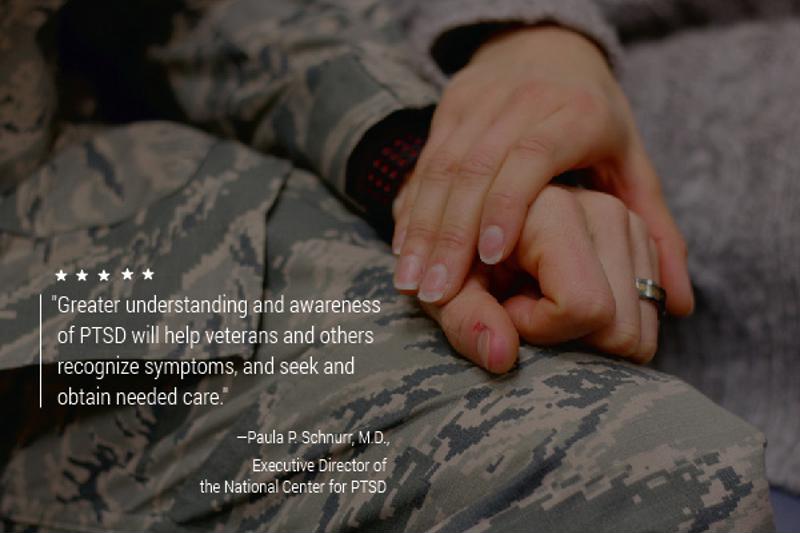
"Greater understanding and awareness of PTSD will help veterans and others recognize symptoms, and seek and obtain needed care," explained Paula P. Schnurr, M.D., executive director of the National Center for PTSD.
During June, government agencies, advocacy groups, medical associations and other PTSD-related associations come together to boost awareness for the condition.
How common is PTSD?
The nature of the environments where military members and first responders work puts them in precarious and sometimes life-threatening situations and the lingering trauma can have a big impact on their lives. These traumatic events can lead to:
- Nightmares.
- Flashbacks.
- Trouble sleeping or concentrating.
- Negative feelings.
Often people experiencing PTSD think they're alone, but the truth is it is far more widespread than many might believe. Veterans often have higher incidences of having stress disorders. According to VA statistics, veterans with PTSD account for:
- Between 11 and 20 percent of soldiers who served in Operations Iraqi Freedom and Enduring Freedom.
- Around 12 percent of Gulf War (Desert Storm) veterans.
- An estimated 30 percent of military members deployed in the Vietnam War.
While veterans comprise a large percentage of those with PTSD, first responders are also regularly exposed to the types of traumas that lead to stress disorders. A recent report published by the International Association of Fire Fighters found that firefighters and paramedics suffer from PTSD at similar levels to veterans.
Writing on the American Military University's website In Public Safety, faculty member Michelle Beshears explained how police officers often experience cumulative PTSD – the result of repeated stress-related incidents.
Further, PTSD is not strictly limited to the military and first responders. The VA also noted that roughly 7 to 8 percent of the U.S. population will experience PTSD at some point. In a year, approximately 8 million U.S. adults have PTSD. However, many won't seek treatment for a number of reasons.
What you can do to help
If you know anyone who might be suffering PTSD, be sure to offer support. While not everyone will want to discuss the issue, it's important to let them know you're available to help.
If a dialogue about the person's PTSD opens up, encourage him or her to seek treatment. There are a variety of centers and organizations that offer options for assistance and care.
Congress mandated the formation of the VA's National Center for PTSD in 1989 to address the needs of veterans with military-related PTSD. They have extensive research, education material and training opportunities for advancing the social welfare and clinical care of veterans with stress disorders.
In addition, non-governmental groups like Operation We Are Here provide an extensive directory of resources for those who have experienced a traumatic incident. From anonymous self-assessments and financial assistance to veteran service organizations and reintegration sources, there are plenty of options available to help.
By spreading awareness and contributing to ongoing treatment efforts, everyone can lend a hand in combating PTSD.
There are many ways that companies and communities show their support for the brave men and women who protect our great nation. From organizing benefits and raising donations to hosting gatherings and simply saying "Thank you," these acts of kindness and generosity go a long way toward welcoming soldiers back from deployment and encouraging firefighters, police officers and other heroes to continue their efforts.
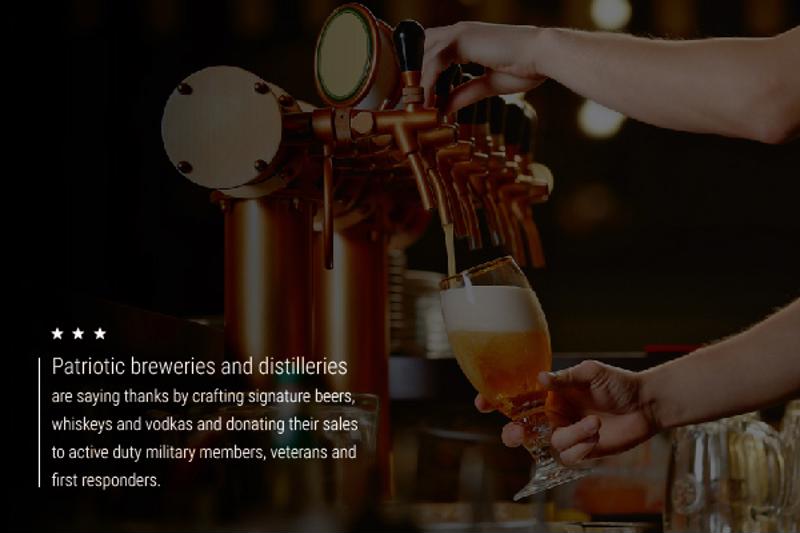
For instance, patriotic breweries and distilleries are saying thanks by crafting signature beers, whiskeys and vodkas and donating their sales for active duty military members, veterans and first responders. Other establishments provide discounts for these individuals. As craft breweries and local distilleries grow in popularity all across the country, the efforts these owners put forward demonstrate their gratitude. These are a great way to give back to soldiers, while also having some fun yourself.
Check out these companies doing their parts to lift spirits for those who serve:
Refreshing first responders
Virginia Distilling Company is one organization showing its appreciation for the heroics of local first responders, according to Nelson County Times. In April, the distillery launched the Nelson County First Responders Single Cask, with the net proceeds of sales donated to local fire and EMS crews.
Virginia Distillery CEO and Chairman Gareth Moore said they wanted to help the first responders for their work in fighting a wildfire that destroyed more than 1,500 acres in Livingston.
"There are no words to describe how thankful we are for the Nelson County first responders who assisted this past November when there was a forest fire behind the distillery," said Moore. "We're so excited that this special release will be able to benefit such an important group of people within our community and that we can give back in this way."
Another example is recently opened Loose Rail, a local brewery in Columbus, Ohio, which offers all first responders and active and former military personnel a 10 percent discount. The bar also boasts the original 48-star flag flown on the USS Compton in 1945 at the end of WWII in Tokyo Bay, which initiated Japan's formal surrender five days later.
Serving our soldiers
Just like the support shown for first responders, craft brewers and local distillers have been serving up special drinks for active duty military members and veterans.
Beer and Brewing recently highlighted 12 different breweries that have been playing a part in lifting spirits for the troops. There's Veteran Beer Co. in Chicago that donates a portion of their revenue to help veterans while also employing them. Gettysburg's Battlefield Brew Works's Red Circle Ale provides children of Special Operators with enrichment scholarships and the emergency gap funding for injured soldiers and their families.
For cocktail afficionados, Warrior Vodka uses revenue to provide monetary grants to disabled veterans wounded in combat. Jonathan Jans, an injured veteran himself, partnered with Mid Oak Distillery, the makers of CD Vodka on Chicago's Southside, and launched the line of vodkas to help those who sacrificed for our country.
With all that active duty military members, veterans and first responders sacrifice to keep us safe, it's great to see breweries and distillers providing grants, savings and other financial and moral support for these groups.
The Space Available Travel program, better known as Space-A or HOPS, offers Department of Defense members and their families open seats on flights at no charge. Hurlburt Air Force Base recently joined the ranks of participating bases in the the Space-A program, according to the base's news page.
Hurlburt Field welcomes HOPS
The first Space-A flight took off from Hurlburt Field April 8, 2017, en route to Las Vegas, Nevada. The efforts follow three months of planning and execution by the 1st Special Operations Logistics Readiness Squadron air transportation team and it amounted to a major success.
"The efforts follow three months of planning and execution."
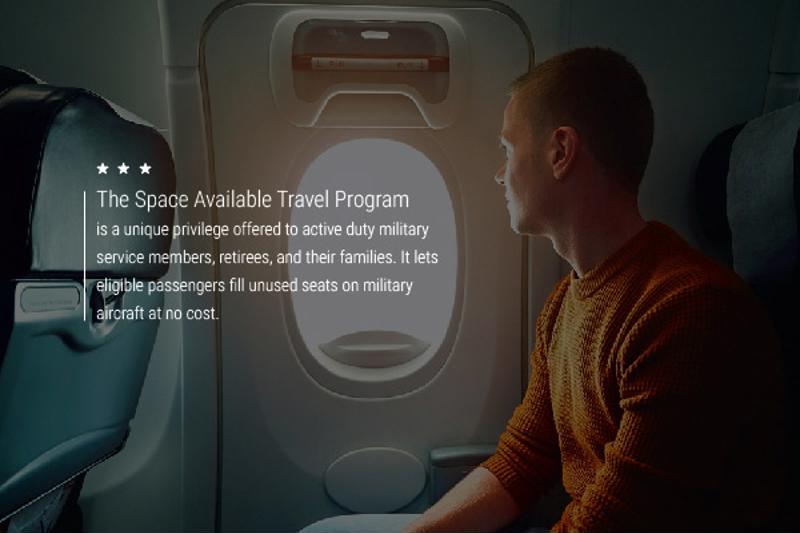
This unique privilege offered to active duty military servicemembers, retirees, and their families lets eligible passengers fill unused seats on military aircraft at no cost. With Hurlburt Field now supporting air travel for the Space-A program, Gulf Coast servicemembers can take advantage of this great opportunity.
Master Sgt. James Tompkins, superintendent of air terminal and aerial delivery at Hurlburt Field, noted that a study showed the 1st SOLRS air transportation shop fell under the classification for both an aerial delivery shop and a small terminal. This officially made Hurlburt a Space-A supported base and kickstarted the entire process.
The source noted leave status, type of leave and a first-come, first-serve will form the basis for seat assignment.
- Emergency leave.
- Environmental morale leave.
- Active duty military on leave.
- Dependents when sponsors are deployed.
- Command sponsorship.
- National Guard, Reserves and retirees.
"Colonel Palenske has said if it's going to improve our Airmen's lives and not going to be a negative factor let's go ahead and do it," explained Lt. Col. John Klohr, commander of the 1st SOLRS. "It's a way of saying 'thank you for your service'."
This provides another opportunity for both active duty military members, veterans and their families to take advantage of free air travel.
Other travel options
While the HOPS program offers a great benefit for current and discharged soldiers, it's not the most reliable means of transportation for someone on a strict schedule with little room to maneuver. These flights don't operate like normal commercial aircrafts. This means there typically isn't a backup flight if the plane gets diverted or canceled, in addition to there not being any guaranteed seats in the first place. Servicemembers should still seek out any opportunities for Space-A flights when they get the itch to travel, but they should remember they also have other discounted recreational options available to them.
The U.S. army also manages the Armed Forces Recreation Center, which offers affordable joint service hotels and resorts for servicemembers and their families. These locations in Florida, Hawaii, Germany and South Korea are great destinations for a vacation.
The Armed Forces Vacation Club arranged low rates for the military at more than 3,500 companies, including hotels, resorts, campgrounds, cruise lines, air fare, rental cars and more.
From HOPS to discounted travel options, active duty military members have many convenient options to take a much-needed vacation, visit family or go on a new adventure.
With Loyalty Day on May 1, Victory in Europe Day on May 8, Military Spouse Appreciation Day on May 12, Armed Forces Day on May 20 and Memorial Day on May 29, this is a big month for the military. Due to the number of days honoring the armed forces, in 1999 Congress designated May as National Military Appreciation Month, according to Military.com. These days of national unity offer an opportunity for everyone to honor, recognize, remember and appreciate all those who have served and continue to serve our country.
- Loyalty Day kicks off the month-long celebration as a day set aside for everyone to reaffirm their loyalty to our great nation and take a moment to reflect on the proud heritage of our unique American freedom.
- Victory in Europe Day commemorates the Allies acceptance of the German surrender to end World War II in Europe.
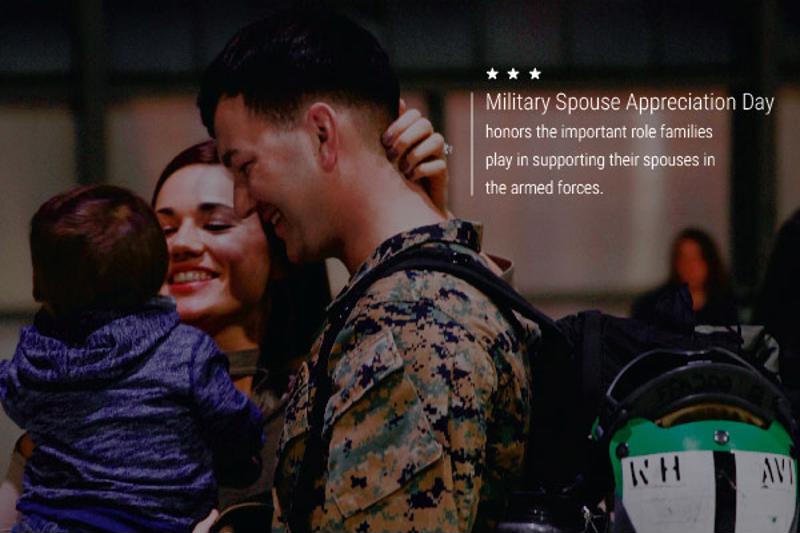
- Military Spouse Appreciation Day honors the important role families play in supporting their spouses in the armed forces.
- Armed Forces Day is when when citizens can show their appreciation and thanks to everyone serving in the U.S. military branches, including the Air Force, Army, Coast Guard, Marines and Navy.
- Memorial Day, while traditionally the kick-off to summer for most people, is one of the most cherished days for remembering and honoring the sacrifices made by those men and women who gave everything for our country.
"Retailers, restaurants and recreational organizations are providing discounts and promotions."
Some of the great benefits during this month
As a way of celebrating National Military Appreciation Month, many retailers, restaurants and recreational organizations provide discounts and promotions for members of the armed forces and veterans.
Home Depot and Lowe's offers a 10 percent discount on all in-store purchases on Memorial Day.
Blue Star Museums, in collaboration with the U.S. Department of Defense, the National Endowment of the Arts and Blue Star Families, offers free admission to military members starting Memorial Day and going through Labor Day.
Various hotels, such as Hilton, Red Roof Inn and Westgate Resorts also offer a 10 percent discount to all active, reserve or retired service members, offering a great incentive to hit the road and take in some much-needed relaxation.
Military families who want to take advantage of these hotel discounts, can take a trip and receive a discount at the following amusement parks and tourist sites:
- California's Great America.
- Carowinds in Charlotte, North Carolina.
- The Cincinnati Zoo.
- Colonial Williamsburg.
- Kings Island.
- Michigan's Adventure.
- Valleyfair.
In addition to these national chains offering great perks for military members and their families, small businesses and local organizations all across the country are also doing their part with various discounts and promotions. From parades to concerts to special events, people everywhere will be showing their support for the brave men and women who keep our country safe.
While most people tend to think of adults when it comes to the armed forces, children and teenagers play an important role in the military family. From dealing with a deployed parent to moving from one base and school to another, military children face their own set of challenges that most kids their age never have to experience. To applaud the commitment and sacrifices made by the youngest members of military families, the Department of Defense Military Community and Family Policy (MC&FP) designated April as the Month of the Military Child.
Spotlight on the military child
Started by Defense Secretary Caspar Weinberger in 1986, all the branches of the armed forces honor the Month of the Military Child in their own way. For instance, the Department of Defense Education Activity (DoDEA) celebrates these brave youths by:
- Implementing strategies designed to prepare DoDEA students more thoroughly for college and career readiness.
- Challenging students to embrace their full potential and excel academically, socially, physically and emotionally.
- Creating the organizational capacity to maximize the effectiveness and efficiency of its model, unified school system.
As noted by National PTA, since the 2001, about 2 million military children have seen one of their parents be deployed. Further, more than 900,000 youths have had one or both of their parents deployed multiple times. Currently, there are 1.2 million children around the world with a parent who's on an active duty.

Supporting military children
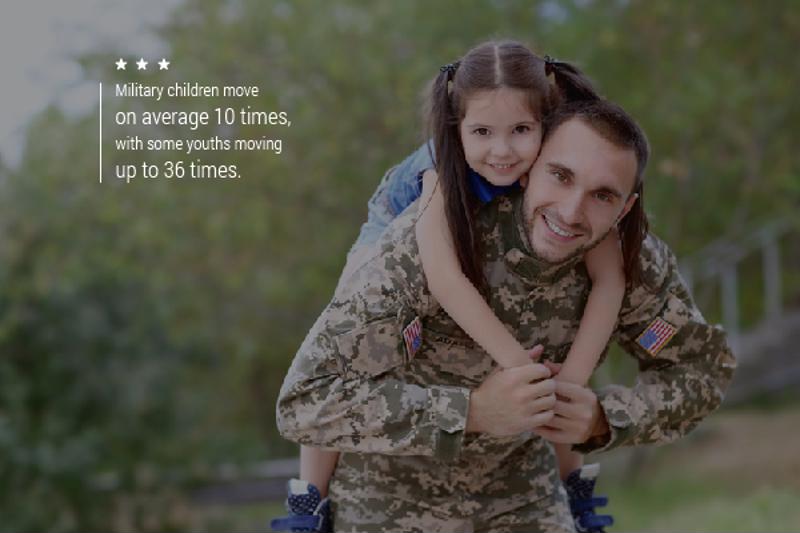
Regularly switching home, communities and schools can place a stressor on military children that other kids don't always have to face. Compared to civilian children, children in a military family will move, on average, about three times more often throughout their youth, the PTA noted. All told, military children move on average 10 times, with some youths moving up to 36 times.
From schools to sports to community programs, there are organizations and groups of all sorts that help children deal with some of the stressors arising from their unique experiences. For instance, the University of Southern California houses an entire department solely dedicated to researching and supporting military children in school. This is extremely helpful, as the PTA noted that it takes a school-wide effort to support military children during their transitions.
In March, the Washington Capitals hockey team invited more than 200 military members and their families to enjoy a night of ice skating at the Kettler Capitals IcePlex in Arlington, Virginia, according to the official blog of the Coast Guard workforce, All Hands. Several players of the team also came out to meet with the families.
One way that families with active duty servicemembers can alleviate some of their children's stress that arises from the constant moving is by adequately preparing them for the transition. All Hands noted that being honest with the children about what is happening should be a top priority. Communicating with children helps reassure them about the move and makes it easier to adjust to the changes. Further, providing fun activities for the trip, whether it's a short plane ride or a cross-country drive, can help.
Another way that organizations and groups show their support is by offering scholarships for military children. From Fisher House, a nonprofit organization that helps servicemembers and their families, to the Corvias Foundation, a private, charitable group, military children have plenty of options to choose from to pursue scholarship opportunities.
While their childhood might be a bit different than their civilian counterparts, military youths enjoy the support and gratitude from everyone for their strength and perseverance during what can sometimes be tough times.
From Sara Emma Edmonds, who served in the Civil War as a man to Army Gen. Ann E. Dunwoody, the first female 4-star general, women veterans have made considerable contributions to the U.S through their service.
Comprising 10 percent of the armed services veteran population in the United States and projected to grow to 15 percent by 2030, women veterans experience some unique challenges and opportunities compared to male veterans, according to the U.S. Department of Veterans Affairs.
With more than 2 million women veterans there are many programs in place to provide an easier way for female veterans to transition back into civilian life and get started on their next chapter, whether that's going to school, starting a family or opening their own business. The National Woman's Veterans Summit serves as one such event where individuals can come together to learn about issues that affect women veterans, such as entrepreneurial training and opportunities.

The National Women Veterans Summit
The 2017 National Women Veterans Summit, originally scheduled for April but now moved to August, will celebrate the storied history and sacrifices made by women in the armed forces. The event, which takes place in Dallas, offers women veterans and their families a great opportunity to spark dialogues and collaboration among:
- Private industry.
- Nonprofit sector.
- Federal government.
- Innovators.
- Researchers.
- Caregivers.
This event marks the first national-level summit for women veterans since 2011 and will provide a platform to discuss the issues important to women veterans, on topics such as:
- Employment.
- Mental health.
- Entrepreneurship.
- Military sexual trauma.
- Reproductive health.
- Culture change.
While all of these are important women veterans issues, many attendees visit the summit for the chance to learn more about starting a new business or growing a current one.
Entrepreneurial aspirations
One of the more popular aspects of the National Women Veterans Summit is the guidance and workshops for boosting entrepreneurship among women veterans. Women veterans own more than 380,000 small businesses, according to the VA. Not only are these owners seeking new networking opportunities, many entrepreneurs and prospective founders attend the summit for guidance on how to get their business ideas up and running.
To help women in their pursuit of following the American dream and starting their own business or growing a current one, there are many different programs and resources already available for female veterans.
One such program is the VA's Office of Small and Disadvantaged Business Utilization, which helps veterans navigate the federal procurement system and increase participation.
The U.S. Small Business Administration also has several programs and offers several grants for women veterans. Some of these grants include the Veteran Women Igniting the Spirit of Entrepreneurship and the San Antonio Lift Fund, a seven-week entrepreneurship program. Late last year, the SBA and the VA partnered together to provide $300,000 in funding for women and veteran-owned businesses by granting up to six awards of at least $25,000.
The Coalition for Veteran Owned Business serves entrepreneurial military veterans by connecting them with additional programs for education and training on commerce and supplier opportunities.
For those individuals who need a place to network, collaborate and exchange ideas, Women As Veteran Entrepreneurs provides a forum for small-business owners to connect with subcontracting and mentoring opportunities, strategic information, business teaming and more.
With a proud history in the military and many outreach programs available, women veterans have many promising entrepreneurial opportunities awaiting them when they finish their service to our country.