
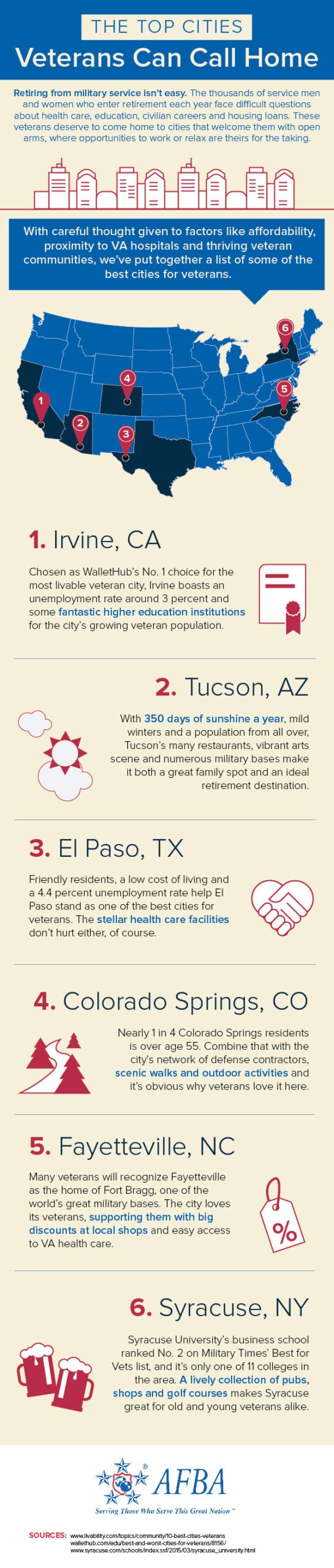
There are few life changes bigger than that involved in transitioning from military service to the civilian world. The thousands of servicemen and women who do it each year know it isn’t easy to trade the uniform for a dress shirt and tie, or base housing for a private home or apartment.
Questions over health care, education, employment and much more have to be answered, preferably a few months before actually being discharged. One way to make the transition to a life after service easier is if servicemembers know they’re coming home to cities that welcome them with open arms, where opportunities to work and relax are theirs for the taking.
What would such cities look like? Which factors would determine their suitability for veterans? Affordability is obviously a key concern. Housing, including single family homes, condos and apartments, would have to be within an achievable price range, with guarantees that prices wouldn’t skyrocket in the next few years. That rules out some major cities but opens plenty of other options nationwide.
Proximity to Department of Veterans Affairs hospitals and care providers is obviously essential. Veterans need to have immediate access to medical support, both of the physical and emotional kind, so that rules out deep, rural areas and urban areas with only limited facilities.
Here’s another factor to consider – a sense of community. One of the great benefits of military service is the camaraderie and fellowship of being with like-minded men and women united in a patriotic effort. Many veterans miss that sense of togetherness when they leave, but they don’t have to. Veterans communities exist all over the country, and they’re often just as important to the happiness and well-being of retired servicemembers as a quality hospital or bright employment outlook.
Considering these requirements and many others, here’s a list of some of the best cities for veterans.
Small gestures of kindness and recognition can sometimes have a very big impact on veterans.
The Washington Post recently reported that members of the Washington Nationals professional baseball team decided to give a veteran a truly unforgettable gift. According to the news provider, the team had been in Viera, Florida for spring training, which was also where army veteran Joe Stanfield moved to be closer to a VA.
A lover of baseball, though with his allegiance more tied to the Atlanta Braves, Stanfield was watching the team play at a field very close to the VA when the players walked over. Rather than signing a baseball, the source explained that the team decided to sign Stanfield's golf cart.
"'I'd lose a baseball," Stanfield told the Washington Post. "I don't think I'll lose a golf cart."
The news provider noted that Stanfield had completed three tours in Iraq.
These types of simple, genuine methods of honoring veterans can positively affect a community as well. The Reporter published a letter to the editor from one individual who pointed out that such events have improved the connections across diverse members of his community.
The Arizona Coalition to End Homelessness estimates that there are roughly 556,729 veterans living in the state, which is about 2.5 percent of all servicemembers in the United States. Local and state government officials have been working to improve the quality of living among this community's members through programs related to homelessness and post-traumatic stress disorder.
Tucson News Now recently reported that Senator John McCain, a decorated veteran himself, spoke at a town hall to discuss some of the programs being launched to improve health care for veterans living in Arizona. Although the state has been involved in national initiatives including the Veterans' Access to Care through Choice, Accountability and Transparency Act, the source pointed out that the senator's announcement related to his own plan.
According to the news provider, the Care Veterans Deserve program would work to improve the ways in which veterans seek and acquire medical care, especially for needs that transcend PTSD.
"The VA does a magnificent job with PTSD, with traumatic brain injury," McCain told Tucson News Now. "But there are many other areas of medical care that it can be done as well or better by a private health care provider."
The news provider noted that McCain made it a point to discuss the ways in which all of these programs intertwine in the lives of veterans, such as how homelessness contributes to medical-related issues down the road. His plan seeks to take a more comprehensive approach to caring for veterans and positioning them for success.
Veterans in Arizona and other states should keep their eyes open for announcements such as this one, as more officials are pushing to advance care for servicemembers beyond the scope of traditional treatments and services.
Most people don't realize that veterans make some of the best business people around. In fact, many of the most popular countries in the United States got their starts in the minds of former servicemembers or are now under the watchful leadership of a veteran. Take a look at the list below to get a closer look at some of the most well-known veteran-run businesses.
Johnson & Johnson
Alex Gorsky, the CEO of this mega company, is a proud graduate of West Point Academy, according to Business Insider. Gorsky's military career lasted six years, during which time he was a member of the Rangers and earned the Captain ranking. Gorsky's service took him all over the world before bring him back to the U.S. to head Johnson & Johnson.
Casey's General Store
After serving the Army in Germany, Vietnam, Saudi Arabia, and Kuwait for 22 years, Robert Myers returned to America. According to Business Insider, this is when he began working for a Casey's General Store. Myers eventually earned himself the role of CEO of the company and remains in charge today.
Verizon
This communications giant is helmed by Lowell McAdam. The Veterans United Network stated that McAdam served as in US Navy Civil Engineer Corps for six years. Now, the former servicemember is CEO of one of the nation's leading communications providers.
Proctor & Gamble
According to Business Insider, Robert A. McDonald, the current CEO of Proctor & Gamble, wrote his congressman at 11 years old to ask for special permission to enter military service. When McDonald reached legal age, he entered the Armed Forces. He was put in the 82nd Airborne Division where he served until he retired. McDonald is now the head of Proctor & Gamble as well as the secretary of Veterans Affairs.
General Motors
This massive automotive company is another veteran-headed company. Daniel Akerson, the business' former CEO, spent five years as a Navy officer before assuming his role at the helm of General Motors, according to the Veterans United Network. Akerson reportedly comes from a long line of military service.
Veterans interested in pursuing entrepreneurial interests should look to their predecessors for inspiration. Many proud former servicemembers have started some of the country's most important and successful enterprises, and many of them have their military service to thank for giving them the drive necessary to complete these goals.
Many military servicemembers have families that live with them on-base. However, raising children amidst the hustle and bustle of the base and under strict military schedules can be difficult. AFBA has composed a list of tips to help parents raise families despite the semi-chaos of military life:
1. Establish a routine and stick to it.
Between relocations and the deployment of parents, military children may have a difficult time adjusting. To help your children find stability and normalcy, try to create a schedule with them. This means waking up around the same time each day, following a similar routine throughout the day and going to bed about the same time each night. Erratic sleep schedules or unpredictable daily routines can make it difficult for children to adjust to change.
2. They are children, not cadets.
As a military parent, it can be challenging to separate your work life from your home life, especially when it comes to your children. Do your best to avoid treating them like part of your unit. They will make mistakes, get messy and disobey. They are children, after all. It can be tempting to put them under the same strict regimen as your soldiers. Try to remember that they are young and are learning. This will help keep your relationship from souring.
3. Give them emotional outlets.
Whether they are dealing with a parent deploying or a cross-country move, military children have a lot to deal with. With all of their experiences come plenty of emotions. If your children do not have an outlet for their thoughts and feelings, it could become a problem. Make it clear that your are available to talk with them if they want or set up some time on a regular basis for them to talk with a military youth counselor.
4. Carve out family time.
Sure, military life is hectic, but it is important for children to get family time. If you or your spouse are available, schedule family meals on a regular basis or try to go for a family outing. If one of your is deployed, make an effort to video call your family on a regular basis, if possible. Even a few minutes of face-to-face screen time can be beneficial to both the children and the military parent.
5. Socialization is important.
Change is a big part of military children's lives. It is important that, despite frequent moves, they learn to socialize properly with their peers. Encourage your children to get active in groups on-base and to participate in activities. With a little support, they will learn to reach out to others and make healthy connections.
There is something entirely unique and special about growing up a military child. As a military parent, it is your job to help your children develop good social skills, healthy coping habits and strong family bonds. Hopefully, the tips listed above can help you accomplish this mission.
The Vietnam War began more than 50 years ago, and many local communities have taken to honoring the veterans who served there through various events. The National Vietnam Veterans Foundation explained that more than 2.7 million Americans served in Vietnam during this war, while nearly 60,000 gave their lives for their country. Now, five decades later, nonprofit organizations, businesses, government agencies and others are working to ensure veterans know they are appreciated.
In 2008, the federal government passed a portion of the 2008 National Defense Authorization Act to ensure that a commemoration would take place for veterans of the Vietnam War, and ceremonies are taking place planned across the nation as a result. The Vietnam War Commemoration's official website states that there are 5,256 events that have already occurred or will soon, while more than 9,700 partners have been involved in the project. One ceremony was recently held in Boston, Massachusetts.
A long time coming
The Boston Globe recently reported that the VA Medical Center in Jamaica Plain, a neighborhood in Boston, conducted a commemorative event to honor Vietnam War Navy veteran John Wilkinson for his service. According to the news provider, the ceremony also brought together 59 other local veterans and was part of the national Vietnam War Commemoration. Individuals involved in the planning of the event spoke to the importance of such ceremonies.
"This is an opportunity for us to stop for a moment and acknowledge the sacrifice and the things that they did for this country," VA Regional Benefits Office director Bradley Mayes told The Boston Globe. "They really paved the way for generations of veterans that came after them."
The source noted that this particular war was not popular among civilians back home, and that many veterans returned to hostile conditions stateside taking place. However, The Boston Globe pointed out that Vincent Ng, system director for VA Boston Healthcare, argued that these ceremonies are a great way to right those wrongs.
"It was a controversial time," Ng told the news provider. "Today's ceremony really makes all of us feel better, and feel good that they are not lost; that we remember them, and officially welcome them home."
More to come in Baltimore
The Baltimore Sun reported that Maryland held a series of commemoration events on March 29 to memorialize and recognize local veterans. As of 2014, the source stated that an estimated 130,000 veterans of the Vietnam War were living in Maryland, which is why the state hosted so many events, including ones in Baltimore, Rockville, Easton, Friendsville and Frederick.
More ceremonies will take place through 2025 to commemorate the 50th anniversary of the Vietnam War, and parties interested in contributing to the events can do so through the official website. Additionally, local VA organizations can likely provide other opportunities to become a part of the national project.
The U.S. Department of Veterans Affairs estimates that between 11 and 20 percent of veterans from conflicts in Iraq, 12 percent of those from the Gulf War, and 15 percent of Vietnam servicemembers suffer from post-traumatic stress disorder. This is why so many leaders and advocacy groups have stressed the importance of raising awareness and increasing funding for research to combat the affliction within the population.
One veteran recently discovered a very interesting approach to treatments.
MilitaryTimes reported that Army veteran Robin Krauth, who worked as a medic during her time in the military, has begun using Legos to help ease her anxieties while in therapy for PTSD. Interestingly, while the initial use of this technique only helped in the process of counseling rather than at home, Krauth eventually found that a much larger puzzle carried the positive effects outside of the doctor's office.
According to the source, Krauth's approach falls within the definition of "recreational therapy," or activities incorporated into a rehabilitation program that ease the stress of the participants. Perhaps the greatest outcome Krauth cited having was the feeling of normalcy and confidence that had thus far eluded her since first being diagnosed.
"And there's a fun element, too," Brent Hawkins, a recreational therapy professor at Clemson University, told MilitaryTimes. "When something is fun, we tend to engage in it more often, and the therapeutic values get bigger and bigger the more you do something."
Contributions to PTSD research can have a major impact on the lives of veterans, as so much of this particular fight is reliant on increased knowledge regarding the causes and symptoms. With awareness building, more treatments such as this unique Lego tactic are likely to become available in the future.
Homelessness has been a major problem in the veteran community for decades, and both public and private sector organizations are working to quell the issue as quickly as possible. The U.S. Department of Housing and Urban Development estimated that there were as many as 47,725 homeless veterans in January 2015. Although this did represent a 4 percent drop between 2014 and 2015, and a 35 percent decrease from 2009's figures, there is still much to be done in this fight.
Because of how complex the problem is, state, federal and local governments are all working to contribute their fair share to the reduction of homelessness in their veteran populations. The private sector has also been an important component in this battle, as businesses and others have raised significant funds and donated them to nonprofits or government entities that handle the legwork of ending homelessness among veterans.
A new shot of life
The New York Daily News recently reported that the Real Estate Bond of New York has donated $450,000 to New York City specifically for its projects related to homeless veterans, while another $300,000 were logged from other entities. According to the news provider, about $500,000 of that will be sent directly to the Veterans Housing Initiative, with pieces being used for other various matters such as helping servicemembers get the furniture they need.
The source pointed out that the remaining $250,000 of the total donation came from Deutsche Bank Americas, and much of this will be used to fuel a program called "Functional Zero" that involves the assurance that shelters are not getting overloaded. This particular city has been a bright point for the country, as The New York Daily News noted that the municipality has seen a 90 percent decrease in the number of homeless veterans since 2011.
Making a difference
ABC News reported on an Army veteran named Tony Jones who recently moved into an apartment after being homeless for roughly six years and has enjoyed a much greater standard of living since. The news provider explained that Jones, like 1,500 other veterans living in Washington, D.C., has moved into an apartment or house thanks to nonprofit organization Miriam's Kitchen.
The source noted that the case worker from the organization who was assigned to Jones, Emily Buzzell, believes her firm will effectively reduce veteran homelessness in the nation's capital before 2016 comes to a close.
Veteran homelessness is still a major problem that affects tens of thousands of former servicemembers across the country. Fortunately, there are many efforts now under way to help those veterans get the stability and support they need. One location where that kind of help is becoming more available is New York City.
In a city famous for its high cost of living, veteran homelessness is a major problem, according to a report from the New York Daily News. To that end, the city government set up the Veterans Housing Initiative as part of its existing Mayor's Fund to Advance New York, which recently received sizable donations totaling $750,000. Of that money, $450,000 came from the Real Estate Board of New York. Another $50,000 came from a variety of other sources.
"The amount donated is nothing in comparison to what they (the vets) have already given," John Banks, REBNY president, told the newspaper.
A portion of that money will go to help veterans who were recently put into free housing get back on their feet with $1,000 gift cards to Target, the report said. Already, over the past five years the city says it has cut veteran homelessness by 90 percent, but still has quite a ways to go.
Another donation, in the form of a $250,000 grant from Deutsche Bank Americas, will be more directly focused at putting more homeless veterans into housing, the report said. Part of that will include finding permanent homes for veterans who lived on the streets for a year or more, as well as those who have been homeless at least four times in the last three years.
These efforts, not only in New York City but nationwide, could end up saving plenty of veterans' lives in a relatively short period of time.
Private groups and government agencies nationwide are now trying to do more to combat veteran homelessness, often by creating new facilities in which these former servicemembers can live. Just such an effort is now underway in Davenport, Iowa.
Freedom Home Ministries is now working to completely renovate an old home in time to move homeless veterans in during the month of May, according to a report from Davenport television station KWQC. The property had been vacant for a decade before the organization negotiated a long-term deal with the owner to expedite the process of renovations for the good cause.
"Our goal is to get 10 veterans off the streets and into their own apartments," Angie Walker, president of Freedom Home Ministries of the Quad Cities Area, told the station. "Homelessness with our veterans is unacceptable and we just want to do our part to help as many people as we can."
The efforts of organizations like this one provide significant benefits to veterans who often simply don't have other options for stabilizing their lives and getting themselves back into a successful ongoing situation.