
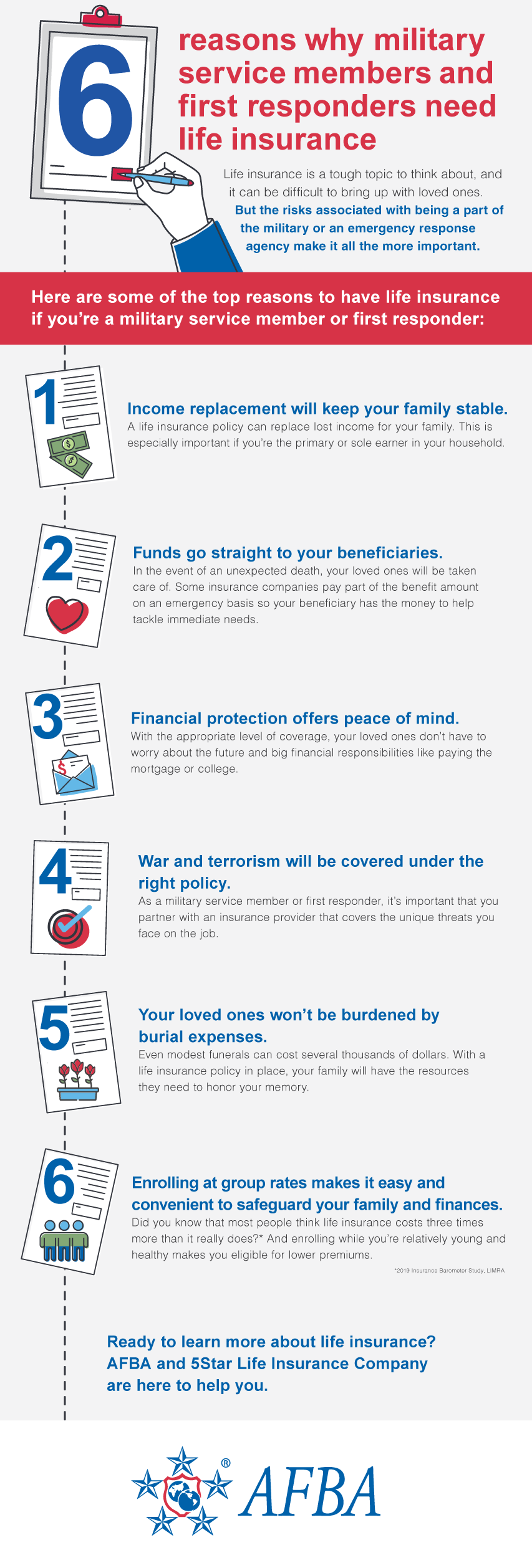
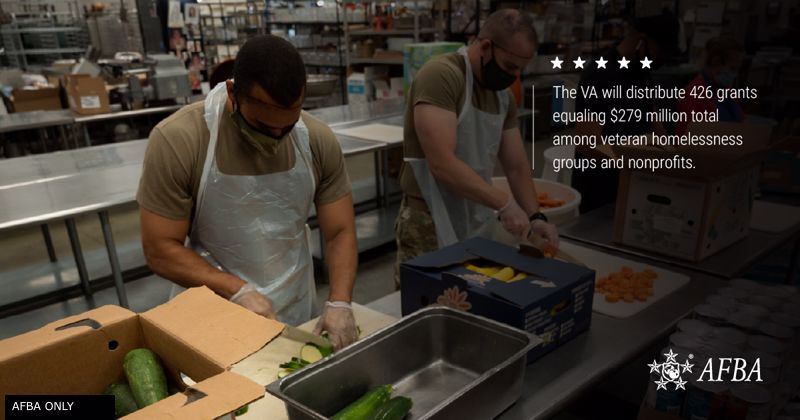
The U.S. Department of Veterans Affairs (VA) recently announced it will award a significant number of grants to community organizations that provide assistance and aid to veterans experiencing homelessness. The VA will distribute 426 grants equaling $279 million total among various groups and nonprofits.
Expansion of the VA's Grant and Per Diem program
This initiative is part of ongoing efforts, including the Grant and Per Diem (GPD) program, to prevent veteran homelessness and help veterans exit homelessness.
According to the VA, the GPD program's mission is "to promote the development and provision of supportive housing and/or supportive services with the goal of helping homeless veterans achieve residential stability, increase their skill levels and/or income, and obtain greater self-determination."
Service centers and supportive housing programs are eligible for GPD funding. Grants are issued to help organizations acquire, build or renovate facilities that will be used for transitional housing. Additionally, per diem subsidies are awarded to help cover the housing and operational costs for centers that provide supportive housing and other services to veterans experiencing homelessness. Grant recipients are typically first in line to receive per diem funding, although other groups can apply.
"The GPD program is one component of VA's multifaceted continuum of services and resources to help veterans exit homelessness," VA Secretary Robert Wilkie said in the announcement. "No veteran should ever have to worry whether they will have stable housing, and these grants put us one step closer to ensuring all veterans are living in a safe and supportive environment."
Grant types designed to support veterans' various needs
Beginning Oct. 1, 2020, the VA will start awarding three types of grants to eligible community organizations. The majority of the newly announced funds — roughly $221 million — will be directed toward "per diem only grants," which will subsidize 12,138 beds and 18 service centers to cover the costs of lodging and care.
An additional $2.4 million will be provided through "special needs grants" aimed at supporting veterans experiencing homelessness who have additional care needs related to chronic mental illnesses, childcare or women's health.
Finally, $55.3 million worth of "transition in place grants" will be awarded to community agencies that help veterans exit homelessness and achieve housing stability and independence. According to the VA, veterans participating in transitional housing programs benefit from support services and housing with the goal of taking ownership of their housing agreements.
Veteran homelessness rates in decline
As of January 2019, the U.S. Department of Housing and Urban Development (HUD) determined that 37,085 veterans were living in unsheltered locations, emergency shelters or transitional housing programs. At that time, states with the largest population of veterans experiencing homelessness were California, Florida and Texas.
However, the number of homeless veterans has dropped by 43.3% since 2011, as a result of interventions like the GPD program. Additionally, as of September 2019, three states (Virginia, Delaware and Connecticut) and 78 communities around the U.S. had eliminated veteran homelessness.
"Our nation's veterans have sacrificed so much for our country and now it's our duty to make certain they have a home to call their own," HUD Secretary Ben Carson noted in a 2019 news release. "We've made great progress in our efforts to end veteran homelessness, but we still have a lot of work to do to ensure our heroes have access to affordable housing."

Engaged couples have a lot to plan and prepare. Wedding day logistics can be even more complicated when one partner has a demanding career with the military or an emergency response agency.
But the day you tie the knot is just that — one day. Afterward, other important life planning matters like financial management will require the same level of organization and attention to detail in order to keep you on solid ground for years to come.
When it comes to managing your finances after getting married, you'll have three options to consider, each with its own pros and cons.
1. Combining all finances
In a marriage, two become one. For some newlyweds, two (or more) bank accounts are united as well. Given the pace at which bills are paid, groceries are purchased and savings are bolstered, there are quite a few advantages to operating the household budget from joint accounts. Combining finances creates greater transparency and easier access to funds for both parties, helping facilitate better communication and budget tracking.
As paychecks and financial obligations fluctuate, couples who follow this approach don't need to make dramatic shifts in how they divide up their income or responsibilities. Plus, with two pairs of eyes actively monitoring an account, budgeting mistakes are less likely to happen. Couples who are on the same page can also grow together while jointly working toward important financial goals.
The downside is that this total transparency can create a perceived loss of financial independence, and it doesn't always allow for differing opinions and spending habits. It can cause resentment or even prompt secrecy.
A recent poll found 44% of people in a partnership were either harboring a secret account, dealing with hidden debt or covering up spending habits their significant others would disapprove of. However, 57% of people believe financial infidelity to be as bad as, or worse than, unfaithfulness.
2. Keeping everything separate
Many partners agree to keep accounts and individual financial matters to themselves. This helps each person maintain a desired level of financial independence. If both parties communicate frequently to reconcile accounts and accomplish shared goals, a separate system can work well.
However, this approach doesn't remove the emotional aspect of money management from a committed relationship. Keeping separate accounts and responsibilities can create a sense of imbalance. For instance, if one partner pays most of the bills while the other spends a little too freely, credit card bills and emotions can run high.
Also, dividing the household's budget and obligations in two can complicate even the simplest transactions. Everything from buying groceries and gifts to financing a vacation can create stress if spouses don't have a solid plan in place. In an emergency, accessing the other partner's personal accounts can be a complicated process.
3. Taking a hybrid approach
Given the pros and cons of both of these financial management strategies, many couples choose a blended model. This might involve keeping personal accounts for discretionary spending but combining most income into a joint account to cover household expenses. Each partner could also contribute to their own personal savings in addition to a shared savings account.
The best approach to managing finances after getting married is one that you can agree on together. Whichever strategy you choose, honesty and good communication will help make your money management more successful. Ultimately, having someone by your side when working toward individual and shared financial goals is something to love and cherish.
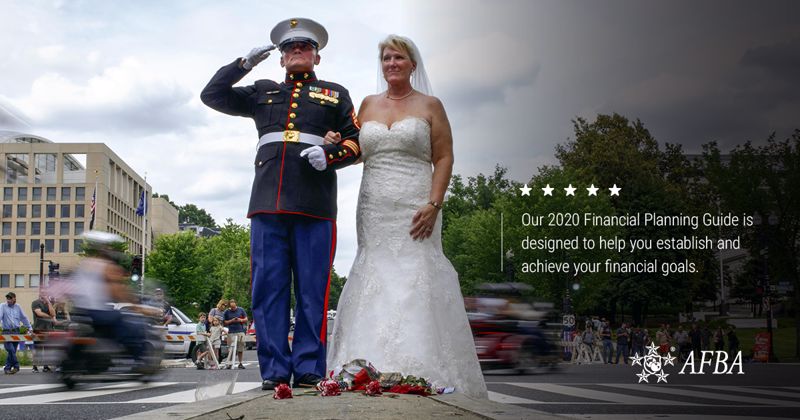
Not sure where to start? Download AFBA's 2020 Financial Planning Guide for our best-in-class collection of resources — from budgeting worksheets to military benefits information — designed to help you more easily establish and achieve your financial goals.
When preparing to transition from military service to civilian life, service members have a lot of factors to weigh when deciding what the next chapter will look like. This includes everything from what type of career to pursue to what sort of lifestyle to embrace. Many of these considerations revolve around one important question: where to live after military retirement.
Here are a few tips for choosing the best city or region to live in after completing your service in the military.
 “The appearance of U.S. Department of Defense (DoD) visual information does not imply or constitute DoD endorsement.”
Establish career goals
One of the most important considerations in deciding your next step will be your career prospects. Spend some time assessing how your skills and experiences can translate into the civilian workforce, and consider what sort of roles or industries interest you. If you have specific ideas, look for cities with an abundance of job openings in those areas. If you’re not sure, living in proximity to a large metro area with a diverse range of opportunities may be a smart choice.
Consider educational opportunities
Academic goals can help inform your options for where to live after military retirement, as you’ll most likely want to settle down near a school of choice. You might be considering bolstering your education with an advanced degree or professional certification program after concluding your military service. Or, someone in your immediate family, such as a spouse or child, might be exploring colleges and universities. You may also want to find a new home within a good school district for younger children.
Identify your ideal lifestyle
Major changes like military retirement allow you to redefine your lifestyle. Consider your values and what you’re looking for in the next chapter. It might be that you want to find somewhere that allows you to explore your favorite outdoor hobbies — or you may choose somewhere with an affordable cost of living so you can have a bigger travel budget. There may be a certain climate or community atmosphere you’re looking for, or a specific type of housing. It might also be important for you to reside near a military installation for easier access to benefits and health care facilities. Either way, these personal preferences should play a part in your decision-making process.
Think about family
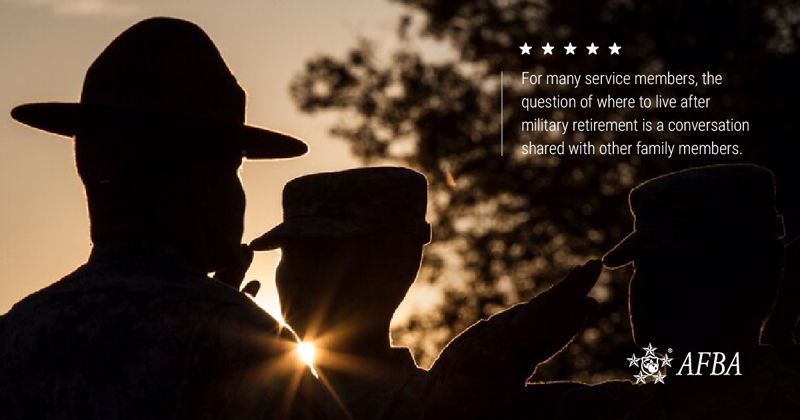
For many service members, the question of where to live after military retirement is a conversation shared with other family members. Military spouses and children often have input on where they might like to set down roots. You may also want to consider how close you’d like to be to extended family members. Moving back to your hometown or choosing a new city to call your own both have their advantages.
Take advantage of available resources
It might seem like you have an endless list of choices for where to live after military retirement. To help make the search and decision-making process easier, utilize the resources available to you. There are plenty of resources online to help you visualize what life might be like in different parts of the country. You can also explore the VA’s Transition Assistance Program (TAP) and connect with military installations in your current and future locations to learn more about relocation support.
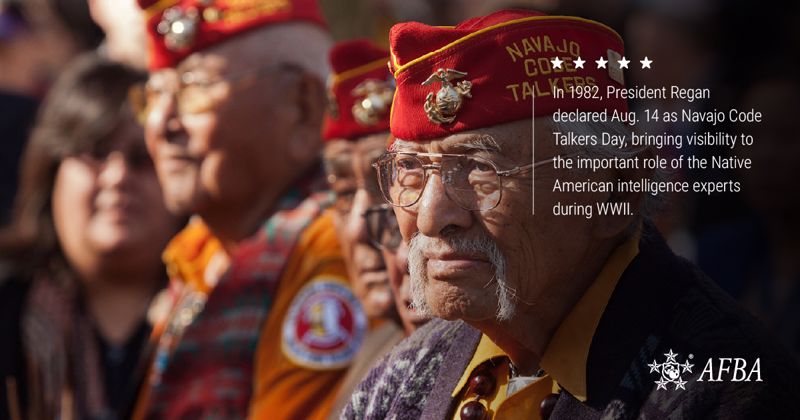
Aug. 14 is National Navajo Code Talkers Day. This observance recalls how approximately 400 members of the Cherokee, Choctaw, Comanche, Hopi and Navajo nations partnered with the CIA and the Marine Corps during WWII to develop a complex military code that helped the Allied Forces win.
 “The appearance of U.S. Department of Defense (DoD) visual information does not imply or constitute DoD endorsement.”
Devising an unbreakable code
Previously, the Choctaw language was used as a code for transmitting messages during WWI, helping launch a victorious attack against German forces. When the Marine Corps sought out another Native American language to use in the Pacific Theater in 1942, the language of the Navajo Nation was nominated and selected.
The military’s code-breaking technologies used at the time could translate three lines of text into English in about half an hour. Once the new system was developed, Navajo Code Talkers could process this same amount of text in just 20 seconds.
While the Navajo Code did use various Navajo words that translated directly into English, the level of complexity went further than that. Code Talkers created a harder-to-crack system based on word association in which different birds were used to describe planes and sea creatures were used to identify ships. For example, lo-tso (whale) was code for battleship while jay-sho (buzzard) was code for bomber plane. Similarly, so-na-kih (two star) signified Major General and toh-ta (between waters) referred to Great Britain.
The Code Talkers also created an encoded alphabet in which English letters could be referenced using up to three possible Navajo words. Wol-la-chee (ant), be-la-sana (apple) and tse-nill (axe) were all code for the letter A.
A total of 411 codewords were added to the Navajo Code Talkers’ Dictionary — and the code remained unbroken through the end of WWII.
Honoring the Code Talkers
The Marines selected a group of 29 Navajo recruits for the pilot program. Once the possibilities became clear, approximately 400 Code Talkers joined the Marines from the Navajo, Cherokee, Comanche, Choctaw and Hopi Nations. They were called the Navajo Code Talkers not because of their identity, but because of their mastery of the Navajo Code.
Code Talkers participated in every Marine operation in the Pacific Theater during WWII. Over phones and radios, they conveyed top-secret tactical information to help facilitate the rapid exchange of information while keeping intelligence safe from enemy ears and eyes. During the Battle of Iwo Jima, a team of six Navajo Code Talker Marines transmitted and translated more than 800 messages, helping secure that critical victory.
The Code Talkers’ efforts weren’t recognized until the operation’s declassification in 1968. In 1982, President Regan declared Aug. 14 as Navajo Code Talkers Day, bringing visibility to the important role of the Native American intelligence experts during WWII. The program’s original 29 participants were granted the Congressional Gold Medal in 2000 by President Clinton, and the four surviving Code Talkers received their medals from President Bush during a ceremony the following year.
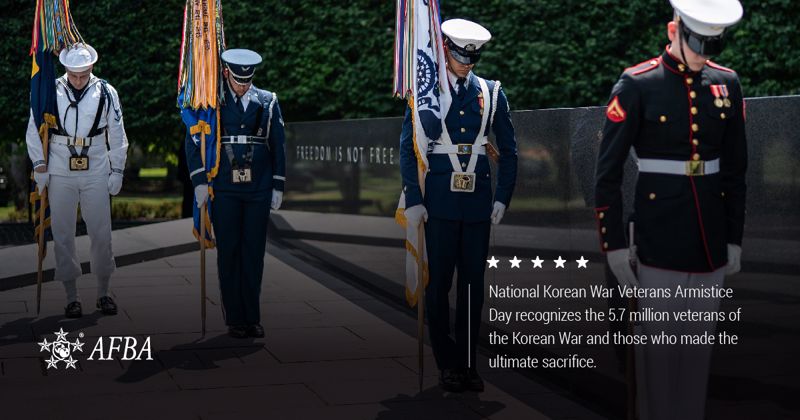
National Korean War Veterans Armistice Day falls on July 27 each year. This observance recognizes the 5.7 million veterans of the Korean War and those who made the ultimate sacrifice.
During the three-year war, which lasted from June 25, 1950, to July 27, 1953, active-duty servicemembers faced unique risks and experiences that set them apart from previous generations. This armistice observance presents the opportunity to remember and honor their service.
Causes and casualties of the Korean War
After being colonized by Japan, the southern part of the Korean peninsula was liberated in the wake of World War II. Backed by the Soviet Union, communist North Korea made an invasion into democratic South Korea in 1950. The U.S. deployed troops to support South Korea during this devastating war of attrition, where both sides fought to wear down the enemy and gain complete control over the territory. After three years, an armistice was signed and the region has remained divided.
The fighting resulted in 36,574 in-theater casualties for the U.S. More than 103,000 service members were wounded in action. As of June 2020, there are still 7,578 individuals whose fate in the Korean War remains unaccounted for.
Health risks for Korean War veterans
According to the U.S. Department of Veterans Affairs, extremely cold climates during the Chosin Reservoir Campaign in the winter of 1950 posed serious risks to those serving and accounted for more than 5,000 U.S. casualties. Temperatures dropped to -50 degrees Fahrenheit with a wind chill of -100 F.
As a result, Korean War veterans are more likely to face health issues including trauma to the nervous system, skin and muscles, vascular conditions, foot-related injuries such as trench foot, frostbite scars and skin cancer.
Active-duty servicemembers may have also been exposed to hazardous substances such as asbestos, polychlorinated biphenyl (PCB) and ionizing radiation during their service in the Korean War. These are known to cause certain illnesses and cancers even decades after the exposure. Those who qualify as atomic veterans may have witnessed the impacts of radiation passed down to their children.
'A different kind of homecoming' in 1953
Given the fact that no peace treaty was ever signed, those who served received a very different treatment upon their return.
"Compared to other wars, theirs was a different kind of homecoming," President Obama observed on the 60th anniversary of the Korean War armistice. "Unlike the Second World War, Korea did not galvanize our country. These veterans did not return to parades. […] Among many Americans, tired of war, there was, it seemed, a desire to forget, to move on."
Each year on July 27, National Korean War Veterans Armistice Day provides a moment for reflection on the service and sacrifices of Americans during this conflict.
The Military Family Advisory Network (MFAN) recently published the results of its 2019 Military Family Support Programming Survey.
First presented during a virtual data release event on June 23, 2020, the responses from nearly 8,000 members of military families were analyzed and divided into four sections:
- Health and well-being.
- Finances, housing and moving.
- Employment and transition
- Modern military family dynamics.
The biennial study's main findings highlight some of the most common challenges and experiences of military families and those transitioning from military service to civilian life.
Active duty spouses and veterans sought flexible employment
Active duty spouses noted that they looked for employers who were understanding and flexible, in general. Specific requests included an appreciation for the demands of military life as well as adaptable schedules, leave policies and remote work options.
Military veterans also desired flexibility, but a few other priorities came first. They primarily sought employers who valued their service in the armed forces and acknowledged their unique skills, and who offered a positive work environment.
While the top reason to leave the service was becoming eligible for military retirement benefits, the next most common reasons to transition out of the military were:
- Issues with leadership or the work climate.
- Family or lifestyle reasons.
- Career limitations.
Couples cited marital stresses
Only small percentages of respondents said their marriages have not been impacted (14.4%) or have grown stronger (13.7%) as a result of a spouse's military service. Negative effects were more commonly cited. Specifically, the following effects on marriage were reported by between 27% and 30% of respondents:
- General stress and strain on the marriage.
- Specific difficulties and challenges.
- Separation and absences.
In addition, 8 in 10 respondents recognized the existence and impacts of intimate partner violence among the military community. More than half (56.7%) reported that it is a common issue.
Parents identified limitations around child care and educational support
As for child care, over three-quarters of military parents said the search has been difficult or very difficult. Many respondents desired a wider variety of child care options, additional care flexibility and more affordable services.
Two in five respondents said they could not think of or access any helpful educational support for their children. Specifically, parents in the military community felt that there was a lack of support for special needs and learning needs in general. Some also agreed that more transition support and curriculum continuity would improve the quality of their children's' education.
Many lacked emergency savings
For the majority of active-duty families, the civilian spouse took on financial responsibilities including managing the day-to-day budget and overseeing larger financial decisions. The roles were largely reversed for veterans and their families.
However, nearly one-quarter said they had no plan whatsoever for addressing a financial emergency. Many respondents cited having less than $500 in an emergency fund or no savings at all, including:
- 22.2% of military retiree families with a pension.
- 27.4% of active duty military families.
- 49.2% of veteran families with no pension.
And yet, most would recommend military life
The top two reasons for not recommending military life included the fact that such a career can negatively impact one's family and add stress and instability to one's life.
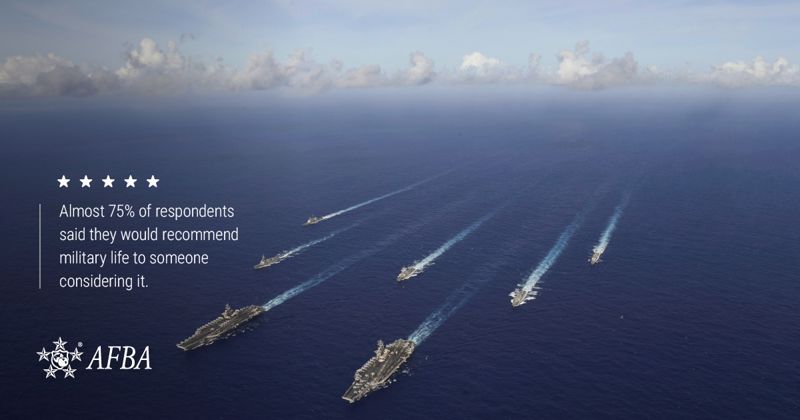
But, in spite of all the aforementioned challenges, roughly three in four (74.5%) respondents said they would recommend military life to someone considering it. The top three reasons included access to a rewarding and secure career in the military, the honor associated with doing one's civic duty and advantageous salaries and benefits.
Considering all the challenges military families may face together, financial matters might not always be top-of-mind. But the burden of debts and late payments can have a negative impact on mission readiness, relationships, future opportunities and decision-making processes.
Personal finance is undoubtedly an important part of life. With the federal tax deadline extended to July 15, 2020, this summer is a good time for families to check in on their financial progress and revisit goals.
These tips for boosting financial literacy, growing savings and reducing debt can help military personnel and their families achieve financial stability.
1. Explore and utilize resources from MilitaryConsumer.gov
Jointly created by the Federal Trade Commission and the Department of Defense, MilitaryConsumer.gov is a resource center for all matters related to personal finance for military servicemembers and families. Topics range from buying and financing a vehicle, using allotments, improving your credit rating and recovering from identity theft. Since each toolkit and guide is specifically designed with military life in mind, this site can be a great starting point when you're looking for helpful, actionable information.
2. Make military-specific deductions when you file your taxes
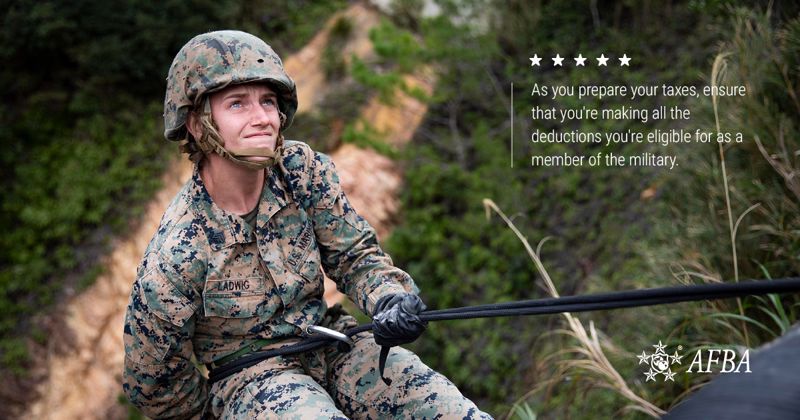
As you prepare your taxes, ensure that you're making all the deductions you're eligible for as a member of the military. Possible deductions include the cost of uniforms, moving expenses and civilian job search costs, to name a few.
There are other ways to get strategic with your tax liabilities. For instance, while you're serving, you and your spouse can establish your residency in a tax-free state so that, regardless of where you're stationed, you will benefit from substantial income tax breaks.
3. Contribute regularly to your retirement savings as soon as possible
The sooner you start making significant contributions to your retirement fund, the larger your savings will grow by the time you reach retirement age. Because many military service members don't stay in the armed forces long enough to become eligible for a pension, it's advisable to make your own contributions early and all throughout your career.
One military-specific option to explore is the Thrift Savings Plan (TSP), a defined contribution plan for retirement savings. Through this plan, members of the uniformed services can make traditional pre-tax or Roth after-tax contributions — or both. The Roth TSP option is similar to a Roth 401(k) in that there are no income limits.
4. Plan out how you'll use or transfer your education benefits
Student debt is one of the biggest financial burdens many families in the U.S. experience. Military members who are eligible for the substantial college tuition benefits available through the Post-9/11 GI Bill should carefully consider how this benefit can be used to further their own career or that of a family member. Servicemembers and veterans who don't plan to go back to school should find out how to transfer these tuition benefits to a spouse or child.
5. Familiarize yourself with the financial programs available to you
There are a number of advantageous savings and investment options available to members of the armed forces. It's a good idea to familiarize yourself with all of these programs so that you can start saving and seeing growth early on. For example, you may be eligible to receive 10% annual interest on savings up to $10,000 through the DOD's Savings Deposit Program (SDP). This growth rate is unlike any traditional savings plan you'll find in the civilian world.
Another example is a new program launched in October 2019 through which you may be able to receive free electronic credit reporting services from one of the major credit reporting agencies while serving on active duty. This is a helpful resource to help you monitor for fraud and improve your credit score.
Remember that these types of programs may evolve or be expanded over the years. Make it a habit to check back in and ensure that you're getting the most out of the opportunities available to you.
According to GuideStar, there are more than 45,000 registered nonprofit organizations in the U.S. that are dedicated to serving the veteran community. With so many groups doing good, veterans and their families may not be aware of all the services, support and resources available through these nonprofits.
Here is a small introductory handful of the esteemed nonprofits for veterans:
Children of Fallen Patriots Foundation
As a way to honor the fallen and support future generations, this organization helps provide educational counseling and college scholarships to children whose parents have made the ultimate sacrifice in service to our country.
Esposas Militares Hispanas USA Armed Forces
What started as a Facebook group of military spouses soon became a nonprofit organization committed to serving Hispanic military and veteran families by offering helpful resources and information in Spanish.
Give an Hour
This national network of volunteer mental health professionals provides free services to active-duty military personnel and veterans. Give an Hour also advocates for changing the culture around mental and emotional well-being and treatment.
Hire Heroes USA
To help military members transition into civilian life and employment, Hire Heroes USA offers job search support and career assistance to veterans and their spouses.
Honor Flight Network
This nonprofit's mission to support veterans of World War II, the Korean War and the Vietnam War entails flying these veterans out to visit the memorials erected in remembrance of those who served.
Hope For The Warriors
This service organization supports a variety of programs for veterans and military families. These are designed around wellness, peer engagement, recreation, and transition to civilian life.
Operation Gratitude
Since the early 2000s, Operation Gratitude has delivered more than 2.6 million care packages to members of the military, veteran and first responder communities.
Operation Homefront
This nonprofit for veterans helps families secure rent-free transitional housing, financial assistance for homebuying and caregiver support services.
Operation Second Chance
This organization serves ill, injured and wounded combat veterans. Volunteers identify immediate needs and offer support through hospital visits, counseling resources, scholarships, retreats and more.
Operation Troop Appreciation
Active-duty and veteran members of the armed forces have their wish lists fulfilled by morale-boosting gifts from Operation Troop Appreciation. The organization also supports transitional housing and distributes letters of gratitude.
Reel American Heroes Foundation
Partnering with military hospitals and bases, this cleverly named nonprofit provides wounded veterans and service members with recreation therapy through fishing trips and duck hunts.
United Service Organizations
Perhaps one of the most well-known nonprofits for veterans and active-duty servicemembers, the USO supports a broad range of programs and resources, from transitional assistance to entertainment and community building.
Veteran Tickets Foundation
Vet Tix distributes free event tickets to veterans and their loved ones, promoting stress-free opportunities for family bonding, memory-making and community engagement.
Vietnam Veterans of America
The VVA advocates for veterans' issues including health care access, public opinion and perception, POW and MIA accountability, and more, specifically focusing on supporting veterans of the Vietnam War.
Wounded Warrior Project
This nonprofit for veterans serves those who have experienced a physical injury or mental illness as a result of their post-9/11 military service. The organization sponsors a wide range of programs focused on recovery and empowerment.
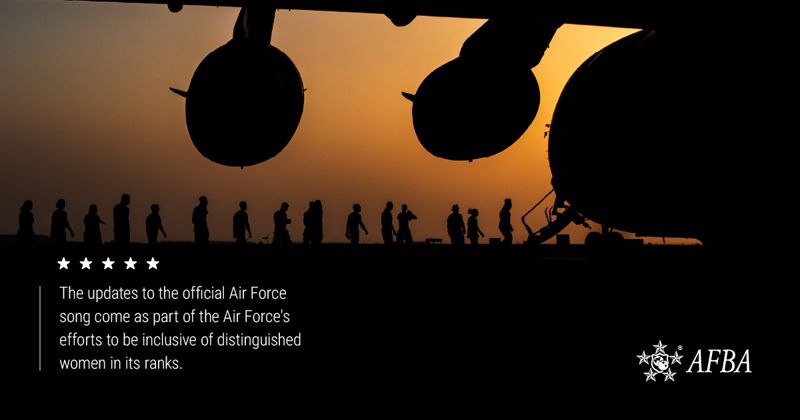
Lyrics to the official Air Force song that formerly recognized the contributions of male airmen only have been rewritten to be gender-neutral. This change comes as part of the Air Force's efforts to be inclusive and to acknowledge the distinguished women airmen in its ranks.
Updates made eighty-one years after the song's initial composition
The song is officially titled "The U.S. Air Force" but is more commonly known by its first line, "Off we go, into the wild blue yonder."
It was originally written to help establish a sense of camaraderie and identity for the U.S. Army Air Corps in the late 1930s. Since the Corps did not have the budget to commission such as song, the publisher of a magazine called "Liberty" established a songwriting contest in 1938 with a $1,000 prize. The winning submission came in a couple of days before the final deadline from a musician and civilian pilot, Robert M. Crawford. Too young to enlist during World War I, he later flew for the U.S. Army Air Forces' Air Transport Command during the Second World War.
This is not the first time the song has been modified in its 81-year lifetime to better reflect the force and its servicemembers. Before the Air Force was its own independent branch, the song was titled "The Army Air Corps." It was changed to "Army Air Forces" during World War II, and the title and lyrics were rewritten once again in 1947 upon the establishment of the U.S. Air Force.
"Off we go, into the wild blue yonder" is also the U.S. Air Force Academy's official school song and is frequently sung at sporting events and during graduation ceremonies. According to Air Force Times, the U.S. Military Academy at West Point and the U.S. Naval Academy already modified their lyrics over a decade ago to better reflect the presence and contributions of women cadets.
Half a dozen gendered reference rewritten
After a series of updates that began in February 2020, half a dozen changes have now been made across the song's four verses. In the popular opening verse, "At 'em boys" is now "At 'em now, give 'em the gun." In the second verse, the phrases "Minds of men," "Hands of men" and "Souls of men" have been updated to create three updated lyrics:
- "Brilliant minds fashioned a crate of thunder."
- "Valiant hands blasted the world asunder."
- "Boundless souls dreaming of skies to conquer."
In the third verse, the lyric formerly ending in "of his brother men who fly" now goes, "To a friend we send a message of the brave who serve on high." Additionally, "men" has been changed to "those" in the verse's triumphant conclusion, "A toast to the host of those we boast, the U.S. Air Force!" And, in the final verse, "Flying men" has been removed in favor of "Fly to fight, guarding the nation's border."
Gender-neutral lyrics acknowledge that one in five airmen are women
According to Air Force demographic data, women could first begin pilot and navigator training in 1976 and 1977, respectively, and were not able to complete fighter pilot training until 1993. Nowadays, approximately one in five Air Force active-duty servicemembers are women — 68,470 women airmen total, as of January 2020. Among them, 806 serve as pilots; 347 are navigators, and 233 are air battle managers for Air Force.
Although the name given to servicemembers — airmen — remains awkwardly gendered, the Air Force considers this a step in the right direction.
"These new lyrics speak more accurately to all we do, all that we are and all that we strive to be as a profession of arms," Air Force Chief of Staff Gen. David L. Goldfein said in a news release. "They add proper respect and recognition to everyone who serves and who has served."