
Every year on July 27, Americans recognize the National Korean War. This day celebrates veterans of the Korean War, one of the most brutal and dangerous wars in United States history. The history and significance of July 27 is deep, and the national holiday gives Americans the chance to honor the service members who sacrificed so much during the Korean War.
A refresh on the Korean War
The Korean War began on June 25, 1950 when North Korea invaded South Korea. The conflict had been brewing for some time. When this military action took place, American troops were deployed by July on behalf of South Korea. America had to take a stand against communism and a harsh, three-year war followed.
Not only did combat itself kill many soldiers, but the hot, humid climate also took a toll on those who occupied the Korean peninsula. Civilian deaths as a result of bombings and other conflicts contributed massively to the total casualties, which was about 5 million, though the total number is still uncertain because North Korea did not release casualty numbers.
Almost 40,000 Americans died in the war, and more than 100,000 were wounded. At the time, there was not as much media coverage of what was happening in Korea, especially when compared to World War ll and the Vietnam war. This led to the Korean War being called "The Forgotten War." Veterans of the war were not treated with as much reverence, as it seemed that Americans wanted to forget this tragic period.
For several years, armistice agreement negotiations were underway, to no avail. That is, until July 27, 1953. On that day, the Korean People's Army (KPA), the Chinese People's Volunteer Army (PVA) and the UN Command signed the Korean Armistice Agreement, and America officially took its troops out of Korea, despite South Korean president Syngman Rhee refusing to sign the agreement. The agreement did not include a peace treaty, but did require North Korea, South Korea, China, and the United States to continue their peace talks.
National Korean War Veterans Armistice Day
National Korean War Veterans Armistice Day is a time to remember the tragedies that occurred during the Korean War and to commemorate those who died in active duty, disappeared as prisoners of war, or were seriously injured in service.
In memoriam, every year the President of the United States issues a proclamation calling on the nation to observe National Korean War Veterans Armistice Day with appropriate ceremonies. American flags across the nation rest at half mast out of respect.
The Korean War Veterans Memorial located in Washington, D.C. was erected on July 27, 1995. If you ever visit the memorial, you will be able to read its inscription: "Our Nation honors her sons and daughters who answered the call to defend a country they never knew and a people they never met."
Take the time to thank a veteran, volunteer in your community, or simply reflect on the impact that the Korean War has on our American legacy.
June 14th of every year marks the United States Army’s birthday. The 14th day of June 2021 was the Army’s 246th year of existence. Having been created in 1775, the Army is the oldest branch of the US military and is soaked with a richly fascinating history. The Army’s many years of committed service to the country truly reflect the branch’s dedication to defense.
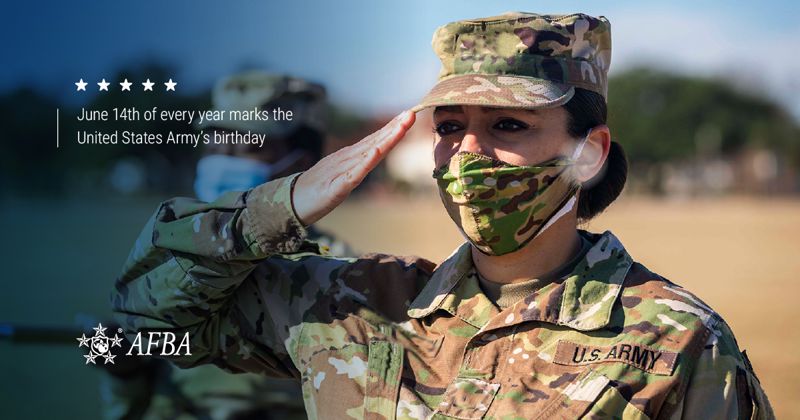 The appearance of U.S. Department of Defense (DoD) visual information does not imply or constitute DoD endorsement.
Historical legacy
The U.S. Army’s legacy started nearly in tandem with the United States itself. In 1778, the Army claimed the motto “This we’ll defend,” and has taken the phrase seriously ever since.
Revolutionary War (1775)
During the rise of civil unrest of the 1770s, the original 13 colonies formed the first version of a U.S. armed forces. The 2nd Continental Congress created the Continental Army as a means of revolting against the rule of Britain. This initial version of the army fought its first battle in 1776, and the 20,000 revolutionaries were forced to retreat by the much more sophisticated redcoats.
With grit and determination that remains today, the army rallied and followed its commander in chief, George Washington, to victory. The U.S. Army is inextricably linked with the United States of America’s brave and independent origins.
The Civil War (1861)
Nearly 100 years later, the United States Army was called into action and underwent a major renovation. The Civil War era was a very important time for weapons technology development in the army. The result was the most deadly war in the Army’s history.
World Wars (1917/1941)
It took many years for the army to build itself back up from the destruction the Civil War wrought. The first world war saw the advancement of the army’s technological sophistication as well as the creation of 17 new National Army divisions. This included the Aviation Section of the Army Signal Corps, which was the predecessor of the Air Force.
Some cite the second World War as being the beginning of the United States Military as we know it today. WWll was also a very important time for the evolution of modern battlefield strategy with the invention of the atomic bomb.
Modern day
Every era of major conflict (many of which are not named here) has resulted in a more advanced and strategic Army, but it’s roots of bravery and valor have remained at its core since the beginning. Today, the United States Army has more than 700,000 members, including both active duty and Army reserve.
Every year on June 14th, members of the Army and their families come together to celebrate the Army’s birthday with balls, dinners, parades and parties. This year was no exception. It was a time for modern-day servicemen to remember and commemorate the incredible history of their branch.
Just like every year, the Pentagon and Capitol Hill recognized the anniversary of the Army through a traditional cake cutting ceremony, using a classic Army saber. Even those who are not directly tied to the United States Army took a brief moment to recognize our country’s oldest military service.
The creation of Women Veterans Day in 2018 was meant to recognize the unique struggles and sacrifices of female servicemembers. The holiday is on June 12th and celebrates all women who have served in the armed forces. Though not nationally recognized, more and more states are starting to adopt it.
A brief history of women in the military
Women have provided military service in many different ways since the beginning of the United States’ military. From holding positions as nurses and seamstresses to helping raise money for the war efforts, women have always played an important role in the military.
Early efforts
Outside of these roles, there are many stories of women covertly enlisting in the Civil War era military as spies and even soldiers. Frances Clayton, Nancy Morgan Hart and Deborah Sampson are just a few of the women who disguised themselves as men to fight for their beliefs in the Civil War.
The first woman to formally enlist in the military was Loretta Walsh. In 1917, she became a member of the Navy and acted as the ship’s secretary. It did not take very long for other women to begin formally joining the armed forces.
Women’s Army Corps (WAC)
The Women’s Army Corps was created during World War ll to allow women to assist the war effort in non-combat positions. This allowed 150,000 women to serve their country and opened up America to the idea of a woman among the ranks of the military.
The Women’s Army Corps came into existence thanks to Rep. Edith Nourse Rogers. This was a huge step forward in gender integration, but it expired in 1948. Despite this, there was a huge demand for women to be permanent members of the military.
Women’s Armed Services Integration Act
Directly after the expiration of WAC, the Women’s Armed Services Integration Act was passed and granted women the right to serve in the Army, Navy, Marine Corps and the Air Force.
Modern women in the military
Today, it is nowhere near uncommon for a woman to join the military, and both genders are recruited equally. Generally speaking, there are still more men in active duty than women, but overall trends show an increase in female servicemembers. Despite this, retaining female recruits is far more difficult than the retention of male recruits.
This exposes unique challenges that women face as a part of the military, struggles that each branch works diligently to eliminate. The United States Government Accountability Office released a report in March 2021 that details a retention plan. The report notes this discretion while reporting that the Department of Defense plans on “updating its diversity and inclusion strategic plan.”
Women as veterans
Women make up at least 10% of all living veterans, most of them having served in the Gulf War. Aside from the normal struggles that all veterans face regardless of gender or race, minorities can face additional hardship. Much like their male counterparts, 28% of female veterans are disabled and are unable to find work due to their disability.
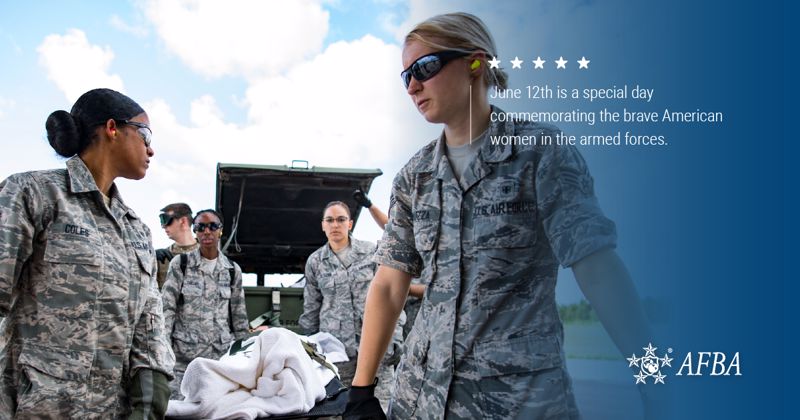 The appearance of U.S. Department of Defense (DoD) visual information does not imply or constitute DoD endorsement.
Womens Veterans Day is an opportunity to thank those women who have given their lives in active duty and those who have dedicated so much in service to the United States of America. June 12th is a special day commemorating the brave American women in the armed forces.
For some, Memorial Day simply represents a three-day weekend and the unofficial beginning of summer. But for many of us, Memorial Day commemorates and celebrates those brave soldiers who sacrificed their lives for the country.
The history and traditions of Memorial Day go back a long way, from the history of casual observances to the first official observances in the U.S. Today.
Origins of Memorial Day
Since antiquity, people have remembered fallen soldiers with parades and memorials.
In the U.S., the first traces of what would become Memorial Day began a few weeks following the end of the Civil War. On May 1, 1865, a regiment of African American Union troops along with more than 1,000 newly freed individuals, marched a procession into a former prisoner of war camp in Charleston, South Carolina. There, the group consecrated a burial site for the more than 250 prisoners who died of disease or exposure. They sang hymns, recited Bible verses and scattered flowers on the graves of the fallen.
Then, on May 5, 1866, the city of Waterloo, New York, held a community-wide ceremony honoring the local Civil War veterans. Residents flew flags at half-mast, businesses closed for the day and vigils were held.
Three years later, in 1868, the Grand Army of the Republic (GAR) established Decoration Day as May 30. The idea was to decorate the graves of the fallen soldiers with flowers, and this day was chosen as many flowers would be in full bloom. Though some legends say this was chosen because no Civil War battles took place on May 30.
May 30, 1868, marks the first observance of Decoration Day. Ceremonies were held at Arlington National Cemetery with General Ulysses S. Grant presiding over the solemn occasion. Small American flags and flowers were placed on the graves of soldiers, a tradition that carries through to this day.
Since that time, however, more than 25 different locations around the country have claimed to be the birthplace of Decoration Day or Memorial Day. In 1966, President Lyndon Johnson and Congress declared Waterloo, New York, as the original home of Memorial Day. Then, in 1971, Congress passed an act declaring Memorial Day a national holiday, and moving the day of remembrance to the last Monday in May.
Memorial Day's Legacy Continues
Although it's been a long journey from the original Decoration Day to the holiday as we know it, today, the tradition and legacy of Memorial Day holds strong across the country and the U.S. military bases around the world.
Most recently, Congress passed the "The National Moment of Remembrance Act" and President George W. Bush signed it into law in December 2000. The act encourages all people in the U.S. to give something back to their country, and to help coordinate commemorations in honor of those who gave their lives in service for the country.
The National Moment of Remembrance is at 3 p.m. on Memorial Day. Remember our fallen soldiers during this moment of silence at your local time.
This can be done anywhere you are, even if you're out with friends or at a cookout with family. Spread the word about the National Moment of Remembrance to help ensure everyone understands what this serious day means for servicemembers and their loved ones.
Any veteran who has worked with the Department of Veterans Affairs (VA) to receive GI Bill benefits know the process can be challenging. In an effort to address this issue and provide a more streamlined experience for veterans, the VA will build and launch a new online platform for the management of most GI Bill benefits.
An innovative platform for accessing tuition benefits and more
Accenture Federal Services won the VA contract, and is working closely with the VA to create a user-friendly digital platform.
Following 2017 legislation, the VA has been working hard to update the way veterans can receive tuition and other benefits for higher education. However, these previous attempts led to glitches and other problems, which prompted the department to request additional funds from Congress. The CARES Act, the initial coronavirus relief package Congress passed in March 2020, allocates $243 million for this Digital GI Bill Modernization project.
Although this will be a multi-year, joint undertaking, the VA is optimistic that it will provide a modern, fully integrated solution for the nearly 1 million veteran students the department serves each year.
Goals of the Digital GI Bill Modernization
Currently, the VA distributes around $12 billion dollars worth of benefits using up to 23 different legacy computer systems. Claims processors are required to toggle between the systems, manually transferring data and performing duplicative duties. All this extra, time-consuming work creates more opportunities for human error that can slow down benefit distribution.
The features being developed in this modernization project include:
- Improved customer support and financial services. This will allow for more timely and accurate payment delivery with real-time eligibility and access to benefit information.
- Upgraded communication tools. With these refreshed tools, the VA will be able to call, email, text and chat directly with beneficiaries, as well as grant access to records.
- End-to-end systems management. This will enable proper compliance and oversight of GI Bill programs. It will also ensure the effective use of data and business intelligence tools to track, monitor and measure school and student outcomes.
- New program and policy requirement supports. As the academic community and job market continue to evolve, this will ensure the VA keeps pace with these changes.

Ultimately, the upgraded platform will provide veterans with the advantages of a new, modernized system with real-time support from VA staff. This includes better troubleshooting assistance with payment issues as well as easier, faster access to beneficiary records for VA staff.
While the VA has experienced setbacks with attempts to modernize other major programs, such as electronic health records modernization, the department is hoping for strong progress. By hiring an experienced systems integrator and software developer, the VA will be able to deliver improved services for veterans.
Since the GI Bill's implementation following World War II, the program has been instrumental in ensuring veterans have the means to access higher education and more. This digital modernization effort will guarantee distribution of these benefits, and will evolve alongside the available technology to make the entire process more efficient and streamlined.
Each year in April, families, communities and people of all stripes come together to celebrate military children and applaud them for surmounting unique challenges.
The Department of Defense Education Activity (DODEA) commemorates this month with its "Purple Up!" campaign, in which people wear and display the color purple to show support for the children of soldiers. The military chose this color with the reasoning that purple combines each branch's colors into one, since the Air Force, Navy and Coast Guard all use shades of blue, the Army uses green and the Marines use red.
Month of the Military Child: A backstory
Established by former Defense Secretary Caspar Weinberger in 1986, the Month of the Military Child has since become an annual tradition for military families deployed worldwide. More than 1.7 million total force-dependent children across the globe face obstacles unlike most others their age. Wearing purple helps let them know you care.
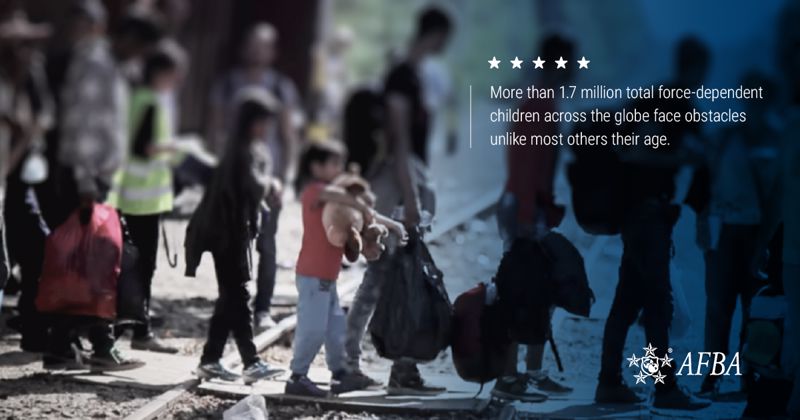
While the entire month of April is set aside to celebrate children of soldiers, the military also designates a single day during the month as "Purple Up! For Military Kids" Day. This typically falls halfway through the month, at or around April 15 each year.
Many military-related private organizations put a special emphasis on the programs they administer and provide downloadable toolkits and other resources for military children and families.
Additionally, participating Exchange restaurants worldwide will often offer free treats or other specials for any child who wears purple during the month.
How you can Purple Up! this April
Although schools and workplaces are not closed for Purple Up! Day, there are still plenty of creative ways to observe this important occasion. Many military bases and communities celebrate with special events, such as contests, parades, fairs and seminars all centered around the central message of supporting military children.
In addition to wearing purple throughout the month, anyone not currently stationed at a military base can consider trying some of these activities to observe the Month of the Military Child:
- Work with local schools, governments, businesses and organizations to raise awareness of this observance.
- Spread the word by using the #purpleup hashtag on social media or putting up purple flyers in community centers.
- Write a letter to your local newspaper that recognizes and celebrates military children.
- Create an award, or use one created by Blue Star Families, to let a military child know that they're awesome.
- Print out and pass around Purple Up! labels from the Military Child Education Coalition.
If you're already involved with the local schools and organizations, consider holding an award ceremony for military children. Be sure to include recognition of military children during morning announcements and have members or students tie purple ribbons around trees outside.
For more ways to celebrate our country's youngest heroes, check out these 50 additional ideas from the Military Child Education Coalition.
Vietnam War Veterans Day became a nationwide, yearly observance in 2017. A strong bipartisan effort to recognize the holiday on a regular schedule concluded with President Donald Trump signing the Vietnam War Veterans Recognition Act of 2017 into law. Since then, National Vietnam War Veterans Day has fallen on March 29 each year.
The roots of a dedicated holiday
This special observance recognizes all veterans who served in the U.S. military over the course of the Vietnam War, which spanned nearly 20 years of escalating conflict.
The first U.S. ground combat troops — 3,500 Marines — arrived in 1965, according to The Atlantic. By early 1973, when U.S. combat forces were ordered to withdraw from the country, 3,403,000 Americans had served in the armed forces during the Vietnam conflict, according to the U.S. Department of Veterans Affairs. That number includes more than 55,000 servicemembers who gave their lives for their country, and more than 150,000 who were wounded.
Despite meritorious service from so many servicemembers and the ultimate sacrifice made by tens of thousands of U.S. troops, the tense and complex social and political climate of the mid-1970s meant that many returning veterans were denied a proper welcome home, as the National Conference of State Legislatures explained. National Vietnam War Veterans Day, and the somewhat irregular state- and territory-level observances that preceded it, are an effort to belatedly recognize the valiant efforts of U.S. troops who served in this war.
The date of the observance is especially significant for veterans. March 29, 1973 was the day the last combat troops left Vietnam.
Supporting Vietnam veterans every year
Military Benefits estimated a total of 6.4 million Americans living today served in the armed forces during the Vietnam War.
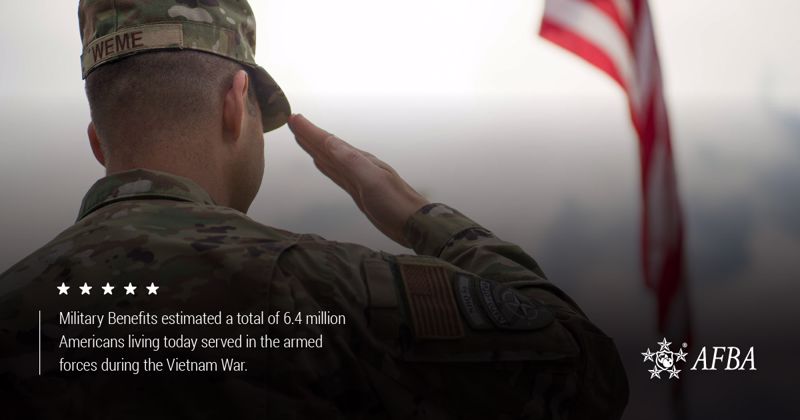
The holiday takes this into account: It officially recognizes all personnel with active-duty service between Nov. 1, 1955 and May 15, 1975. This inclusive approach celebrates and shows respect to all Vietnam veterans regardless of other details such as length of service, where they were stationed and which duties they performed.
A single, national date for the observance also raises cultural awareness as events across the country fall on the same date on a predictable, yearly schedule. Instead of most, but not all, states and territories holding observances on or around March 29, the entirety of the U.S. recognizes a unified event.
Safely recognizing National Vietnam War Veterans Day during a pandemic
Memorials and ceremonies recognizing and thanking Vietnam veterans for their service have developed across the country since the conflict ended. They represent untold hours of organizing and effort on the part of veterans groups, nonprofits, government agencies and others who want to provide the appropriate respect and gratitude to the Americans who served in this conflict. While the coronavirus pandemic has curtailed many in-person gatherings, the U.S. Department of Defense (DOD) highlighted many examples of safer events that still effectively thank and remember Vietnam veterans.
The DOD listed three goals for the 2021 observance of this event, and for every March 29 in the future:
- Thanking and honoring Vietnam veterans for their service and sacrifice.
- Connecting with veterans who are isolated or hard to reach.
- Supporting the healing that occurs when veterans denied a proper welcome home after their service finally receive the recognition they deserve.
As March 29 approaches, take some time out of your day to recognize the Vietnam veterans in your own life and community.

Nearly 100 years ago in 1926, Carter G. Woodson, a scholar of African American history and the African diaspora, set aside a week in February for the recognition and remembrance of Black history. Fifty years later during the U.S. bicentennial, President Gerald Ford extended this into the federal observance now known as Black History Month.
Ford urged the nation to "seize the opportunity to honor the too-often neglected accomplishments of Black Americans in every area of endeavor throughout our history."
This February, we are honoring the accomplishments of Black servicemembers in the armed forces by sharing a timeline of several notable firsts that contributed to key turning points in military history, from 1770 to the present.
1770: Crispus Attucks, first American casualty in the Revolutionary War
Crispus Attucks, a former enslaved person and dockworker of African and Native American descent, joined a group of Boston patriots in protest against British soldiers. He was fatally shot, becoming the first American to sacrifice his life in defense of the colonies. Tens of thousands of Black soldiers would ultimately serve in the Revolutionary War. Attucks was honored at the time of his death and would later become a symbol for the abolitionist movement.
1863: William Carney, first Black Medal of Honor recipient
William Carney enlisted in the first Black unit recruited for the Union Army — the 54th Massachusetts Infantry Regiment — where he served alongside 40 other Black service members. When the unit's color guard was shot during battle, Carney sustained enemy fire and nearly lost his life in an effort to ensure that the American flag did not touch the ground. His moving and valiant patriotism was acknowledged in 1900 with the Congressional Medal of Honor. As of 2020, 92 remarkable Black servicemembers have since been awarded the Medal of Honor.
1917: Harlem Hellfighters, first all-Black combat unit to serve overseas during WWI
During the First World War, the 369th Infantry regiment — known as the Harlem Hellfighters — became the first Black combat unit to serve overseas. The U.S. did not offer combat roles to African Americans, so the unit was assigned to the French Army. The Hellfighters served in the trenches for 191 days straight without getting captured or ceding any ground, earning them the Croix de Guerre.
1946: Della Raney, first Black woman to serve as an Army major
In 1941, nursing graduate Della Raney became the first Black nurse to serve as a lieutenant in the U.S. Army Nurse Corps. As the Second World War continued, Raney continued as a trailblazer in the Army, marking new firsts with each promotion. She was promoted to captain in 1944 and major in 1946. Maj. Raney continued her Army service until her retirement in 1978.
1941: Tuskegee Airmen, first Black military aviators
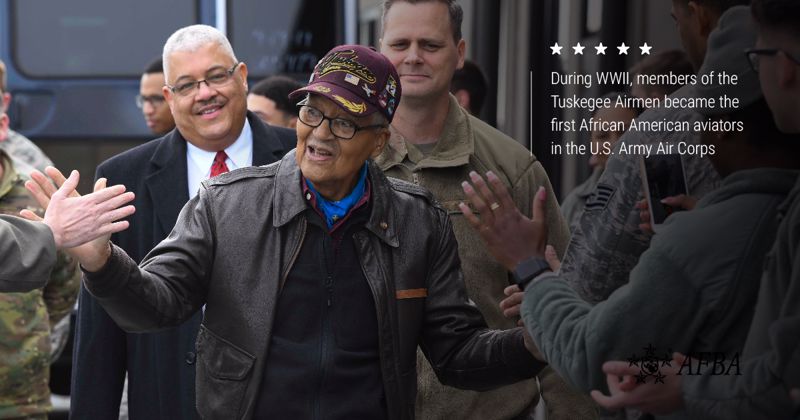
During WWII, nearly 1,000 members of the Tuskegee Airmen trained in the Jim Crow South and became the first African American aviators in the U.S. Army Air Corps, the precursor to the U.S. Air Force. They never lost an escorted plane to enemy forces despite completing hundreds of escort missions and more than 15,000 sorties. The Tuskegee Airmen earned 150 Distinguished Flying Crosses and are being recognized in 2021 with a commemorative quarter inscribed, "They fought two wars."
1989: Colin Powell, first Black Chairman of the Joint Chiefs of Staff
When he was appointed as the Chairman of the Joint Chiefs of Staff by President George H.W. Bush, Colin Powell took on the highest-ranking military position in the Department of Defense and became the first African American and youngest person to do so.
Present day
According to the latest data, roughly 224,000 servicemembers and about 2.1 million military veterans are Black Americans. These brave men and women have continued making a mark on military history thanks to their courageous contributions and service to the nation.
Amid the ongoing pandemic, the unemployment rate for veterans has fluctuated significantly. As the new year begins, here is a look at the latest data, how this compares to the record unemployment lows experienced just over a year ago, and what this means for veterans in the civilian workforce.
Unemployment raced from record lows to record highs in 2020
In January 2020, the veteran population and the workforce at large were continuing a streak of high employment and stability. The Department of Labor (DOL) noted that the 3.1% unemployment rate for veterans seen in 2019 was a 19-year record low.
However, the economic impacts of the COVID-19 pandemic shook the civilian workforce, leading many companies to downsize or shutter their doors for months on end.
According to the latest DOL data, the veteran unemployment rate stood at 6.3% in November 2020, an increase from 5.9% the previous month. This was slightly better than the unemployment rate for the non-veteran working population, which was 6.7%.
Granted, these figures are significantly more promising than the 14.7% collective unemployment rate of April 2020. A staggering 11.7% of the veteran population — more than 1 million former service members — filed for unemployment that month.
Half a million veterans remain unemployed
Despite how far these numbers have settled since the spring, decreasing from nearly 12% in April to about half that figure in November, the ongoing pandemic and widespread economic turmoil still mean employment prospects are shaky for those who were pushed out of the workforce in 2020.
If the government's most recent data is still true for the start of 2021, 552,000 people who served in the armed forces and transitioned to the civilian workforce are still combating the instability of unemployment.
Youngest veterans impacted the most
According to a December 2020 report by the U.S. Bureau of Labor Statistics (BLS), post-9/11 veterans have a higher unemployment rate than most others:
- Of the veterans who served after 2001 (Gulf War era II), 244,000 (6.9%) were unemployed.
- Of the veterans whose service occurred between 1990 and 2001 (Gulf War-era I), 107,000 (4.7%) faced unemployment.
- Of all veterans of the Vietnam War, the Korean War or World War II, 75,000 (6.4%) were unemployed.
- Of veterans of other service periods, 126,000 (7.0%) experienced unemployment.
Certain sectors show promise for job seekers
In December 2020, the BLS reported that, although the retail trade and government sectors experienced declines in employment, "notable job gains occurred in transportation and warehousing, professional and business services and health care."
Veterans seeking employment can focus on these growth areas, while also taking advantage of resources available through the Department of Veterans Affairs, such as the Veteran Readiness and Employment (VR&E) program.
In the Valentine's Day spirit, we're tracing the history of "sweetheart jewelry," which became widely popular during the Second World War.
Traditionally given by a soldier heading off to war to a loved one at home, a piece of sweetheart jewelry was both romantic and patriotic in nature. Today, these items are considered collectible pieces of our nation's past.
Sentimental jewelry to remember soldiers during times of war
As the Cooper Hewitt museum explains, the custom of gifting sweetheart jewelry dates back to World War I. However, it became even more popular during World War II, when countless couples and families were separated as soldiers left home to fight overseas.
Sweetheart jewelry was most commonly exchanged between romantic couples. But fathers, brothers and sons also left family members with these tokens in their absence. Women purchased their own sweetheart jewelry, too, either to remember a certain soldier or show support for the nation's forces as a whole.
Wherever these sentimental items came from, their owners wore them proudly and passionately. Women wore brooches to keep their family and country close to the heart. They tucked pictures of the soldiers they missed into treasured lockets and they wore their hearts on their sleeves in the form of bracelets.
Patriotic colors and imagery permeated jewelry design
While hearts were a common theme, sweetheart jewelry was not only romantic in design; it was also highly patriotic. Many of these items featured military insignia and other icons related to a loved one's branch of service. Others included the American flag or details featuring stars and stripes.
An all-American red, white and blue color scheme was also typical of sweetheart jewelry. Additionally, a library of patriotic imagery, ranging from the eagle and the victory "V" to Uncle Sam's top hat, can be seen in jewelry from the WWII period. Phrases like "Loose Talk Can Cost Lives" and "Remember Pearl Harbor" also made their way into pins and pendants.
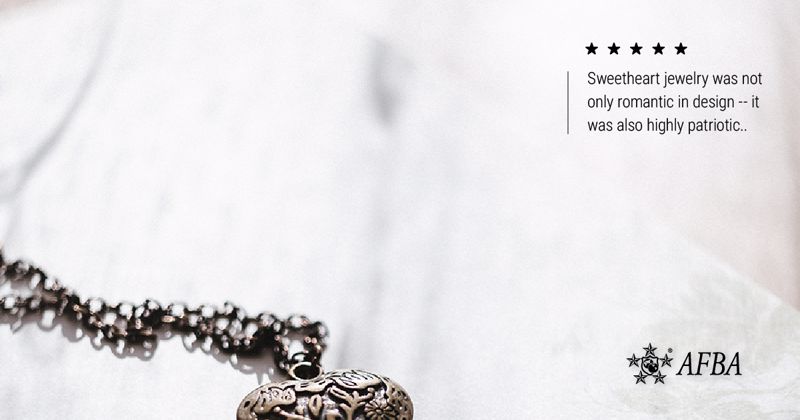
As the National Museum of American History explains, sweetheart jewelry became quite fashionable during WWII. Under rationing rules, new clothes and accessories were hard to come by. Women were urged to make do with what they had. Sporting a sparkling brooch was a welcome way to enliven an old dress collar and show one's support for the nation.
Meaningful jewelry made of modest materials
Sweetheart jewelry did not need to be made of fine, expensive materials like rubies, diamonds or sapphires set in gold. Instead, many Americans exchanged items made of gilded base metals set with sparkling glass crystals, rhinestones and imitation gemstones.
When access to certain base metals was restricted during rationing, jewelers turned to sterling silver. As the Cooper Hewitt museum notes, this forced one manufacturer to triple its jewelry prices — but consumer demand didn't falter.
Other materials such as enamel, wood, mother-of-pearl, shell, and celluloid and Bakelite plastics were also often found in sweetheart jewelry. Some soldiers handcrafted their own sweetheart jewelry items, carving bullets, coins, casings and other metal objects into sentimental adornments.
Sweetheart jewelry inspires a new generation of Americans
According to Collectors Weekly, wartime sweetheart jewelry is now highly collectible: "Sweetheart jewelry is among the most affordable of home-front collectibles, even though the prices have risen in the last 10 years. That's because these items have been growing in popularity with both military and jewelry collectors, as well as Americans who yearn to connect to veterans of past wars and express their patriotism."
Sweetheart jewelry has also inspired a new generation of jewelry makers, including Jessica Gibson, a former Supply Sergeant of the U.S. Army Reserves. In response to the COVID-19 pandemic, Gibson created a sweetheart jewelry-inspired collection.
As she explained in a news release, "1940s fashion and history have captivated my heart over the past few years. Considering all the challenges we are currently navigating, remembering that we've collectively navigated more challenging times has given me hope that together we'll get through this, as we've done in the past. Working on this collection has been therapeutic and inspiring as I designed it with the intention of providing the wearer with a sense of strength and comfort."