
Every year on March 25, the United States of America observes National Medal of Honor Day, a time for remembering and honoring those who have earned the highest and most prestigious personal military decoration that may be awarded to U.S. military service members for acts of valor.
According to the Department of Veterans Affairs, the Medal of Honor is awarded to military members who have distinguished themselves "conspicuously by gallantry and intrepidity" that went above and beyond the call of duty.
All five branches of the military are eligible for the honor, though there are only three versions of the medal: one each for the Army, Air Force and Navy, with personnel of the Marine Corps and Coast Guard able to receive the Navy version.
To understand the significance of the MOH, as well as the reasoning behind its annual holiday on March 25, it helps to educate yourself on the history of this incomparable honor.
Over 150 years of recognizing our nation's finest
Though there were several precursors to the MOH, including the George Washington's Badge of Military Merit and a Fidelity Medallion presented to three persons who helped capture a spy associated with Benedict Arnold in the 1700s, it was not until 1862 that the Navy Medal of Honor was created, quickly followed by the Army Medal of Honor, according to the Congressional Medal of Honor Society. The Air Force did not design its own MOH until 1963, over a century later.
On April 11, 1862, a group of Union soldiers led by civilian spy James J. Andrews boarded the train General disguised as a group of new recruits traveling north from Georgia to join the Confederate army. During a breakfast stop, Andrews' Raiders uncoupled the passenger cars and took off with the General, traveling seventy miles on the Western and Atlantic Railway, along the way cutting telegraph wire, uprooting railroad tracks and setting bridges on fire, according to the National Archives.
The group was eventually captured and Andrews was executed by the Confederacy, along with seven of his fellow Raiders. Twelve remaining members of the group were taken prisoner, six of whom were exchanged within a year.
On March 25, 1863, those six exchanged soldiers were summoned to the secretary of war's office, where Edwin M. Stanton greeted them as heroes and surprised them with medallions.
"Congress has by a recent law ordered medals to be prepared… and your party shall have the first," Stanton said upon presenting the first ever Medals of Honor.
Then and now
In the 156 years since that initial ceremony, there have been more than 3,500 Medals of Honor awarded to America's bravest soldiers, sailors, airmen, marines and coast guardsmen. Among the thousands honored, there are currently 72 living recipients of the MOH. Ranging in age from 29 to 98, the list of living recipients includes four heroes who earned their Medals of Honor in World War II, five who fought in the Korean War, 50 in the Vietnam War, and 13 in the War in Afghanistan.
In 2016, Congress authorized the VA's National Cemetery Administration to issue, upon request, a medallion, headstone or marker signifying a Veteran as a recipient of the Medal of Honor. Two years later, during a private ceremony at West Grove Cemetery in Lexington, Mississippi, the first Medal of Honor Medallion was placed upon the private headstone of Pfc. Milton L. Olive III, a decorated war hero who fought in Vietnam.
"Private First Class Olive was posthumously awarded a Medal of Honor for his service during the Vietnam War after he heroically used his body to cover a grenade to save the lives of his fellow soldiers," said VA Secretary Robert Wilkie. "The Medal of Honor Medallion illustrates VA's commitment to ensuring all who see this symbol will know of the courageous sacrifice of our nation's distinguished service members."
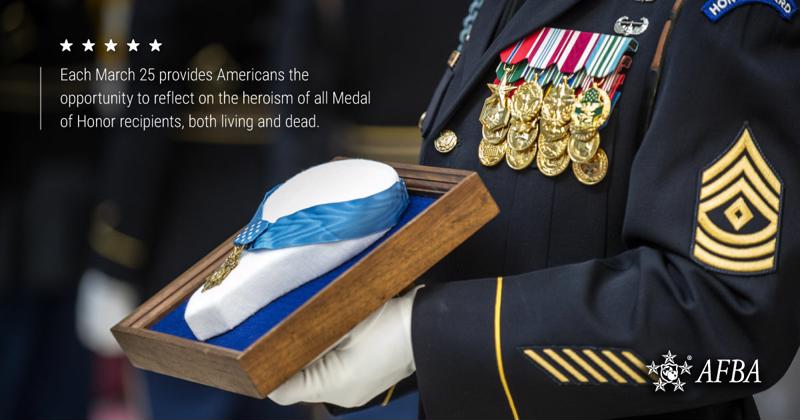
Each March 25 provides Americans the opportunity to reflect on the heroism of all Medal of Honor recipients, both living and dead.

March marks Women's History Month, a 31-day observance of female contributions made throughout history and in contemporary society.
The month-long celebration can trace its own history back to the very first National Woman's Day, organized by the Socialist Party of America and held in New York City on Feb. 28, 1909 – a full nine years before American women achieved the right to vote.
On March 19, 1911, the first-ever International Women's Day was celebrated by over a million people in Austria, Denmark, Germany and Switzerland, many of whom held demonstrations demanding suffrage and an end to employment sex discrimination. In 1917, after women in Soviet Russia earned the right to vote, March 8 became a national holiday there. International Women's Day was primarily observed in socialist and communist countries, until being taken up by the feminist movement in the late 1960s, and in 1975 the United Nations began celebrating the day.
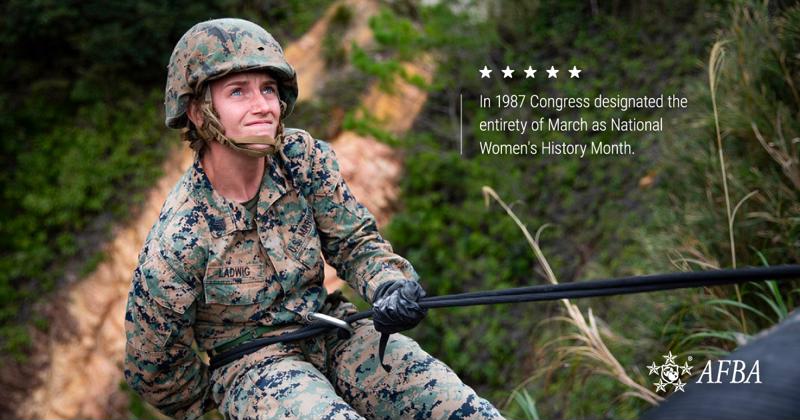
In 1980, President Jimmy Carter issued a presidential proclamation declaring the week of March 8 as National Women's History Week, and in 1987 Congress designated the entirety of March as National Women's History Month.
Today Women's History Month provides an occasion to honor women who have broken glass ceilings and claimed major achievements in a variety of fields, including the United States military.
A decorated history of women in the military
Today there are over 216,000 women serving in the United States Army, Air Force, Marine Corps and Navy, accounting for over 16 percent of the total number of officers and enlisted personnel.
Women also now comprise 10 percent of the total U.S. veteran population, and represent 20 percent of veterans under the age of 35, according to the Department of Labor.
The very first woman to serve in the American military was Deborah Sampson, who in 1782 enlisted in the Continental Army under a man's name to fight in the Revolutionary War. At one point, she removed a musket ball from her own thigh so that her true gender would not be revealed in surgery. Once her identity was discovered, Sampson was honorably discharged, and her husband received a military widow's pension in 1832, according to The New York Times.
Female enlistees disguised themselves as men during the Mexican-American War and Civil War as well, though most women served as nurses during this period of American history. Most notably, Dr. Mary Walker acted as a surgeon for Union troops, and was held by the Confederacy as a prisoner of war after she crossed enemy lines to treat wounded civilians. To this day, she is the only woman to ever receive the Medal of Honor.
In the early part of the 20th century, Congress created the Army Nurse Corps and the Navy Nurse Corps. Though they did not possess military rank, nor were they entitled to the same pay or Veterans' Benefits as men, over 21,000 of these nurses served military hospitals both at home and overseas during World War I.
In WWII, roughly 400,000 women served in noncombatant roles, including as nurses, mechanics, clerks, pilots and ambulance drivers. Hundreds more acted as field intelligence agents in the OSS, 88 were taken as POWs and 16 were killed in action, according to Task and Purpose.
In 1948, the Women's Armed Service Integration Act enabled women to become permanent members of the military, rather than only serve during wartime. There was a female presence in America's subsequent wars, with 50,000 women participating in Korea, many as nurses in M.A.S.H. units, and 11,000 deployed to Vietnam, where Commander Elizabeth Barrett became the first woman to hold a command in a combat zone.
Congress authorized women to fly in combat missions and serve on combat ships in 1991 and 1993, and the first female fighter pilots flew combat missions in Iraq in 1998, the same year that Captain Kathleen McGrath became the first woman to command a U.S. Navy warship.
The 21st century has been filled with even more landmarks, including Col. Linda McTague becoming the first woman to command a U.S. Air Force fighter squadron in 2004 and Army Gen. Ann Dunwoody becoming the first woman to achieve four-star officer rank in 2008.
In 2016, the Department of Defense opened all combat jobs to women, without exception, paving the way for even greater female military heroics now and in the future. The following year, the first woman graduated from the U.S. Marine Corps infantry officer course. Though the female lieutenant requested that her name not be released, the Marines did put out a video that showed her training for her milestone achievement.
This Women's History Month is a great time for all Americans to reflect upon the rich history of women in the military, while also thanking current female officers and enlistees for their service.
On Wednesday, March 13, patriots and dog lovers alike can join together in saluting our nation's four-legged heroes for National K9 Veterans Day.
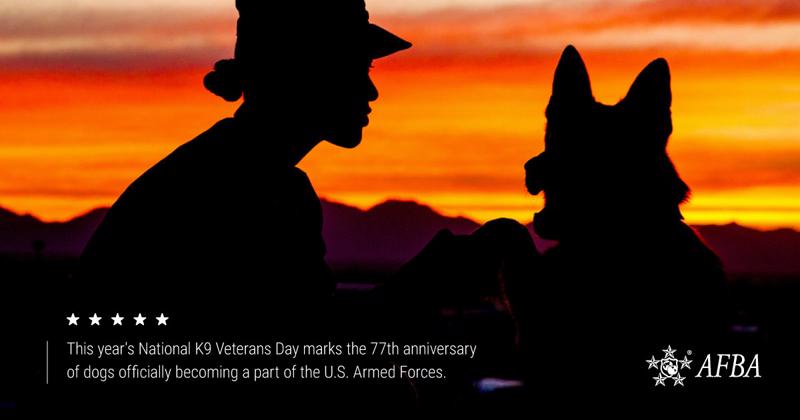
This year's holiday will commemorate the 77th anniversary of dogs officially becoming a part of the U.S. Armed Forces. According to Military.com, it was on March 13, 1942, that the Army first began training for its new War Dog Program, known also as the "K-9 Corps."
The United States Postal Service is among those paying tribute, having recently announced a new booklet of 20 stamps that "honors the nation's brave and loyal military working dogs."
According to the USPS, each block of four stamps features one stamp each of the four breeds chosen for inclusion in the booklet: German shepherd, Labrador retriever, Belgian Malinois and Dutch shepherd.
The patriotic stamps were designed by art director Greg Breeding, and created by the Los Angeles-based DKNG Studios. The stylized digital images feature red, white, blue and gold coloring, along with illustrations of dogs wearing tactical service vests. In the background of each stamp is the detail of a white star. A full white star on a gold background also appears on the center of each block.
Though an official release date for the military dog stamps has not yet been revealed, the Postal Service did promise that more details on dates and locations for the first-day-of-issue ceremonies would be forthcoming.
A distinguished breed of service
Though the K-9 Corps dates back to WWII, military dogs have been serving in the U.S. military since World War I. The most famous canine veteran of the Great War was a Staffordshire terrier mix named Stubby, who saved many sleeping soldiers by barking and waking them during a German mustard gas attack. According to History.com, Stubby went on to serve in 17 battles and survive at least two major injuries, including shrapnel in his chest and leg, before becoming the first dog to be given the rank of Sergeant in the U.S. Armed Forces.
When Sergeant Stubby died in his sleep at the age of 10 in 1926, his remains were gifted to the Smithsonian Institution where they continue to be displayed today.
Examples of canine heroism can be found in more recent conflicts, as well. Just this past November, an Army Ranger dog named Maiko was killed in action during a skirmish in Afghanistan, according to Stars and Stripes. The 7-year-old military working dog was leading Rangers into a compound when he was fired upon by a militant, revealing the militant's position and saving the lives of other soldiers, who then targeted that position.
There is a memorial in Holmdel, New Jersey, that recognizes such sacrifices. Although the War Dog Memorial was originally built to remember only those dogs that served in Vietnam, it now honors all dogs that have served in the United States military.
Today an estimated 2,300 military working dogs serve on U.S. bases worldwide, performing dangerous tasks alongside their human counterparts. These canine warriors often use their noses and smaller sizes to engage in search and rescue missions that more traditional service members are less equipped to complete.
"These military dogs, and search-and-rescue dogs, are putting themselves on the line. They're out in the front lines," Diane Whetsel, head of the Sage Foundation that works to help fund medical services for military dogs, told CNN.
While it may be true that "all dogs go to heaven," surely a special place there is reserved for all of the pups that we remember and pay tribute to on National K9 Veterans Day.
Veterans often have a difficult time finding jobs after leaving the military for a variety of reasons, ranging from employers with unconscious hiring biases to soldiers themselves having skill sets that do not easily translate to the civilian workforce. One potential career path that would provide veterans with the ability to continue doing meaningful work is the role of educator.
For over 25 years, the Troops to Teachers Program has enabled military members with a baccalaureate degree or higher to complete a teaching certification process and become an academic subject teacher for kindergarten through twelfth grade.
Military members who wish to use their unique experiences and knowledge to transform young lives can do so through TTT, and they can even get started while still on active duty.
How to transition to teaching through TTT
All current and former members of the U.S. Armed Forces interested in a career in teaching can receive counseling, referrals and job assistance through TTT.
Though a bachelor's degree or higher is required to teach elementary or secondary school, becoming a vocational or technical instructor requires only the equivalent of one year of college and six years work experience in the technical or vocational field in which you wish to teach.
Those who qualify and choose to participate in TTT can receive stipends of up to $5,000 to defray the cost of teacher certification training. There are also bonuses of up to $10,000 available to those who teach in high-needs schools. In order to receive a stipend or bonus, a program participant must commit to teaching for at least three years at targeted schools, typically located in low-income areas.
It's important to keep in mind that Troops to Teachers is not a teacher certification program itself, but rather a program that works through a network of state offices to provide participants with certification counseling, certification tuition funds and referrals for employment leads.
Participants can use an Alternative Certification Program or University Teacher Preparation Program to complete their certification. According to The Balance, those stationed in Europe would likely benefit the most from ACP, since it allows individuals to complete their teaching certification through online courses.
There are 31 state TTT offices operating across the country, providing placement assistance for the more than 50 states and territories that are part of the program. These offices will help military members with state certification requirements, though participants can also use the TTT website to speak with representatives and receive alternative certification information.
A history of serving in uniform and in the classroom
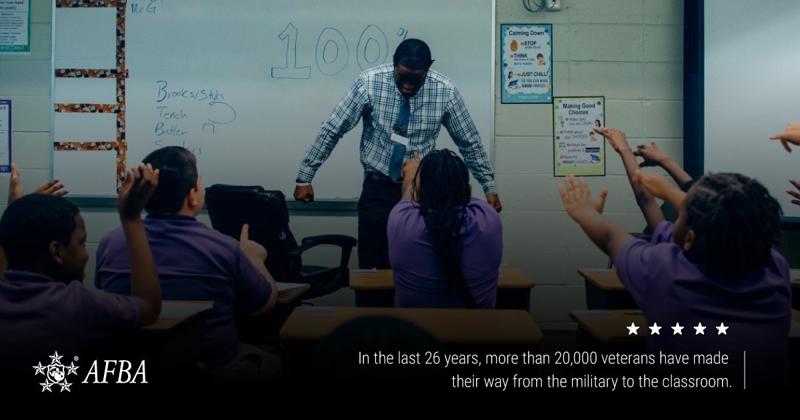
The Troops to Teachers program began in 1993, as a response to the military downsizing of the early nineties and a way to transition service members to a rewarding and vital teaching career. In the last 26 years, more than 20,000 veterans have made their way from the military to the classroom, becoming teachers and establishing the program's credibility and reputation through their impressive performances in the classroom.
"School systems are finding former military members to be very valuable assets," John Gantz, director of the TTT program, told The Balance. "They bring leadership skills, a concern for their students [similar to their troops] and a lot of experience to the classroom."
Over the course of the program, schools have also noticed a higher retention rate from former military members than from teachers who just finished college.
Service members who would like to learn more about the Troops to Teachers Program can obtain more information from their state TTT office, or by visiting www.ProudToServeAgain.com.
Black History Month can trace its origins back 50 years, to when black educators at Kent State University first proposed the idea in February 1969. The following year, the public research college in Northeastern Ohio observed the first Black History Month, which since then has expanded across the United States, as well as to Canada, the United Kingdom, the Netherlands and Ireland.
While African Americans have made countless positive contributions to our country's cultural, economic and political fabric, their service in our nation's armed forces deserves special recognition. From the 5,000 black soldiers who fought during the Revolutionary War to the Tuskegee Airmen who piloted bombers in WWII, African Americans have been serving the United States since it's inception, even at times when the U.S. failed to serve them.
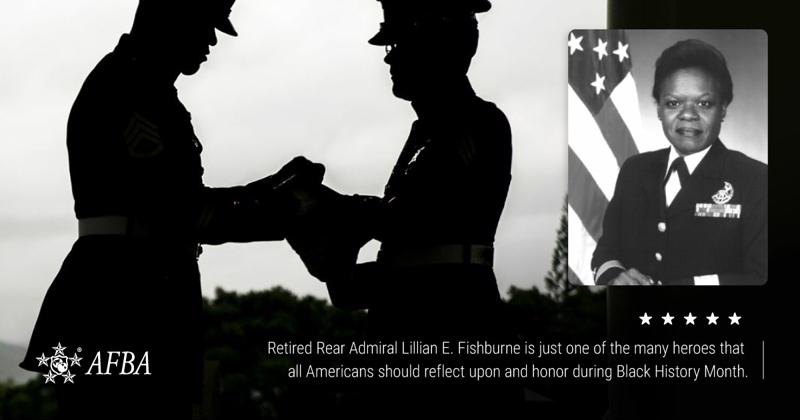
And of the many pioneering black servicemen and women worthy of praise, special attention should be given to Lillian E. Fishburne, who in 1998 became the first African-American woman to hold the rank of Rear Admiral in the United States Navy.
The life and career of Rear Adm. Fishburne
Lillian Elaine Fishburne was born into a naval family in Patuxent River, Maryland, on March 25, 1949–just one year after the integration of minorities and women in the military.
Fishburne was raised in Rockville, Maryland, by an active-duty father who never doubted his daughter's military ambitions. After obtaining a Bachelor's degree in Sociology from Lincoln University in 1971, she spent two years at the Women Officers School at Newport, Rhode Island, becoming an ensign after graduating in February 1973.
According to Black Past, Fishburne's first naval assignment was serving as a personnel and legal officer at the Naval Air Test Facility in Lakehurst, New Jersey. She went on to act as an Officer Programs recruiter in Miami, then as the officer in charge of the Naval Telecommunications Center at the Great Lakes, Illinois Naval Base.
Fishburne then went back to school for another two years, earning her Master of Arts in Management from Webster College in St. Louis, Missouri. She spent the next two years at the Naval Postgraduate School in Monterey, California, graduating with a Master of Science in Telecommunications Systems Management in 1982.
Thanks to appointments to positions such as executive officer at the Naval Communications Command in Yokosuka, Japan, and special projects officer for the Navy's Command, Control, and Communications Directorate, Fishburne was eventually selected for the Industrial College of the Armed Forces.
After becoming Chief of the Command and Control Systems Support Division in Washington, D.C., and commanding the Naval Computer and Telecommunications Area Master Station, Eastern Pacific, in Hawaii, Fishburne made history by attaining the rank of Rear Admiral on Feb. 1, 1998, and was promoted by President Bill Clinton.
A legacy of heroism
Fishburne retired in February 2001, with a long list of decorations that included the Defense Superior Service Medal, Legion of Merit, two Meritorious Service Medals, two Navy Commendation Medals, and the Navy Achievement Medal.
During a 1998 ceremony to honor Fishburne, along with other military members, Secretary of Defense William Cohen delivered a speech in which he quoted novelist and retired Air Force Maj. Albert Murray as saying, "Heroism… is measured in terms of the stress and strain it can endure, and the magnitude and complexity of the obstacles that it overcomes… which bring out the best in [heroes]."
"Considering the stresses and strains endured by African-Americans in the defense of our country, it's little wonder that we have so many heroes among us," Secretary Cohen added, according to Military.com.
Retired Rear Admiral Lillian E. Fishburne is just one of the many heroes that all Americans should reflect upon and honor during Black History Month.
The United Service Organizations will be celebrating its 78th birthday on Monday, Feb. 4, 2019.
Better known as the USO, the private, not-for-profit organization works in cooperation with the Department of Defense to provide live entertainment and other services to members of the United States military and their families.
Born in 1941, the USO claims six different parents—the Salvation Army, the YMCA, the YWCA, Catholic Community Services, National Travelers Aid Association and the National Jewish Welfare Board. President Franklin D. Roosevelt asked the six agencies to combine their resources to boost the morale of troops fighting in World War II.
Although congressionally chartered, the USO is not a government agency, and has relied on charitable donations and the efforts of tens of thousands of volunteers for all of its nearly eight decades of history.
A new organization gives Hope to America's heroes
After being formed in 1941, the USO quickly became known for its live performances, which began with stateside military theaters spread throughout the country, and soon led to Hollywood stars heading overseas to entertain the troops.
Of those stars, the one most closely associated with the organization was comedian Bob Hope, who performed his first USO show only three months after its founding. Hope went on to entertain troops for the next 50 years, making his last trip overseas in 1990 during the Gulf War.
In 1997, the U.S. Congress declared Bob Hope the "first and only honorary veteran of the U.S. armed forces," in recognition of his half a century of entertaining those serving in the nation's wars. The USO Center at the Los Angeles International Airport also bears his name.
Of course, no one could have originally imagined that Hope would eventually develop such a lengthy tenure as an ambassador for the USO—especially since the organization originally disbanded in 1947, after the Axis powers surrendered and ended WWII.
But in 1949, with America at the beginning of what would eventually become a lengthy Cold War, the USO's six original founding organizations decided to revive the agency. But due to funding issues, it wasn't until the Korean War began that the USO was back entertaining troops overseas, and the Defense Department earmarked $13 million for the organization's operations.
Yet the agency dealt with similar funding issues after the war concluded, and became dormant once more, remaining inactive until the U.S. entered the conflict in Vietnam.
Eventually, the USO received a government charter, and the organization also began placing more emphasis on improving the lives of military families, while still providing entertainment to soldiers as well.
Over 35 million troops served
Today the USO claims over 200 locations spread across 14 countries, including America, where it has a presence in 27 states. Over 30,000 volunteers help the organization realize its mission, as do the many musicians and entertainers who continue to perform live shows for military service members.
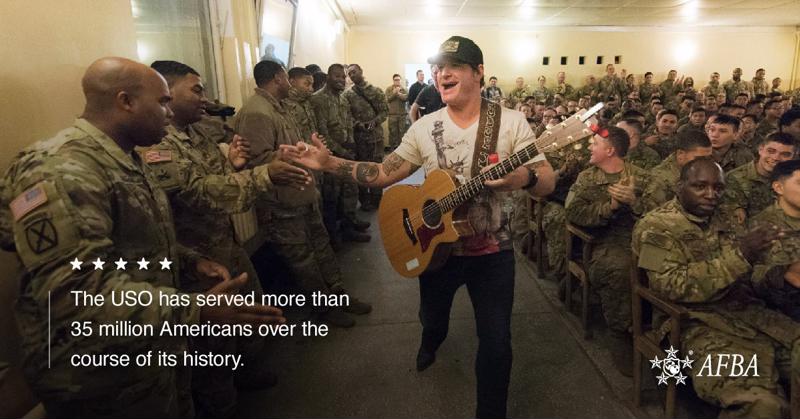
In 2016, during a gala event to celebrate the USO's 75th birthday, retired Army Gen. George W. Casey Jr. estimated that the USO had served more than 35 million Americans over the course of its history, according to The Providence Journal.
That service continues to take many forms, including family counseling for military members returning home from deployment, services for troops at airports as they travel to and from duty overseas and various programs that allow those deployed overseas to connect with their families stateside
As mentioned, the USO is a charity organization with a small paid staff, which relies on volunteers and charitable donations. To give the USO a birthday gift, head to their donation page and show your support.

Late last year, just days before breaking for the holidays, the 115th United States Congress managed to pass two pieces of legislation aimed at improving education benefits for members of the military transitioning into civilian life.
The Forever GI Bill Housing Payment Fulfillment Act, which was designed to correct mistakes made by the Department of Veterans Affairs that led to delayed and inaccurate payments for thousands of Post-9/11 GI Bill users, passed both houses with unanimous consent. Further bipartisan support was shown for the Veterans Benefits and Transition Act, which had a similar goal of protecting student veterans, as well as easing voting rules for military spouses and expanding burial benefits for military families, among other provisions.
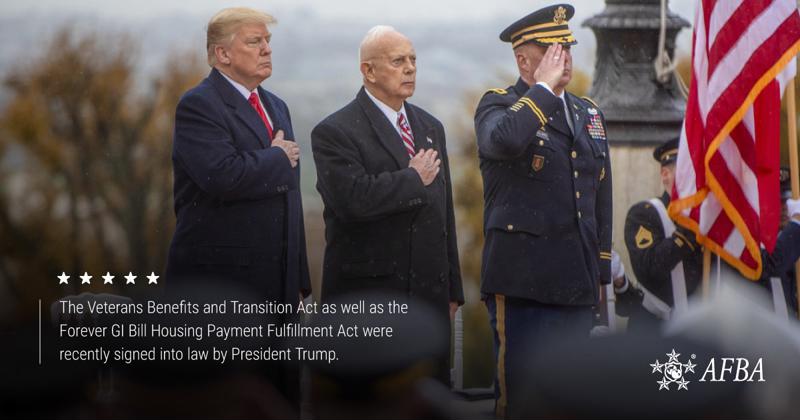
President Donald Trump has since signed both bills into law. Here's what the new legislation will mean for military members and veterans moving forward.
GI Bill students underpaid due to VA errors to receive reimbursement
The first bill pertains to those taking college classes or getting on-the-job training through the Post-9/11 GI Bill, which provides up to 36 months of education benefits to qualifying veterans or active duty military members with at least 90 days of aggregate active duty service after Sept. 10, 2001.
Veterans were previously required to use these education benefits within 15 years of completing their service, yet that deadline was erased with the creation of the Forever GI Bill. Unfortunately, a Forever GI Bill provision that changed the way housing stipends are calculated was not implemented on time due to major technology failures at the Department of Veterans Affairs, which led to many students being underpaid, according to Military Times.
Not only did some students struggle to pay their rent or mortgage bills as a result, but many were also hit by late fees for tuition that the VA also failed to pay on time.
The Forever GI Bill Housing Payment Fulfillment Act of 2018 holds the VA accountable for retroactively fixing inaccurate payments and reimbursing affected students, while also barring schools from the practice of charging GI Bill students for tuition payments that are delayed through no fault of their own.
"For many student veterans, every dime counts," said Sen. Brian Schatz, D-Hawaii, who co-sponsored the bill. "That's why the VA needs to get this right and pay student veterans the full amount of money they were promised. I'm glad that my colleagues in the Senate saw how important this issue is, and I hope this bill stays on the fast track to becoming law, so we can make this right for our veterans."
More benefits for student, transitioning and homeless veterans
These student veterans protections are complemented by a provision in the new Veterans Benefits and Transition Act of 2018, which requires the Department of Veterans Affairs to provide GI Bill users with electronic proof that they will be receiving housing payments from the VA.
The new requirement will enable students to prove to landlords their ability to pay for housing even if they are a full-time student without active employment. The new law also enables the spouse of a service member who dies on active duty to terminate a residential lease without penalty for up to one year after the death.
In addition to students, transitioning service members and homeless veterans are also set to receive greater assistance acclimating to life on the homefront, thanks to the new law.
The VA is now required to contract with a non-federal entity to identify and post a list of programs and organizations that can help service members transition out of the military.
Another provision gives homeless veterans up to 60 days after moving into housing to apply for employment assistance under the federal Homeless Veterans' Reintegration Program. Previously, only veterans living on the streets or in a shelter were eligible for assistance.
The spouses and family members of U.S. military members are also impacted by the new legislation, according to Air Force Times.
Military spouses are now allowed to use the same residence as their active-duty spouse for state and local voting purposes, whether or not they meet the residency requirements of a state on their own merits.
The law also extends veteran burial rights to the spouses and children of active-duty service members, even if they pass away before the military member. Previously, being buried in veteran cemeteries required approval from the VA.
This Friday marks the 77th anniversary of the "date which will live in infamy," as President Franklin Delano Roosevelt famously described December 7, 1941.
A total of 2,403 service members and civilians were killed during the Japanese military's surprise aerial attack on the naval base at Pearl Harbor, Hawaii. An additional 1,178 Americans were injured in the tragedy, which also destroyed 188 aircraft and two U.S. Navy battleships, the USS. Arizona and USS. Utah.
For six decades, the incident stood as the deadliest attack on U.S. soil, until being eclipsed by the events of September 11, 2001. And each year since 1994, Americans have solemnly observed its anniversary with National Pearl Harbor Remembrance Day.
The history of the Pearl Harbor attack
Just before 8 a.m. on the morning of Sunday, December 7, 1941, a surprise attack consisting of 353 Imperial Japanese aircraft descended upon the Pearl Harbor Naval Base, located near Honolulu, on the Hawaiian island of Oahu.
The unprovoked act of war killed 2,335 members of the U.S. military, according to the Pearl Harbor Visitors Bureau, including 2,008 Navy personnel, 109 Marines and 218 Army service members. An additional 68 civilians also lost their lives as a result.
Nearly half of those casualties were from the USS Arizona. The remains of the battleship have since become a memorial to the incident, and are also the final resting place of 1,102 of the 1,177 sailors and Marines killed on the ship that day.
The day after the attack, Roosevelt delivered his iconic "Infamy Speech" to Congress and requested a formal declaration of war on the Empire of Japan, which the legislature granted in less than an hour. Three days later, Germany and Italy declared war on the United States.
"No matter how long it may take us to overcome this premeditated invasion, the American people in their righteous might will win through to absolute victory," Roosevelt promised during his speech to Congress.
It ended up taking over three years and eight months for America and its Allies to claim victory over the Axis powers. Though his words proved true, Roosevelt himself died in office five months before they fully came to fruition on September 2, 1945, when General Douglas MacArthur accepted Japan's surrender.
There were also 407,316 United States military members who never lived to see peace, having made the ultimate sacrifice for their country during the deadliest conflict in world history.
National Pearl Harbor Remembrance Day
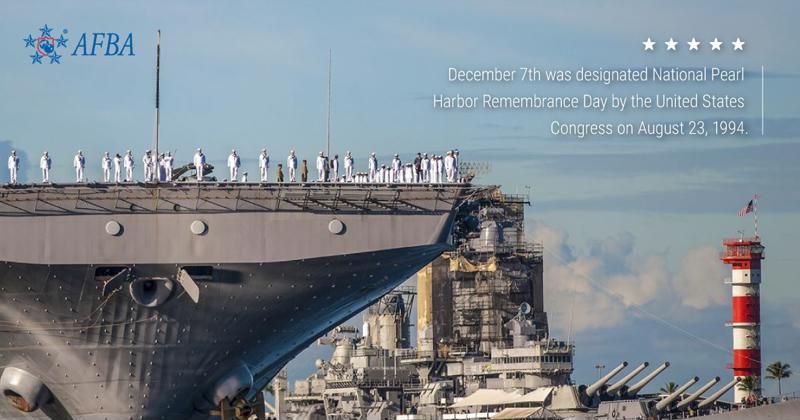
December 7th was designated National Pearl Harbor Remembrance Day by the United States Congress on August 23, 1994. The following November, 29, President Bill Clinton issued a proclamation declaring December 7, 1994 the first National Pearl Harbor Remembrance Day.
This year will be the 25th observance of National Pearl Harbor Remembrance. As is customary, events will be held at World War II Valor in the Pacific National Monument, culminating with a commemoration ceremony on Friday morning.
According to the National Parks Service, the 2018 National Pearl Harbor Remembrance Day Commemoration will take place from 7:50 a.m. until 9:15 a.m., and include a moment of silence at 7:55 a.m., when the original attack occurred. The event will be open to the public, with the Pearl Harbor Visitor Center opening at 6:00 a.m. and closing at 5:00 p.m. that day.
USS Arizona Memorial programs will run from 11:00 a.m. until 3:00 p.m., with tickets distributed on a first-come, first-served basis, beginning at 6:00 a.m. the morning of Dec. 7. Tickets cannot be reserved.
Those interested can go to the official Pearl Harbor Events website to find more information about other commemorative events happening that day in Hawaii, or to watch live streams of the ceremonies.
Thanksgiving is considered the kickoff of the holiday shopping season, and so far, it has succeeded in kicking off no less than three different unofficial retail holidays observed over a span of four days.
First there was Black Friday, the day after Thanksgiving, celebrated with massively popular "doorbuster deals," which enable companies to turn a profit and move from being "in the red" to "in the black." Then that gave way to Cyber Monday, in which e-commerce stores offered deep discounts to online shoppers. Feeling left out, mom-and-pop shops tried to lure customers away from big corporations by offering them Small Business Saturday specials, which occurred in between Black Friday and Cyber Monday.
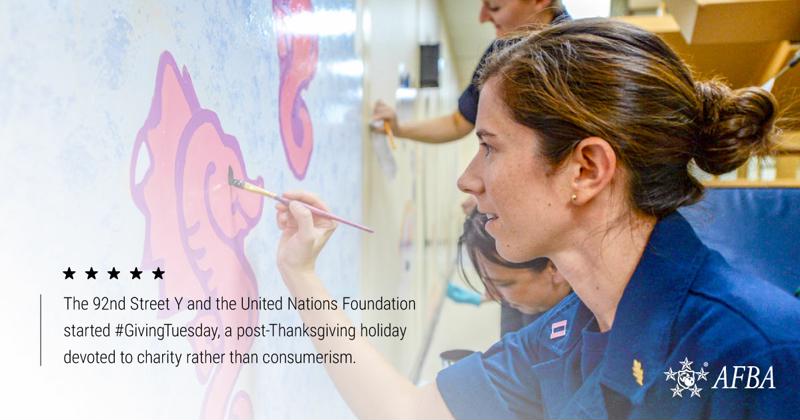
Lastly, in 2012, the 92nd Street Y and the United Nations Foundation started #GivingTuesday, the one post-Thanksgiving holiday devoted to charity rather than consumerism.
This year, Giving Tuesday will fall on November 27. There are many deserving nonprofits to which you can donate your time or money, but if you would like to give back to those who have given the most, here are some great ways to support veterans and military families this holiday season.
Homes For Our Troops
Homes For Our Troops is a private nonprofit devoted to building custom-made homes for injured post-9/11 veterans, many of whom suffer from partial or full paralysis and require specially designed homes to grant them full independence and mobility. This year, the organization is setting a #GivingTuesday fundraising goal of $150,000. You can help the nonprofit hit that goal by donating directly, and by sharing their #GivingTuesday video on social media channels like Facebook. And if you really want a concrete way to get involved, you can learn how to attend a build event and help welcome a family into their new, mortgage-free home.
Intrepid Fallen Heroes Fund
Many soldiers carry home wounds that aren't physical. Fortunately, there are resources available to them as well, including the Intrepid Fallen Heroes Fund, which serves United States military personnel experiencing Traumatic Brain Injury and Post-Traumatic Stress. The IFHF builds world-class advanced treatment centers that provide servicemembers with the best available TBI and PTS care. If you decide to get involved, you can feel good knowing that 100 percent of of every dollar donated from the public goes directly to funding programs.
Armed Services YMCA
For over 150 years, the Armed Services YMCA has provided servicemembers and their families with a place to turn for everything from recreational events to housing and educational programs. Low to no-cost childcare, hospital assistance, counseling, emergency food and clothing assistance are among the services that this top-rated charity provides to military families. You can help out by donating or volunteering at one of the Armed Services YMCA's 34 branch and affiliate locations.
USO
Closely associated with comedian Bob Hope, who in 1997 was named the "first and only honorary veteran of the U.S. armed forces" by Congress for his decades of performing for the troops, the United Service Organizations is a nonprofit that provides live entertainment to Armed Forces members and their families. The comedy shows and concerts put on by the organization help lift the spirits of those who serve. And despite being congressionally-chartered, the USO is not a government agency, and so relies on donations from supporters.
Toys for Tots
While not a charity that necessarily benefits veterans or military families directly, Toys for Tots is a program that is run by the United States Marine Corps Reserve. Founded in 1947 by reservist Major Bill Hendricks, Toys for Tots is dedicated to providing gifts to children whose families are struggling financially during the holiday season. All you need to give is a new, unwrapped toy, making this a fun and affordable way to contribute to a proud, 70-year-old military tradition.
Whether you have the skills that could help build a house for a wounded warrior, the funds that could help treat a veteran's physical or mental war injuries or simply a new toy that could help the Marines' mission to provide gifts to the underprivileged, there are many ways to contribute to the cause this Giving Tuesday.
Veterans Day has likely birthed more grammatical errors than any other federal holiday. Despite being frequently written as "Veteran's Day" or "Veterans' Day," the Department of Veterans Affairs insists that there should be no apostrophe there to make the noun possessive, "because it is not a day that 'belongs' to veterans, it is a day for honoring all veterans."
Yet despite the fact that Veterans Day is meant to be observed by all Americans, a majority of them still confuse the date with Memorial Day.
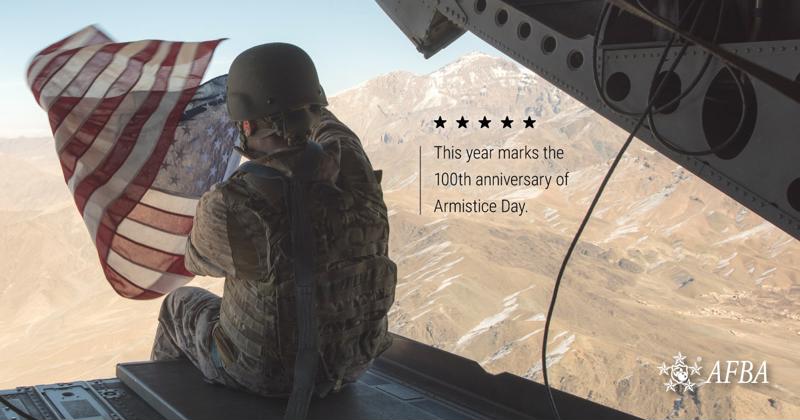
Even if you are familiar with Veterans Day history, there's no better time for a refresher, as this year marks the 100th anniversary of the holiday's forebear, Armistice Day.
The history of Armistice Day
Armistice Day was born out of World War I, or "The Great War," as it was initially known. The global conflict lasted from 1914 to 1918, and pitted the Central Powers—Germany, Austria-Hungary, Bulgaria and the Ottoman Empire—against the Allies, or Entente Powers, consisting principally of France, Great Britain, Japan, Italy, Russia and the United States. The First World War mobilized over 70 million military personnel, 60 million of whom were European, and the massive scale led many to optimistically, yet wrongly, predict that it would be "the war to end all wars."
After 9 million military casualties, there was finally permanent quiet on the Western Front after an armistice was signed between the Allies and Germany on November 11, 1918. The cessation of hostilities officially took effect at 11:00 that morning, or "the eleventh hour of the eleventh day of the eleventh month."
Armistice Day commemorated this end to the fighting, and is observed every November 11th by many of the Allied nations. This year's celebration of peace and remembrance of sacrifice will mark the 100th anniversary of Armistice Day. Events are planned all over the world, and President Donald Trump will travel to Paris to join French President Emmanuel Macron in honoring the more than 116,000 Americans and nearly 1.4 million French troops who died in WWI.
The history of Veterans Day
In the United States, President Woodrow Wilson declared November 11, 1919, as the first commemoration of Armistice Day, which was originally intended to involve parades and public meetings and a brief suspension of business beginning at 11:00 a.m.
Congress made Armistice Day a legal holiday in 1938, declaring it "a day to be dedicated to the cause of world peace."
In 1947, a World War II veteran named Raymond Weeks organized a "National Veterans Day" in Birmingham, Alabama. His intention was to expand Armistice Day into a holiday that celebrates all veterans, not just those from World War I. This idea was later championed by U.S. Representative Edward Rees of Kansas, who proposed a bill that would officially change Armistice Day to Veterans Day. The bill was passed in 1954, and signed into law by President Dwight D. Eisenhower, who later that year issued the first "Veterans Day Proclamation," which read in part, "In order to insure proper and widespread observance of this anniversary, all veterans, all veterans' organizations, and the entire citizenry will wish to join hands in the common purpose."
This year, veterans and citizens alike should again unite to appreciate the service of all veterans, with special attention paid to the century that has passed since peace was achieved with an Armistice signed on the eleventh hour of the eleventh day of the eleventh month.